
Homework Answers
Add Answer to:
i need the 2 significant signals and what they correspond to in the compound. please! 4....
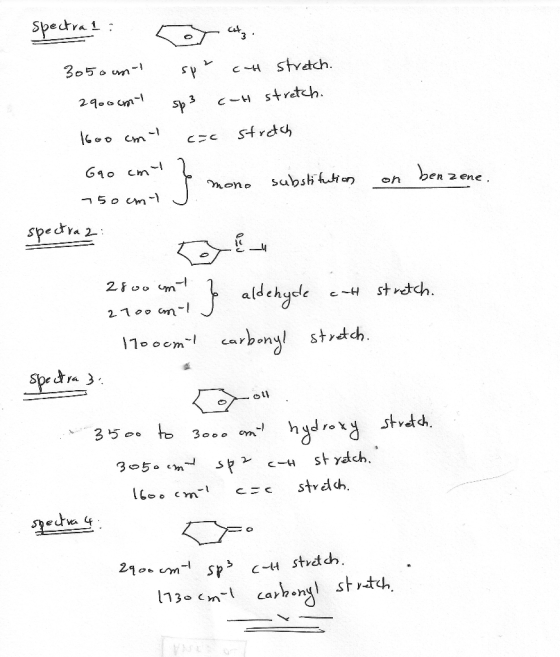
4. Match the following compounds with the IR spectra on the following page, identify 2 significant...
 4. Match the following compounds with the IR spectra on the following page, identify 2 significant signals and what they correspond to in the compound. Compounds to match are: benzaldehyde, cyclohexanone, phenol and toluene. We were unable to transcribe this image
Please tell me what compounds the following IR spectrum represents and why. What's written in Spectrum...
 Please tell me what compounds the following IR spectrum
represents and why. What's written in Spectrum is the experimental
formula of the compound.
0.8 0.6 C5H80 Transmitance 0.4 0.2 3000 1000 2000 Wavenumber (cm-1)
Please tell me what compounds the following IR spectrum
represents and why. What's written in Spectrum is the experimental
formula of the compound.
0.8 0.6 C5H80 Transmitance 0.4 0.2 3000 1000 2000 Wavenumber (cm-1)
Which signature peaks make up the benzil compound? Please include everything even aromatic peaks BENZIL INFRARED...
 Which signature peaks make up the benzil compound? Please
include everything even aromatic peaks
BENZIL INFRARED SPECTRUM 0.8 0.6 Transmitance 0.4 0.2 1000 3000 2000 Wavenumber (cm-1) NIST Chemistry WebBook (https://webbook.nist.gov/chemistry)
Which signature peaks make up the benzil compound? Please
include everything even aromatic peaks
BENZIL INFRARED SPECTRUM 0.8 0.6 Transmitance 0.4 0.2 1000 3000 2000 Wavenumber (cm-1) NIST Chemistry WebBook (https://webbook.nist.gov/chemistry)
Question #2: Predict the compound that matches the following IR spectrum (10 pts): r you i...
 Question #2: Predict the compound that matches the following IR spectrum (10 pts): r you i 0.8 CH,0 08 HO 0.6 0.6 CI a. W would reaction ed with s 04 0.2+ 02 3000 2000 Wavnumber icm-1) 1000 3000 2000 Wavnumber en 1) 1000
can somebody please help me identify these to what it is asking. thank you. 3. The...
 can somebody please help me identify these to what it is
asking. thank you.
3. The infrared spectra of four of the following compounds are shown below. For each compound, determine which structure it represents. (12 pt) CH,CH,CH,CH,NHCH,CH.CH,CH,CENCH.CH.CH-N-CH2CH2CH3 А) (c) CH-CH-CH3 B CH,CHCH.CH -^—CH CH CH CH, CH3CH2CH2CH2– CH,CH,CHCH2 NCH © CHE 0.6 0.4 3000 2000 Wavenumber(cm-1) 1000 波数/cm 3. (continued) 0.9 0.81 Relative Transmittance 4000 3000 1000 2000 Wavenumber (cm-1) t/cm2
can somebody please help me identify these to what it is
asking. thank you.
3. The infrared spectra of four of the following compounds are shown below. For each compound, determine which structure it represents. (12 pt) CH,CH,CH,CH,NHCH,CH.CH,CH,CENCH.CH.CH-N-CH2CH2CH3 А) (c) CH-CH-CH3 B CH,CHCH.CH -^—CH CH CH CH, CH3CH2CH2CH2– CH,CH,CHCH2 NCH © CHE 0.6 0.4 3000 2000 Wavenumber(cm-1) 1000 波数/cm 3. (continued) 0.9 0.81 Relative Transmittance 4000 3000 1000 2000 Wavenumber (cm-1) t/cm2
4. What functional groups are present in the molecules that gave rise to the following IR...
 4. What functional groups are present in the molecules that gave rise to the following IR Spectra? 0.8 O0.6 4 0.2 0.0 3000 2000 Wavenumber (cm-1) 1000 NIST Chemistry WebBook (http://webbook.nist.gov/chemistry) INFRARED SPECTRUM 0.8 2 0.6 0.4 0.2 3000 2000 1000 Wavenumber (cm-1) NIST Chemistry WebBook (http://webbook.nist.gov/chemistry)
please just answer the 2 boxes in the first picture and the last box in the...
 please just answer the 2 boxes in the first picture
and the last box in the second pic. A-F structures are in the 3rd
pic.
thank you and please write neatly
3) Match the IR spectra that follow with compounds A-F (From question 1). result 4000 3000 2000 1500 Wavenumber [cm] 1000 400 400 1000 4000 IR2016-30RR 3000 2000 1500 Wavenumber [cm] MENURER We were unable to transcribe this image
please just answer the 2 boxes in the first picture
and the last box in the second pic. A-F structures are in the 3rd
pic.
thank you and please write neatly
3) Match the IR spectra that follow with compounds A-F (From question 1). result 4000 3000 2000 1500 Wavenumber [cm] 1000 400 400 1000 4000 IR2016-30RR 3000 2000 1500 Wavenumber [cm] MENURER We were unable to transcribe this image
9) The IR spectrum for Compound 9 is shown below. INFRARED SPECTRUM 1 0.8 0.6 a...
 9) The IR spectrum for Compound 9 is shown below. INFRARED SPECTRUM 1 0.8 0.6 a 0.4 3000 2000 1000 Wavenumber (cm-1) Which one of the following compounds is most likely to be Compound 9? a) 1-cyano-3-methylbenzene b) 1-cyano-4-methylbenzene c) (1-methylphenyl)ethyne d) (4-methylphenyl)ethyne e) m-methylbenzaldehyde f) p-methylbenzaldehyde 2
Can someone please solve these problems for me. -- -- ---- U13 (DY W eru Ulla) 1. Describe how IR spectroscopy...
 Can someone please solve these problems for me.
-- -- ---- U13 (DY W eru Ulla) 1. Describe how IR spectroscopy could be used to distinguish between the compounds in each pair. For each compound, indicate the type and range of the key stretches/bends expected to be present or absent. (12 pt) A) CH3CH2CH2C=CCH2CH2CH3 and CH3CH2CH2CH2CH2C=N CH2OH OCH3 and CH3 NH2 N-CH3 and CH3CH2 2. For each spectrum, choose the most appropriate class of compound. Briefly explain your reasoning by...
Can someone please solve these problems for me.
-- -- ---- U13 (DY W eru Ulla) 1. Describe how IR spectroscopy could be used to distinguish between the compounds in each pair. For each compound, indicate the type and range of the key stretches/bends expected to be present or absent. (12 pt) A) CH3CH2CH2C=CCH2CH2CH3 and CH3CH2CH2CH2CH2C=N CH2OH OCH3 and CH3 NH2 N-CH3 and CH3CH2 2. For each spectrum, choose the most appropriate class of compound. Briefly explain your reasoning by...
6. Given the spectral data below, provide a structure. Note you must assign all of the...
 6. Given the spectral data below, provide a structure. Note you must assign all of the signals in the spectrum below to receive full credit. Also assign any key signals in the IR and C NMR spectra that assisted you in deriving your answer. MS: M+ 164 (no significant M+2 signal) (6 pts.) 3H, s зн, 2H, d 2H, d 2H, q 8 6 5 PPM 140 120 100 180 160 80 PPM 60 40 0.8 0.6 0.4 3000 2000...
 4. Match the following compounds with the IR spectra on the following page, identify 2 significant signals and what they correspond to in the compound. Compounds to match are: benzaldehyde, cyclohexanone, phenol and toluene. We were unable to transcribe this image
 Please tell me what compounds the following IR spectrum
represents and why. What's written in Spectrum is the experimental
formula of the compound.
0.8 0.6 C5H80 Transmitance 0.4 0.2 3000 1000 2000 Wavenumber (cm-1)
Please tell me what compounds the following IR spectrum
represents and why. What's written in Spectrum is the experimental
formula of the compound.
0.8 0.6 C5H80 Transmitance 0.4 0.2 3000 1000 2000 Wavenumber (cm-1)
 Which signature peaks make up the benzil compound? Please
include everything even aromatic peaks
BENZIL INFRARED SPECTRUM 0.8 0.6 Transmitance 0.4 0.2 1000 3000 2000 Wavenumber (cm-1) NIST Chemistry WebBook (https://webbook.nist.gov/chemistry)
Which signature peaks make up the benzil compound? Please
include everything even aromatic peaks
BENZIL INFRARED SPECTRUM 0.8 0.6 Transmitance 0.4 0.2 1000 3000 2000 Wavenumber (cm-1) NIST Chemistry WebBook (https://webbook.nist.gov/chemistry)
 Question #2: Predict the compound that matches the following IR spectrum (10 pts): r you i 0.8 CH,0 08 HO 0.6 0.6 CI a. W would reaction ed with s 04 0.2+ 02 3000 2000 Wavnumber icm-1) 1000 3000 2000 Wavnumber en 1) 1000
 can somebody please help me identify these to what it is
asking. thank you.
3. The infrared spectra of four of the following compounds are shown below. For each compound, determine which structure it represents. (12 pt) CH,CH,CH,CH,NHCH,CH.CH,CH,CENCH.CH.CH-N-CH2CH2CH3 А) (c) CH-CH-CH3 B CH,CHCH.CH -^—CH CH CH CH, CH3CH2CH2CH2– CH,CH,CHCH2 NCH © CHE 0.6 0.4 3000 2000 Wavenumber(cm-1) 1000 波数/cm 3. (continued) 0.9 0.81 Relative Transmittance 4000 3000 1000 2000 Wavenumber (cm-1) t/cm2
can somebody please help me identify these to what it is
asking. thank you.
3. The infrared spectra of four of the following compounds are shown below. For each compound, determine which structure it represents. (12 pt) CH,CH,CH,CH,NHCH,CH.CH,CH,CENCH.CH.CH-N-CH2CH2CH3 А) (c) CH-CH-CH3 B CH,CHCH.CH -^—CH CH CH CH, CH3CH2CH2CH2– CH,CH,CHCH2 NCH © CHE 0.6 0.4 3000 2000 Wavenumber(cm-1) 1000 波数/cm 3. (continued) 0.9 0.81 Relative Transmittance 4000 3000 1000 2000 Wavenumber (cm-1) t/cm2
 4. What functional groups are present in the molecules that gave rise to the following IR Spectra? 0.8 O0.6 4 0.2 0.0 3000 2000 Wavenumber (cm-1) 1000 NIST Chemistry WebBook (http://webbook.nist.gov/chemistry) INFRARED SPECTRUM 0.8 2 0.6 0.4 0.2 3000 2000 1000 Wavenumber (cm-1) NIST Chemistry WebBook (http://webbook.nist.gov/chemistry)
 please just answer the 2 boxes in the first picture
and the last box in the second pic. A-F structures are in the 3rd
pic.
thank you and please write neatly
3) Match the IR spectra that follow with compounds A-F (From question 1). result 4000 3000 2000 1500 Wavenumber [cm] 1000 400 400 1000 4000 IR2016-30RR 3000 2000 1500 Wavenumber [cm] MENURER We were unable to transcribe this image
please just answer the 2 boxes in the first picture
and the last box in the second pic. A-F structures are in the 3rd
pic.
thank you and please write neatly
3) Match the IR spectra that follow with compounds A-F (From question 1). result 4000 3000 2000 1500 Wavenumber [cm] 1000 400 400 1000 4000 IR2016-30RR 3000 2000 1500 Wavenumber [cm] MENURER We were unable to transcribe this image
 9) The IR spectrum for Compound 9 is shown below. INFRARED SPECTRUM 1 0.8 0.6 a 0.4 3000 2000 1000 Wavenumber (cm-1) Which one of the following compounds is most likely to be Compound 9? a) 1-cyano-3-methylbenzene b) 1-cyano-4-methylbenzene c) (1-methylphenyl)ethyne d) (4-methylphenyl)ethyne e) m-methylbenzaldehyde f) p-methylbenzaldehyde 2
 Can someone please solve these problems for me.
-- -- ---- U13 (DY W eru Ulla) 1. Describe how IR spectroscopy could be used to distinguish between the compounds in each pair. For each compound, indicate the type and range of the key stretches/bends expected to be present or absent. (12 pt) A) CH3CH2CH2C=CCH2CH2CH3 and CH3CH2CH2CH2CH2C=N CH2OH OCH3 and CH3 NH2 N-CH3 and CH3CH2 2. For each spectrum, choose the most appropriate class of compound. Briefly explain your reasoning by...
Can someone please solve these problems for me.
-- -- ---- U13 (DY W eru Ulla) 1. Describe how IR spectroscopy could be used to distinguish between the compounds in each pair. For each compound, indicate the type and range of the key stretches/bends expected to be present or absent. (12 pt) A) CH3CH2CH2C=CCH2CH2CH3 and CH3CH2CH2CH2CH2C=N CH2OH OCH3 and CH3 NH2 N-CH3 and CH3CH2 2. For each spectrum, choose the most appropriate class of compound. Briefly explain your reasoning by...
 6. Given the spectral data below, provide a structure. Note you must assign all of the signals in the spectrum below to receive full credit. Also assign any key signals in the IR and C NMR spectra that assisted you in deriving your answer. MS: M+ 164 (no significant M+2 signal) (6 pts.) 3H, s зн, 2H, d 2H, d 2H, q 8 6 5 PPM 140 120 100 180 160 80 PPM 60 40 0.8 0.6 0.4 3000 2000...
Most questions answered within 3 hours.
-
Where is the error in this code sequence?
String s1 = "Hello";
String s2 = "ello";...
asked 10 months ago -
Financial data for Joel de Paris, Inc., for last year
follow:
Joel de Paris, Inc.
Balance...
asked 10 months ago -
Consider this reaction:
Al2(SO4)3 (aq)+ BaCl3
(aq) Al2Cl6 (aq)- +
3BaSO4(s) . What is the...
asked 10 months ago -
Suppose that Savneet is considering increasing her
recent random sample from 20 car rentals to 40...
asked 10 months ago -
Trucks arrive at an unloading terminal at an average rate of 120
per hour.
Trucks arrive...
asked 10 months ago -
Why are methanol and ethanol completely soluble in water while
octanol is not very little soluble....
asked 10 months ago -
A facilities manager at a university reads in a research report
that the mean amount of...
asked 10 months ago -
When the CuSO4 is rehydrated by adding water to the anhydrous
compound, is this an endothermic...
asked 10 months ago -
A ray of sunlight is passing from diamond into crown glass; the
angle of incidence is...
asked 10 months ago -
A block of mass 0.249 kg is placed on top of a light, vertical
spring of...
asked 10 months ago -
how do the kidneys compensate in the presences of acidosis
a) trigger hyperventilate
b) reserve acid...
asked 10 months ago -
Question 501 pts
The rental rate of capital to the firm increases. Which of the
following...
asked 10 months ago