Demand is P=70-0.5Q, MC=10. (a) What is optimal price quantity if firm charges only one price?...
Demand is P=70-0.5Q, MC=10.
(a) What is optimal price quantity if firm charges only one price?
(b) What is the price quantity and extra profit firm can earn if firm use blocking price where the first block is sold at price you determined in the previous question. ***I believe that this part is referring to the price in part a***
(c) Can firm be more profitable using a two block price other than what you determined here?
Homework Answers
a) Since the demand is downward sloping, the firm has market power and so the optimal price quantity equilibrium is determined at MR = MC. Here MR is 70 - Q so we have 70 - Q = 10 and Q = 60 units. This gives price P = 70 - 60*0.5 = $40. Thus, when only one price is charged, the price is $40 and quantity is 60 units
b) The block size is now 60 units. Firm can charge a block price which is equivalent to the sum of consumer surplus and sales revenue at this unit. The block price is 0.5*(70 - 40)*60 + 40*60 = 3300. Quantity is 60 units. Extra profit = New profit - old profit = (3300 - 10*60) - (40*60 - 10*60) = 900
c) Yes. The firm can use many blocks and as the number of blocks increases, the profit will increase.
Add Answer to:
Demand is P=70-0.5Q, MC=10. (a) What is optimal price quantity if firm charges only one price?...
Please check to see if correct for Demand: P=1500-0.5Q Supply: P=150+0.25Q Equilibrium Price and Quantity of...
Please check to see if correct for Demand: P=1500-0.5Q Supply: P=150+0.25Q Equilibrium Price and Quantity of Product: P*=600 and Q*=1800 Price Elasticity of Demand at the Equilibrium Price: -0.666 There is a $30 per unit tax levied on the consumers, what price will buyers pay after the tax is imposed: $630 Quantity of the good that will be sold after the tax is imposed? 1740 Deadweight loss created by the tax: $180
MC, AC Sum of MSB MBS Quantity a. What is the optimal quantity of the public...
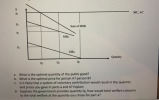 MC, AC Sum of MSB MBS Quantity a. What is the optimal quantity of the public good? b. What is the optimal price for person A? person B? C. Is it likely that a system of voluntary contribution would result in the quantity and prices you gave in parts a and b? Explain d. Suppose the government provides quantity Q., how would total welfare compare to the total welfare at the quantity you chose for part a?
$slunit Competitive firm MC ATC Profit Demand MR OMAX Quantity in units/period WHAT IS WRONG WITH...
 $slunit Competitive firm MC ATC Profit Demand MR OMAX Quantity in units/period WHAT IS WRONG WITH THIS GRAPH? G Focu 0 WHAT IS WRONG WITH THIS GRAPH? $slunit Competitive firm MC ATC P= AR MR Profit QMAX Quantity in units/period
The inverse demand for a product is P=50-0.1Q, and the mc to produce is $10. What...
The inverse demand for a product is P=50-0.1Q, and the mc to produce is $10. What is the best pricing strategy for this firm: charging all customers the same price, 2-part pricing, or block pricing?
2. Use the graph below to figure out if the following price searching firm is profitable,...
 2. Use the graph below to figure out if the following price searching firm is profitable, at zero economic profit, or losing money. Label the firm's demand, MC, ATC, and MR curves. Calculate the quantity of the profit or loss, and indicate what the equilibrium price and quantity is. 30 40 50 60 70 80 90 100Q
For each price in the following table, calculate the firm's optimal quantity of units to produce,...
 For each price in the
following table, calculate the firm's optimal quantity of units to
produce, and determine the profit or loss if it produces at that
quantity, using the data from the previous graph to identify its
total variable cost. Assume that if the firm is indifferent between
producing and shutting down, it will produce.
(Hint: You can select the purple points [diamond
symbols] on the previous graph to see precise information on
average variable cost.)
If the firm...
For each price in the
following table, calculate the firm's optimal quantity of units to
produce, and determine the profit or loss if it produces at that
quantity, using the data from the previous graph to identify its
total variable cost. Assume that if the firm is indifferent between
producing and shutting down, it will produce.
(Hint: You can select the purple points [diamond
symbols] on the previous graph to see precise information on
average variable cost.)
If the firm...
The weekly demand function for x units of a product sold by only one firm is...
 The weekly demand function for x units of a product sold by only one firm is p = 600 – 3x dollars, and the average cost of production and sale is 7 = 400 + 2x dollars. (a) Find the quantity that will maximize profit. units (b) Find the selling price at this optimal quantity. per unit (c) What is the maximum profit?
Price and cost per unit fo Demand Quantity The figure above represents a firm in a monopolistic competition a. What...
 Price and cost per unit fo Demand Quantity The figure above represents a firm in a monopolistic competition a. What is the firm's profit-maximizing or loss-minimizing output (0.5 point) b. What is the price they are going to charge at the output from part a) (0.5 point) c. What is the ATC they are subjected to at the output from part a) (0.5 point) d. Is this firm earning a loss or profit? What is it equal to (You can...
1) A monopolist firm sells its output in two regions: Califomia and Florida. The demand curves...
 1) A monopolist firm sells its output in two regions: Califomia and Florida. The demand curves for each market are QF15-PF OF and Qc are measured in 1000s of units, so you may get decimal values for Q. If P-$10 and Q-1, the profit of S10 that you calculate is actually $10,000). Qc 12.5 - 2 Pc The monopoly's cost function is C 5+3Q5+3(QF+Qc) First, we'll assume that the monopoly can only charge one price in both markets. a) Calculate...
PART 1 Costs & Revenue Price MC The INDUSTRY is the price maker The SINGLE FIRM...
 PART 1 Costs & Revenue Price MC The INDUSTRY is the price maker The SINGLE FIRM IS a price taker S ATC ARMR D Q Q Quantity Output Price Costs Revenue The INDUSTRY is the TSINGLES a proto MC pro NOIVAL proft in the US ATC AR-MR P1 AR-MR D Q01 Q10 Output a. What type of market structure is shown in the diagram above and how did you determine this? b. What are the firm's short run profit maximizing...
 MC, AC Sum of MSB MBS Quantity a. What is the optimal quantity of the public good? b. What is the optimal price for person A? person B? C. Is it likely that a system of voluntary contribution would result in the quantity and prices you gave in parts a and b? Explain d. Suppose the government provides quantity Q., how would total welfare compare to the total welfare at the quantity you chose for part a?
 $slunit Competitive firm MC ATC Profit Demand MR OMAX Quantity in units/period WHAT IS WRONG WITH THIS GRAPH? G Focu 0 WHAT IS WRONG WITH THIS GRAPH? $slunit Competitive firm MC ATC P= AR MR Profit QMAX Quantity in units/period
 2. Use the graph below to figure out if the following price searching firm is profitable, at zero economic profit, or losing money. Label the firm's demand, MC, ATC, and MR curves. Calculate the quantity of the profit or loss, and indicate what the equilibrium price and quantity is. 30 40 50 60 70 80 90 100Q
 For each price in the
following table, calculate the firm's optimal quantity of units to
produce, and determine the profit or loss if it produces at that
quantity, using the data from the previous graph to identify its
total variable cost. Assume that if the firm is indifferent between
producing and shutting down, it will produce.
(Hint: You can select the purple points [diamond
symbols] on the previous graph to see precise information on
average variable cost.)
If the firm...
For each price in the
following table, calculate the firm's optimal quantity of units to
produce, and determine the profit or loss if it produces at that
quantity, using the data from the previous graph to identify its
total variable cost. Assume that if the firm is indifferent between
producing and shutting down, it will produce.
(Hint: You can select the purple points [diamond
symbols] on the previous graph to see precise information on
average variable cost.)
If the firm...
 The weekly demand function for x units of a product sold by only one firm is p = 600 – 3x dollars, and the average cost of production and sale is 7 = 400 + 2x dollars. (a) Find the quantity that will maximize profit. units (b) Find the selling price at this optimal quantity. per unit (c) What is the maximum profit?
 Price and cost per unit fo Demand Quantity The figure above represents a firm in a monopolistic competition a. What is the firm's profit-maximizing or loss-minimizing output (0.5 point) b. What is the price they are going to charge at the output from part a) (0.5 point) c. What is the ATC they are subjected to at the output from part a) (0.5 point) d. Is this firm earning a loss or profit? What is it equal to (You can...
 1) A monopolist firm sells its output in two regions: Califomia and Florida. The demand curves for each market are QF15-PF OF and Qc are measured in 1000s of units, so you may get decimal values for Q. If P-$10 and Q-1, the profit of S10 that you calculate is actually $10,000). Qc 12.5 - 2 Pc The monopoly's cost function is C 5+3Q5+3(QF+Qc) First, we'll assume that the monopoly can only charge one price in both markets. a) Calculate...
 PART 1 Costs & Revenue Price MC The INDUSTRY is the price maker The SINGLE FIRM IS a price taker S ATC ARMR D Q Q Quantity Output Price Costs Revenue The INDUSTRY is the TSINGLES a proto MC pro NOIVAL proft in the US ATC AR-MR P1 AR-MR D Q01 Q10 Output a. What type of market structure is shown in the diagram above and how did you determine this? b. What are the firm's short run profit maximizing...
Most questions answered within 3 hours.
-
Where is the error in this code sequence?
String s1 = "Hello";
String s2 = "ello";...
asked 11 months ago -
Financial data for Joel de Paris, Inc., for last year
follow:
Joel de Paris, Inc.
Balance...
asked 11 months ago -
Consider this reaction:
Al2(SO4)3 (aq)+ BaCl3
(aq) Al2Cl6 (aq)- +
3BaSO4(s) . What is the...
asked 11 months ago -
Suppose that Savneet is considering increasing her
recent random sample from 20 car rentals to 40...
asked 11 months ago -
Trucks arrive at an unloading terminal at an average rate of 120
per hour.
Trucks arrive...
asked 11 months ago -
Why are methanol and ethanol completely soluble in water while
octanol is not very little soluble....
asked 11 months ago -
A facilities manager at a university reads in a research report
that the mean amount of...
asked 11 months ago -
When the CuSO4 is rehydrated by adding water to the anhydrous
compound, is this an endothermic...
asked 11 months ago -
A ray of sunlight is passing from diamond into crown glass; the
angle of incidence is...
asked 11 months ago -
A block of mass 0.249 kg is placed on top of a light, vertical
spring of...
asked 11 months ago -
how do the kidneys compensate in the presences of acidosis
a) trigger hyperventilate
b) reserve acid...
asked 11 months ago -
Question 501 pts
The rental rate of capital to the firm increases. Which of the
following...
asked 11 months ago