
Homework Answers
Add Answer to:
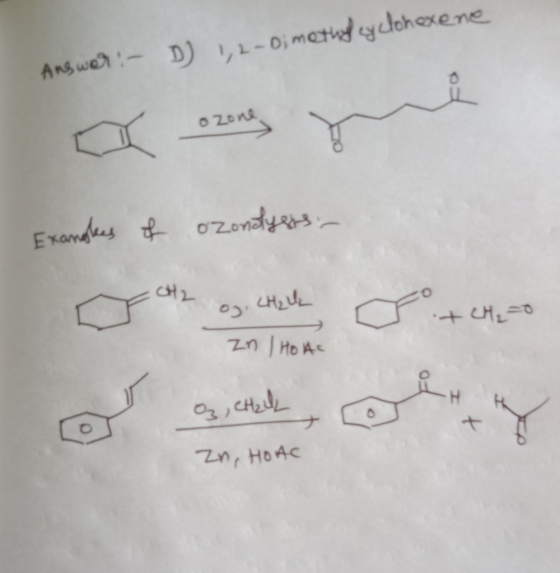
A33 Consider the ozonolysis reaction shown below: ozone Starting material The structure of the starting material...
Draw the structure of the starting material in the ozonolysis reaction below
 Draw the structure of the starting material in the ozonolysis reaction below. Hint: The starting material and product have the same number of carbons i.e., 1 molreactant : 1 mol product.
Draw the structure of the starting material in the ozonolysis reaction below. Hint: The starting material and product...
 Draw the structure of the starting material in the ozonolysis
reaction below. Hint: The starting material and product have the
same number of carbons (i.e., 1 mol reactant : 1 mol product.
Draw the structure of the starting material in the ozonolysis
reaction below. Hint: The starting material and product have the
same number of carbons (i.e., 1 mol reactant : 1 mol product.
Q 3(b) [50 Marks] Ozone is a 1,3-dipole, and ozonolysis (reaction of ozone and an alkene)...
Q 3(b) [50 Marks] Ozone is a 1,3-dipole, and ozonolysis (reaction of ozone and an alkene) has been used extensively in identification of organic structure, prior to development of modern spectroscopic techniques. (i) Draw the 1,2- and 1,3- canonical forms of ozone. (ii) Draw the molecular orbitals for a 1,3-dipole, and identify the HOMO and LUMO of ozone.
4. Draw structures corresponding to the following systematic names; a) 1-isopropyl-4-methylcyclohexene b) 3-butyl-2-heptene c) 4-methyl-1,2- hexadiene...
 4. Draw structures corresponding to the following systematic names; a) 1-isopropyl-4-methylcyclohexene b) 3-butyl-2-heptene c) 4-methyl-1,2- hexadiene d) trans-3,3-dimethyl-4-propyl-1,5-octadiene e) (42)-2,4-diethyl-1,4-hexadiene f) 1.2-propadiene g) (32,5E) -2,6-dimethyl-1,3,5,7-octatetraene h) cis-2,2,5,5-tetramethyl-3-hexene i) Methylenecyclohexane, j) trans- 1,2 divinylcyclohexane
please explain fully. also I am confused why there are numbers in with E and Z...
 please explain fully. also I am confused why there are numbers in
with E and Z
(2.) Draw structures corresponding to the following names: a) (4E)-2,4-dimehyl-1,4-hexadiene b) Cis-3,3-dimethyl-4-propyl-1,5-octadiene c) 4-methyl-1,2-pentadiene d) (3E,5Z)-2,6-dimethyl-1,3,5,7-octatetraene e) 3-butyl-2-heptene f) Trans-2,2,5,5-tetramethyl-3-hexene
please explain fully. also I am confused why there are numbers in
with E and Z
(2.) Draw structures corresponding to the following names: a) (4E)-2,4-dimehyl-1,4-hexadiene b) Cis-3,3-dimethyl-4-propyl-1,5-octadiene c) 4-methyl-1,2-pentadiene d) (3E,5Z)-2,6-dimethyl-1,3,5,7-octatetraene e) 3-butyl-2-heptene f) Trans-2,2,5,5-tetramethyl-3-hexene
step after each product of the the structure 5. Consider the three reaction sequences below (a, b & e) and draw Stereochemistry in the products should be clearly indicated in your drawings wh...
 step after each product of the the structure 5. Consider the three reaction sequences below (a, b & e) and draw Stereochemistry in the products should be clearly indicated in your drawings when app your entire reaction sequence before you jump into any conclusions! Always make sure that the starting material and p reaction conditions! (24 points, 2 points each) icable Hints: Look very carefully at products, so that you are not adding or losing more of these atoms than...
Consider the dehydration reaction using the starting material shown below to answer questions 20-23. НО Dehydration...
 Consider the dehydration reaction using the starting material shown below to answer questions 20-23. НО Dehydration Identify all carbocations that appear in the mechansim for this reaction. Choose all that apply. iv) ii) a. i b. d. iv e. None of the above. The reaction goes by an E2 mechanism and no carbocations are formed.
3. Assign E or Z configuration of the following alkenes; CH,OH CH-CH, COOCH, CH b) CH_CH...
 3. Assign E or Z configuration of the following alkenes; CH,OH CH-CH, COOCH, CH b) CH_CH CH " CH, CHCHOL OH NC 2 CHÁNH, " OCH CH-CO-HN CH NHCH CH 4. Draw structures corresponding to the following systematic names; a) 1-isopropyl-4-methylcyclohexene b) 3-butyl-2-heptene c) 4-methyl-1,2- hexadiene d) trans-3,3-dimethyl-4-propyl-1,5-octadiene e) (42) -2,4-diethyl-1,4-hexadiene 1) 1.2-propadiene g) (32,5E) -2,6-dimethyl-1,3,5,7-octatetraene h) cis-2,2,5,5- tetramethyl-3-hexene i) Methylenecyclohexane j) trans- 1,2 divinylcyclohexane
show the starting material for the reaction shown below Question 2 Show the starting material for...
 show the starting material for the reaction shown below
Question 2 Show the starting material for the reaction shown below. HOCH(CH3)2 o H20*
show the starting material for the reaction shown below
Question 2 Show the starting material for the reaction shown below. HOCH(CH3)2 o H20*
QUESTION 20 Consider the dehydration reaction using the starting material shown below to answer questions 20-23...
 QUESTION 20 Consider the dehydration reaction using the starting material shown below to answer questions 20-23 Dehydration Which reagent(s) are required to perform a dehydration reaction? o a. HCI С. NaH o d. H2SO4 e. NaOH f, H2SO4, heat g. NaOH, heat QUESTION 21 Identify all carbocations that appear in the mechansim for this reaction. Choose all that apply iv) a. C. eNone of the above. The reaction goes by an E2 mechanism and no carbocations are formed. QUESTION 22...
 Draw the structure of the starting material in the ozonolysis
reaction below. Hint: The starting material and product have the
same number of carbons (i.e., 1 mol reactant : 1 mol product.
Draw the structure of the starting material in the ozonolysis
reaction below. Hint: The starting material and product have the
same number of carbons (i.e., 1 mol reactant : 1 mol product.
 4. Draw structures corresponding to the following systematic names; a) 1-isopropyl-4-methylcyclohexene b) 3-butyl-2-heptene c) 4-methyl-1,2- hexadiene d) trans-3,3-dimethyl-4-propyl-1,5-octadiene e) (42)-2,4-diethyl-1,4-hexadiene f) 1.2-propadiene g) (32,5E) -2,6-dimethyl-1,3,5,7-octatetraene h) cis-2,2,5,5-tetramethyl-3-hexene i) Methylenecyclohexane, j) trans- 1,2 divinylcyclohexane
 please explain fully. also I am confused why there are numbers in
with E and Z
(2.) Draw structures corresponding to the following names: a) (4E)-2,4-dimehyl-1,4-hexadiene b) Cis-3,3-dimethyl-4-propyl-1,5-octadiene c) 4-methyl-1,2-pentadiene d) (3E,5Z)-2,6-dimethyl-1,3,5,7-octatetraene e) 3-butyl-2-heptene f) Trans-2,2,5,5-tetramethyl-3-hexene
please explain fully. also I am confused why there are numbers in
with E and Z
(2.) Draw structures corresponding to the following names: a) (4E)-2,4-dimehyl-1,4-hexadiene b) Cis-3,3-dimethyl-4-propyl-1,5-octadiene c) 4-methyl-1,2-pentadiene d) (3E,5Z)-2,6-dimethyl-1,3,5,7-octatetraene e) 3-butyl-2-heptene f) Trans-2,2,5,5-tetramethyl-3-hexene
 step after each product of the the structure 5. Consider the three reaction sequences below (a, b & e) and draw Stereochemistry in the products should be clearly indicated in your drawings when app your entire reaction sequence before you jump into any conclusions! Always make sure that the starting material and p reaction conditions! (24 points, 2 points each) icable Hints: Look very carefully at products, so that you are not adding or losing more of these atoms than...
 Consider the dehydration reaction using the starting material shown below to answer questions 20-23. НО Dehydration Identify all carbocations that appear in the mechansim for this reaction. Choose all that apply. iv) ii) a. i b. d. iv e. None of the above. The reaction goes by an E2 mechanism and no carbocations are formed.
 3. Assign E or Z configuration of the following alkenes; CH,OH CH-CH, COOCH, CH b) CH_CH CH " CH, CHCHOL OH NC 2 CHÁNH, " OCH CH-CO-HN CH NHCH CH 4. Draw structures corresponding to the following systematic names; a) 1-isopropyl-4-methylcyclohexene b) 3-butyl-2-heptene c) 4-methyl-1,2- hexadiene d) trans-3,3-dimethyl-4-propyl-1,5-octadiene e) (42) -2,4-diethyl-1,4-hexadiene 1) 1.2-propadiene g) (32,5E) -2,6-dimethyl-1,3,5,7-octatetraene h) cis-2,2,5,5- tetramethyl-3-hexene i) Methylenecyclohexane j) trans- 1,2 divinylcyclohexane
 show the starting material for the reaction shown below
Question 2 Show the starting material for the reaction shown below. HOCH(CH3)2 o H20*
show the starting material for the reaction shown below
Question 2 Show the starting material for the reaction shown below. HOCH(CH3)2 o H20*
 QUESTION 20 Consider the dehydration reaction using the starting material shown below to answer questions 20-23 Dehydration Which reagent(s) are required to perform a dehydration reaction? o a. HCI С. NaH o d. H2SO4 e. NaOH f, H2SO4, heat g. NaOH, heat QUESTION 21 Identify all carbocations that appear in the mechansim for this reaction. Choose all that apply iv) a. C. eNone of the above. The reaction goes by an E2 mechanism and no carbocations are formed. QUESTION 22...
Most questions answered within 3 hours.
-
Where is the error in this code sequence?
String s1 = "Hello";
String s2 = "ello";...
asked 10 months ago -
Financial data for Joel de Paris, Inc., for last year
follow:
Joel de Paris, Inc.
Balance...
asked 10 months ago -
Consider this reaction:
Al2(SO4)3 (aq)+ BaCl3
(aq) Al2Cl6 (aq)- +
3BaSO4(s) . What is the...
asked 10 months ago -
Suppose that Savneet is considering increasing her
recent random sample from 20 car rentals to 40...
asked 10 months ago -
Trucks arrive at an unloading terminal at an average rate of 120
per hour.
Trucks arrive...
asked 10 months ago -
Why are methanol and ethanol completely soluble in water while
octanol is not very little soluble....
asked 10 months ago -
A facilities manager at a university reads in a research report
that the mean amount of...
asked 10 months ago -
When the CuSO4 is rehydrated by adding water to the anhydrous
compound, is this an endothermic...
asked 10 months ago -
A ray of sunlight is passing from diamond into crown glass; the
angle of incidence is...
asked 10 months ago -
A block of mass 0.249 kg is placed on top of a light, vertical
spring of...
asked 10 months ago -
how do the kidneys compensate in the presences of acidosis
a) trigger hyperventilate
b) reserve acid...
asked 10 months ago -
Question 501 pts
The rental rate of capital to the firm increases. Which of the
following...
asked 10 months ago