![k [2-)(3 т k ( 2)(x3- 2)- 31/2], т k 2 - s)31/2] т k (2-y) (s- )3, т k )(s-2)-31/2, y2 т k [(yy) (y2-y3)- 31/2], т](http://img.homeworklib.com/images/eb529858-d0ab-4e7c-aa5a-45c8c213bb5b.png?x-oss-process=image/resize,w_560)
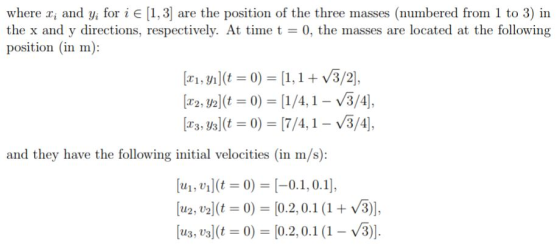
How can I make these equations into 6 first order equations to input them in MATLAB as :
function yp = ivpsys_fun_oscillator(t, y)
% IVPSYS_FUN evaluates the right-hand-side of the ODE's.
% Inputs are current time and current values of y. Outputs are
values of y'.
% Call format: yp = ivpsys_fun_oscillator(t, y)
global m k l
%% Define ODE for IVP
% Reduce high order derivative to first order
% y1 -> x1, y2 -> x2, y3 -> x3
% y4 -> z1, y5 -> z2, y6 -> z3
% y7 -> u1, y8 -> u2, y9 -> u3
% y10 -> w1, y11 -> w2, y12 -> w3
yp(1) = y(7);
yp(2) = y(8);
yp(3) = y(9);
yp(4) = y(10);
yp(5) = y(11);
yp(6) = y(12);
yp(7) = (k/m) * ( (y(2)-y(1)) + (y(3)-y(1)) );
yp(8) = (k/m) * ( (y(1)-y(2)) + (y(3)-y(2)) - 3*l/2);
yp(9) = (k/m) * ( (y(1)-y(3)) + (y(2)-y(3)) + 3*l/2);
yp(10) = (k/m) * ( (y(5)-y(4)) + (y(6)-y(4)) + sqrt(3)*l );
yp(11) = (k/m) * ( (y(4)-y(5)) + (y(6)-y(5)) - sqrt(3)*l/2);
yp(12) = (k/m) * ( (y(4)-y(6)) + (y(5)-y(6)) - sqrt(3)*l/2);
end
This is probably wrong but it is as far as I got, thank you
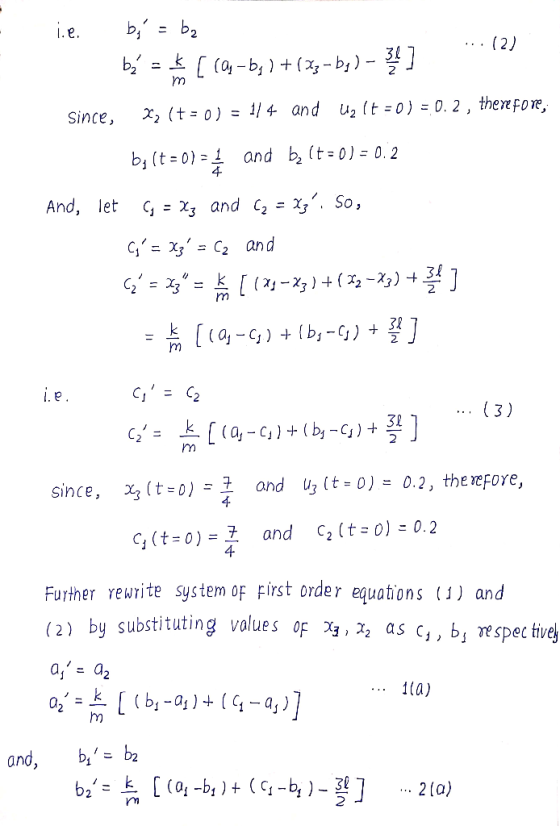
where and y for i [1, 3 are the position of the three masses (numbered from 1 to 3) in the x and y directions, respectively. At time t 0, the masses are located at the following position (in m): 1, (t = 0) = [1,1 3/2], [ar2, y2](t= 0) = [1/4,1 - 3/4], 3, Ya (t= 0) = [7/4,1 - 3/4], and they have the following initial velocities (in m/s): u1, 1|(t= 0) = [-0.1, 0.1], u2, U2(t 0)(0.2,0.1 (13)] us, v3|(t= 0) [0.2, 0.1 (1 - V3)
Homework Answers

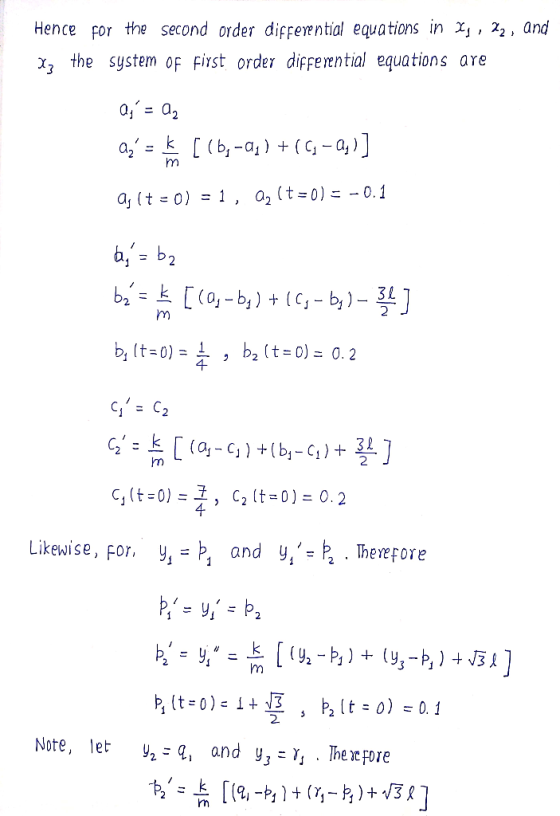
![NOw and y,= q, . Therefoye, ,= q,a=q, and [ (P-,) - q, ) - v31/2] m ai (t 0)=, q, (t =0) = 0.1 1+ V3) 4 And, and 2= y. Ther](http://img.homeworklib.com/images/4a7e029e-e52e-4497-aa80-da9a43bb42b6.png?x-oss-process=image/resize,w_560)
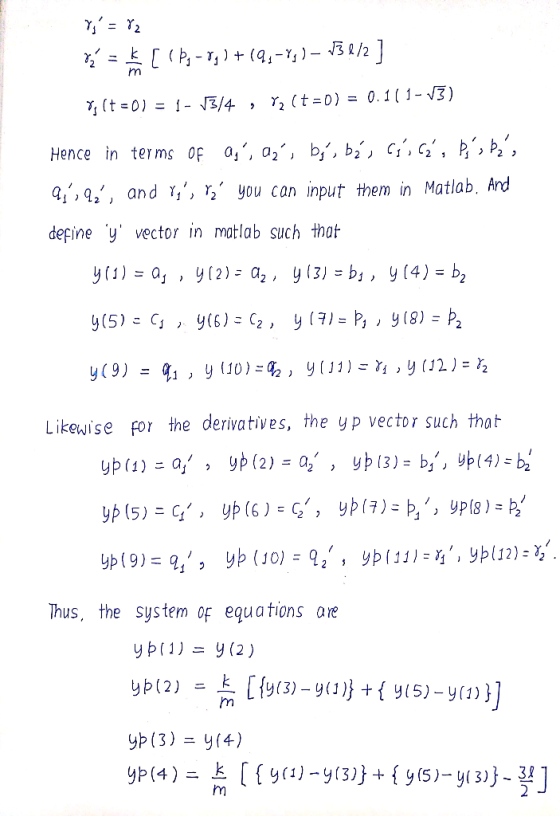
![yp(5) y (6) [y-y5 yp (6) y3) - yl5)} + 3] And y (8) k [y(9)-y y1)-y(7) 1] yb18) - m pC9) y(10) y)y)y(11) - y (9)} - B ] k yp](http://img.homeworklib.com/images/ce772846-30f9-42bd-b444-fab41d87ceab.png?x-oss-process=image/resize,w_560)
Add Answer to:
How can I make these equations into 6 first order equations to input them in MATLAB...
MATLAB only please I am trying to get my getdatafuntion to work. I am also trying to get all my x...
 MATLAB only please
I am trying to get my getdatafuntion to work. I am also trying
to get all my x's, y's, and v's to popup in the command window so I
can put in any value and it will find the value for me using
the equation I put in.
function project_9_sjl()
% PROJECT_9_SJL project_9_sjl() is the driver function for the
program.
%
% Name: Scott Lawrence
% Date: 3/27/2019
% Class: CMPSC 200
% Description: Determine the optimal...
MATLAB only please
I am trying to get my getdatafuntion to work. I am also trying
to get all my x's, y's, and v's to popup in the command window so I
can put in any value and it will find the value for me using
the equation I put in.
function project_9_sjl()
% PROJECT_9_SJL project_9_sjl() is the driver function for the
program.
%
% Name: Scott Lawrence
% Date: 3/27/2019
% Class: CMPSC 200
% Description: Determine the optimal...
Please answer using MATHLAB. I need the code and the answer. Thanks, Use MATLAB or Scilab...
 Please answer using MATHLAB. I need the code and the answer.
Thanks,
Use MATLAB or Scilab to perform the following matrix operations 1) Find the determinant of ſi 7 -2 31 5 -1 9 13 2 51 31 4 6 18 -4 21 2) Find the inverse (A-2) of ſi 7 -2 3] 5 -1 9 13 2 51 314 6 18 -4 2' 3) Given the following set of linear equations X, + 2 x, – x3 + xy...
Please answer using MATHLAB. I need the code and the answer.
Thanks,
Use MATLAB or Scilab to perform the following matrix operations 1) Find the determinant of ſi 7 -2 31 5 -1 9 13 2 51 31 4 6 18 -4 21 2) Find the inverse (A-2) of ſi 7 -2 3] 5 -1 9 13 2 51 314 6 18 -4 2' 3) Given the following set of linear equations X, + 2 x, – x3 + xy...
(8 pts) In this problem you will solve the non-homogeneous differential equation y" + 9y =...
 (8 pts) In this problem you will solve the non-homogeneous differential equation y" + 9y = sec (3x) (1) Let C and C2 be arbitrary constants. The general solution to the related homogeneous differential equation y" + 9y = 0 is the function yn (x) = C1 yı(2) + C2 y2(x) = C1 +C2 NOTE: The order in which you enter the answers is important; that is, Cif(x) + C2g(x) + C19(x) + C2 f(x). (2) The particular solution yp(x)...
Solve the system of first-order linear differential equations given below. yil ya' = -1 12y2 =...
 Solve the system of first-order linear differential equations given below. yil ya' = -1 12y2 = Y3 Vi = O aY2 = 3 = C+e+ C2 +12 Czte Oby2 yu = Cie C₂e-12 Cze? 13 yi Ce? Cze12 OC. Y2 = 13 Cze' y = 1+Cje od yz = 1+ Cze-12 93 1+Cze y = 1+0,e- Oe. Y2 = Cze12 V3 = Czte
Looking for Muller Method MatLab coding for these following equations: This is the code I currently...
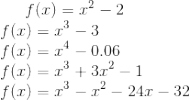 Looking for Muller Method MatLab coding for these following
equations:
This is the code I currently have but is not working
fun = @(x) x.^2-2;
x1 = 0;
x2 = 1;
tol = 0.0001;
kmax = 100;
function [x, y] = Muller(fun, x1, x2, tol, kmax)
x(1) = x1;
x(2) = x2;
x(3) = (x(2)+x(1))/2;
y(1) = feval(fun, x1);
y(2) = feval(fun, x2);
y(3) = feval(fun, x(3));
c(1) = (y(2)-y(1))/(x(2)-x(1));
for k = 3 : kmax
c(k-1) = (y(k)-y(k-1))/(x(k)-x(k-1));
d(k-2)...
Looking for Muller Method MatLab coding for these following
equations:
This is the code I currently have but is not working
fun = @(x) x.^2-2;
x1 = 0;
x2 = 1;
tol = 0.0001;
kmax = 100;
function [x, y] = Muller(fun, x1, x2, tol, kmax)
x(1) = x1;
x(2) = x2;
x(3) = (x(2)+x(1))/2;
y(1) = feval(fun, x1);
y(2) = feval(fun, x2);
y(3) = feval(fun, x(3));
c(1) = (y(2)-y(1))/(x(2)-x(1));
for k = 3 : kmax
c(k-1) = (y(k)-y(k-1))/(x(k)-x(k-1));
d(k-2)...
how this mathematical model relates to the physical hypothesis given in Eq. 2. equation 2 Calculate...
 how this mathematical model relates to the physical hypothesis
given in Eq. 2.
equation 2
Calculate the spring stiffness, k, from your fit
parameter, A.
“y = A*sqrt(x).”
Mass vs T 1.6 1.4 y = 2.2486x0.41 1.2 1 Period (s) 0.8 0.6 0.4 0.2 0 0 0.05 0.1 0.15 0.2 0.25 0.3 0.35 Mass (kg) т T= 21 k
how this mathematical model relates to the physical hypothesis
given in Eq. 2.
equation 2
Calculate the spring stiffness, k, from your fit
parameter, A.
“y = A*sqrt(x).”
Mass vs T 1.6 1.4 y = 2.2486x0.41 1.2 1 Period (s) 0.8 0.6 0.4 0.2 0 0 0.05 0.1 0.15 0.2 0.25 0.3 0.35 Mass (kg) т T= 21 k
I have all of the answers to this can someone just actually explain this matlab code and the results to me so i can get a better understanding? b) (c) and (d) %% Matlab code %% clc; close all; clear...
 I have all of the answers to this can someone just actually
explain this matlab code and the results to me so i can get a
better understanding?
b)
(c) and (d)
%% Matlab code %%
clc;
close all;
clear all;
format long;
f=@(t,y)y*(1-y);
y(1)=0.01;
%%%% Exact solution
[t1 y1]=ode45(f,[0 9],y(1));
figure;
plot(t1,y1,'*');
hold on
% Eular therom
M=[32 64 128];
T=9;
fprintf(' M Max error \n' );
for n=1:length(M)
k=T/M(n);
t=0:k:T;
for h=1:length(t)-1
y(h+1)=y(h)+k*f(t(h),y(h));
end
plot(t,y);
hold on
%%%...
I have all of the answers to this can someone just actually
explain this matlab code and the results to me so i can get a
better understanding?
b)
(c) and (d)
%% Matlab code %%
clc;
close all;
clear all;
format long;
f=@(t,y)y*(1-y);
y(1)=0.01;
%%%% Exact solution
[t1 y1]=ode45(f,[0 9],y(1));
figure;
plot(t1,y1,'*');
hold on
% Eular therom
M=[32 64 128];
T=9;
fprintf(' M Max error \n' );
for n=1:length(M)
k=T/M(n);
t=0:k:T;
for h=1:length(t)-1
y(h+1)=y(h)+k*f(t(h),y(h));
end
plot(t,y);
hold on
%%%...
Matlab-How can i exit the for loop when counts exceeds the max value, then continue to...
Matlab-How can i exit the for loop when counts exceeds the max value, then continue to the last loop and plot accepted values. counts = 0; for k = 2:length(partDiameter) overlaps = 1; while overlaps == 1 counts = counts + 1; if counts >= 10000 disp('Max particles packed') inCoord = [inCoord;[x,y]]; return; end x = (partDiameter(k)-L)*rand(1,1) + (L-partDiameter(k)/2); y = (partDiameter(k)-L)*rand(1,1) + (L-partDiameter(k)/2); % check if this x,y postion overlaps with previously packed % partices for m = 1:length(inCoord(:,1))...
we assume that X solves the differential equation X'=AX. In this problem, we will investigate the strategy to deal...
 we assume that X solves the differential equation X'=AX.
In this problem, we will investigate the strategy to deal with repeated eigenvalues. Conside:r A=17-2-6 1. This matrix has only one eigenvalue Ao of multiplicity 3. Find the characteristic equation, the eigenvalue λ0 and an eigenvector P for λ0 2. Find vectors K. L such that (A-X0IK-P and (A-X01)L-K. Compute the matrix M-1AM where M-(PIKL) 3. Let Y -M'X. Solve the equation for Y in the following manner : first, solve...
we assume that X solves the differential equation X'=AX.
In this problem, we will investigate the strategy to deal with repeated eigenvalues. Conside:r A=17-2-6 1. This matrix has only one eigenvalue Ao of multiplicity 3. Find the characteristic equation, the eigenvalue λ0 and an eigenvector P for λ0 2. Find vectors K. L such that (A-X0IK-P and (A-X01)L-K. Compute the matrix M-1AM where M-(PIKL) 3. Let Y -M'X. Solve the equation for Y in the following manner : first, solve...
Differential Equations with MATLAB/Plotting first order differential equations in Matlab/ Differential Equations MATLAB/IVP Matlab/IVP I'd really...
 Differential Equations with MATLAB/Plotting first order
differential equations in Matlab/ Differential Equations MATLAB/IVP
Matlab/IVP
I'd really appreciate if I can get some help plotting these 3
first order differential equations as well as their comments.
PLEASE! ANYTHING HELPS, I am very stuck :(
EZplot and ODE 45 were mentioned in class and the instructions
in class were not clear at all.
Given the first order differential equation with initial condition. dy/dt = y t, y(0)=-1 Complete problems 1-3 in one...
Differential Equations with MATLAB/Plotting first order
differential equations in Matlab/ Differential Equations MATLAB/IVP
Matlab/IVP
I'd really appreciate if I can get some help plotting these 3
first order differential equations as well as their comments.
PLEASE! ANYTHING HELPS, I am very stuck :(
EZplot and ODE 45 were mentioned in class and the instructions
in class were not clear at all.
Given the first order differential equation with initial condition. dy/dt = y t, y(0)=-1 Complete problems 1-3 in one...
 MATLAB only please
I am trying to get my getdatafuntion to work. I am also trying
to get all my x's, y's, and v's to popup in the command window so I
can put in any value and it will find the value for me using
the equation I put in.
function project_9_sjl()
% PROJECT_9_SJL project_9_sjl() is the driver function for the
program.
%
% Name: Scott Lawrence
% Date: 3/27/2019
% Class: CMPSC 200
% Description: Determine the optimal...
MATLAB only please
I am trying to get my getdatafuntion to work. I am also trying
to get all my x's, y's, and v's to popup in the command window so I
can put in any value and it will find the value for me using
the equation I put in.
function project_9_sjl()
% PROJECT_9_SJL project_9_sjl() is the driver function for the
program.
%
% Name: Scott Lawrence
% Date: 3/27/2019
% Class: CMPSC 200
% Description: Determine the optimal...
 Please answer using MATHLAB. I need the code and the answer.
Thanks,
Use MATLAB or Scilab to perform the following matrix operations 1) Find the determinant of ſi 7 -2 31 5 -1 9 13 2 51 31 4 6 18 -4 21 2) Find the inverse (A-2) of ſi 7 -2 3] 5 -1 9 13 2 51 314 6 18 -4 2' 3) Given the following set of linear equations X, + 2 x, – x3 + xy...
Please answer using MATHLAB. I need the code and the answer.
Thanks,
Use MATLAB or Scilab to perform the following matrix operations 1) Find the determinant of ſi 7 -2 31 5 -1 9 13 2 51 31 4 6 18 -4 21 2) Find the inverse (A-2) of ſi 7 -2 3] 5 -1 9 13 2 51 314 6 18 -4 2' 3) Given the following set of linear equations X, + 2 x, – x3 + xy...
 (8 pts) In this problem you will solve the non-homogeneous differential equation y" + 9y = sec (3x) (1) Let C and C2 be arbitrary constants. The general solution to the related homogeneous differential equation y" + 9y = 0 is the function yn (x) = C1 yı(2) + C2 y2(x) = C1 +C2 NOTE: The order in which you enter the answers is important; that is, Cif(x) + C2g(x) + C19(x) + C2 f(x). (2) The particular solution yp(x)...
 Solve the system of first-order linear differential equations given below. yil ya' = -1 12y2 = Y3 Vi = O aY2 = 3 = C+e+ C2 +12 Czte Oby2 yu = Cie C₂e-12 Cze? 13 yi Ce? Cze12 OC. Y2 = 13 Cze' y = 1+Cje od yz = 1+ Cze-12 93 1+Cze y = 1+0,e- Oe. Y2 = Cze12 V3 = Czte
 Looking for Muller Method MatLab coding for these following
equations:
This is the code I currently have but is not working
fun = @(x) x.^2-2;
x1 = 0;
x2 = 1;
tol = 0.0001;
kmax = 100;
function [x, y] = Muller(fun, x1, x2, tol, kmax)
x(1) = x1;
x(2) = x2;
x(3) = (x(2)+x(1))/2;
y(1) = feval(fun, x1);
y(2) = feval(fun, x2);
y(3) = feval(fun, x(3));
c(1) = (y(2)-y(1))/(x(2)-x(1));
for k = 3 : kmax
c(k-1) = (y(k)-y(k-1))/(x(k)-x(k-1));
d(k-2)...
Looking for Muller Method MatLab coding for these following
equations:
This is the code I currently have but is not working
fun = @(x) x.^2-2;
x1 = 0;
x2 = 1;
tol = 0.0001;
kmax = 100;
function [x, y] = Muller(fun, x1, x2, tol, kmax)
x(1) = x1;
x(2) = x2;
x(3) = (x(2)+x(1))/2;
y(1) = feval(fun, x1);
y(2) = feval(fun, x2);
y(3) = feval(fun, x(3));
c(1) = (y(2)-y(1))/(x(2)-x(1));
for k = 3 : kmax
c(k-1) = (y(k)-y(k-1))/(x(k)-x(k-1));
d(k-2)...
 how this mathematical model relates to the physical hypothesis
given in Eq. 2.
equation 2
Calculate the spring stiffness, k, from your fit
parameter, A.
“y = A*sqrt(x).”
Mass vs T 1.6 1.4 y = 2.2486x0.41 1.2 1 Period (s) 0.8 0.6 0.4 0.2 0 0 0.05 0.1 0.15 0.2 0.25 0.3 0.35 Mass (kg) т T= 21 k
how this mathematical model relates to the physical hypothesis
given in Eq. 2.
equation 2
Calculate the spring stiffness, k, from your fit
parameter, A.
“y = A*sqrt(x).”
Mass vs T 1.6 1.4 y = 2.2486x0.41 1.2 1 Period (s) 0.8 0.6 0.4 0.2 0 0 0.05 0.1 0.15 0.2 0.25 0.3 0.35 Mass (kg) т T= 21 k
 I have all of the answers to this can someone just actually
explain this matlab code and the results to me so i can get a
better understanding?
b)
(c) and (d)
%% Matlab code %%
clc;
close all;
clear all;
format long;
f=@(t,y)y*(1-y);
y(1)=0.01;
%%%% Exact solution
[t1 y1]=ode45(f,[0 9],y(1));
figure;
plot(t1,y1,'*');
hold on
% Eular therom
M=[32 64 128];
T=9;
fprintf(' M Max error \n' );
for n=1:length(M)
k=T/M(n);
t=0:k:T;
for h=1:length(t)-1
y(h+1)=y(h)+k*f(t(h),y(h));
end
plot(t,y);
hold on
%%%...
I have all of the answers to this can someone just actually
explain this matlab code and the results to me so i can get a
better understanding?
b)
(c) and (d)
%% Matlab code %%
clc;
close all;
clear all;
format long;
f=@(t,y)y*(1-y);
y(1)=0.01;
%%%% Exact solution
[t1 y1]=ode45(f,[0 9],y(1));
figure;
plot(t1,y1,'*');
hold on
% Eular therom
M=[32 64 128];
T=9;
fprintf(' M Max error \n' );
for n=1:length(M)
k=T/M(n);
t=0:k:T;
for h=1:length(t)-1
y(h+1)=y(h)+k*f(t(h),y(h));
end
plot(t,y);
hold on
%%%...
 we assume that X solves the differential equation X'=AX.
In this problem, we will investigate the strategy to deal with repeated eigenvalues. Conside:r A=17-2-6 1. This matrix has only one eigenvalue Ao of multiplicity 3. Find the characteristic equation, the eigenvalue λ0 and an eigenvector P for λ0 2. Find vectors K. L such that (A-X0IK-P and (A-X01)L-K. Compute the matrix M-1AM where M-(PIKL) 3. Let Y -M'X. Solve the equation for Y in the following manner : first, solve...
we assume that X solves the differential equation X'=AX.
In this problem, we will investigate the strategy to deal with repeated eigenvalues. Conside:r A=17-2-6 1. This matrix has only one eigenvalue Ao of multiplicity 3. Find the characteristic equation, the eigenvalue λ0 and an eigenvector P for λ0 2. Find vectors K. L such that (A-X0IK-P and (A-X01)L-K. Compute the matrix M-1AM where M-(PIKL) 3. Let Y -M'X. Solve the equation for Y in the following manner : first, solve...
 Differential Equations with MATLAB/Plotting first order
differential equations in Matlab/ Differential Equations MATLAB/IVP
Matlab/IVP
I'd really appreciate if I can get some help plotting these 3
first order differential equations as well as their comments.
PLEASE! ANYTHING HELPS, I am very stuck :(
EZplot and ODE 45 were mentioned in class and the instructions
in class were not clear at all.
Given the first order differential equation with initial condition. dy/dt = y t, y(0)=-1 Complete problems 1-3 in one...
Differential Equations with MATLAB/Plotting first order
differential equations in Matlab/ Differential Equations MATLAB/IVP
Matlab/IVP
I'd really appreciate if I can get some help plotting these 3
first order differential equations as well as their comments.
PLEASE! ANYTHING HELPS, I am very stuck :(
EZplot and ODE 45 were mentioned in class and the instructions
in class were not clear at all.
Given the first order differential equation with initial condition. dy/dt = y t, y(0)=-1 Complete problems 1-3 in one...
Most questions answered within 3 hours.
-
Where is the error in this code sequence?
String s1 = "Hello";
String s2 = "ello";...
asked 10 months ago -
Financial data for Joel de Paris, Inc., for last year
follow:
Joel de Paris, Inc.
Balance...
asked 10 months ago -
Consider this reaction:
Al2(SO4)3 (aq)+ BaCl3
(aq) Al2Cl6 (aq)- +
3BaSO4(s) . What is the...
asked 10 months ago -
Suppose that Savneet is considering increasing her
recent random sample from 20 car rentals to 40...
asked 10 months ago -
Trucks arrive at an unloading terminal at an average rate of 120
per hour.
Trucks arrive...
asked 10 months ago -
Why are methanol and ethanol completely soluble in water while
octanol is not very little soluble....
asked 10 months ago -
A facilities manager at a university reads in a research report
that the mean amount of...
asked 10 months ago -
When the CuSO4 is rehydrated by adding water to the anhydrous
compound, is this an endothermic...
asked 10 months ago -
A ray of sunlight is passing from diamond into crown glass; the
angle of incidence is...
asked 10 months ago -
A block of mass 0.249 kg is placed on top of a light, vertical
spring of...
asked 10 months ago -
how do the kidneys compensate in the presences of acidosis
a) trigger hyperventilate
b) reserve acid...
asked 10 months ago -
Question 501 pts
The rental rate of capital to the firm increases. Which of the
following...
asked 10 months ago