The HACEK organisms include Haemophilus species, Aggregatibacter actinomycetemcomitans, Cardiobacterium hominis, Eikenella corrodens, and Kingella kingae. HACEK...
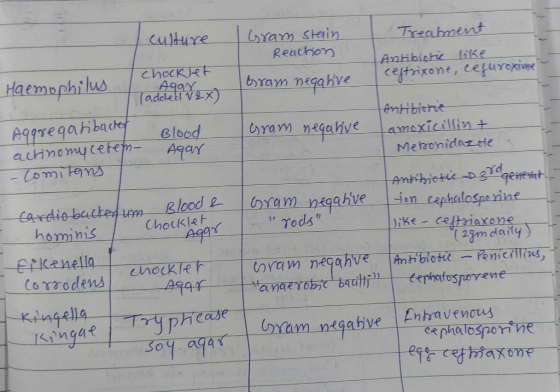
The HACEK organisms include Haemophilus species, Aggregatibacter actinomycetemcomitans, Cardiobacterium hominis, Eikenella corrodens, and Kingella kingae. HACEK organisms are most often associated with infective endocarditis, accounting for up to 10% of cases. For each organism describe environmental growth requirements, culture media, gram stain reaction, and treatment options.
Homework Answers
Add Answer to:
The HACEK organisms include Haemophilus species, Aggregatibacter actinomycetemcomitans, Cardiobacterium hominis, Eikenella corrodens, and Kingella kingae. HACEK...
Case Study #3 Clinical History: A 67-year-old male had rheumatic heart disease for thirty years. Three...
 Case Study #3 Clinical History: A 67-year-old male had rheumatic heart disease for thirty years. Three months prior to death he began to have episodes of fever and chills accompanied by signs of worsening congestive heart failure. Splinter hemorrhages and purpuric skin rashes were noted three weeks before death. Laboratory Findings: Blood cultures grew alpha-hemolytic streptococci. Gram stain shows gram positive cocci in chains. Autopsy revealed thickening of the mitral valve. Many friable calcified pink-gray granular lesions were present on...
Case Study #1 Clinical history: An HIV positive male presented in clinic with confusion and disorientation. He had a fev...
 Case Study
#1
Clinical
history: An HIV positive male presented in clinic with
confusion and disorientation. He had a fever 38.5°C and
photophobia. His CD4 T cell count was 80/ul. An MRI and lumbar
puncture were performed. The MRI showed various small lesions
within the brain. CSF analysis indicated 32 White Blood Cells/ul
with 89% lymphocytes, and 6% monocytes, glucose of 22mg/dl, and
protein of 89mg/dl. Gram stain showed yeast and India ink negative
stain showed a thick capsule.
Image...
Case Study
#1
Clinical
history: An HIV positive male presented in clinic with
confusion and disorientation. He had a fever 38.5°C and
photophobia. His CD4 T cell count was 80/ul. An MRI and lumbar
puncture were performed. The MRI showed various small lesions
within the brain. CSF analysis indicated 32 White Blood Cells/ul
with 89% lymphocytes, and 6% monocytes, glucose of 22mg/dl, and
protein of 89mg/dl. Gram stain showed yeast and India ink negative
stain showed a thick capsule.
Image...
NEISSERIA EXPERIMENT MICROBIOLOGY LAB (Revised March 2016) Background There are two main pathogens in the genus...
 NEISSERIA EXPERIMENT MICROBIOLOGY LAB (Revised March 2016) Background There are two main pathogens in the genus Neisseria: N.gonorrhoeae and N meningitidis, along with many species which are normal flora for mucus membranes like the nasopharynx, vagina, urogenital tract, etc. In order to diagnose gonorrhea in a male, a Gram stain of the urethral discharge should reveal Gram negative diplococci and many white blood cells. This is considered sufficient grounds to treat for gonorrhea. In a female, diagnosis must be based...
You are given a mixed culture of two organisms in a small tube of TSB.
 You are given a mixed culture of two organisms in a small tube of TSB. These two organisms include a Gram-negative strain (your bacterial strain to identify) and a Gram-positive strain (a contaminant). Your first task is to isolate these organisms which will help you identify which Gram-negative strain you are working with. 1) You inoculate two streak plates on TSA media and MacConkey Agar using aseptic technique. For each medium, state whether the medium is selective, differential, or neither and...
mixed unknown. the goal of this assignment is to identity each organism. so this attachement or...
 mixed unknown. the goal of this assignment is to identity each
organism. so this attachement or picture has both organism
seperated by gram stanin and result of each on macConkeys Agar and
Columbia CNA. so in order to identify the genus and specise both
organsims, i have to order 2 additional test per. MY questions to
you is what kinds of test do have to requesd or do in oder to
identity the organism ?
N (No Title) Gram + Gram...
mixed unknown. the goal of this assignment is to identity each
organism. so this attachement or picture has both organism
seperated by gram stanin and result of each on macConkeys Agar and
Columbia CNA. so in order to identify the genus and specise both
organsims, i have to order 2 additional test per. MY questions to
you is what kinds of test do have to requesd or do in oder to
identity the organism ?
N (No Title) Gram + Gram...
1. The graph below depicts the growth of a Gram-positive, spore-forming bacterium Bacillus thuringiensis (B. t.). This species normally lives in the soil as well as the alkaline gut of insects. a)...
 1. The graph below depicts the growth of a
Gram-positive, spore-forming bacterium Bacillus thuringiensis (B.
t.). This species normally lives in the soil as well as the
alkaline gut of insects.
a) Label on the graph the phases of this growth cycle.
Below, describe the important features of each phase.
b) The graph shown was obtained by culturing B. t. in
media containing only minimal amounts of nutrients and salts. Draw
a growth curve on the same graph that would...
1. The graph below depicts the growth of a
Gram-positive, spore-forming bacterium Bacillus thuringiensis (B.
t.). This species normally lives in the soil as well as the
alkaline gut of insects.
a) Label on the graph the phases of this growth cycle.
Below, describe the important features of each phase.
b) The graph shown was obtained by culturing B. t. in
media containing only minimal amounts of nutrients and salts. Draw
a growth curve on the same graph that would...
Describe two different diseases and disorders caused by prokaryotic organisms. Be sure to include the following...
Describe two different diseases and disorders caused by prokaryotic organisms. Be sure to include the following elements of the two diseases you select: -Define the disease or disorder and explain its specific cause. -Describe the signs and symptoms of the disease or disorder. -Describe the anatomical structures involved or that can be involved in this disease or disorder. -Describe the treatment and any possible cures. -Describe how a prokaryotic organism causes this disease. -Include a picture or drawing of each...
Match the following: Corynebacterium diphtheriae's virulence requires this A Neurotoxin Major virulence factor of strep. pneumoniae...
 Match the following: Corynebacterium diphtheriae's virulence requires this A Neurotoxin Major virulence factor of strep. pneumoniae The major virulence factor of group A strep, in recent fatal cases V Clostridium tetani's main virulent factor is this B Erythrogenic tosin C Hyaluronidase D. Lysogenic conversion E. Capsule Spreading factor in staph. aureus cellulitis infections Match the following: ✓ Gram positive cocci which causes pharyngitis Patient must be treated with antitoxcin plus an antibiotic for this disease Gram negative rod which causes...
Which pulmonary infections are associated with cavitary lesions of the lungs? Which mycobacterial species are included...
 Which pulmonary infections are associated with cavitary lesions of the lungs? Which mycobacterial species are included in the Mycobacterium tuberculosis Complex? List the 4 most common species. Which organism in the M.tb Complex is often identified by the niacin test? Define the following terms relative to mycobacteria: 3. 4. 5. 6. a. Photochromogen b. Scotochromogen c. Nonphotochromogen d. Rapid grower 7. List 2 AFB media which are egg-based. 8. List 2 AFB media which are chemically defined agar-based media. 9....
A bacterium was isolated from the human gut and successfully grown on NA in the lab....
 A bacterium was isolated from
the human gut and successfully grown on NA in the lab. Where
in thioglycollate medium would you expect to see growth for this
organism and why?
AaBbCcDdE ABCD de AaBbCcDde AaBbCD AaBbCcDdE A. A. EEZE, . Normal Preformatted No Spacing Heading 1 Heading 2 1) A bacterium was isolated from the human gut and successfully grown on NA in the lab. Where in thioglycollate medium would you expect to see growth for this organism, and...
A bacterium was isolated from
the human gut and successfully grown on NA in the lab. Where
in thioglycollate medium would you expect to see growth for this
organism and why?
AaBbCcDdE ABCD de AaBbCcDde AaBbCD AaBbCcDdE A. A. EEZE, . Normal Preformatted No Spacing Heading 1 Heading 2 1) A bacterium was isolated from the human gut and successfully grown on NA in the lab. Where in thioglycollate medium would you expect to see growth for this organism, and...
 Case Study #3 Clinical History: A 67-year-old male had rheumatic heart disease for thirty years. Three months prior to death he began to have episodes of fever and chills accompanied by signs of worsening congestive heart failure. Splinter hemorrhages and purpuric skin rashes were noted three weeks before death. Laboratory Findings: Blood cultures grew alpha-hemolytic streptococci. Gram stain shows gram positive cocci in chains. Autopsy revealed thickening of the mitral valve. Many friable calcified pink-gray granular lesions were present on...
 Case Study
#1
Clinical
history: An HIV positive male presented in clinic with
confusion and disorientation. He had a fever 38.5°C and
photophobia. His CD4 T cell count was 80/ul. An MRI and lumbar
puncture were performed. The MRI showed various small lesions
within the brain. CSF analysis indicated 32 White Blood Cells/ul
with 89% lymphocytes, and 6% monocytes, glucose of 22mg/dl, and
protein of 89mg/dl. Gram stain showed yeast and India ink negative
stain showed a thick capsule.
Image...
Case Study
#1
Clinical
history: An HIV positive male presented in clinic with
confusion and disorientation. He had a fever 38.5°C and
photophobia. His CD4 T cell count was 80/ul. An MRI and lumbar
puncture were performed. The MRI showed various small lesions
within the brain. CSF analysis indicated 32 White Blood Cells/ul
with 89% lymphocytes, and 6% monocytes, glucose of 22mg/dl, and
protein of 89mg/dl. Gram stain showed yeast and India ink negative
stain showed a thick capsule.
Image...
 NEISSERIA EXPERIMENT MICROBIOLOGY LAB (Revised March 2016) Background There are two main pathogens in the genus Neisseria: N.gonorrhoeae and N meningitidis, along with many species which are normal flora for mucus membranes like the nasopharynx, vagina, urogenital tract, etc. In order to diagnose gonorrhea in a male, a Gram stain of the urethral discharge should reveal Gram negative diplococci and many white blood cells. This is considered sufficient grounds to treat for gonorrhea. In a female, diagnosis must be based...
 mixed unknown. the goal of this assignment is to identity each
organism. so this attachement or picture has both organism
seperated by gram stanin and result of each on macConkeys Agar and
Columbia CNA. so in order to identify the genus and specise both
organsims, i have to order 2 additional test per. MY questions to
you is what kinds of test do have to requesd or do in oder to
identity the organism ?
N (No Title) Gram + Gram...
mixed unknown. the goal of this assignment is to identity each
organism. so this attachement or picture has both organism
seperated by gram stanin and result of each on macConkeys Agar and
Columbia CNA. so in order to identify the genus and specise both
organsims, i have to order 2 additional test per. MY questions to
you is what kinds of test do have to requesd or do in oder to
identity the organism ?
N (No Title) Gram + Gram...
 1. The graph below depicts the growth of a
Gram-positive, spore-forming bacterium Bacillus thuringiensis (B.
t.). This species normally lives in the soil as well as the
alkaline gut of insects.
a) Label on the graph the phases of this growth cycle.
Below, describe the important features of each phase.
b) The graph shown was obtained by culturing B. t. in
media containing only minimal amounts of nutrients and salts. Draw
a growth curve on the same graph that would...
1. The graph below depicts the growth of a
Gram-positive, spore-forming bacterium Bacillus thuringiensis (B.
t.). This species normally lives in the soil as well as the
alkaline gut of insects.
a) Label on the graph the phases of this growth cycle.
Below, describe the important features of each phase.
b) The graph shown was obtained by culturing B. t. in
media containing only minimal amounts of nutrients and salts. Draw
a growth curve on the same graph that would...
 Match the following: Corynebacterium diphtheriae's virulence requires this A Neurotoxin Major virulence factor of strep. pneumoniae The major virulence factor of group A strep, in recent fatal cases V Clostridium tetani's main virulent factor is this B Erythrogenic tosin C Hyaluronidase D. Lysogenic conversion E. Capsule Spreading factor in staph. aureus cellulitis infections Match the following: ✓ Gram positive cocci which causes pharyngitis Patient must be treated with antitoxcin plus an antibiotic for this disease Gram negative rod which causes...
 Which pulmonary infections are associated with cavitary lesions of the lungs? Which mycobacterial species are included in the Mycobacterium tuberculosis Complex? List the 4 most common species. Which organism in the M.tb Complex is often identified by the niacin test? Define the following terms relative to mycobacteria: 3. 4. 5. 6. a. Photochromogen b. Scotochromogen c. Nonphotochromogen d. Rapid grower 7. List 2 AFB media which are egg-based. 8. List 2 AFB media which are chemically defined agar-based media. 9....
 A bacterium was isolated from
the human gut and successfully grown on NA in the lab. Where
in thioglycollate medium would you expect to see growth for this
organism and why?
AaBbCcDdE ABCD de AaBbCcDde AaBbCD AaBbCcDdE A. A. EEZE, . Normal Preformatted No Spacing Heading 1 Heading 2 1) A bacterium was isolated from the human gut and successfully grown on NA in the lab. Where in thioglycollate medium would you expect to see growth for this organism, and...
A bacterium was isolated from
the human gut and successfully grown on NA in the lab. Where
in thioglycollate medium would you expect to see growth for this
organism and why?
AaBbCcDdE ABCD de AaBbCcDde AaBbCD AaBbCcDdE A. A. EEZE, . Normal Preformatted No Spacing Heading 1 Heading 2 1) A bacterium was isolated from the human gut and successfully grown on NA in the lab. Where in thioglycollate medium would you expect to see growth for this organism, and...
Most questions answered within 3 hours.
-
Where is the error in this code sequence?
String s1 = "Hello";
String s2 = "ello";...
asked 10 months ago -
Financial data for Joel de Paris, Inc., for last year
follow:
Joel de Paris, Inc.
Balance...
asked 10 months ago -
Consider this reaction:
Al2(SO4)3 (aq)+ BaCl3
(aq) Al2Cl6 (aq)- +
3BaSO4(s) . What is the...
asked 10 months ago -
Suppose that Savneet is considering increasing her
recent random sample from 20 car rentals to 40...
asked 10 months ago -
Trucks arrive at an unloading terminal at an average rate of 120
per hour.
Trucks arrive...
asked 10 months ago -
Why are methanol and ethanol completely soluble in water while
octanol is not very little soluble....
asked 10 months ago -
A facilities manager at a university reads in a research report
that the mean amount of...
asked 10 months ago -
When the CuSO4 is rehydrated by adding water to the anhydrous
compound, is this an endothermic...
asked 10 months ago -
A ray of sunlight is passing from diamond into crown glass; the
angle of incidence is...
asked 10 months ago -
A block of mass 0.249 kg is placed on top of a light, vertical
spring of...
asked 10 months ago -
how do the kidneys compensate in the presences of acidosis
a) trigger hyperventilate
b) reserve acid...
asked 10 months ago -
Question 501 pts
The rental rate of capital to the firm increases. Which of the
following...
asked 10 months ago