The addition of HBr to 1,3-butadiene in the presence of a catalytic amount of peroxides
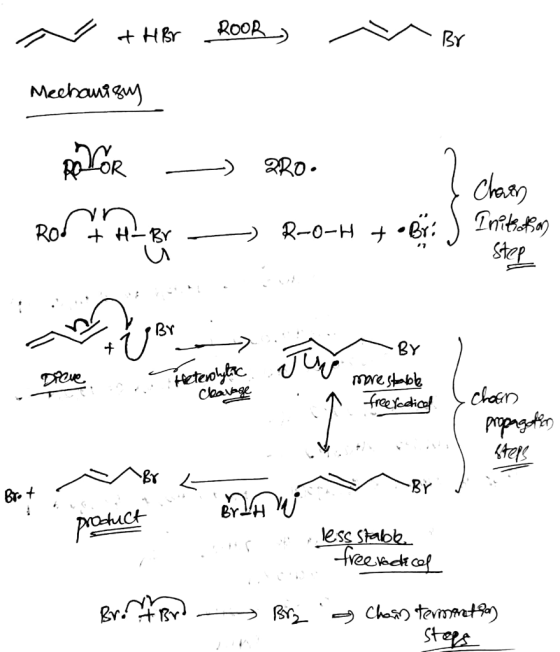
The addition of HBr to 1,3-butadiene in the presence of a catalytic amount of peroxides gives the expected product from anti-Markovnikov addition of HBr to one of the double bonds (BrCH2CH2CH CHa) and another product as shown below.

Propose mechanism that explains how this product could be formed via a free radical mechanism. (Note: An ionic mechanism for the addition of HBr is also a possible explanation for the formation of the product. This is not what I am looking for here. Propose a free radical chain mechanism.)
Homework Answers
the free radical mechanism involves the chain initiation
, propagation and the termination steps and the mechanism is as
follows for the formation of product
Add Answer to:
The addition of HBr to 1,3-butadiene in the presence of a catalytic amount of peroxides
Question 6 Free-radical addition of HBr/peroxides to an alkene goes through A) a carbocation intermediate that...
 Question 6 Free-radical addition of HBr/peroxides to an alkene goes through A) a carbocation intermediate that is formed on the more substituted carbon B) a carbocation intermediate that is formed on the least substituted carbon C) a radical intermediate that is formed on the least substituted carbon. D) a radical intermediate that is formed on the most substituted carbon.
Question 6 Free-radical addition of HBr/peroxides to an alkene goes through A) a carbocation intermediate that is formed on the more...
Question 6 Free-radical addition of HBr/peroxides to an alkene goes through A) a carbocation intermediate that is formed on the more substituted carbon B) a carbocation intermediate that is formed on the least substituted carbon C) a radical intermediate that is formed on the least substituted carbon. D) a radical intermediate that is formed on the most substituted carbon.
Question 6 Free-radical addition of HBr/peroxides to an alkene goes through A) a carbocation intermediate that is formed on the more...
1,3-Butadiene undergoes an electrophilic addition with HBr. Complete the steps in the mechanism to produce the...
 1,3-Butadiene undergoes an electrophilic addition with HBr.
Complete the steps in the mechanism to produce the product
shown1) Add curved arrows for the first step. 2) Draw both the organic and inorganic intermediate species. Include all nonbonding electrons and charges. Draw a curved arrow to convert the intermediate into the product shown.
1,3-Butadiene undergoes an electrophilic addition with HBr.
Complete the steps in the mechanism to produce the product
shown1) Add curved arrows for the first step. 2) Draw both the organic and inorganic intermediate species. Include all nonbonding electrons and charges. Draw a curved arrow to convert the intermediate into the product shown.
13. When HBr is added to a simple alkene containing peroxides, the regiochemistry obtained is in...
 13. When HBr is added to a simple alkene containing peroxides, the regiochemistry obtained is in a polar solvent. dded to a simple alkene in the presence of an ether solvent regiochemistry obtained is the reverse of that obtained a. Explain what is meant by an ether solvent (2 pts) b. Write the general formula for a peroxide. (2 pts) c. Explain what is meant by regiochemistry. (2 pts) d. When we say that a solvent is polar what do...
please help me by answeing part 2. please include mechanism. Electrophilic addition of HBr to 3-methylbut-1-ene gi...
 please help me by answeing part 2. please include mechanism.
Electrophilic addition of HBr to 3-methylbut-1-ene gives a mixture of two constitutional isomers. Only one of the isomers, however, is formed when the 2 methylbut 2 ene reacts with HBr in the presence of peroxides. Draw each of the isomers. Part 1: Draw the isomer that is formed in both reactions Br view structure Part 2 out of 2 Draw the isomer formed only in electrophilic addition reaction. edit structure......
please help me by answeing part 2. please include mechanism.
Electrophilic addition of HBr to 3-methylbut-1-ene gives a mixture of two constitutional isomers. Only one of the isomers, however, is formed when the 2 methylbut 2 ene reacts with HBr in the presence of peroxides. Draw each of the isomers. Part 1: Draw the isomer that is formed in both reactions Br view structure Part 2 out of 2 Draw the isomer formed only in electrophilic addition reaction. edit structure......
Specifically explain the differences between the addition of HBr to 1-methylcyclohexene by the ionic mechanism and...
 Specifically explain the differences between the addition of HBr to 1-methylcyclohexene by the ionic mechanism and by the free-radical mechanism. Differences should include: Reactants Mechanism (When writing a mechanism, be sure to write out complete structures.) Product (may be abbreviated with alien-angle drawing ii you wish.
1.1What is the major product formed upon radical bromination of (S)-3-methylhexane? Select the best response. Draw...
1.1What is the major product formed upon radical bromination of (S)-3-methylhexane? Select the best response. Draw the full mechanism. A. (S)-3-bromo-3-methylhexane B. (R)-3-bromo-3-methylhexane C. A mixture of (R) and (S) 3-Bromo-3-methylhexane D. (3R)-1-bromo-3-methylhexane 1.2 What is the major product obtained from the reaction of 2-methyl-2-butene with hydrogen bromide in the presence of peroxides?Select the best response. Draw the mechanism. A. 2,3-dibromo-2-methylbutane B. 2-bromo-3-methylbutane C. 2-bromo-2-methylbutane D. (E)-1-bromo-2-methyl-2-butene 1.3 There are 4 major products formed upon treatment of (E)-3-methyl-2-hexene with HBr...
1. Specifically explain the differences between the addition of HBr to propene by the ionic mechanism...
 1. Specifically explain the differences between the addition of HBr to propene by the ionic mechanism and by the free-radical mechanism. Differences should include: (a) Reactants (when writing a mechanism be sure to write out (b) Mechanisms complete structures.) (c) Product (may be abbreviated with a line-angle drawing if you wish) differences
Acid Catalyzed Hydration-treatment of alkenes with water in the presence of acid catalyst leads to the...
 Acid Catalyzed Hydration-treatment of alkenes with water in the presence of acid catalyst leads to the formation of alcohols. H2SO4/H2O > 150°C Mechanism Major Product Acid catalyzed dehydration goes through a carbocation intermediate. This means that the Markovnikov product is obtained when carbocation rearrangements do not occur. The need for excessively high temperatures makes this reaction of limited use in laboratory synthesis. Oxymercuration - Oxymercuration involves the addition of Hg to the alkene using mercury (II) acetate Hg(OAc) followed by...
What is Wrong? Select the keyword or phrase that will best complete each sentence. Key terms: A radical...
 What is Wrong?
Select the keyword or phrase that will best complete each sentence. Key terms: A radical is a reactive intermediate with a single unpaired electron, formed by homoloysis of a covalent bond. paired unpaired Allylic radicals are stabilized by resonance, making them more stable than tertiary radicals increases inductive effects A compound that contains an especially weak bond that serves as a source of radicals is called a radical initiator ess homoloysis decreases more J Treatment of cyclohexene...
What is Wrong?
Select the keyword or phrase that will best complete each sentence. Key terms: A radical is a reactive intermediate with a single unpaired electron, formed by homoloysis of a covalent bond. paired unpaired Allylic radicals are stabilized by resonance, making them more stable than tertiary radicals increases inductive effects A compound that contains an especially weak bond that serves as a source of radicals is called a radical initiator ess homoloysis decreases more J Treatment of cyclohexene...
I need help on all of these! Please help with d-h, if possible! d. The reaction...
 I need help on all of these! Please help with d-h, if
possible!
d. The reaction of (2R)-butanol with NaBr and sulfuric acid in acetone proceeds with inversion of configuration. e. The addition reaction of HBr to 1-butene in the presence of peroxides produces the anti- Markovnikov product. (Might not be a review question, might make an appearance in early 3060.) The reaction of 2-methyl-2-butanol with HCl produces as a major product an alkyl halide. An ether and an alkene...
I need help on all of these! Please help with d-h, if
possible!
d. The reaction of (2R)-butanol with NaBr and sulfuric acid in acetone proceeds with inversion of configuration. e. The addition reaction of HBr to 1-butene in the presence of peroxides produces the anti- Markovnikov product. (Might not be a review question, might make an appearance in early 3060.) The reaction of 2-methyl-2-butanol with HCl produces as a major product an alkyl halide. An ether and an alkene...
 Question 6 Free-radical addition of HBr/peroxides to an alkene goes through A) a carbocation intermediate that is formed on the more substituted carbon B) a carbocation intermediate that is formed on the least substituted carbon C) a radical intermediate that is formed on the least substituted carbon. D) a radical intermediate that is formed on the most substituted carbon.
Question 6 Free-radical addition of HBr/peroxides to an alkene goes through A) a carbocation intermediate that is formed on the more...
Question 6 Free-radical addition of HBr/peroxides to an alkene goes through A) a carbocation intermediate that is formed on the more substituted carbon B) a carbocation intermediate that is formed on the least substituted carbon C) a radical intermediate that is formed on the least substituted carbon. D) a radical intermediate that is formed on the most substituted carbon.
Question 6 Free-radical addition of HBr/peroxides to an alkene goes through A) a carbocation intermediate that is formed on the more...
 13. When HBr is added to a simple alkene containing peroxides, the regiochemistry obtained is in a polar solvent. dded to a simple alkene in the presence of an ether solvent regiochemistry obtained is the reverse of that obtained a. Explain what is meant by an ether solvent (2 pts) b. Write the general formula for a peroxide. (2 pts) c. Explain what is meant by regiochemistry. (2 pts) d. When we say that a solvent is polar what do...
 please help me by answeing part 2. please include mechanism.
Electrophilic addition of HBr to 3-methylbut-1-ene gives a mixture of two constitutional isomers. Only one of the isomers, however, is formed when the 2 methylbut 2 ene reacts with HBr in the presence of peroxides. Draw each of the isomers. Part 1: Draw the isomer that is formed in both reactions Br view structure Part 2 out of 2 Draw the isomer formed only in electrophilic addition reaction. edit structure......
please help me by answeing part 2. please include mechanism.
Electrophilic addition of HBr to 3-methylbut-1-ene gives a mixture of two constitutional isomers. Only one of the isomers, however, is formed when the 2 methylbut 2 ene reacts with HBr in the presence of peroxides. Draw each of the isomers. Part 1: Draw the isomer that is formed in both reactions Br view structure Part 2 out of 2 Draw the isomer formed only in electrophilic addition reaction. edit structure......
 Specifically explain the differences between the addition of HBr to 1-methylcyclohexene by the ionic mechanism and by the free-radical mechanism. Differences should include: Reactants Mechanism (When writing a mechanism, be sure to write out complete structures.) Product (may be abbreviated with alien-angle drawing ii you wish.
 1. Specifically explain the differences between the addition of HBr to propene by the ionic mechanism and by the free-radical mechanism. Differences should include: (a) Reactants (when writing a mechanism be sure to write out (b) Mechanisms complete structures.) (c) Product (may be abbreviated with a line-angle drawing if you wish) differences
 Acid Catalyzed Hydration-treatment of alkenes with water in the presence of acid catalyst leads to the formation of alcohols. H2SO4/H2O > 150°C Mechanism Major Product Acid catalyzed dehydration goes through a carbocation intermediate. This means that the Markovnikov product is obtained when carbocation rearrangements do not occur. The need for excessively high temperatures makes this reaction of limited use in laboratory synthesis. Oxymercuration - Oxymercuration involves the addition of Hg to the alkene using mercury (II) acetate Hg(OAc) followed by...
 What is Wrong?
Select the keyword or phrase that will best complete each sentence. Key terms: A radical is a reactive intermediate with a single unpaired electron, formed by homoloysis of a covalent bond. paired unpaired Allylic radicals are stabilized by resonance, making them more stable than tertiary radicals increases inductive effects A compound that contains an especially weak bond that serves as a source of radicals is called a radical initiator ess homoloysis decreases more J Treatment of cyclohexene...
What is Wrong?
Select the keyword or phrase that will best complete each sentence. Key terms: A radical is a reactive intermediate with a single unpaired electron, formed by homoloysis of a covalent bond. paired unpaired Allylic radicals are stabilized by resonance, making them more stable than tertiary radicals increases inductive effects A compound that contains an especially weak bond that serves as a source of radicals is called a radical initiator ess homoloysis decreases more J Treatment of cyclohexene...
 I need help on all of these! Please help with d-h, if
possible!
d. The reaction of (2R)-butanol with NaBr and sulfuric acid in acetone proceeds with inversion of configuration. e. The addition reaction of HBr to 1-butene in the presence of peroxides produces the anti- Markovnikov product. (Might not be a review question, might make an appearance in early 3060.) The reaction of 2-methyl-2-butanol with HCl produces as a major product an alkyl halide. An ether and an alkene...
I need help on all of these! Please help with d-h, if
possible!
d. The reaction of (2R)-butanol with NaBr and sulfuric acid in acetone proceeds with inversion of configuration. e. The addition reaction of HBr to 1-butene in the presence of peroxides produces the anti- Markovnikov product. (Might not be a review question, might make an appearance in early 3060.) The reaction of 2-methyl-2-butanol with HCl produces as a major product an alkyl halide. An ether and an alkene...
Most questions answered within 3 hours.
-
Where is the error in this code sequence?
String s1 = "Hello";
String s2 = "ello";...
asked 11 months ago -
Financial data for Joel de Paris, Inc., for last year
follow:
Joel de Paris, Inc.
Balance...
asked 11 months ago -
Consider this reaction:
Al2(SO4)3 (aq)+ BaCl3
(aq) Al2Cl6 (aq)- +
3BaSO4(s) . What is the...
asked 11 months ago -
Suppose that Savneet is considering increasing her
recent random sample from 20 car rentals to 40...
asked 11 months ago -
Trucks arrive at an unloading terminal at an average rate of 120
per hour.
Trucks arrive...
asked 11 months ago -
Why are methanol and ethanol completely soluble in water while
octanol is not very little soluble....
asked 11 months ago -
A facilities manager at a university reads in a research report
that the mean amount of...
asked 11 months ago -
When the CuSO4 is rehydrated by adding water to the anhydrous
compound, is this an endothermic...
asked 11 months ago -
A ray of sunlight is passing from diamond into crown glass; the
angle of incidence is...
asked 11 months ago -
A block of mass 0.249 kg is placed on top of a light, vertical
spring of...
asked 11 months ago -
how do the kidneys compensate in the presences of acidosis
a) trigger hyperventilate
b) reserve acid...
asked 11 months ago -
Question 501 pts
The rental rate of capital to the firm increases. Which of the
following...
asked 11 months ago