
Homework Answers
Add Answer to:
5. (100 points) A very thin plastic rod of length L is rubbed with cloth and...
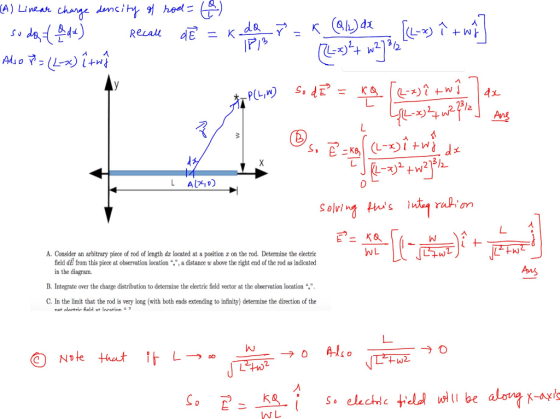
A very thin plastic rod of length L is rubbed with cloth and becomes uniformly charged with a total positive charge Q.
 A very thin plastic rod of length L is rubbed with cloth and
becomes uniformly charged with a total positive charge Q. In this
problem you will be asked to calculate the electric field a distance
d from the top of the rod and on axis with the rod at observation
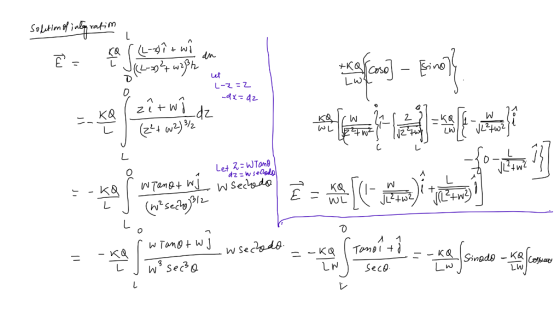
location “∗” as indicated in the diagram.C. Integrate over the charge distribution to determine the
electric field vector at the observation location. Your answer
should only contain the given...
A very thin plastic rod of length L is rubbed with cloth and
becomes uniformly charged with a total positive charge Q. In this
problem you will be asked to calculate the electric field a distance
d from the top of the rod and on axis with the rod at observation
location “∗” as indicated in the diagram.C. Integrate over the charge distribution to determine the
electric field vector at the observation location. Your answer
should only contain the given...
A thin plastic rod of length 2.8 m is rubbed all over with wool, and acquires...
A thin plastic rod of length 2.8 m is rubbed all over with wool, and acquires a charge of 54 nC, distributed uniformly over its surface. Calculate the magnitude of the electric field due to the rod at a location 13 cm from the midpoint of the rod. Do the calculation two ways, first using the exact formula for a rod of any length, and second using the approximate formula for a long rod. (a) exact formula E = N/C (b)...
A thin plastic rod of length 2.7 m is rubbed all over with wool, and acquires...
 A thin plastic rod of length 2.7 m is rubbed all over with wool, and acquires a charge of 72 nC, distributed uniformly over its surface. Calculate the magnitude of the electric field due to the rod at a location 12 cm from the midpoint of the rod. Do the calculation two ways, first using the exact formula for a rod of any length, and second using the approximate formula for a long rod. (a) exact formula E _ |17378.31...
A very thin plastic rod is bent into a nearly complete circle with a radius of...
 A very thin plastic rod is bent into a nearly complete circle with a radius of R-5 cm. There is a gap between the ends of width D 2 cm. A positive charge of Q-1 nC is uniformly spread over the length of the rod. What is the magnitude and direction of the electric field at the center of the circle?
2 Charged Loop A very thin plastic rod is bent into a nearly complete circle with...
 2 Charged Loop A very thin plastic rod is bent into a nearly complete circle with a radius of R-5 cm. There is a gap between the ends of width D 2 cm. A positive charge of Q-1 nC is uniformly spread over the length of the rod. What is the magnitude and direction of the electric field at the center of the circle?
penu oT 2 Charged Loop A very thin plastic rod is bent into a nearly complete...
 penu oT 2 Charged Loop A very thin plastic rod is bent into a nearly complete circle with a radius of R-5 cm. There is a gap between the ends of width D- 2 cm. A positive charge of Q 1 nC is uniformly spread over the length of the rod. What is the magnitude and direction of the electric field at the center of the circle?
A thin rod lies on the x-asix with one end at -A and the other end...
 A thin rod lies on the x-asix with one end at -A and the other
end at A, as shown in the diagram. A charge of -Q is spread
uniformly over the surface of the rod. We want to set up an
integral to find the electric field at location <0, y, 0> due
to the rod. Following the procedure discussed in the textbook, we
have cut up the rod into small segments, each of which can be
considered as...
A thin rod lies on the x-asix with one end at -A and the other
end at A, as shown in the diagram. A charge of -Q is spread
uniformly over the surface of the rod. We want to set up an
integral to find the electric field at location <0, y, 0> due
to the rod. Following the procedure discussed in the textbook, we
have cut up the rod into small segments, each of which can be
considered as...
A uniformly charged rod of length L=1.6 m lies along the x-axis with its right end at the origin. The rod has a total charge of Q = 2.6 uC.
 A uniformly charged rod of length L=1.6 m lies along the x-axis with its right end at the origin. The rod has a total charge of Q = 2.6 uC. A point P is located on the x-axis a distance a = 1.2 m to the right of the origin.Part (a) Consider a thin slice of the rod of thickness dr located a distance x away from the origin, what is the direction of the electric field t point P due...
A very thin uniformly charged plastic rod with total charge radius r and placed in the...
 A very thin uniformly charged plastic rod with total charge
radius r and placed in the second quadrant, with its center at the
origin. An identical rod (except with charge + Q) continues the
circle as shown in the figure, to form a half circle centered at
the origin. Find the electric field vector E at the origin, writing
it in component form.
Can anyone answer this question? Will give thump up :)
3) A very thin uniformly charged plastic...
A very thin uniformly charged plastic rod with total charge
radius r and placed in the second quadrant, with its center at the
origin. An identical rod (except with charge + Q) continues the
circle as shown in the figure, to form a half circle centered at
the origin. Find the electric field vector E at the origin, writing
it in component form.
Can anyone answer this question? Will give thump up :)
3) A very thin uniformly charged plastic...
Electric charge is distributed uniformly along a thin rod of length a, with total charge Q. Take the potential to be zero at infinity.
 Electric charge is distributed uniformly along a thin rod of
length a, with total charge Q. Take the potential to be zero at
infinity.a. Find the electric field E at point P, a distance x to the
right of the rodb. Find the electric field E at point R, a distance y above of
the rodc. In parts (a) and (b), what does your result reduce to as x or
y becomes much larger than a?
Electric charge is distributed uniformly along a thin rod of
length a, with total charge Q. Take the potential to be zero at
infinity.a. Find the electric field E at point P, a distance x to the
right of the rodb. Find the electric field E at point R, a distance y above of
the rodc. In parts (a) and (b), what does your result reduce to as x or
y becomes much larger than a?
 A very thin plastic rod of length L is rubbed with cloth and
becomes uniformly charged with a total positive charge Q. In this
problem you will be asked to calculate the electric field a distance
d from the top of the rod and on axis with the rod at observation
location “∗” as indicated in the diagram.C. Integrate over the charge distribution to determine the
electric field vector at the observation location. Your answer
should only contain the given...
A very thin plastic rod of length L is rubbed with cloth and
becomes uniformly charged with a total positive charge Q. In this
problem you will be asked to calculate the electric field a distance
d from the top of the rod and on axis with the rod at observation
location “∗” as indicated in the diagram.C. Integrate over the charge distribution to determine the
electric field vector at the observation location. Your answer
should only contain the given...
 A thin plastic rod of length 2.7 m is rubbed all over with wool, and acquires a charge of 72 nC, distributed uniformly over its surface. Calculate the magnitude of the electric field due to the rod at a location 12 cm from the midpoint of the rod. Do the calculation two ways, first using the exact formula for a rod of any length, and second using the approximate formula for a long rod. (a) exact formula E _ |17378.31...
 A very thin plastic rod is bent into a nearly complete circle with a radius of R-5 cm. There is a gap between the ends of width D 2 cm. A positive charge of Q-1 nC is uniformly spread over the length of the rod. What is the magnitude and direction of the electric field at the center of the circle?
 2 Charged Loop A very thin plastic rod is bent into a nearly complete circle with a radius of R-5 cm. There is a gap between the ends of width D 2 cm. A positive charge of Q-1 nC is uniformly spread over the length of the rod. What is the magnitude and direction of the electric field at the center of the circle?
 penu oT 2 Charged Loop A very thin plastic rod is bent into a nearly complete circle with a radius of R-5 cm. There is a gap between the ends of width D- 2 cm. A positive charge of Q 1 nC is uniformly spread over the length of the rod. What is the magnitude and direction of the electric field at the center of the circle?
 A thin rod lies on the x-asix with one end at -A and the other
end at A, as shown in the diagram. A charge of -Q is spread
uniformly over the surface of the rod. We want to set up an
integral to find the electric field at location <0, y, 0> due
to the rod. Following the procedure discussed in the textbook, we
have cut up the rod into small segments, each of which can be
considered as...
A thin rod lies on the x-asix with one end at -A and the other
end at A, as shown in the diagram. A charge of -Q is spread
uniformly over the surface of the rod. We want to set up an
integral to find the electric field at location <0, y, 0> due
to the rod. Following the procedure discussed in the textbook, we
have cut up the rod into small segments, each of which can be
considered as...
 A very thin uniformly charged plastic rod with total charge
radius r and placed in the second quadrant, with its center at the
origin. An identical rod (except with charge + Q) continues the
circle as shown in the figure, to form a half circle centered at
the origin. Find the electric field vector E at the origin, writing
it in component form.
Can anyone answer this question? Will give thump up :)
3) A very thin uniformly charged plastic...
A very thin uniformly charged plastic rod with total charge
radius r and placed in the second quadrant, with its center at the
origin. An identical rod (except with charge + Q) continues the
circle as shown in the figure, to form a half circle centered at
the origin. Find the electric field vector E at the origin, writing
it in component form.
Can anyone answer this question? Will give thump up :)
3) A very thin uniformly charged plastic...
Most questions answered within 3 hours.
-
Where is the error in this code sequence?
String s1 = "Hello";
String s2 = "ello";...
asked 11 months ago -
Financial data for Joel de Paris, Inc., for last year
follow:
Joel de Paris, Inc.
Balance...
asked 11 months ago -
Consider this reaction:
Al2(SO4)3 (aq)+ BaCl3
(aq) Al2Cl6 (aq)- +
3BaSO4(s) . What is the...
asked 11 months ago -
Suppose that Savneet is considering increasing her
recent random sample from 20 car rentals to 40...
asked 11 months ago -
Trucks arrive at an unloading terminal at an average rate of 120
per hour.
Trucks arrive...
asked 11 months ago -
Why are methanol and ethanol completely soluble in water while
octanol is not very little soluble....
asked 11 months ago -
A facilities manager at a university reads in a research report
that the mean amount of...
asked 11 months ago -
When the CuSO4 is rehydrated by adding water to the anhydrous
compound, is this an endothermic...
asked 11 months ago -
A ray of sunlight is passing from diamond into crown glass; the
angle of incidence is...
asked 11 months ago -
A block of mass 0.249 kg is placed on top of a light, vertical
spring of...
asked 11 months ago -
how do the kidneys compensate in the presences of acidosis
a) trigger hyperventilate
b) reserve acid...
asked 11 months ago -
Question 501 pts
The rental rate of capital to the firm increases. Which of the
following...
asked 11 months ago