I know how to do A but not sure how to do B, C and D.
Thank you so much!
Homework Answers
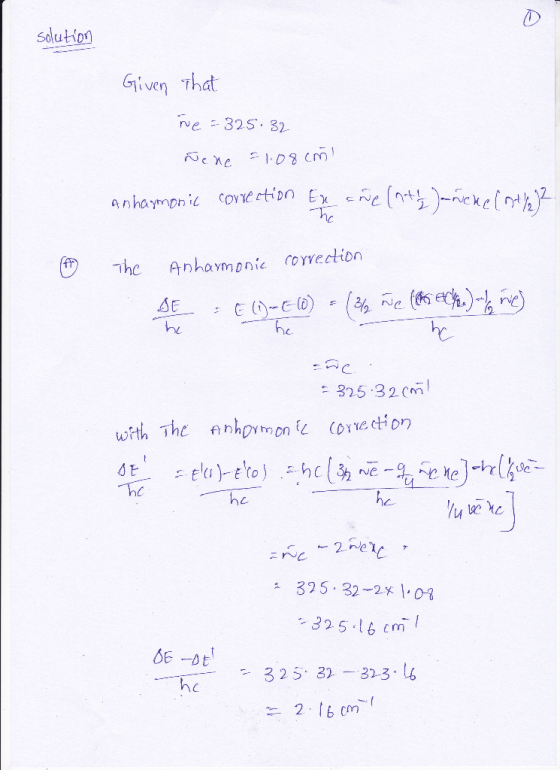
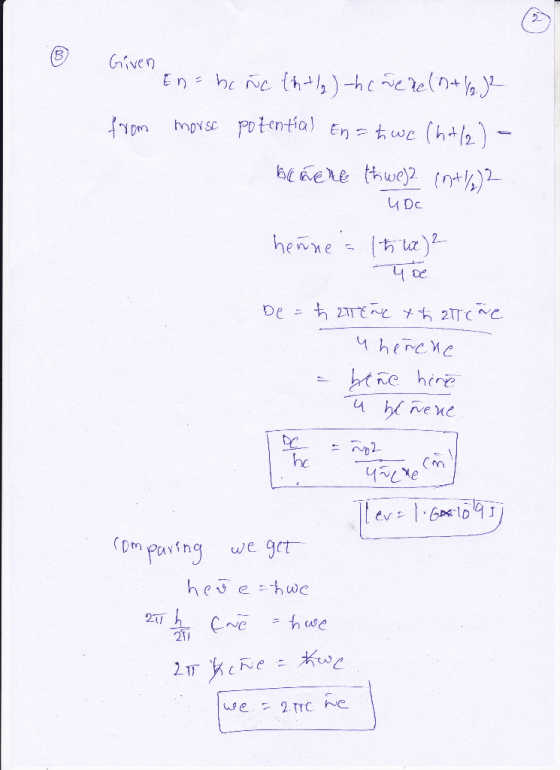
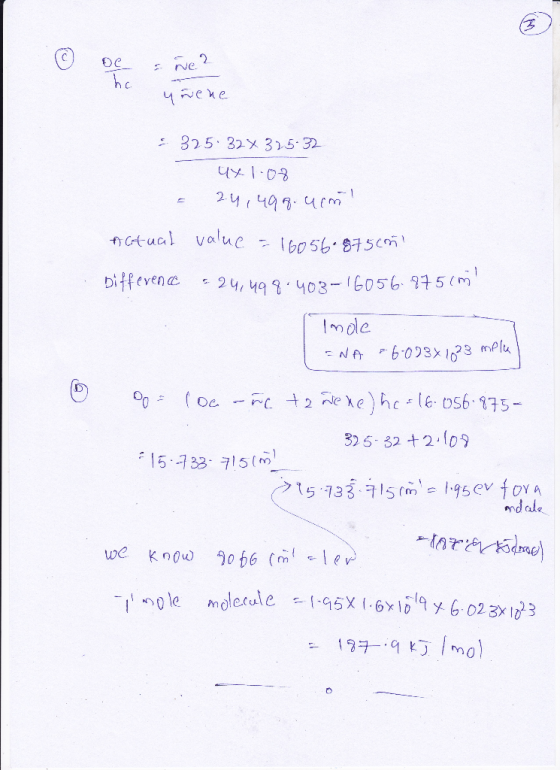
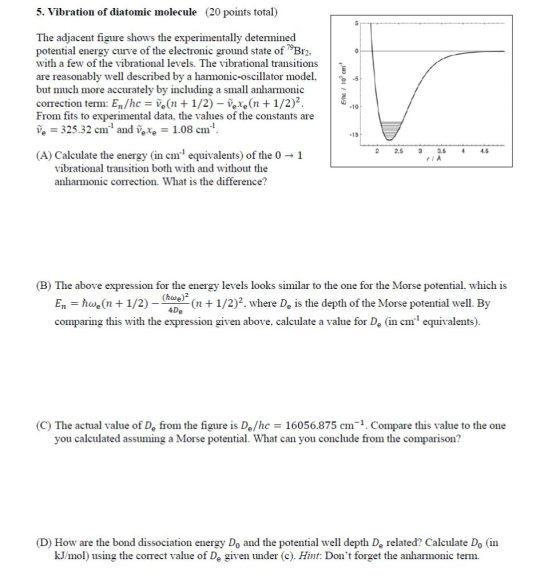
4. Anharmonic potential (15 points) The adjacent figure shows the experimentally determined potential energy curve of the electronic ground state of"Br2, with a few of the vibrational levels. The...
 4. Anharmonic potential (15 points) The adjacent figure shows the experimentally determined potential energy curve of the electronic ground state of"Br2, with a few of the vibrational levels. The vibrational transitions are reasonably well described by a harmonic oscillator model, but much more accurately by including a small anharmonic correction term: En/hcVe(n 1/2) - vexe(n + 1/2)2. From fits to experimental data, the values of the constants are 325.32 cm and exe 1.08 cm .5 10 15 (a) Calculate the...
Don’t have to give exact answer, I just need to know one n equals in terms...
 Don’t have to give exact answer, I just need to know one n
equals in terms of variables
d. The solution of the Schrödinger equation for the Morse potential yields the following expression for the vibrational energy levels (in units of cm 1) of a diatomic molecule: where n is the vibrational quantum number, V is the fundamental vibrational frequency (in cm1) that you calculated in part a), and is the anharmonicity constant given by: En n1/2) 1/2)2 = hc9/4D....
Don’t have to give exact answer, I just need to know one n
equals in terms of variables
d. The solution of the Schrödinger equation for the Morse potential yields the following expression for the vibrational energy levels (in units of cm 1) of a diatomic molecule: where n is the vibrational quantum number, V is the fundamental vibrational frequency (in cm1) that you calculated in part a), and is the anharmonicity constant given by: En n1/2) 1/2)2 = hc9/4D....
1. Anharmonic oscillator. Hydrogen bromide, 'HiBr, vibrates approximately according to a Morse potential VM(r) = Dell-e-w2De)1/2 (r-rej2 with De= 4.8 10 eV, re= 1.4 1 44Ă, and k= 408.4 N m-1. Wit...
 1. Anharmonic oscillator. Hydrogen bromide, 'HiBr, vibrates approximately according to a Morse potential VM(r) = Dell-e-w2De)1/2 (r-rej2 with De= 4.8 10 eV, re= 1.4 1 44Ă, and k= 408.4 N m-1. With ω,-VRA, the energies of the stationary states in a Morse potential are En (hwo) 4D ho(n+ 1/2)- (n + 1/2)2. (A) On the same graph, plot the Morse potential and the harmonic potential as a function of bond length (from 0.7 Te to 2 re).(B) Describe the differences....
Anharmonic oscillator. Hydrogen bromide, H8Br, vibrates approximately according to a Morse potential VM(r) = Dell-e-ck/2De)i/2(r-re) , with De= 4.810 eV, = 1.4144 A, and k= 408.4 N m-1. With a0-Vk/a,...
 Anharmonic oscillator. Hydrogen bromide, H8Br, vibrates approximately according to a Morse potential VM(r) = Dell-e-ck/2De)i/2(r-re) , with De= 4.810 eV, = 1.4144 A, and k= 408.4 N m-1. With a0-Vk/a, the energies of the stationary states in a Morse potential are En (n + 1/2)2. (A) On the same graph, plot the Morse potential and the harmonic potential as a function of bond length (from 0.7 to 2 %). Use the software of your choice to generate this plot. (B)...
4&5 only thnkyouu :) 3. The force constant for 119F molecule is 966 N/m. a) Calculate...
 4&5 only
thnkyouu :)
3. The force constant for 119F molecule is 966 N/m. a) Calculate the zero-point vibrational energy using a harmonic oscillator potential. b) Calculate the frequency of light needed to excite this molecule from the ground state to the first excited state. 4. Is 41(x) = *xe 2 an eigenfunction for the kinetic energy operator? Is it an eigenfunction for potential energy operator? 5. HCI molecule can be described by the Morse potential with De = 7.41...
4&5 only
thnkyouu :)
3. The force constant for 119F molecule is 966 N/m. a) Calculate the zero-point vibrational energy using a harmonic oscillator potential. b) Calculate the frequency of light needed to excite this molecule from the ground state to the first excited state. 4. Is 41(x) = *xe 2 an eigenfunction for the kinetic energy operator? Is it an eigenfunction for potential energy operator? 5. HCI molecule can be described by the Morse potential with De = 7.41...
Draw a typical Morse potential energy surface for a diatomic molecule. Label the following i) The...
 Draw a typical Morse potential energy surface for a diatomic molecule. Label the following i) The vertical and horizontal axes ii The equilibrium bond length. iii) The v=0, 1, 2 vibrational iv) The dissociation energy (Do) from the v-0 vibrational level 1 levels.
3. Anharmonicity (6 marks] Consider the three-dimensional isotropic harmonic oscillator 2 1 242 р...
 3. Anharmonicity (6 marks] Consider the three-dimensional isotropic harmonic oscillator 2 1 242 рґ which has energy eigenvalues En-hu(n+3/2), where n- 0,1,2.. (a) Calculate the first-order shift in the ground-state energy of the harmonic oscillator due to the addition of an anharmonic term C24 to the potential, where C> 0. (b) Calculate instead the first-order shifts in the energies of the n - 1 ercited states due to the addition of the anharmonic term C (c) For the lowest energy...
Please answer a,b and c. Now, consider a 1-d infinite square well of width a, between...
 Please answer a,b and c.
Now, consider a 1-d infinite square well of width a, between x = 0 and a, such that V(x) = 0 for 0<x<a and too elsewhere. A perturbation is then added to it so that V(x) = V. for 0 <x <a/2, and the same as before elsewhere. In other words, a flat bump of width a/2 and height V. in the left half of the well. (a) (5 pts) Carefully sketch the potential and...
Please answer a,b and c.
Now, consider a 1-d infinite square well of width a, between x = 0 and a, such that V(x) = 0 for 0<x<a and too elsewhere. A perturbation is then added to it so that V(x) = V. for 0 <x <a/2, and the same as before elsewhere. In other words, a flat bump of width a/2 and height V. in the left half of the well. (a) (5 pts) Carefully sketch the potential and...
5. (10 points) A simple function that looks like the potential well of a diatomic molecule...
 5. (10 points) A simple function that looks like the potential well of a diatomic molecule is the Morse potential given by: U(x) = D. (1-e-Bx) (1) where, x is the displacement of the bond from its equilibrium position, and D. is the value of U(x) at large separations. D. is called the classical dissociation energy and is characterized by the depth of the potential well. We can expand U(x) in a Taylor series about x = 0 to obtain...
(b) For a system of N independent harmonic oscillators at temperature T, all having a common...
 (b) For a system of N independent harmonic oscillators at temperature T, all having a common vibrational unit of energy, the partition function is Z = ZN. For large values of N, the system's internal energy is given by U = Ne %3D eBe For large N, calculate the system's heat capacity C. 3. This problem involves a collection of N independent harmonic oscillators, all having a common angular frequency w (such as in an Einstein solid or in the...
 4. Anharmonic potential (15 points) The adjacent figure shows the experimentally determined potential energy curve of the electronic ground state of"Br2, with a few of the vibrational levels. The vibrational transitions are reasonably well described by a harmonic oscillator model, but much more accurately by including a small anharmonic correction term: En/hcVe(n 1/2) - vexe(n + 1/2)2. From fits to experimental data, the values of the constants are 325.32 cm and exe 1.08 cm .5 10 15 (a) Calculate the...
 Don’t have to give exact answer, I just need to know one n
equals in terms of variables
d. The solution of the Schrödinger equation for the Morse potential yields the following expression for the vibrational energy levels (in units of cm 1) of a diatomic molecule: where n is the vibrational quantum number, V is the fundamental vibrational frequency (in cm1) that you calculated in part a), and is the anharmonicity constant given by: En n1/2) 1/2)2 = hc9/4D....
Don’t have to give exact answer, I just need to know one n
equals in terms of variables
d. The solution of the Schrödinger equation for the Morse potential yields the following expression for the vibrational energy levels (in units of cm 1) of a diatomic molecule: where n is the vibrational quantum number, V is the fundamental vibrational frequency (in cm1) that you calculated in part a), and is the anharmonicity constant given by: En n1/2) 1/2)2 = hc9/4D....
 1. Anharmonic oscillator. Hydrogen bromide, 'HiBr, vibrates approximately according to a Morse potential VM(r) = Dell-e-w2De)1/2 (r-rej2 with De= 4.8 10 eV, re= 1.4 1 44Ă, and k= 408.4 N m-1. With ω,-VRA, the energies of the stationary states in a Morse potential are En (hwo) 4D ho(n+ 1/2)- (n + 1/2)2. (A) On the same graph, plot the Morse potential and the harmonic potential as a function of bond length (from 0.7 Te to 2 re).(B) Describe the differences....
 Anharmonic oscillator. Hydrogen bromide, H8Br, vibrates approximately according to a Morse potential VM(r) = Dell-e-ck/2De)i/2(r-re) , with De= 4.810 eV, = 1.4144 A, and k= 408.4 N m-1. With a0-Vk/a, the energies of the stationary states in a Morse potential are En (n + 1/2)2. (A) On the same graph, plot the Morse potential and the harmonic potential as a function of bond length (from 0.7 to 2 %). Use the software of your choice to generate this plot. (B)...
 4&5 only
thnkyouu :)
3. The force constant for 119F molecule is 966 N/m. a) Calculate the zero-point vibrational energy using a harmonic oscillator potential. b) Calculate the frequency of light needed to excite this molecule from the ground state to the first excited state. 4. Is 41(x) = *xe 2 an eigenfunction for the kinetic energy operator? Is it an eigenfunction for potential energy operator? 5. HCI molecule can be described by the Morse potential with De = 7.41...
4&5 only
thnkyouu :)
3. The force constant for 119F molecule is 966 N/m. a) Calculate the zero-point vibrational energy using a harmonic oscillator potential. b) Calculate the frequency of light needed to excite this molecule from the ground state to the first excited state. 4. Is 41(x) = *xe 2 an eigenfunction for the kinetic energy operator? Is it an eigenfunction for potential energy operator? 5. HCI molecule can be described by the Morse potential with De = 7.41...
 Draw a typical Morse potential energy surface for a diatomic molecule. Label the following i) The vertical and horizontal axes ii The equilibrium bond length. iii) The v=0, 1, 2 vibrational iv) The dissociation energy (Do) from the v-0 vibrational level 1 levels.
 3. Anharmonicity (6 marks] Consider the three-dimensional isotropic harmonic oscillator 2 1 242 рґ which has energy eigenvalues En-hu(n+3/2), where n- 0,1,2.. (a) Calculate the first-order shift in the ground-state energy of the harmonic oscillator due to the addition of an anharmonic term C24 to the potential, where C> 0. (b) Calculate instead the first-order shifts in the energies of the n - 1 ercited states due to the addition of the anharmonic term C (c) For the lowest energy...
 Please answer a,b and c.
Now, consider a 1-d infinite square well of width a, between x = 0 and a, such that V(x) = 0 for 0<x<a and too elsewhere. A perturbation is then added to it so that V(x) = V. for 0 <x <a/2, and the same as before elsewhere. In other words, a flat bump of width a/2 and height V. in the left half of the well. (a) (5 pts) Carefully sketch the potential and...
Please answer a,b and c.
Now, consider a 1-d infinite square well of width a, between x = 0 and a, such that V(x) = 0 for 0<x<a and too elsewhere. A perturbation is then added to it so that V(x) = V. for 0 <x <a/2, and the same as before elsewhere. In other words, a flat bump of width a/2 and height V. in the left half of the well. (a) (5 pts) Carefully sketch the potential and...
 5. (10 points) A simple function that looks like the potential well of a diatomic molecule is the Morse potential given by: U(x) = D. (1-e-Bx) (1) where, x is the displacement of the bond from its equilibrium position, and D. is the value of U(x) at large separations. D. is called the classical dissociation energy and is characterized by the depth of the potential well. We can expand U(x) in a Taylor series about x = 0 to obtain...
 (b) For a system of N independent harmonic oscillators at temperature T, all having a common vibrational unit of energy, the partition function is Z = ZN. For large values of N, the system's internal energy is given by U = Ne %3D eBe For large N, calculate the system's heat capacity C. 3. This problem involves a collection of N independent harmonic oscillators, all having a common angular frequency w (such as in an Einstein solid or in the...
Most questions answered within 3 hours.
-
Where is the error in this code sequence?
String s1 = "Hello";
String s2 = "ello";...
asked 11 months ago -
Financial data for Joel de Paris, Inc., for last year
follow:
Joel de Paris, Inc.
Balance...
asked 11 months ago -
Consider this reaction:
Al2(SO4)3 (aq)+ BaCl3
(aq) Al2Cl6 (aq)- +
3BaSO4(s) . What is the...
asked 11 months ago -
Suppose that Savneet is considering increasing her
recent random sample from 20 car rentals to 40...
asked 11 months ago -
Trucks arrive at an unloading terminal at an average rate of 120
per hour.
Trucks arrive...
asked 11 months ago -
Why are methanol and ethanol completely soluble in water while
octanol is not very little soluble....
asked 11 months ago -
A facilities manager at a university reads in a research report
that the mean amount of...
asked 11 months ago -
When the CuSO4 is rehydrated by adding water to the anhydrous
compound, is this an endothermic...
asked 11 months ago -
A ray of sunlight is passing from diamond into crown glass; the
angle of incidence is...
asked 11 months ago -
A block of mass 0.249 kg is placed on top of a light, vertical
spring of...
asked 11 months ago -
how do the kidneys compensate in the presences of acidosis
a) trigger hyperventilate
b) reserve acid...
asked 11 months ago -
Question 501 pts
The rental rate of capital to the firm increases. Which of the
following...
asked 11 months ago