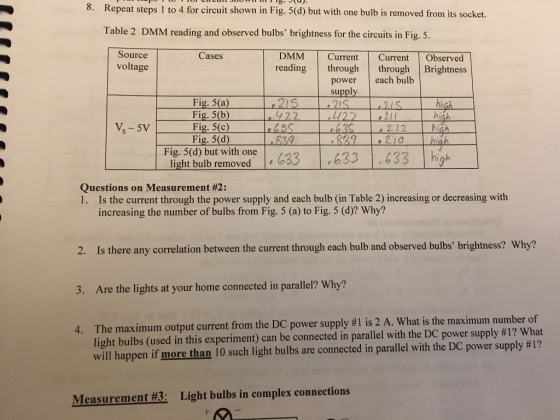
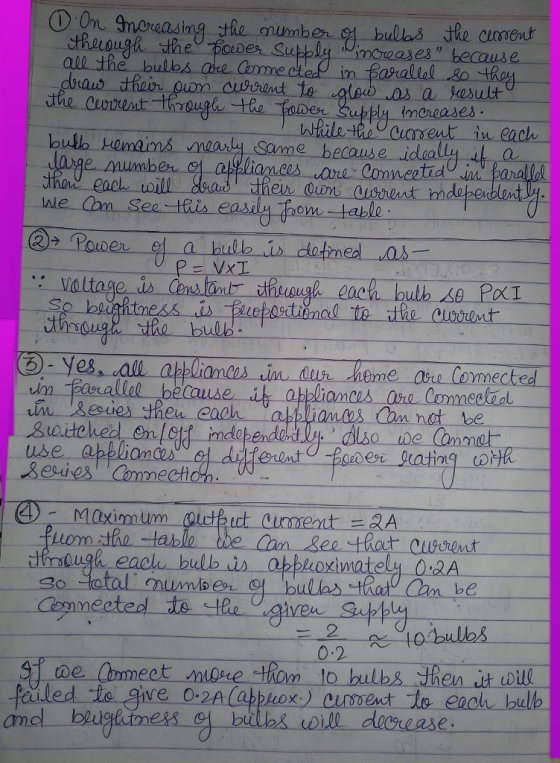
1. Is the current through the power supply and each bulb (in Table 2) increasing or decreasing with increasing the number of bulbs in Fig. 5 (a) to Fig. 5 (d)? Why
2. Is there any correlation between the current through each bulb and observed bulbs' brightness? Why?
3. Are the lights at your home connected in parallel? Why?
4. The maximum output current from the DC power supply #1 is 2 A. What is the maximum number of light bulbs (used in the experiment) that can be connected in parallel with the DC power supply #1? What will happen if more than 10 such light bulbs are connected in parallel with the DC power supply #1?

I need help answering these 4 post-lab questions. Any help would be very much appreciated.
Thank you
Homework Answers
Add Answer to:
1. Is the current through the power supply and each bulb (in Table 2) increasing or...
1. Find the resistance in ohms of a light bulb that produces 60 W of power...
1. Find the resistance in ohms of a light bulb that produces 60 W of power when connected to 120 V household current. (5 pts) 2. Indicate if the statements below are true or false: (a) AC currents are changing, and the voltage is constant (b) DC currents are constant, and the voltage is constant (c) The time dependence of AC current and voltage follows a “sin” wave with frequency 60 Hz (d) When several light bulbs are arranged in...
PART 1: Combination of series and parallel circuit: In this activity you will measure the currents...
 PART 1: Combination of series and parallel circuit: In this activity you will measure the currents and voltages in a circuit with li combination circuit. connected in The three light bulbs in your circuit board can be either connected in series, parallel or in two d combination circuits. If you do not remember the brightness of the light bulbs for the series an ee circuit connect the bulbs again for those basic arrangements. Next, wire the three light bulbs as...
Two light bulbs are connected in parallel, and then connected to a battery, as shown in...
 Two light bulbs are connected in parallel, and then connected to
a battery, as shown in Fig. 4.51(a). You observe that bulb 1 is
twice as bright as bulb 2. Assuming that the brightness of a bulb
is proportional to the power dissipated in the bulb’s resistor,
which bulb’s resistor is larger, and by what factor? The bulbs are
now connected in series ,as shown in Fig.4.51(b). Which bulb is
brighter, and by what factor? How bright is each bulb...
Two light bulbs are connected in parallel, and then connected to
a battery, as shown in Fig. 4.51(a). You observe that bulb 1 is
twice as bright as bulb 2. Assuming that the brightness of a bulb
is proportional to the power dissipated in the bulb’s resistor,
which bulb’s resistor is larger, and by what factor? The bulbs are
now connected in series ,as shown in Fig.4.51(b). Which bulb is
brighter, and by what factor? How bright is each bulb...
In this set of exercises (in the pre-lab AND lab), we will test/make the following assumptions:...
 In this set of exercises (in the pre-lab AND lab), we will test/make the following assumptions: A flow exists in a complete circuit from one terminal of the battery, through the rest of the circuit, back to the other terminal of the battery, through the battery and back around i. the circuit. We will call this flow electric current For identical bulbs, bulb brightness can be used as an indicator of the amount of current through that bulb: the brighter...
The battery is charged during the day to keep the bulb string lights shining at night. The solar ...
 In this tutorial you will analyse a solar powered Christmas tree. The tree has a solar panel at the top, a battery at the base, and bulb string lights around it. The bulb string lights are made from 4 parallel strings with 8 light bulbs in series each. Each light bulb has a nominal resistance of 8 2. The resistance of the wiring is negligible. The battery is charged during the day to keep the bulb string lights shining at...
Two light bulbs have resistances of 40 2 and 802. The two light bulbs are now...
 Two light bulbs have resistances of 40 2 and 802. The two light bulbs are now connected in parallel across the 12 V supply. Find the current through each bulb. Express your answer in amperes separated by a comma. VASO 140, 180 = A Submit Request Answer Part E The two light bulbs are connected in parallel across the 12 V supply. Find the power dissipated in each bulb. Express your answer in watts separated by a comma. LOAD ?...
A 12-volt battery is connected to two light bulbs, as drawn in Figure 1. Light bulb...
 A 12-volt battery is connected to two light bulbs, as drawn in
Figure 1. Light bulb 1 has resistance 3 ohms, while light bulb 2
has resistance 6 ohms. The battery has essentially no internal
resistance, and all the wires are essentially resistanceless,
too.
When a light bulb is unscrewed, no current flows through that
branch of the circuit. For instance, if light bulb 2 is unscrewed,
current flows only around the lower loop of the circuit, which
consists of...
A 12-volt battery is connected to two light bulbs, as drawn in
Figure 1. Light bulb 1 has resistance 3 ohms, while light bulb 2
has resistance 6 ohms. The battery has essentially no internal
resistance, and all the wires are essentially resistanceless,
too.
When a light bulb is unscrewed, no current flows through that
branch of the circuit. For instance, if light bulb 2 is unscrewed,
current flows only around the lower loop of the circuit, which
consists of...
1.A single light bulb is connected to a 12 V battery. The light bulb uses 55...
1.A single light bulb is connected to a 12 V battery. The light bulb uses 55 W of power (which is about what a car’s headlight uses). (a) What is the current flowing out of the high-voltage (+) end of the battery? (b) What is the current flowing into the low-voltage (-) end of the battery? (c) The battery has a sticker on it that says “This 12V battery contains 50 Amp-hours.” This indicates Amps × hours that the battery...
1. Does the resistance of the WHOLE circuit increase, decrease, or stay the same when additional...
1. Does the resistance of the WHOLE circuit increase, decrease, or stay the same when additional light bulbs are added in series? 2. Does the voltage across each individual light bulb increase, decrease, or stay the same when additional light bulbs are added in series? 3. Does the resistance of the whole circuit increase, decrease, or stay the same when additional light bulbs are added in parallel? 4. Does the voltage across each individual light bulb increase, decrease, or stay...
1. Does the resistance of the whole circuit increase, decrease, or stay the same when additional...
1. Does the resistance of the whole circuit increase, decrease, or stay the same when additional light bulbs are added in parallel? 2. Does the voltage across each individual light bulb increase, decrease, or stay the same when additional light bulbs are added in parallel? 3. Are light bulbs brighter when they're connected in series or in parallel? 4. Consider a whole circuit. When the power supply is set to 12V, does the power supply provide more current to the...
 PART 1: Combination of series and parallel circuit: In this activity you will measure the currents and voltages in a circuit with li combination circuit. connected in The three light bulbs in your circuit board can be either connected in series, parallel or in two d combination circuits. If you do not remember the brightness of the light bulbs for the series an ee circuit connect the bulbs again for those basic arrangements. Next, wire the three light bulbs as...
 Two light bulbs are connected in parallel, and then connected to
a battery, as shown in Fig. 4.51(a). You observe that bulb 1 is
twice as bright as bulb 2. Assuming that the brightness of a bulb
is proportional to the power dissipated in the bulb’s resistor,
which bulb’s resistor is larger, and by what factor? The bulbs are
now connected in series ,as shown in Fig.4.51(b). Which bulb is
brighter, and by what factor? How bright is each bulb...
Two light bulbs are connected in parallel, and then connected to
a battery, as shown in Fig. 4.51(a). You observe that bulb 1 is
twice as bright as bulb 2. Assuming that the brightness of a bulb
is proportional to the power dissipated in the bulb’s resistor,
which bulb’s resistor is larger, and by what factor? The bulbs are
now connected in series ,as shown in Fig.4.51(b). Which bulb is
brighter, and by what factor? How bright is each bulb...
 In this set of exercises (in the pre-lab AND lab), we will test/make the following assumptions: A flow exists in a complete circuit from one terminal of the battery, through the rest of the circuit, back to the other terminal of the battery, through the battery and back around i. the circuit. We will call this flow electric current For identical bulbs, bulb brightness can be used as an indicator of the amount of current through that bulb: the brighter...
 In this tutorial you will analyse a solar powered Christmas tree. The tree has a solar panel at the top, a battery at the base, and bulb string lights around it. The bulb string lights are made from 4 parallel strings with 8 light bulbs in series each. Each light bulb has a nominal resistance of 8 2. The resistance of the wiring is negligible. The battery is charged during the day to keep the bulb string lights shining at...
 Two light bulbs have resistances of 40 2 and 802. The two light bulbs are now connected in parallel across the 12 V supply. Find the current through each bulb. Express your answer in amperes separated by a comma. VASO 140, 180 = A Submit Request Answer Part E The two light bulbs are connected in parallel across the 12 V supply. Find the power dissipated in each bulb. Express your answer in watts separated by a comma. LOAD ?...
 A 12-volt battery is connected to two light bulbs, as drawn in
Figure 1. Light bulb 1 has resistance 3 ohms, while light bulb 2
has resistance 6 ohms. The battery has essentially no internal
resistance, and all the wires are essentially resistanceless,
too.
When a light bulb is unscrewed, no current flows through that
branch of the circuit. For instance, if light bulb 2 is unscrewed,
current flows only around the lower loop of the circuit, which
consists of...
A 12-volt battery is connected to two light bulbs, as drawn in
Figure 1. Light bulb 1 has resistance 3 ohms, while light bulb 2
has resistance 6 ohms. The battery has essentially no internal
resistance, and all the wires are essentially resistanceless,
too.
When a light bulb is unscrewed, no current flows through that
branch of the circuit. For instance, if light bulb 2 is unscrewed,
current flows only around the lower loop of the circuit, which
consists of...
Most questions answered within 3 hours.
-
Where is the error in this code sequence?
String s1 = "Hello";
String s2 = "ello";...
asked 10 months ago -
Financial data for Joel de Paris, Inc., for last year
follow:
Joel de Paris, Inc.
Balance...
asked 10 months ago -
Consider this reaction:
Al2(SO4)3 (aq)+ BaCl3
(aq) Al2Cl6 (aq)- +
3BaSO4(s) . What is the...
asked 10 months ago -
Suppose that Savneet is considering increasing her
recent random sample from 20 car rentals to 40...
asked 10 months ago -
Trucks arrive at an unloading terminal at an average rate of 120
per hour.
Trucks arrive...
asked 10 months ago -
Why are methanol and ethanol completely soluble in water while
octanol is not very little soluble....
asked 10 months ago -
A facilities manager at a university reads in a research report
that the mean amount of...
asked 10 months ago -
When the CuSO4 is rehydrated by adding water to the anhydrous
compound, is this an endothermic...
asked 10 months ago -
A ray of sunlight is passing from diamond into crown glass; the
angle of incidence is...
asked 10 months ago -
A block of mass 0.249 kg is placed on top of a light, vertical
spring of...
asked 10 months ago -
how do the kidneys compensate in the presences of acidosis
a) trigger hyperventilate
b) reserve acid...
asked 10 months ago -
Question 501 pts
The rental rate of capital to the firm increases. Which of the
following...
asked 10 months ago