
Homework Answers
Add Answer to:
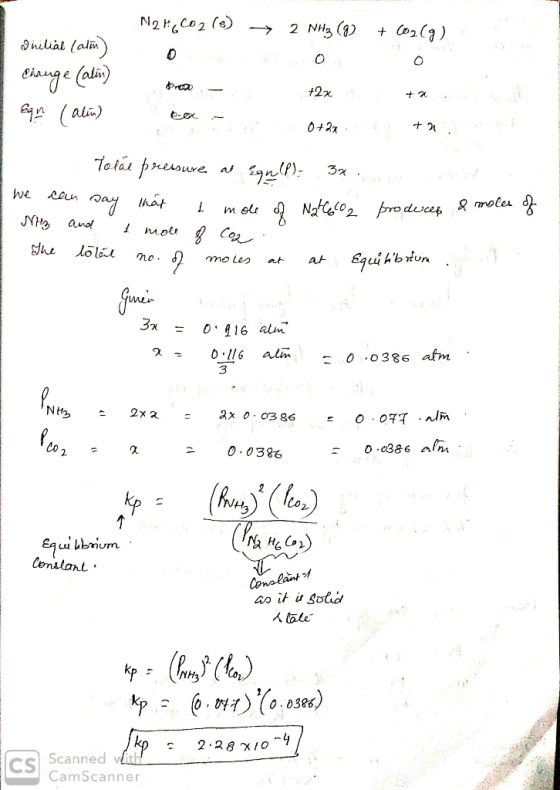
10 pts) Solid ammonium carbamate decomposes to ammonia and carbon dioxide: N2H.CO2 (s) → 2 NH3(g)...
9. (10 pts) Solid ammonium carbamate decomposes to ammonia and carbon dioxide: N,H.CO2 (s) → 2 NH3(g) + CO2(g) At r...
 9. (10 pts) Solid ammonium carbamate decomposes to ammonia and carbon dioxide: N,H.CO2 (s) → 2 NH3(g) + CO2(g) At room temperature the total pressure of ammonia and carbon dioxide over ammonium carbonate is 0.116 atm, What is the equilibrium constant for the reaction?
StUP 7. (5 pts) The equilibrium constant for dissociation of silver chloride AgCl (s) Ag' (aq)...
 StUP 7. (5 pts) The equilibrium constant for dissociation of silver chloride AgCl (s) Ag' (aq) + CI (aq) Is 1.8x10¹⁰ Find concentration of silver and chloride ions in saturated aqueous solution of silver chloride (10 pts) The equilibrium constant at certain temperature for 8 H2(g) +1:(g) 2 HI(g) is 55.17. If 10mole of hydrogen and 1.0 mole of iodine are placed in 0.5L flask, what is the equilibrium concentration of hydrogen iodide? (10 pts) Solid ammonium carbamate decomposes to...
10. (5 pts) Consider the following reaction in equilibrium H2(g) + Brz(g) → 2 HBr (g)...
 10. (5 pts) Consider the following reaction in equilibrium H2(g) + Brz(g) → 2 HBr (g) AH = + 68 kJ How will each of the following changes affect the equilibrium concentrations of each chemical: a) addition of HBr(g) b) increasing temperature c) increasing pressure d) decreasing volume of the reacting vessel at constant temperature. e) addition of bromine f) addition of argon g) addition of catalyst
10. (5 pts) Consider the following reaction in equilibrium H2(g) + Br(g) → 2 HBr (g) AH = +68 kJ How will each of t...
 10. (5 pts) Consider the following reaction in equilibrium H2(g) + Br(g) → 2 HBr (g) AH = +68 kJ How will each of the following changes affect the equilibrium concentrations of each chemical: a) addition of HBr(s) b) increasing temperature and timor od moment c) increasing pressure d) decreasing volume of the reacting vessel at constant temperature. e) addition of bromine f) addition of argon neonatology g) addition of catalyst bobb s oods Laboratorio
At high temperatures, solid ammonium chloride decomposes into gaseous ammonia and hydrogen chloride. NH4Cl (s) ⇌...
At high temperatures, solid ammonium chloride decomposes into gaseous ammonia and hydrogen chloride. NH4Cl (s) ⇌ NH3 (g) + HCl (g) a) An excess of ammonium chloride was introduced into an evacuated container. After raising the temperature to 340 ° C, the pressure was measured 1.013 bar. Calculate the equilibrium constant at this temperature. (4p) b) A container of volume 1.00 dm3 initially contained 0.0200 moles of ammonia. What are the partial pressures for ammonia and hydrogen chloride after an...
Ammonium iodide, a solid, decomposes to give NH3(g) and HI(g). At 406 °C, some NH4I(s) is...
Ammonium iodide, a solid, decomposes to give NH3(g) and HI(g). At 406 °C, some NH4I(s) is placed in an evacuated container. A portion of it decomposes, and the total pressure at equilibrium is 1.08 atm. Extra NH3(g) is then injected into the container, and when equilibrium is reestablished, the partial pressure of NH3(g) is 1.27 atm. (a) Compute the equilibrium constant in terms of pressures, Kp, for the decomposition of ammonium iodide at 406 °C. NH4I(s) -->NH3(g) + HI(g) K...
Ammonia and hydrogen chloride react to form solid ammonium chloride, NH4Cl(s): NH3 (g) + HCl (g) -> NH4Cl(s). Two 2....
Ammonia and hydrogen chloride react to form solid ammonium chloride, NH4Cl(s): NH3 (g) + HCl (g) -> NH4Cl(s). Two 2.50 L flasks at 20.0°C are connected by a stopcock. One flask contains 5.80NH3(g) and the other contains 4.40 HCl(g). When the stopcock is opened, the gases react until one is completely consumed. A. Which gas will remain in the system after the reaction is complete? B. What will be the final pressure of the system after the reaction is complete?...
0/ 1 pts Question 2 During a certain titration, 35.0 mL of 0.175 M aqueous sulfuric...
 0/ 1 pts Question 2 During a certain titration, 35.0 mL of 0.175 M aqueous sulfuric acid was required to exactly neutralize 49.0 mL of sodium hydroxide. Determine the molarity of the base. H2SO4 (aq) + 2NaOH(aq) + 2 H2O (0) + Na2SO4 (aq) [balanced] 0.125 M 6.00 x 10 M 0.250 M 0.175 M 0.600 M 2ct Question 6 0/1 pts Calculate the pressure exerted by 5.12 grams of chlorine gas in a 850 mL sealed flask at 27.0°C....
 9. (10 pts) Solid ammonium carbamate decomposes to ammonia and carbon dioxide: N,H.CO2 (s) → 2 NH3(g) + CO2(g) At room temperature the total pressure of ammonia and carbon dioxide over ammonium carbonate is 0.116 atm, What is the equilibrium constant for the reaction?
 StUP 7. (5 pts) The equilibrium constant for dissociation of silver chloride AgCl (s) Ag' (aq) + CI (aq) Is 1.8x10¹⁰ Find concentration of silver and chloride ions in saturated aqueous solution of silver chloride (10 pts) The equilibrium constant at certain temperature for 8 H2(g) +1:(g) 2 HI(g) is 55.17. If 10mole of hydrogen and 1.0 mole of iodine are placed in 0.5L flask, what is the equilibrium concentration of hydrogen iodide? (10 pts) Solid ammonium carbamate decomposes to...
 10. (5 pts) Consider the following reaction in equilibrium H2(g) + Brz(g) → 2 HBr (g) AH = + 68 kJ How will each of the following changes affect the equilibrium concentrations of each chemical: a) addition of HBr(g) b) increasing temperature c) increasing pressure d) decreasing volume of the reacting vessel at constant temperature. e) addition of bromine f) addition of argon g) addition of catalyst
 10. (5 pts) Consider the following reaction in equilibrium H2(g) + Br(g) → 2 HBr (g) AH = +68 kJ How will each of the following changes affect the equilibrium concentrations of each chemical: a) addition of HBr(s) b) increasing temperature and timor od moment c) increasing pressure d) decreasing volume of the reacting vessel at constant temperature. e) addition of bromine f) addition of argon neonatology g) addition of catalyst bobb s oods Laboratorio
 0/ 1 pts Question 2 During a certain titration, 35.0 mL of 0.175 M aqueous sulfuric acid was required to exactly neutralize 49.0 mL of sodium hydroxide. Determine the molarity of the base. H2SO4 (aq) + 2NaOH(aq) + 2 H2O (0) + Na2SO4 (aq) [balanced] 0.125 M 6.00 x 10 M 0.250 M 0.175 M 0.600 M 2ct Question 6 0/1 pts Calculate the pressure exerted by 5.12 grams of chlorine gas in a 850 mL sealed flask at 27.0°C....
Most questions answered within 3 hours.
-
Where is the error in this code sequence?
String s1 = "Hello";
String s2 = "ello";...
asked 10 months ago -
Financial data for Joel de Paris, Inc., for last year
follow:
Joel de Paris, Inc.
Balance...
asked 10 months ago -
Consider this reaction:
Al2(SO4)3 (aq)+ BaCl3
(aq) Al2Cl6 (aq)- +
3BaSO4(s) . What is the...
asked 10 months ago -
Suppose that Savneet is considering increasing her
recent random sample from 20 car rentals to 40...
asked 10 months ago -
Trucks arrive at an unloading terminal at an average rate of 120
per hour.
Trucks arrive...
asked 10 months ago -
Why are methanol and ethanol completely soluble in water while
octanol is not very little soluble....
asked 10 months ago -
A facilities manager at a university reads in a research report
that the mean amount of...
asked 10 months ago -
When the CuSO4 is rehydrated by adding water to the anhydrous
compound, is this an endothermic...
asked 10 months ago -
A ray of sunlight is passing from diamond into crown glass; the
angle of incidence is...
asked 10 months ago -
A block of mass 0.249 kg is placed on top of a light, vertical
spring of...
asked 10 months ago -
how do the kidneys compensate in the presences of acidosis
a) trigger hyperventilate
b) reserve acid...
asked 10 months ago -
Question 501 pts
The rental rate of capital to the firm increases. Which of the
following...
asked 10 months ago