
Homework Answers
Add Answer to:
A cylinder contains a mixture of gases under constant atmospheric pressure. The gases undergo a chemical...
A cylinder contains a gas under constant atmospheric pressure. When 0.262 kJ of heat is added...
 A cylinder contains a gas under constant atmospheric pressure. When 0.262 kJ of heat is added to the gas, it expands and does 569 J of work on the surroundings. What is the value of AH in joules for this process? AH = What is the value of AE in joules for this process? AE=
A gas is confined to a cylinder under constant atmospheric pressure, as illustrated in the following...
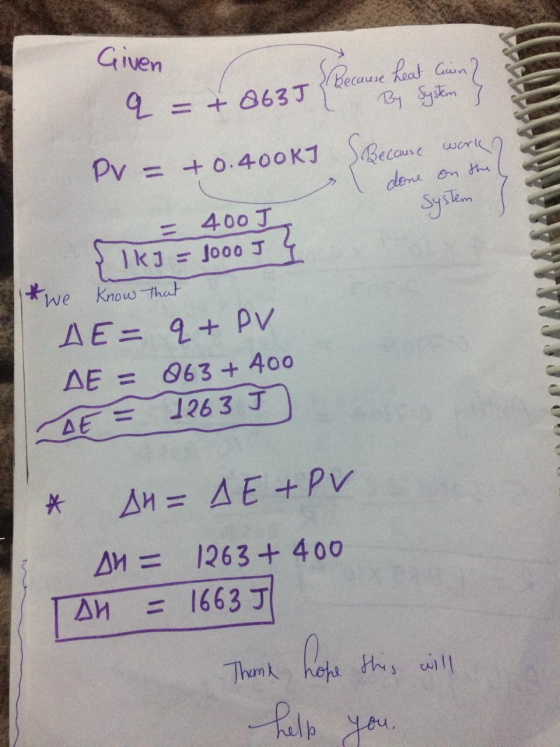
A gas is confined to a cylinder under constant atmospheric pressure, as illustrated in the following figure. When the gas undergoes a particular chemical reaction, it absorbs 822 J of heat from its surroundings and has 0.69 kJ of P−V work done on it by its surroundings. What is the value of ΔH for this process? Express your answer with the appropriate units.
A gas is confined to a cylinder under constant atmospheric pressure, as illustrated in the following...
A gas is confined to a cylinder under constant atmospheric pressure, as illustrated in the following figure. When the gas undergoes a particular chemical reaction, it absorbs 822 J of heat from its surroundings and has 0.69 kJ of P−V work done on it by its surroundings. What is the value of ΔE for this process? Express your answer with the appropriate units.
A gas is confined to a cylinder under constant pressure. When 450. J of heat is...
 A gas is confined to a cylinder under constant pressure. When 450. J of heat is added to the gas, it expands and does 95 J of work on the surroundings. What are the values of AH and AE for the process? 3.
1 altm=101.32j A gas is confined to a cylinder under constant pressure of 3.50 atm. When...
 1 altm=101.32j
A gas is confined to a cylinder under constant pressure of 3.50 atm. When the gas undergoes a particular chemical reaction, it releases 79 kJ of heat to its surroundings and expands from 22.0L to 75.2 L. Determine both AE and AH for this scenario.
1 altm=101.32j
A gas is confined to a cylinder under constant pressure of 3.50 atm. When the gas undergoes a particular chemical reaction, it releases 79 kJ of heat to its surroundings and expands from 22.0L to 75.2 L. Determine both AE and AH for this scenario.
1 atm pressure A mixture of gaseous reactants is put into a cylinder, where a chemical...
 1 atm pressure A mixture of gaseous reactants is put into a cylinder, where a chemical reaction turns them into gaseous products. The cylinder has a piston that moves in or out, as necessary, to keep a constant pressure on the mixture of 1 atm. The cylinder is also submerged in a large insulated water bath. (See sketch at right.) piston cylinder water bath The temperature of the water bath is monitored, and it is determined from this data that...
1 atm pressure A mixture of gaseous reactants is put into a cylinder, where a chemical...
 1 atm pressure A mixture of gaseous reactants is put into a cylinder, where a chemical reaction turns them into gaseous products. The cylinder has a piston that moves in or out, as necessary, to keep a constant pressure on the mixture of 1 atm. The cylinder is also submerged in a large insulated water bath. (See sketch at right.) piston cyli From previous experiments, this chemical reaction is known to absorb 379. kJ of energy. gases The position of...
1 atm pressure A mixture of gaseous reactants is put into a cylinder, where a chemical...
 1 atm pressure A mixture of gaseous reactants is put into a cylinder, where a chemical reaction turns them into gaseous products. The cylinder has a piston that moves in or out, as necessary, to keep a constant pressure on the mixture of 1 atm. The cylinder is also submerged in a large insulated water bath. (See sketch at right.) piston cylinder From previous experiments, this chemical reaction is known to absorb 236. kJ of energy. water bath gases The...
A mixture of gaseous reactants is put into a cylinder, where a chemical reaction turns them...
 A mixture of gaseous reactants is put into a cylinder, where a chemical reaction turns them into gaseous products. The cylinder has a piston that moves in or out, as necessary, to keep a constant pressure on the mixture of 1 atm. The cylinder is also submerged in a large insulated water bath. (See sketch at right.) 1 atm pressure piston bath From previous experiments, this chemical reaction is known to absorb 339. kJ of gases energy The position of...
A frictionless-piston-cylinder device contains a liquid-vapor mixture of water at 200°C. During a constant- pressure process,...
 A frictionless-piston-cylinder device contains a liquid-vapor mixture of water at 200°C. During a constant- pressure process, 500 kJ of heat is transferred to the surrounding air at 20°C. As a result, part of the water vapor contained in the cylinder condenses. a) Draw a schematic of your system including the boundary and all relevant energy transfer. (2 pts) b) Determine the entropy change of the water, in kJ/K. (3 pts) c) For the extended system (system + surroundings), write an...
 A cylinder contains a gas under constant atmospheric pressure. When 0.262 kJ of heat is added to the gas, it expands and does 569 J of work on the surroundings. What is the value of AH in joules for this process? AH = What is the value of AE in joules for this process? AE=
 A gas is confined to a cylinder under constant pressure. When 450. J of heat is added to the gas, it expands and does 95 J of work on the surroundings. What are the values of AH and AE for the process? 3.
 1 altm=101.32j
A gas is confined to a cylinder under constant pressure of 3.50 atm. When the gas undergoes a particular chemical reaction, it releases 79 kJ of heat to its surroundings and expands from 22.0L to 75.2 L. Determine both AE and AH for this scenario.
1 altm=101.32j
A gas is confined to a cylinder under constant pressure of 3.50 atm. When the gas undergoes a particular chemical reaction, it releases 79 kJ of heat to its surroundings and expands from 22.0L to 75.2 L. Determine both AE and AH for this scenario.
 1 atm pressure A mixture of gaseous reactants is put into a cylinder, where a chemical reaction turns them into gaseous products. The cylinder has a piston that moves in or out, as necessary, to keep a constant pressure on the mixture of 1 atm. The cylinder is also submerged in a large insulated water bath. (See sketch at right.) piston cylinder water bath The temperature of the water bath is monitored, and it is determined from this data that...
 1 atm pressure A mixture of gaseous reactants is put into a cylinder, where a chemical reaction turns them into gaseous products. The cylinder has a piston that moves in or out, as necessary, to keep a constant pressure on the mixture of 1 atm. The cylinder is also submerged in a large insulated water bath. (See sketch at right.) piston cyli From previous experiments, this chemical reaction is known to absorb 379. kJ of energy. gases The position of...
 1 atm pressure A mixture of gaseous reactants is put into a cylinder, where a chemical reaction turns them into gaseous products. The cylinder has a piston that moves in or out, as necessary, to keep a constant pressure on the mixture of 1 atm. The cylinder is also submerged in a large insulated water bath. (See sketch at right.) piston cylinder From previous experiments, this chemical reaction is known to absorb 236. kJ of energy. water bath gases The...
 A mixture of gaseous reactants is put into a cylinder, where a chemical reaction turns them into gaseous products. The cylinder has a piston that moves in or out, as necessary, to keep a constant pressure on the mixture of 1 atm. The cylinder is also submerged in a large insulated water bath. (See sketch at right.) 1 atm pressure piston bath From previous experiments, this chemical reaction is known to absorb 339. kJ of gases energy The position of...
 A frictionless-piston-cylinder device contains a liquid-vapor mixture of water at 200°C. During a constant- pressure process, 500 kJ of heat is transferred to the surrounding air at 20°C. As a result, part of the water vapor contained in the cylinder condenses. a) Draw a schematic of your system including the boundary and all relevant energy transfer. (2 pts) b) Determine the entropy change of the water, in kJ/K. (3 pts) c) For the extended system (system + surroundings), write an...
Most questions answered within 3 hours.
-
Where is the error in this code sequence?
String s1 = "Hello";
String s2 = "ello";...
asked 11 months ago -
Financial data for Joel de Paris, Inc., for last year
follow:
Joel de Paris, Inc.
Balance...
asked 11 months ago -
Consider this reaction:
Al2(SO4)3 (aq)+ BaCl3
(aq) Al2Cl6 (aq)- +
3BaSO4(s) . What is the...
asked 11 months ago -
Suppose that Savneet is considering increasing her
recent random sample from 20 car rentals to 40...
asked 11 months ago -
Trucks arrive at an unloading terminal at an average rate of 120
per hour.
Trucks arrive...
asked 11 months ago -
Why are methanol and ethanol completely soluble in water while
octanol is not very little soluble....
asked 11 months ago -
A facilities manager at a university reads in a research report
that the mean amount of...
asked 11 months ago -
When the CuSO4 is rehydrated by adding water to the anhydrous
compound, is this an endothermic...
asked 11 months ago -
A ray of sunlight is passing from diamond into crown glass; the
angle of incidence is...
asked 11 months ago -
A block of mass 0.249 kg is placed on top of a light, vertical
spring of...
asked 11 months ago -
how do the kidneys compensate in the presences of acidosis
a) trigger hyperventilate
b) reserve acid...
asked 11 months ago -
Question 501 pts
The rental rate of capital to the firm increases. Which of the
following...
asked 11 months ago