Sodium hydroxide is used extensively in acid-base titrations because it is a strong, inexpensive base. A...
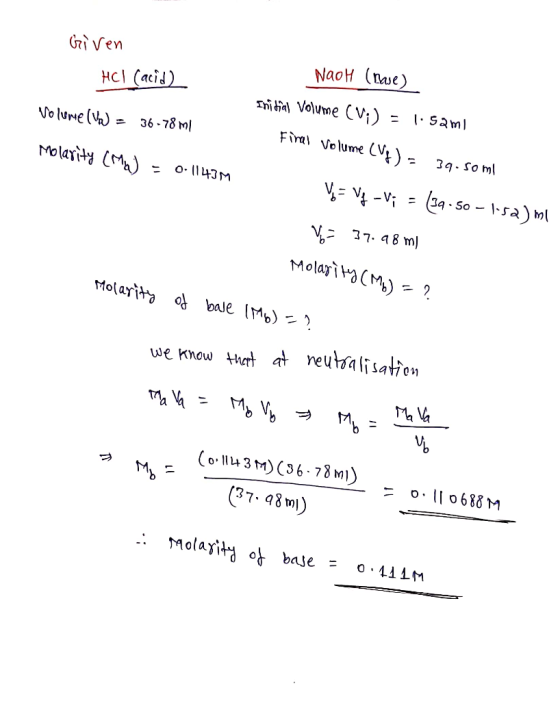
Sodium hydroxide is used extensively in acid-base titrations because it is a strong, inexpensive base. A sodium hydroxide solution was standardized by titrating 36.78 mL of 0.1143 M standard hydrochloric acid. The initial buret reading of the sodium hydroxide was 1.52 mL, and the final reading was 39.50 mL. What was the molarity of the base solution?
Homework Answers
Add Answer to:
Sodium hydroxide is used extensively in acid-base titrations because it is a strong, inexpensive base. A...
5.) Enter your answer in the provided box. Calculate the following quantity: volume of 1.551 M...
5.) Enter your answer in the provided box. Calculate the following quantity: volume of 1.551 M copper(II) nitrate that must be diluted with water to prepare 946.4 mL of a 0.9513 M solution. __?___ mL 6.) . Enter your answer in the provided box. How many milliliters of 0.836 M HCl are needed to react with 28.8 g of CaCO3? 2HCl(aq) + CaCO3(s) → CaCl2(aq) + CO2(g) + H2O(l) __?__ mL 7.) . Enter your answer in the provided box. Sodium...
Question 7 2 pts Consider the following sodium hydroxide, oxalic acid titration data. Remember sodium hydroxide...
 Question 7 2 pts Consider the following sodium hydroxide, oxalic acid titration data. Remember sodium hydroxide is in the buret mass of oxalic acid - 1.301 g initial buret reading = 2.16 mL final buret reading = 39.13 mL Calculate the molarity of the sodium hydroxide. .761 M 0.705 M 733 M 782M
Standardization of NaOH: Acid Base Titration Objective: In this lab, you will accurately determine the concentration...
Standardization of NaOH: Acid Base Titration Objective: In this lab, you will accurately determine the concentration of a solution of sodium hydroxide (NaOH) using a 0.500M potassium hydrogen phthalate (KHP) standard solution. Background: Acid–Base Titrations When an acid reacts with a base, a neutralization reaction occurs. The H+ ions from the acid and the HO– ions from the base combine to form water and are therefore neutralized. The other product of reaction is a salt. For example, hydrochloric acid reacts...
Questions: A. From the standardization data, calculate the molarity of the sodium hydroxide solution for each...
 Questions:
A. From the standardization data, calculate the molarity of the
sodium hydroxide solution for each trail. Average the values and
enter the average in the Standardization Data Table.
B. From the equivalent mass data, calculate the equivalent mass
of the unknown acid for each trial. Average the values and enter
the average in the Equivalent Mass Data Table.
Acid-Base Titrations continued Standardization Data Table Trial 1 Trial 2 Trial 3 Mass KHP Final Volume, mL Initial Volume, ml Volume...
Questions:
A. From the standardization data, calculate the molarity of the
sodium hydroxide solution for each trail. Average the values and
enter the average in the Standardization Data Table.
B. From the equivalent mass data, calculate the equivalent mass
of the unknown acid for each trial. Average the values and enter
the average in the Equivalent Mass Data Table.
Acid-Base Titrations continued Standardization Data Table Trial 1 Trial 2 Trial 3 Mass KHP Final Volume, mL Initial Volume, ml Volume...
A sodium hydroxide solution was standardized by titrating it against a 0.3057g sample of potassium hydrogen...
A sodium hydroxide solution was standardized by titrating it against a 0.3057g sample of potassium hydrogen phthalate. the inital buret reading was 0.28mL and the final was 31.44. Calculate the molarity of the NaOh solution. The molar mass of KHP is 204.23g/mol HKC8H4O4 + NaOH --> NaKC8H4O4 +H2O
An aqueous solution of sodium hydroxide is standardized by titration with a 0.143 M solution of...
An aqueous solution of sodium hydroxide is standardized by titration with a 0.143 M solution of hydrochloric acid. If 14.9 mL of base are required to neutralize 28.6 mL of the acid, what is the molarity of the sodium hydroxide solution? __________M sodium hydroxide
What molarity of sodium hydroxide solution is used to react 0.511 grams of KHP, if the...
What molarity of sodium hydroxide solution is used to react 0.511 grams of KHP, if the initial buret reading for the addition of sodium hyrdoxide is 0.4mL and the final reading is 12.7 mL? The molar mass of KHP is 204.2 g/mol. The reaction is KHP + NaOH --> KNaP +H2O
ELIMINARY EXERCISES: Experiment 16 Acid-Base Titrations- Define the following terms associated with titrations: a. standard solutions...
 ELIMINARY EXERCISES: Experiment 16 Acid-Base Titrations- Define the following terms associated with titrations: a. standard solutions are base Soluchon When the molanty is alrea known. b. ondpoint is the pant at which color change occurs. C. indicator quie. Watersplutte dues that have one color in basic. 2. Write the balanced formula equation and the net ionic equation for the reaction of sodium hydroxide with hydrochloric acid. Formula equation: Net Ionic equation: 3. What is the molarity of a solution prepared...
During a titration of a weak base with a strong acid, you are slowing converting molecules...
 During a titration of a weak base with a strong acid, you are slowing converting molecules of the weak base into molecules of its conjugate acid. For the hypothetical weak base, B we see the following: B (aq) + H30+ (aq) - BH+ (aq) + H20 (1) In the problem below you will be adding some strong acid, but not enough to reach the endpoint of the titration. 2.00 mL of hydrochloric acid added to the weak base 2.00M hydrochloric...
Below are hypothetical data from a titration experiment. Part A focuses on determining the molarity of...
Below are hypothetical data from a titration experiment. Part A focuses on determining the molarity of a sodium hydroxide solution. Part B uses the sodium hydroxide solution to determine the molarity, and ultimately the mass percent, of acetic acid in an unknown vinegar sample. Vinegar is an aqueous solution containing 4 to 6% by mass acetic acid. Please use the data provided below to perform the calculations and answer the questions in this assignment. Part A: A 0.883 M standard...
 Question 7 2 pts Consider the following sodium hydroxide, oxalic acid titration data. Remember sodium hydroxide is in the buret mass of oxalic acid - 1.301 g initial buret reading = 2.16 mL final buret reading = 39.13 mL Calculate the molarity of the sodium hydroxide. .761 M 0.705 M 733 M 782M
 Questions:
A. From the standardization data, calculate the molarity of the
sodium hydroxide solution for each trail. Average the values and
enter the average in the Standardization Data Table.
B. From the equivalent mass data, calculate the equivalent mass
of the unknown acid for each trial. Average the values and enter
the average in the Equivalent Mass Data Table.
Acid-Base Titrations continued Standardization Data Table Trial 1 Trial 2 Trial 3 Mass KHP Final Volume, mL Initial Volume, ml Volume...
Questions:
A. From the standardization data, calculate the molarity of the
sodium hydroxide solution for each trail. Average the values and
enter the average in the Standardization Data Table.
B. From the equivalent mass data, calculate the equivalent mass
of the unknown acid for each trial. Average the values and enter
the average in the Equivalent Mass Data Table.
Acid-Base Titrations continued Standardization Data Table Trial 1 Trial 2 Trial 3 Mass KHP Final Volume, mL Initial Volume, ml Volume...
 ELIMINARY EXERCISES: Experiment 16 Acid-Base Titrations- Define the following terms associated with titrations: a. standard solutions are base Soluchon When the molanty is alrea known. b. ondpoint is the pant at which color change occurs. C. indicator quie. Watersplutte dues that have one color in basic. 2. Write the balanced formula equation and the net ionic equation for the reaction of sodium hydroxide with hydrochloric acid. Formula equation: Net Ionic equation: 3. What is the molarity of a solution prepared...
 During a titration of a weak base with a strong acid, you are slowing converting molecules of the weak base into molecules of its conjugate acid. For the hypothetical weak base, B we see the following: B (aq) + H30+ (aq) - BH+ (aq) + H20 (1) In the problem below you will be adding some strong acid, but not enough to reach the endpoint of the titration. 2.00 mL of hydrochloric acid added to the weak base 2.00M hydrochloric...
Most questions answered within 3 hours.
-
Where is the error in this code sequence?
String s1 = "Hello";
String s2 = "ello";...
asked 10 months ago -
Financial data for Joel de Paris, Inc., for last year
follow:
Joel de Paris, Inc.
Balance...
asked 10 months ago -
Consider this reaction:
Al2(SO4)3 (aq)+ BaCl3
(aq) Al2Cl6 (aq)- +
3BaSO4(s) . What is the...
asked 10 months ago -
Suppose that Savneet is considering increasing her
recent random sample from 20 car rentals to 40...
asked 10 months ago -
Trucks arrive at an unloading terminal at an average rate of 120
per hour.
Trucks arrive...
asked 10 months ago -
Why are methanol and ethanol completely soluble in water while
octanol is not very little soluble....
asked 10 months ago -
A facilities manager at a university reads in a research report
that the mean amount of...
asked 10 months ago -
When the CuSO4 is rehydrated by adding water to the anhydrous
compound, is this an endothermic...
asked 10 months ago -
A ray of sunlight is passing from diamond into crown glass; the
angle of incidence is...
asked 10 months ago -
A block of mass 0.249 kg is placed on top of a light, vertical
spring of...
asked 10 months ago -
how do the kidneys compensate in the presences of acidosis
a) trigger hyperventilate
b) reserve acid...
asked 10 months ago -
Question 501 pts
The rental rate of capital to the firm increases. Which of the
following...
asked 10 months ago