
Homework Answers
Case when interest rate declines, investment increases which causes aggregate demand to shift rightward.
In short run Aggregate demand shift rightward from AD0 to AD1
and the level of output rises from Y0 to Y1 and price level from P0
to P1. 
In long run when aggregate supply curve is vertical shaped,
increasing in aggregate demand from AD0 to AD1 will only raise the
price level while keeping output level at constant level because in
long run no matter how innovative your firm is your output wil
increase upto a level.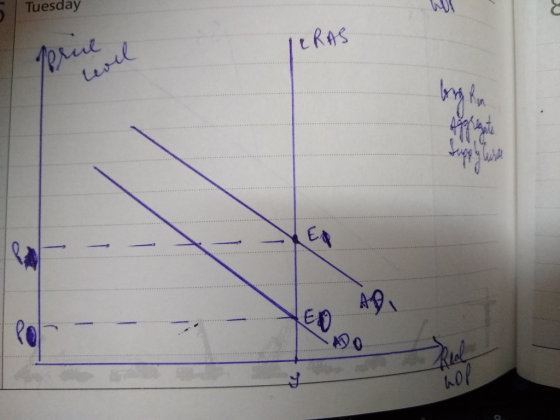
Add Answer to:
6. The Federal Reserve cuts interest rates. Graphically show using a model of aggregate demand and...
In July 2019 the Federal Reserve lowered interest rates for the first time in a decade....
In July 2019 the Federal Reserve lowered interest rates for the first time in a decade. The Federal Reserve has two missions: to keep unemployment low and to keep inflation low. To reduce the unemployment rate, it cuts rates to increase the money supply and increase aggregate demand. To reduce inflation the Fed raises interest rates to decrease the money supply and tamp down aggregate demand. Right now the unemployment rate is at a 50-year low and inflation is below...
Suppose the Federal Reserve decides to increase interest rates, as discussed in the news. What change...
Suppose the Federal Reserve decides to increase interest rates, as discussed in the news. What change must occur in money supply and how would this affect unemployment and inflation? What are the goals of the Federal Reserve, in terms of the impact on the aggregate economy, when it is considering this change? Use the AD/AS graph to support your answer. Explain in words and graphically.
QUESTION 7 (25 points): Economic Fluctuation using AD-AS framework Suppose that the short-run aggregate supply curve...
 QUESTION 7 (25 points): Economic Fluctuation using AD-AS framework Suppose that the short-run aggregate supply curve has a positive slope and that the economy starts at a long-run equilibrium. Now imagine that 10 million people move to Australia they found that Australians live an average of 10 extra years due to the relax lifestyle that they enjoy. This is a permanent change in Labor in the U.S. economy. (a) (10 points) No Policy Intervention: Using the model of Aggregate Demand...
7. fiscal policy tool Show graphically that tax cuts are a more effective demand to interest rate...
 7. fiscal policy tool Show graphically that tax cuts are a more effective demand to interest rates. the greater is the sensitivity of money Show graphically that monetary policy is a less powerful tool the greater is the sensitivity of money demand to interest rates. 8.
7. fiscal policy tool Show graphically that tax cuts are a more effective demand to interest rates. the greater is the sensitivity of money Show graphically that monetary policy is a less powerful tool...
7. fiscal policy tool Show graphically that tax cuts are a more effective demand to interest rates. the greater is the sensitivity of money Show graphically that monetary policy is a less powerful tool the greater is the sensitivity of money demand to interest rates. 8.
7. fiscal policy tool Show graphically that tax cuts are a more effective demand to interest rates. the greater is the sensitivity of money Show graphically that monetary policy is a less powerful tool...
Using aggregate demand (AD), short-run aggregate supply (SRAS) and long-run aggregate supply (LRAS) curves
Question 1: AD-SRAS-LRAS Model Using aggregate demand (AD), short-run aggregate supply (SRAS) and long-run aggregate supply (LRAS) curves, graphically illustrate the effect of an increase in the money supply on output and prices in the short and long run. Assume that the economy is initially in long run equilibrium at the potential output level and prices are fixed in the short-run. In your graph, label "A" for the initial equilibrium, "B' for the short-run equilibrium, and "C" for the long-run equilibrium.
Write the answers to and explain the following: What action can the Federal Reserve take to...
Write the answers to and explain the following: What action can the Federal Reserve take to reduce unemployment? What is the primary tool used by the Federal Reserve to accomplish the action you listed in part (a)? Explain in detail how this tool works. Assuming the economy is currently operating at the natural rate of unemployment, what effect will the action you listed in part (a) have in the short-run on: output price level interest rates Use the AS/AD (Aggregate...
On March 15, 2017, Federal Reserve Chairman Janet L. Yellen announced the Federal Reserve was raising...
 On March 15, 2017, Federal Reserve Chairman Janet L. Yellen announced the Federal Reserve was raising its benchmark rate (the federal funds rate) by a quarter of a percentage point (to a range of 0.75-1.00 percent). This was the third time the Fed has raised rates after the Great Recession. Consider the market for money illustrated in the figure below. Assume the market initially just prior to March 15, 2017) is in equilibrium at point A. Describe the effects of...
Study Guide for Exam Four. Cumulative Material You Want To Know. Module 27. Aggregate Demand. 1....
Study Guide for Exam Four. Cumulative Material You Want To Know. Module 27. Aggregate Demand. 1. Know the difference between what can cause shifts in the aggregate demand curve. 2. Know what causes movements along the aggregate demand curve. Module 28. Aggregate Supply. 1. What factors cause the short run aggregate supply curve to shift? 2. Know what causes movements along the short run aggregate supply curve. 3. Be able to define and explain the long-run aggregate supply curve. Potential...
Using the Aggregate Demand/ Aggregate Supply Model, explain how lowering the reserve ratio affects the economy.
Using the Aggregate Demand/ Aggregate Supply Model, explain how lowering the reserve ratio affects the economy.
Consider the aggregate demand – aggregate supply (AD-AS) model. Assume the economy is initially at its...
Consider the aggregate demand – aggregate supply (AD-AS) model. Assume the economy is initially at its long-run equilibrium. Produce a new graph, draw the aggregated demand curve, short-run aggregate supply curve, and the long-run aggregate supply curve and label the curves. Label both the horizonal and vertical axes clearly. Label the long-run equilibrium as A and its corresponding output level as Y1 Now assume a positive supply shock hits the economy. In the graph, show the short-run effects of this...
 QUESTION 7 (25 points): Economic Fluctuation using AD-AS framework Suppose that the short-run aggregate supply curve has a positive slope and that the economy starts at a long-run equilibrium. Now imagine that 10 million people move to Australia they found that Australians live an average of 10 extra years due to the relax lifestyle that they enjoy. This is a permanent change in Labor in the U.S. economy. (a) (10 points) No Policy Intervention: Using the model of Aggregate Demand...
 7. fiscal policy tool Show graphically that tax cuts are a more effective demand to interest rates. the greater is the sensitivity of money Show graphically that monetary policy is a less powerful tool the greater is the sensitivity of money demand to interest rates. 8.
7. fiscal policy tool Show graphically that tax cuts are a more effective demand to interest rates. the greater is the sensitivity of money Show graphically that monetary policy is a less powerful tool...
7. fiscal policy tool Show graphically that tax cuts are a more effective demand to interest rates. the greater is the sensitivity of money Show graphically that monetary policy is a less powerful tool the greater is the sensitivity of money demand to interest rates. 8.
7. fiscal policy tool Show graphically that tax cuts are a more effective demand to interest rates. the greater is the sensitivity of money Show graphically that monetary policy is a less powerful tool...
 On March 15, 2017, Federal Reserve Chairman Janet L. Yellen announced the Federal Reserve was raising its benchmark rate (the federal funds rate) by a quarter of a percentage point (to a range of 0.75-1.00 percent). This was the third time the Fed has raised rates after the Great Recession. Consider the market for money illustrated in the figure below. Assume the market initially just prior to March 15, 2017) is in equilibrium at point A. Describe the effects of...
Most questions answered within 3 hours.
-
Where is the error in this code sequence?
String s1 = "Hello";
String s2 = "ello";...
asked 11 months ago -
Financial data for Joel de Paris, Inc., for last year
follow:
Joel de Paris, Inc.
Balance...
asked 11 months ago -
Consider this reaction:
Al2(SO4)3 (aq)+ BaCl3
(aq) Al2Cl6 (aq)- +
3BaSO4(s) . What is the...
asked 11 months ago -
Suppose that Savneet is considering increasing her
recent random sample from 20 car rentals to 40...
asked 11 months ago -
Trucks arrive at an unloading terminal at an average rate of 120
per hour.
Trucks arrive...
asked 11 months ago -
Why are methanol and ethanol completely soluble in water while
octanol is not very little soluble....
asked 11 months ago -
A facilities manager at a university reads in a research report
that the mean amount of...
asked 11 months ago -
When the CuSO4 is rehydrated by adding water to the anhydrous
compound, is this an endothermic...
asked 11 months ago -
A ray of sunlight is passing from diamond into crown glass; the
angle of incidence is...
asked 11 months ago -
A block of mass 0.249 kg is placed on top of a light, vertical
spring of...
asked 11 months ago -
how do the kidneys compensate in the presences of acidosis
a) trigger hyperventilate
b) reserve acid...
asked 11 months ago -
Question 501 pts
The rental rate of capital to the firm increases. Which of the
following...
asked 11 months ago