
Homework Answers
Add Answer to:
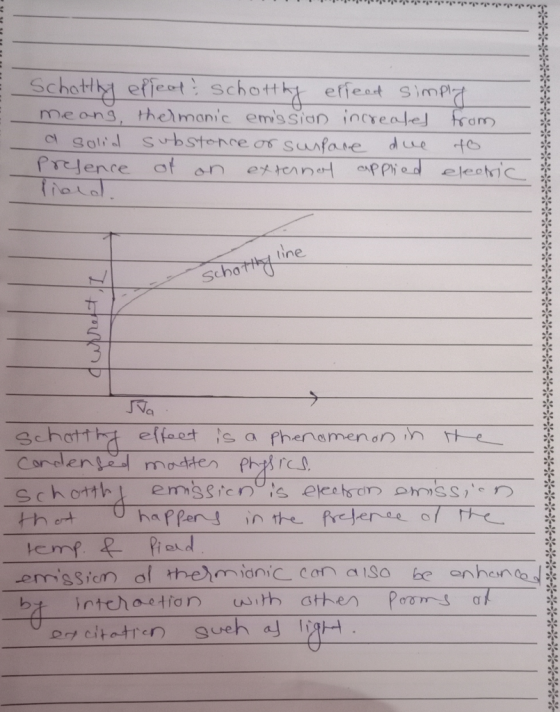
thank you!! #3. (Schottky effect: 20 pts) (a) Explain about the Schottky effect by drawing the...
A metal, with a work function Ф,,-41 V, is deposited on an n-type silicon semiconductor with elec...
 A metal, with a work function Ф,,-41 V, is deposited on an n-type silicon semiconductor with electron affinity 4.0V and energy bandgap 1.12eV. Assuming no interface states exist at the junction and operation temperature at 300K. Effective density of states in conduction band (N 3.22 x 10 cm3. Effective density of states in valence band (N) 1.83 x 10" cm 193 A) Sketch the energy band diagram for zero bias for the case when no space charge region exists at...
Subject : Semiconductor topic MOS + 1. Figure 1 illustrates the energy band diagram of a...
 Subject :
Semiconductor
topic MOS
+ 1. Figure 1 illustrates the energy band diagram of a Metal-Oxide-Semiconductor (MOS). Based on the Figure 1 and the given parameters, Semicon surface Ec Figure 1 a) write the posson's equation that relates the potential and distance from the oxide-semiconductor interface b) write the mathematical relationship of the surface potential as a function of substrate doping concentration when the surface is under strong inversion condition c) write the equation for the maximum width of...
Subject :
Semiconductor
topic MOS
+ 1. Figure 1 illustrates the energy band diagram of a Metal-Oxide-Semiconductor (MOS). Based on the Figure 1 and the given parameters, Semicon surface Ec Figure 1 a) write the posson's equation that relates the potential and distance from the oxide-semiconductor interface b) write the mathematical relationship of the surface potential as a function of substrate doping concentration when the surface is under strong inversion condition c) write the equation for the maximum width of...
Please help. Thank you. (3.) (40 pts) An insulating sphere of radius a has an embedded...
 Please help. Thank you.
(3.) (40 pts) An insulating sphere of radius a has an embedded nonuniform charge den- sity: p(P) = (1+) where pe is a positive constant (this charge density is only valid for r <a). Sur- rounding the sphere, and concentric with it, is a conducting shell of inner radius b> a and outer radius c which is charged (not neutral). I do not know what the charge on the conductor is, but I am told that...
Please help. Thank you.
(3.) (40 pts) An insulating sphere of radius a has an embedded nonuniform charge den- sity: p(P) = (1+) where pe is a positive constant (this charge density is only valid for r <a). Sur- rounding the sphere, and concentric with it, is a conducting shell of inner radius b> a and outer radius c which is charged (not neutral). I do not know what the charge on the conductor is, but I am told that...
I tried to solve this exercise: Which says to think about the Hall effect, but usually...
 I
tried to solve this exercise:
Which says to think about the Hall effect, but usually there’s
an external current flow when considering this effect, so I tried
to solve the exercise in another way. My questions are:
1) did I solve it right (see below)?
2) how can I solve the exercise considering the Hall effect
(and Lorentz force) ?
A cubic metal volume of side d =1.5? and density of charge carriers n is moving along y-axis with...
I
tried to solve this exercise:
Which says to think about the Hall effect, but usually there’s
an external current flow when considering this effect, so I tried
to solve the exercise in another way. My questions are:
1) did I solve it right (see below)?
2) how can I solve the exercise considering the Hall effect
(and Lorentz force) ?
A cubic metal volume of side d =1.5? and density of charge carriers n is moving along y-axis with...
P's The diagram above shows a cross-section view of a very long straight metal cylinder of radius...
 P's The diagram above shows a cross-section view of a very long straight metal cylinder of radius ri within a coaxial hollow metal cylinder of inner radius r2 and outer radius r3. The inner cylinder has a positive charge per unit length λ, whereas the outer cylinder has negative charge per unit length There are no other objects nearby Part A (a) What is the shape of the electric field in and around the cylinders? In your answer (i) explain...
Sorry this problem has so many parts--thank you in advance for your effort. Conservative Forces It...
 Sorry this problem has so many
parts--thank you in advance for your effort.
Conservative Forces It takes work to lift an object under the influence of the Earth's gravitational force. This increases the gravitational potential energy of the object. Lowering the ob- ject releases the gravitational potential energy that was stored when it was lifted. When you studied the gravitational force, you applied the term conservative to it because it allows the recovery of all of the stored energy. You...
Sorry this problem has so many
parts--thank you in advance for your effort.
Conservative Forces It takes work to lift an object under the influence of the Earth's gravitational force. This increases the gravitational potential energy of the object. Lowering the ob- ject releases the gravitational potential energy that was stored when it was lifted. When you studied the gravitational force, you applied the term conservative to it because it allows the recovery of all of the stored energy. You...
PART A AND B PLEASE THIS IS ONE QUESTION. please explain in detail. and PLEASE label each parts o...
 PART A AND B PLEASE THIS IS ONE QUESTION. please explain in
detail. and PLEASE label each parts of the question u are
addressing (a,b,c etc) . ive posted this 3 times and still no
correct response
Problem 2 The diagram above shows a crow-section view of a very long straight metal cylinder of radius ri within a coaxial hollow metal eylinder of inner radius rz atnd outer radius rs- The inser cylinder has -2A. There are no other objects...
PART A AND B PLEASE THIS IS ONE QUESTION. please explain in
detail. and PLEASE label each parts of the question u are
addressing (a,b,c etc) . ive posted this 3 times and still no
correct response
Problem 2 The diagram above shows a crow-section view of a very long straight metal cylinder of radius ri within a coaxial hollow metal eylinder of inner radius rz atnd outer radius rs- The inser cylinder has -2A. There are no other objects...
Thanks! 5. (10 pts) (a) Einstein's explanation of the photoelectric effect launched the study of quantum...
 Thanks!
5. (10 pts) (a) Einstein's explanation of the photoelectric effect launched the study of quantum mechanics. A minimum frequency of UV light shining on a metal is necessary to create a current. Explain in your own words, how Einstein explained this particular observation. Be to the point. Points will be deducted for answers that do not have enough detail, or if there is irrelevant information. (b) You discover a new metal. You conduct a photoelectric experiment on the metal...
Thanks!
5. (10 pts) (a) Einstein's explanation of the photoelectric effect launched the study of quantum mechanics. A minimum frequency of UV light shining on a metal is necessary to create a current. Explain in your own words, how Einstein explained this particular observation. Be to the point. Points will be deducted for answers that do not have enough detail, or if there is irrelevant information. (b) You discover a new metal. You conduct a photoelectric experiment on the metal...
When an atom is placed in an external field, the nucleus moves just a tiny bit,...
When an atom is placed in an external field, the nucleus moves just a tiny bit, so that it is no longer centered, until it is once again in equilibrium As a result, the atom acquires a dipole moment. For many atoms, the induced dipole moment is proportional to the applied field; these are called linear materials, or dielectrics. This dependence, called the polarizability, can be measured fairly easily in the lab. Remarkably, Gauss’s law is all we need to...
Parts a through d are a part of the SAME problem. THANK YOU in advance! 3....
 Parts a through d are a part of the SAME problem.
THANK YOU in advance!
3. Single converging (convex) lens: Suppose an object is placed a distance 8 cm to the left of a convex lens of focal length 10 cm. (a) On a separate sheet of paper, make a scaled ray drawing. Use a ruler. A free hand sketch is not acceptable State whether the image is real or virtual and upright or inverted the lateral magnification of the...
Parts a through d are a part of the SAME problem.
THANK YOU in advance!
3. Single converging (convex) lens: Suppose an object is placed a distance 8 cm to the left of a convex lens of focal length 10 cm. (a) On a separate sheet of paper, make a scaled ray drawing. Use a ruler. A free hand sketch is not acceptable State whether the image is real or virtual and upright or inverted the lateral magnification of the...
 A metal, with a work function Ф,,-41 V, is deposited on an n-type silicon semiconductor with electron affinity 4.0V and energy bandgap 1.12eV. Assuming no interface states exist at the junction and operation temperature at 300K. Effective density of states in conduction band (N 3.22 x 10 cm3. Effective density of states in valence band (N) 1.83 x 10" cm 193 A) Sketch the energy band diagram for zero bias for the case when no space charge region exists at...
 Subject :
Semiconductor
topic MOS
+ 1. Figure 1 illustrates the energy band diagram of a Metal-Oxide-Semiconductor (MOS). Based on the Figure 1 and the given parameters, Semicon surface Ec Figure 1 a) write the posson's equation that relates the potential and distance from the oxide-semiconductor interface b) write the mathematical relationship of the surface potential as a function of substrate doping concentration when the surface is under strong inversion condition c) write the equation for the maximum width of...
Subject :
Semiconductor
topic MOS
+ 1. Figure 1 illustrates the energy band diagram of a Metal-Oxide-Semiconductor (MOS). Based on the Figure 1 and the given parameters, Semicon surface Ec Figure 1 a) write the posson's equation that relates the potential and distance from the oxide-semiconductor interface b) write the mathematical relationship of the surface potential as a function of substrate doping concentration when the surface is under strong inversion condition c) write the equation for the maximum width of...
 Please help. Thank you.
(3.) (40 pts) An insulating sphere of radius a has an embedded nonuniform charge den- sity: p(P) = (1+) where pe is a positive constant (this charge density is only valid for r <a). Sur- rounding the sphere, and concentric with it, is a conducting shell of inner radius b> a and outer radius c which is charged (not neutral). I do not know what the charge on the conductor is, but I am told that...
Please help. Thank you.
(3.) (40 pts) An insulating sphere of radius a has an embedded nonuniform charge den- sity: p(P) = (1+) where pe is a positive constant (this charge density is only valid for r <a). Sur- rounding the sphere, and concentric with it, is a conducting shell of inner radius b> a and outer radius c which is charged (not neutral). I do not know what the charge on the conductor is, but I am told that...
 I
tried to solve this exercise:
Which says to think about the Hall effect, but usually there’s
an external current flow when considering this effect, so I tried
to solve the exercise in another way. My questions are:
1) did I solve it right (see below)?
2) how can I solve the exercise considering the Hall effect
(and Lorentz force) ?
A cubic metal volume of side d =1.5? and density of charge carriers n is moving along y-axis with...
I
tried to solve this exercise:
Which says to think about the Hall effect, but usually there’s
an external current flow when considering this effect, so I tried
to solve the exercise in another way. My questions are:
1) did I solve it right (see below)?
2) how can I solve the exercise considering the Hall effect
(and Lorentz force) ?
A cubic metal volume of side d =1.5? and density of charge carriers n is moving along y-axis with...
 P's The diagram above shows a cross-section view of a very long straight metal cylinder of radius ri within a coaxial hollow metal cylinder of inner radius r2 and outer radius r3. The inner cylinder has a positive charge per unit length λ, whereas the outer cylinder has negative charge per unit length There are no other objects nearby Part A (a) What is the shape of the electric field in and around the cylinders? In your answer (i) explain...
 Sorry this problem has so many
parts--thank you in advance for your effort.
Conservative Forces It takes work to lift an object under the influence of the Earth's gravitational force. This increases the gravitational potential energy of the object. Lowering the ob- ject releases the gravitational potential energy that was stored when it was lifted. When you studied the gravitational force, you applied the term conservative to it because it allows the recovery of all of the stored energy. You...
Sorry this problem has so many
parts--thank you in advance for your effort.
Conservative Forces It takes work to lift an object under the influence of the Earth's gravitational force. This increases the gravitational potential energy of the object. Lowering the ob- ject releases the gravitational potential energy that was stored when it was lifted. When you studied the gravitational force, you applied the term conservative to it because it allows the recovery of all of the stored energy. You...
 PART A AND B PLEASE THIS IS ONE QUESTION. please explain in
detail. and PLEASE label each parts of the question u are
addressing (a,b,c etc) . ive posted this 3 times and still no
correct response
Problem 2 The diagram above shows a crow-section view of a very long straight metal cylinder of radius ri within a coaxial hollow metal eylinder of inner radius rz atnd outer radius rs- The inser cylinder has -2A. There are no other objects...
PART A AND B PLEASE THIS IS ONE QUESTION. please explain in
detail. and PLEASE label each parts of the question u are
addressing (a,b,c etc) . ive posted this 3 times and still no
correct response
Problem 2 The diagram above shows a crow-section view of a very long straight metal cylinder of radius ri within a coaxial hollow metal eylinder of inner radius rz atnd outer radius rs- The inser cylinder has -2A. There are no other objects...
 Thanks!
5. (10 pts) (a) Einstein's explanation of the photoelectric effect launched the study of quantum mechanics. A minimum frequency of UV light shining on a metal is necessary to create a current. Explain in your own words, how Einstein explained this particular observation. Be to the point. Points will be deducted for answers that do not have enough detail, or if there is irrelevant information. (b) You discover a new metal. You conduct a photoelectric experiment on the metal...
Thanks!
5. (10 pts) (a) Einstein's explanation of the photoelectric effect launched the study of quantum mechanics. A minimum frequency of UV light shining on a metal is necessary to create a current. Explain in your own words, how Einstein explained this particular observation. Be to the point. Points will be deducted for answers that do not have enough detail, or if there is irrelevant information. (b) You discover a new metal. You conduct a photoelectric experiment on the metal...
 Parts a through d are a part of the SAME problem.
THANK YOU in advance!
3. Single converging (convex) lens: Suppose an object is placed a distance 8 cm to the left of a convex lens of focal length 10 cm. (a) On a separate sheet of paper, make a scaled ray drawing. Use a ruler. A free hand sketch is not acceptable State whether the image is real or virtual and upright or inverted the lateral magnification of the...
Parts a through d are a part of the SAME problem.
THANK YOU in advance!
3. Single converging (convex) lens: Suppose an object is placed a distance 8 cm to the left of a convex lens of focal length 10 cm. (a) On a separate sheet of paper, make a scaled ray drawing. Use a ruler. A free hand sketch is not acceptable State whether the image is real or virtual and upright or inverted the lateral magnification of the...
Most questions answered within 3 hours.
-
Where is the error in this code sequence?
String s1 = "Hello";
String s2 = "ello";...
asked 10 months ago -
Financial data for Joel de Paris, Inc., for last year
follow:
Joel de Paris, Inc.
Balance...
asked 10 months ago -
Consider this reaction:
Al2(SO4)3 (aq)+ BaCl3
(aq) Al2Cl6 (aq)- +
3BaSO4(s) . What is the...
asked 10 months ago -
Suppose that Savneet is considering increasing her
recent random sample from 20 car rentals to 40...
asked 10 months ago -
Trucks arrive at an unloading terminal at an average rate of 120
per hour.
Trucks arrive...
asked 10 months ago -
Why are methanol and ethanol completely soluble in water while
octanol is not very little soluble....
asked 10 months ago -
A facilities manager at a university reads in a research report
that the mean amount of...
asked 10 months ago -
When the CuSO4 is rehydrated by adding water to the anhydrous
compound, is this an endothermic...
asked 10 months ago -
A ray of sunlight is passing from diamond into crown glass; the
angle of incidence is...
asked 10 months ago -
A block of mass 0.249 kg is placed on top of a light, vertical
spring of...
asked 10 months ago -
how do the kidneys compensate in the presences of acidosis
a) trigger hyperventilate
b) reserve acid...
asked 10 months ago -
Question 501 pts
The rental rate of capital to the firm increases. Which of the
following...
asked 10 months ago