
Homework Answers
Add Answer to:
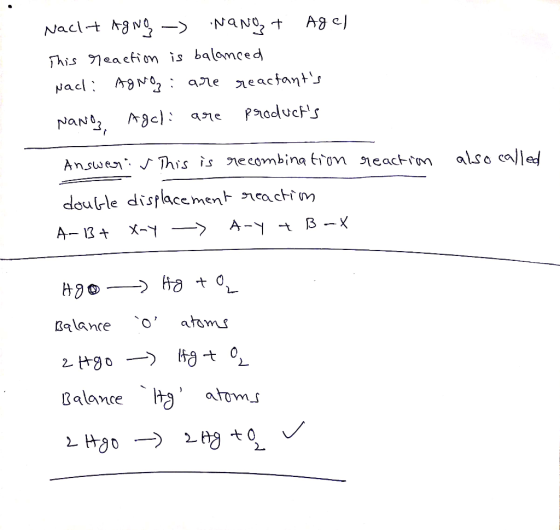
Which statement is TRUE about the reaction below? NaCl + AgNO3 ---> NaNO3 + Agci This...
2. When solutions of AgNO3 and NaCl react, the balanced molecular equation is: AgNO3(aq) + NaCl(aq)...
 2. When solutions of AgNO3 and NaCl react, the balanced molecular equation is: AgNO3(aq) + NaCl(aq) → AgCl(s) + NaNO3(aq) How much AgCl is produced when 3.10 g of AgNO3 reacts with excess NaCl? a. 1.55 g b. 2.62 c. 4.17 g d. 6.20 g 1. Given the reaction 2 HgO(s) → 2 Hg(1) + O2(g). What weight of elemental mercury will be obtained by the decomposition of 94.5 g of HgO? a. 43.8 g b. 78.5 g c. 87.5...
For the reactions below, which reactions have negative entropy? 1. AgNO3(aq) + NaCl(aq) --> AgCl(s) +...
 For the reactions below, which reactions have negative entropy? 1. AgNO3(aq) + NaCl(aq) --> AgCl(s) + NaNO3(aq) 2. H2O(g) + CO2(8) --> H2CO3(aq) 3. H2(g) +12(8) --> 2 HI(g) 4. C2H2O2(g) --> 2 CO(g) + H2(g) 5. H2O(g) --> H2O(1) O 2, 3, 4 1, 2,5 1,4,5 0 2,4
What is true about the following reaction at 25°C?<br /> HBrO(aq) + NaCl(aq) = NaBrO(aq) +...
 What is true about the following reaction at 25°C?<br /> HBrO(aq) + NaCl(aq) = NaBrO(aq) + HCl(aq) OK> 1 hence there will be mostly products at equilibrium. OK> 1 hence there will be mostly reactants at equilibrium. OK< 1 hence there will be mostly products at equilibrium. OK< 1 hence there will be mostly reactants at equilibrium. Question 8 (1 point) Which of the following would be more soluble in an acidic solution?<br />i. LiBr(s)<br /> ji. KNO3(s) O both...
Question 4 1 pts Which of the following mole ratios CANNOT be derived from the reaction 2 502 (g) + O2 (g) + 2 H2...
 Question 4 1 pts Which of the following mole ratios CANNOT be derived from the reaction 2 502 (g) + O2 (g) + 2 H20 (1) --> 2 H2SO4 (aq) ? 02 mol SO2 2 mol H2SO4 2 mol H2SO4 2 mol O2 0 1 mol O2 2 mol H20 O 2 mol O2 1 mol O2 2 mol H20 2 mol SO2 Question 1 1 pts What do the coefficients in a balanced equation tell us? Mark ALL that...
Answer: 19) The reaction between A (light color spheres) and reactant B (dark color spheres) is...
 Answer: 19) The reaction between A (light color spheres) and reactant B (dark color spheres) is shown in the following diagram: Based on this diagram, which equation best describes the reaction? A) A + B ...-> AB B) Az + 4B -----> 2AB, C) 2A + B ---> 2AB2 D) 4A2 + 4B ----> 4AB2 E) 10A + 5B: ------> 5A,B, Answer:( ) 58) Hydrogen cyanide (HCN) is a poisonous gas that has been used to execute prisoners in the...
RODOX EXAMINATION An oxidation-reduction reaction involves the (1) sharing of electrons &n
RODOX EXAMINATION An oxidation-reduction reaction involves the (1) sharing of electrons (3) transfer of electrons (2) sharing of protons (4) transfer of protons In this reaction, CO→ 2 CO + O2 the oxidation number of carbon changes from: (1) 0 to +4 (3) +3 to 0 (2) +2 to +4 (4) +4 to +2 Which balanced equation represents a redox reaction? AgNO3 (aq) +NaCl (aq) →AgCl (s) +NaNO3 (aq) H2CO3 (aq)...
1. Which statement about a balanced chemical reaction equation is always correct? The total number of...
 1. Which statement about a balanced chemical reaction equation is always correct? The total number of moles of the products equals the total number of moles of the reactants. b. The sum of the masses of gaseous reactants equals the sum of the masses of gaseous products. The sum of the stoichiometric coefficients for the products equals the sum of the stoichiometric coefficients for the reactants. The number of atoms of the products is higher to the numbers of atoms...
6. (1 pt) Which represents an ENDOTHERMIC reaction? a. 10 kJ + reactants - products b....
 6. (1 pt) Which represents an ENDOTHERMIC reaction? a. 10 kJ + reactants - products b. reactants-> products + 10 kJ C reactants - products d. reactants-products 7. (1 pt) Which represents a reaction that requires a catalyst? a. 10 kJ + reactants-> products b. reactants -> products + 10 kJ c. reactants products d. reactants-> products 8. (1 pt) Which represents reversible reaction? a. 10 kJ + reactants -> products b. reactants-> products + 10 kJ C. reactants products...
I am very lost. help Question 9 (1 point) What is true about the following reaction...
 I am very lost. help
Question 9 (1 point) What is true about the following reaction at 25°C?<br /> HBrO(aq) + NaOH(aq) = NaBrO(aq) + H2O(1) OK> 1 hence there will be mostly products at equilibrium. OK> 1 hence there will be mostly reactants at equilibrium. OK< 1 hence there will be mostly products at equilibrium. OK< 1 hence there will be mostly reactants at equilibrium. Question 10 (1 point) What is true about the following reaction at 25°C?<br />...
I am very lost. help
Question 9 (1 point) What is true about the following reaction at 25°C?<br /> HBrO(aq) + NaOH(aq) = NaBrO(aq) + H2O(1) OK> 1 hence there will be mostly products at equilibrium. OK> 1 hence there will be mostly reactants at equilibrium. OK< 1 hence there will be mostly products at equilibrium. OK< 1 hence there will be mostly reactants at equilibrium. Question 10 (1 point) What is true about the following reaction at 25°C?<br />...
30) At constant pressure and temperature, which statement is true? A) All reactions for which k...
 30) At constant pressure and temperature, which statement is true? A) All reactions for which k < 1 are spontaneous B) All reactions for which AG are spontaneous C) All reactions for which AH<0 are spontaneous. D) All reactions for which AS <0 are spontaneous 11) 11) Consider the galvanic cell, Pb(s) IP20) Cu2+(a) Cu(s). Which one of the following changes to the cell would cause the cell potential to increase (ie, become more positive)? A) increase the mass of...
 2. When solutions of AgNO3 and NaCl react, the balanced molecular equation is: AgNO3(aq) + NaCl(aq) → AgCl(s) + NaNO3(aq) How much AgCl is produced when 3.10 g of AgNO3 reacts with excess NaCl? a. 1.55 g b. 2.62 c. 4.17 g d. 6.20 g 1. Given the reaction 2 HgO(s) → 2 Hg(1) + O2(g). What weight of elemental mercury will be obtained by the decomposition of 94.5 g of HgO? a. 43.8 g b. 78.5 g c. 87.5...
 For the reactions below, which reactions have negative entropy? 1. AgNO3(aq) + NaCl(aq) --> AgCl(s) + NaNO3(aq) 2. H2O(g) + CO2(8) --> H2CO3(aq) 3. H2(g) +12(8) --> 2 HI(g) 4. C2H2O2(g) --> 2 CO(g) + H2(g) 5. H2O(g) --> H2O(1) O 2, 3, 4 1, 2,5 1,4,5 0 2,4
 What is true about the following reaction at 25°C?<br /> HBrO(aq) + NaCl(aq) = NaBrO(aq) + HCl(aq) OK> 1 hence there will be mostly products at equilibrium. OK> 1 hence there will be mostly reactants at equilibrium. OK< 1 hence there will be mostly products at equilibrium. OK< 1 hence there will be mostly reactants at equilibrium. Question 8 (1 point) Which of the following would be more soluble in an acidic solution?<br />i. LiBr(s)<br /> ji. KNO3(s) O both...
 Question 4 1 pts Which of the following mole ratios CANNOT be derived from the reaction 2 502 (g) + O2 (g) + 2 H20 (1) --> 2 H2SO4 (aq) ? 02 mol SO2 2 mol H2SO4 2 mol H2SO4 2 mol O2 0 1 mol O2 2 mol H20 O 2 mol O2 1 mol O2 2 mol H20 2 mol SO2 Question 1 1 pts What do the coefficients in a balanced equation tell us? Mark ALL that...
 Answer: 19) The reaction between A (light color spheres) and reactant B (dark color spheres) is shown in the following diagram: Based on this diagram, which equation best describes the reaction? A) A + B ...-> AB B) Az + 4B -----> 2AB, C) 2A + B ---> 2AB2 D) 4A2 + 4B ----> 4AB2 E) 10A + 5B: ------> 5A,B, Answer:( ) 58) Hydrogen cyanide (HCN) is a poisonous gas that has been used to execute prisoners in the...
 1. Which statement about a balanced chemical reaction equation is always correct? The total number of moles of the products equals the total number of moles of the reactants. b. The sum of the masses of gaseous reactants equals the sum of the masses of gaseous products. The sum of the stoichiometric coefficients for the products equals the sum of the stoichiometric coefficients for the reactants. The number of atoms of the products is higher to the numbers of atoms...
 6. (1 pt) Which represents an ENDOTHERMIC reaction? a. 10 kJ + reactants - products b. reactants-> products + 10 kJ C reactants - products d. reactants-products 7. (1 pt) Which represents a reaction that requires a catalyst? a. 10 kJ + reactants-> products b. reactants -> products + 10 kJ c. reactants products d. reactants-> products 8. (1 pt) Which represents reversible reaction? a. 10 kJ + reactants -> products b. reactants-> products + 10 kJ C. reactants products...
 I am very lost. help
Question 9 (1 point) What is true about the following reaction at 25°C?<br /> HBrO(aq) + NaOH(aq) = NaBrO(aq) + H2O(1) OK> 1 hence there will be mostly products at equilibrium. OK> 1 hence there will be mostly reactants at equilibrium. OK< 1 hence there will be mostly products at equilibrium. OK< 1 hence there will be mostly reactants at equilibrium. Question 10 (1 point) What is true about the following reaction at 25°C?<br />...
I am very lost. help
Question 9 (1 point) What is true about the following reaction at 25°C?<br /> HBrO(aq) + NaOH(aq) = NaBrO(aq) + H2O(1) OK> 1 hence there will be mostly products at equilibrium. OK> 1 hence there will be mostly reactants at equilibrium. OK< 1 hence there will be mostly products at equilibrium. OK< 1 hence there will be mostly reactants at equilibrium. Question 10 (1 point) What is true about the following reaction at 25°C?<br />...
 30) At constant pressure and temperature, which statement is true? A) All reactions for which k < 1 are spontaneous B) All reactions for which AG are spontaneous C) All reactions for which AH<0 are spontaneous. D) All reactions for which AS <0 are spontaneous 11) 11) Consider the galvanic cell, Pb(s) IP20) Cu2+(a) Cu(s). Which one of the following changes to the cell would cause the cell potential to increase (ie, become more positive)? A) increase the mass of...
Most questions answered within 3 hours.
-
Where is the error in this code sequence?
String s1 = "Hello";
String s2 = "ello";...
asked 10 months ago -
Financial data for Joel de Paris, Inc., for last year
follow:
Joel de Paris, Inc.
Balance...
asked 10 months ago -
Consider this reaction:
Al2(SO4)3 (aq)+ BaCl3
(aq) Al2Cl6 (aq)- +
3BaSO4(s) . What is the...
asked 10 months ago -
Suppose that Savneet is considering increasing her
recent random sample from 20 car rentals to 40...
asked 10 months ago -
Trucks arrive at an unloading terminal at an average rate of 120
per hour.
Trucks arrive...
asked 10 months ago -
Why are methanol and ethanol completely soluble in water while
octanol is not very little soluble....
asked 10 months ago -
A facilities manager at a university reads in a research report
that the mean amount of...
asked 10 months ago -
When the CuSO4 is rehydrated by adding water to the anhydrous
compound, is this an endothermic...
asked 10 months ago -
A ray of sunlight is passing from diamond into crown glass; the
angle of incidence is...
asked 10 months ago -
A block of mass 0.249 kg is placed on top of a light, vertical
spring of...
asked 10 months ago -
how do the kidneys compensate in the presences of acidosis
a) trigger hyperventilate
b) reserve acid...
asked 10 months ago -
Question 501 pts
The rental rate of capital to the firm increases. Which of the
following...
asked 10 months ago