how to calculate the time? number 15 it says we divide it by 10 but how?

how to calculate the time? number 15 it says we divide it by 10 but how?
Homework Answers
In the pendulum experiment, the time is found by using a stop watch. The pendulum is released at a particular angle and at the same time of the releasing,a stopwatch is started and at the moment when the bob of the pendulum completes exactly 10 oscillations ( to and fro motion) the stop watch is stopped and the time is noted.
Time period of a pendulum is the time taken by it for one complete cycle. Since we have calculated the time for 10 oscillations, the perod is calculated by dividing the time by 10, which in turn gives out there time taken for a single oscillation ie, the period of the pendulum.
Add Answer to:
how to calculate the time? number 15 it says we divide it by 10 but how?
step 15 it says that we have to divide the time by 10. how the calculation...
 step 15 it says that we have to divide the time by 10.
how the calculation is done for given column (time for 10 swings).
please show work.
Angle Time for 10 Swings Period (s) 00 19.93 8 HS 0o 19.9 55s oos 9. Click on the pause button at the bottom of the screen. It looks like a button with two parallel lines 10. Next, grab the pendulum and pull it back to to your first chosen angle. It...
step 15 it says that we have to divide the time by 10.
how the calculation is done for given column (time for 10 swings).
please show work.
Angle Time for 10 Swings Period (s) 00 19.93 8 HS 0o 19.9 55s oos 9. Click on the pause button at the bottom of the screen. It looks like a button with two parallel lines 10. Next, grab the pendulum and pull it back to to your first chosen angle. It...
Should we use U chart ?? Because it says number of defects. Can you explain to...
 Should we use U chart ?? Because it says number of defects. Can
you explain to me also how and why u choose ur chart?
Sample N. Number of carpets Inspected N. Of Defects 1 25 12 2 20 5 25 6 25 7 5 15 6 15 7 25 7 15 6 25 5 10 20 10 Construct a suitable control chart for the number of defects per carpet n st st LO. CO
Should we use U chart ?? Because it says number of defects. Can
you explain to me also how and why u choose ur chart?
Sample N. Number of carpets Inspected N. Of Defects 1 25 12 2 20 5 25 6 25 7 5 15 6 15 7 25 7 15 6 25 5 10 20 10 Construct a suitable control chart for the number of defects per carpet n st st LO. CO
When deseasonalizing a time series observation, we divide the actual time series observation by its ___________....
When deseasonalizing a time series observation, we divide the actual time series observation by its ___________. irregular factor cyclical factor seasonal factor weighted aggregate factor
Suppose that, in a divide-and-conquer algorithm, we always divide an instance of size n of a...
 Suppose that, in a divide-and-conquer algorithm, we always
divide an instance of size n of a problem into 5 sub-instances of
size n/3, and the dividing and combining steps take a time
in Θ(n n). Write a recurrence equation for the running time T
(n) , and solve the
equation for T (n)
2. Suppose that, in a divide-and-conquer algorithm, we always divide an instance of size n of a problem into 5 sub-instances of size n/3, and the dividing...
Suppose that, in a divide-and-conquer algorithm, we always
divide an instance of size n of a problem into 5 sub-instances of
size n/3, and the dividing and combining steps take a time
in Θ(n n). Write a recurrence equation for the running time T
(n) , and solve the
equation for T (n)
2. Suppose that, in a divide-and-conquer algorithm, we always divide an instance of size n of a problem into 5 sub-instances of size n/3, and the dividing...
In a repeated measures ANOVA, to calculate MSError, we divide _____ by _____. SSTotal; dfTotal SSBetween;...
In a repeated measures ANOVA, to calculate MSError, we divide _____ by _____. SSTotal; dfTotal SSBetween; dfBetween SSError; dfError SSBetween; dfWithin
Suppose that, in a divide-and-conquer algorithm, we always divide an instance of size n of &nb
Suppose that, in a divide-and-conquer algorithm, we always divide an instance of size n of a problem into n subinstances of size n/3, and the dividing and combining steps take linear time. Write a recurrence equation for the running time T(n), and solve this recurrence equation for T(n). Show your solution in order notation. please help solve this..
In order to calculate the relative sampling standard deviation for each particle type, we divide the...
 In order to calculate the relative sampling standard deviation for each particle type, we divide the standard deviation in the sampling method by the expected number of each particle type. standard deviation in sampling operation=Vnpq where n is the number of particles in the sample, p is the probability of drawing type A particles, and q is the probability of drawing type B particles. If there were 2.30 x 10⁵ Na2SO4 particles and 21600000 K2SO4 particles in the original 100.00...
Question #4 (15 points) In class, we discussed a divide-and-conquer algorithm for matrix multiplication that involved...
 Question #4 (15 points) In class, we discussed a divide-and-conquer algorithm for matrix multiplication that involved solving eight subproblems, each half the size of the original, and performing a constant number of e(n) addition operations. Strassen's Algo- rithm, which we did not cover, reduces the number of (half-sized) subproblems to seven, with a constant number of e(n) addition and subtraction operations. Provide clear, concise answers to each of the following related questions. • (7 points). Express the runtime of Strassen's...
how do you solve these? this is all the information available. it says to calculate for...
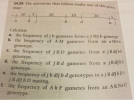 how do you solve these?
this is all the information available. it says to calculate for
each
14.26 The questions that follow make use of this тар: + 10 15 20 10 ki 20 + 151 Calculate a. the frequency of jb gametes from a J B/j b genotype, 0. the frequency of AM gametes from an a M/Am genotype. c. the frequency of JBD gametes from a j B dij bo genotype. d. the frequency of JB d gametes...
how do you solve these?
this is all the information available. it says to calculate for
each
14.26 The questions that follow make use of this тар: + 10 15 20 10 ki 20 + 151 Calculate a. the frequency of jb gametes from a J B/j b genotype, 0. the frequency of AM gametes from an a M/Am genotype. c. the frequency of JBD gametes from a j B dij bo genotype. d. the frequency of JB d gametes...
A survey has 1,000 people. If we divide people into ten deciles according to their income,...
A survey has 1,000 people. If we divide people into ten deciles according to their income, how many people will be assigned to the fifth decile? A survey has 1,000 people. If we divide people into ten deciles according to their income, how many people will be assigned to the second decile?
 step 15 it says that we have to divide the time by 10.
how the calculation is done for given column (time for 10 swings).
please show work.
Angle Time for 10 Swings Period (s) 00 19.93 8 HS 0o 19.9 55s oos 9. Click on the pause button at the bottom of the screen. It looks like a button with two parallel lines 10. Next, grab the pendulum and pull it back to to your first chosen angle. It...
step 15 it says that we have to divide the time by 10.
how the calculation is done for given column (time for 10 swings).
please show work.
Angle Time for 10 Swings Period (s) 00 19.93 8 HS 0o 19.9 55s oos 9. Click on the pause button at the bottom of the screen. It looks like a button with two parallel lines 10. Next, grab the pendulum and pull it back to to your first chosen angle. It...
 Should we use U chart ?? Because it says number of defects. Can
you explain to me also how and why u choose ur chart?
Sample N. Number of carpets Inspected N. Of Defects 1 25 12 2 20 5 25 6 25 7 5 15 6 15 7 25 7 15 6 25 5 10 20 10 Construct a suitable control chart for the number of defects per carpet n st st LO. CO
Should we use U chart ?? Because it says number of defects. Can
you explain to me also how and why u choose ur chart?
Sample N. Number of carpets Inspected N. Of Defects 1 25 12 2 20 5 25 6 25 7 5 15 6 15 7 25 7 15 6 25 5 10 20 10 Construct a suitable control chart for the number of defects per carpet n st st LO. CO
 Suppose that, in a divide-and-conquer algorithm, we always
divide an instance of size n of a problem into 5 sub-instances of
size n/3, and the dividing and combining steps take a time
in Θ(n n). Write a recurrence equation for the running time T
(n) , and solve the
equation for T (n)
2. Suppose that, in a divide-and-conquer algorithm, we always divide an instance of size n of a problem into 5 sub-instances of size n/3, and the dividing...
Suppose that, in a divide-and-conquer algorithm, we always
divide an instance of size n of a problem into 5 sub-instances of
size n/3, and the dividing and combining steps take a time
in Θ(n n). Write a recurrence equation for the running time T
(n) , and solve the
equation for T (n)
2. Suppose that, in a divide-and-conquer algorithm, we always divide an instance of size n of a problem into 5 sub-instances of size n/3, and the dividing...
 In order to calculate the relative sampling standard deviation for each particle type, we divide the standard deviation in the sampling method by the expected number of each particle type. standard deviation in sampling operation=Vnpq where n is the number of particles in the sample, p is the probability of drawing type A particles, and q is the probability of drawing type B particles. If there were 2.30 x 10⁵ Na2SO4 particles and 21600000 K2SO4 particles in the original 100.00...
 Question #4 (15 points) In class, we discussed a divide-and-conquer algorithm for matrix multiplication that involved solving eight subproblems, each half the size of the original, and performing a constant number of e(n) addition operations. Strassen's Algo- rithm, which we did not cover, reduces the number of (half-sized) subproblems to seven, with a constant number of e(n) addition and subtraction operations. Provide clear, concise answers to each of the following related questions. • (7 points). Express the runtime of Strassen's...
 how do you solve these?
this is all the information available. it says to calculate for
each
14.26 The questions that follow make use of this тар: + 10 15 20 10 ki 20 + 151 Calculate a. the frequency of jb gametes from a J B/j b genotype, 0. the frequency of AM gametes from an a M/Am genotype. c. the frequency of JBD gametes from a j B dij bo genotype. d. the frequency of JB d gametes...
how do you solve these?
this is all the information available. it says to calculate for
each
14.26 The questions that follow make use of this тар: + 10 15 20 10 ki 20 + 151 Calculate a. the frequency of jb gametes from a J B/j b genotype, 0. the frequency of AM gametes from an a M/Am genotype. c. the frequency of JBD gametes from a j B dij bo genotype. d. the frequency of JB d gametes...
Most questions answered within 3 hours.
-
Where is the error in this code sequence?
String s1 = "Hello";
String s2 = "ello";...
asked 10 months ago -
Financial data for Joel de Paris, Inc., for last year
follow:
Joel de Paris, Inc.
Balance...
asked 10 months ago -
Consider this reaction:
Al2(SO4)3 (aq)+ BaCl3
(aq) Al2Cl6 (aq)- +
3BaSO4(s) . What is the...
asked 10 months ago -
Suppose that Savneet is considering increasing her
recent random sample from 20 car rentals to 40...
asked 10 months ago -
Trucks arrive at an unloading terminal at an average rate of 120
per hour.
Trucks arrive...
asked 10 months ago -
Why are methanol and ethanol completely soluble in water while
octanol is not very little soluble....
asked 10 months ago -
A facilities manager at a university reads in a research report
that the mean amount of...
asked 10 months ago -
When the CuSO4 is rehydrated by adding water to the anhydrous
compound, is this an endothermic...
asked 10 months ago -
A ray of sunlight is passing from diamond into crown glass; the
angle of incidence is...
asked 10 months ago -
A block of mass 0.249 kg is placed on top of a light, vertical
spring of...
asked 10 months ago -
how do the kidneys compensate in the presences of acidosis
a) trigger hyperventilate
b) reserve acid...
asked 10 months ago -
Question 501 pts
The rental rate of capital to the firm increases. Which of the
following...
asked 10 months ago