
Homework Answers
Add Answer to:
Partial Differential Equations 1. (20 points) Consider the problem u" (x)+ u(x) (0.1) f(x) 1 (0.2)...
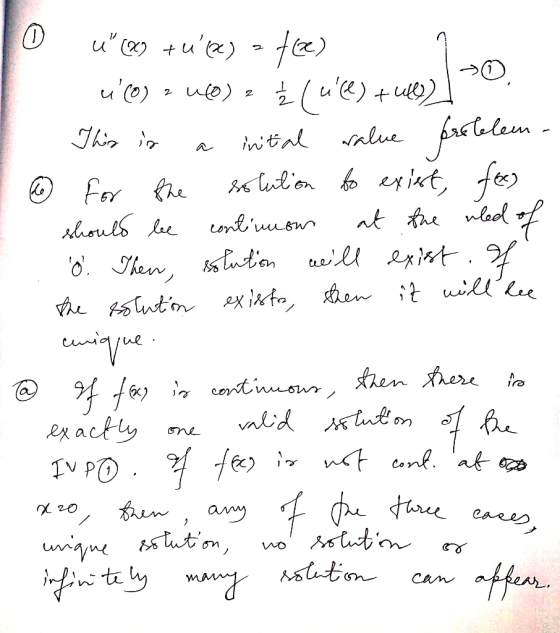
1) Does the problem = f(x), wr(0) = ur (1) 0 (1) da2 always have a...
 1) Does the problem = f(x), wr(0) = ur (1) 0 (1) da2 always have a solution? If not, what condition must f(x) satisfy so that a function u(x) satisfying (1) exists? ( Hint: integrate the equation once between 0 and 1.) In this case, is u(x) unique? ( Hint: does the problem with f = 0 have only one solution?)
2. Consider the following 1-D wave equation with initial condition u (x, 0)- F (x) where F(x) is a given function. a) Show that u (x, t)-F (x - t) is a solution to the given PDE. b) If the function F...
 2. Consider the following 1-D wave equation with initial condition u (x, 0)- F (x) where F(x) is a given function. a) Show that u (x, t)-F (x - t) is a solution to the given PDE. b) If the function F is given as 1; x< 10 x > 10 u(x, 0) = F(x) = use part (a) to write the solution u(x, t) c) Sketch u(x,0) and u(x,1) on the same u-versus-x graph d) Explain in your own...
please answer b. and c. Problem 1. Consider the differential equation given by (a) On the...
 please answer b. and c.
Problem 1. Consider the differential equation given by (a) On the axes provided below, sketch a slope field for the given differential equation at the nine points indicated. locales de mor t e wold qolution to the given differential equation with the initial condition (b) Let y = f(x) be the particular solution to the given differential equation with the initial condition f(0) = 3. Use Euler's method starting at x = 0, with a...
please answer b. and c.
Problem 1. Consider the differential equation given by (a) On the axes provided below, sketch a slope field for the given differential equation at the nine points indicated. locales de mor t e wold qolution to the given differential equation with the initial condition (b) Let y = f(x) be the particular solution to the given differential equation with the initial condition f(0) = 3. Use Euler's method starting at x = 0, with a...
EXERCISE 3.20 Consider the problem ut =u" + u for u(0,t) u(1, t) 0, u(x,0) f(x). ze(0, 1), t>0, S...
 partial differential equations
EXERCISE 3.20 Consider the problem ut =u" + u for u(0,t) u(1, t) 0, u(x,0) f(x). ze(0, 1), t>0, Show that dt and conclude that Use this estimate to bound the difference between two solutions in terms of the difference between the initial functions. Does this problem have a unique solution for each initial function f?
EXERCISE 3.20 Consider the problem ut =u" + u for u(0,t) u(1, t) 0, u(x,0) f(x). ze(0, 1), t>0, Show that...
partial differential equations
EXERCISE 3.20 Consider the problem ut =u" + u for u(0,t) u(1, t) 0, u(x,0) f(x). ze(0, 1), t>0, Show that dt and conclude that Use this estimate to bound the difference between two solutions in terms of the difference between the initial functions. Does this problem have a unique solution for each initial function f?
EXERCISE 3.20 Consider the problem ut =u" + u for u(0,t) u(1, t) 0, u(x,0) f(x). ze(0, 1), t>0, Show that...
(20 points) Consider the following joint distribution of X and Y ㄨㄧㄚ 0 0.1 0.2 1 0.3 0.4 (a) Find the marginal distributions of X and Y. (i.e., Px(x) and Py()) (b) Find the conditional distributio...
 (20 points) Consider the following joint distribution of X and Y ㄨㄧㄚ 0 0.1 0.2 1 0.3 0.4 (a) Find the marginal distributions of X and Y. (i.e., Px(x) and Py()) (b) Find the conditional distribution of X given Y-0. (i.e., Pxjy (xY-0)) (c) Compute EXIY-01 and Var(X)Y = 0). (d) Find the covariance between X and Y. (i.e., Cov(X, Y)) (e) Are X and Y independent? Justify your answer.
(20 points) Consider the following joint distribution of X and...
(20 points) Consider the following joint distribution of X and Y ㄨㄧㄚ 0 0.1 0.2 1 0.3 0.4 (a) Find the marginal distributions of X and Y. (i.e., Px(x) and Py()) (b) Find the conditional distribution of X given Y-0. (i.e., Pxjy (xY-0)) (c) Compute EXIY-01 and Var(X)Y = 0). (d) Find the covariance between X and Y. (i.e., Cov(X, Y)) (e) Are X and Y independent? Justify your answer.
(20 points) Consider the following joint distribution of X and...
Problem 1 (20 points) Consider the PDE for the function u(x, t) e 0<x<T, t> 0...
 Problem 1 (20 points) Consider the PDE for the function u(x, t) e 0<x<T, t> 0 with the boundary conditions n(0, t) 0, u(T, t) 0, t> 0 and the initial condition 0 u(x, 0) 1+cos(2a), (a) Give a one-sentence physical interpretation of this problem. (b) Find the solution u(x, t) using a Fourier cosine series representation An (t) cos(nax) u(x,t)= Ao(t) + n=1
1. Consider the Partial Differential Equation ot u(0,t) = u(r, t) = 0 a(x, 0)-x (Y), sin (! We know the general solution to the Basic Heat Equation is u(z,t)-Σ b e ). n= 1 (b) Find the unique solutio...
 1. Consider the Partial Differential Equation ot u(0,t) = u(r, t) = 0 a(x, 0)-x (Y), sin (! We know the general solution to the Basic Heat Equation is u(z,t)-Σ b e ). n= 1 (b) Find the unique solution that satisfies the given initial condition ur, 0) -2. (Hint: bn is given by the Fourier Coefficients-f(z),sin(Y- UsefulFormulas/Facts for PDEs/Fourier Series 1)2 (TiT) » x sin aL(1)1 a24(부) (TiT) 1)+1 0
1. Consider the Partial Differential Equation ot u(0,t) =...
1. Consider the Partial Differential Equation ot u(0,t) = u(r, t) = 0 a(x, 0)-x (Y), sin (! We know the general solution to the Basic Heat Equation is u(z,t)-Σ b e ). n= 1 (b) Find the unique solution that satisfies the given initial condition ur, 0) -2. (Hint: bn is given by the Fourier Coefficients-f(z),sin(Y- UsefulFormulas/Facts for PDEs/Fourier Series 1)2 (TiT) » x sin aL(1)1 a24(부) (TiT) 1)+1 0
1. Consider the Partial Differential Equation ot u(0,t) =...
Consider a potential well defined as U(x) = for x < 0, U(x) = 0 for 0 < x < L, and U(x) = U0 > 0 for x > L (see the following figure).
 Consider a potential well defined as \(U(x)=\infty\) for \(x<0, U(x)=0\)for \(0<x<L,\)and \(U(x)=U_{0}>0\) for \(x>L\) (see the following figure). Consider a particle with mass \(m\) and kinetic energy \(E<U_{0}\)that is trapped in the well. (a) The boundary condition at the infinite wall ( \(x=\)0) is \(\psi(x)=0\). What must the form of the function \(\psi(x)\) for \(0<x<L\)be in order to satisfy both the Schrödinger equation and this boundary condition? (b) The wave function must remain finite as \(x \rightarrow \infty\). What must...
(b) Let f 0, 1-R be a C2 function and let g, h: [0, 00)-R be C1. Consider the initial-boundary value problem kwr w(...
 (b) Let f 0, 1-R be a C2 function and let g, h: [0, 00)-R be C1. Consider the initial-boundary value problem kwr w(r, 0) f(a) w(0, t) g(t) w(1, t) h(t) for a function w: [0,1 x [0, 0)- R such that w, wn, and wa exist and are continuous. Show that the solution to this problem is unique, that is, if w1 and w2 [0, 1] x [0, 00)- R both satisfy these conditions, then w1 = w2....
Consider the partial differential equation, with the initial condition: 1 2yuz + 3x?uy = 9x?y?, u(x,0)...
 Consider the partial differential equation, with the initial condition: 1 2yuz + 3x?uy = 9x?y?, u(x,0) = x3 + 1 Find the characteristic curves and the orthogonal trajectories and sketch both on the same graph. Find a solution of the partial differential equation with the given initial con- dition valid in the first quadrant of the (x, y)-plane. Is this solution unique? Explain.
 1) Does the problem = f(x), wr(0) = ur (1) 0 (1) da2 always have a solution? If not, what condition must f(x) satisfy so that a function u(x) satisfying (1) exists? ( Hint: integrate the equation once between 0 and 1.) In this case, is u(x) unique? ( Hint: does the problem with f = 0 have only one solution?)
 2. Consider the following 1-D wave equation with initial condition u (x, 0)- F (x) where F(x) is a given function. a) Show that u (x, t)-F (x - t) is a solution to the given PDE. b) If the function F is given as 1; x< 10 x > 10 u(x, 0) = F(x) = use part (a) to write the solution u(x, t) c) Sketch u(x,0) and u(x,1) on the same u-versus-x graph d) Explain in your own...
 please answer b. and c.
Problem 1. Consider the differential equation given by (a) On the axes provided below, sketch a slope field for the given differential equation at the nine points indicated. locales de mor t e wold qolution to the given differential equation with the initial condition (b) Let y = f(x) be the particular solution to the given differential equation with the initial condition f(0) = 3. Use Euler's method starting at x = 0, with a...
please answer b. and c.
Problem 1. Consider the differential equation given by (a) On the axes provided below, sketch a slope field for the given differential equation at the nine points indicated. locales de mor t e wold qolution to the given differential equation with the initial condition (b) Let y = f(x) be the particular solution to the given differential equation with the initial condition f(0) = 3. Use Euler's method starting at x = 0, with a...
 partial differential equations
EXERCISE 3.20 Consider the problem ut =u" + u for u(0,t) u(1, t) 0, u(x,0) f(x). ze(0, 1), t>0, Show that dt and conclude that Use this estimate to bound the difference between two solutions in terms of the difference between the initial functions. Does this problem have a unique solution for each initial function f?
EXERCISE 3.20 Consider the problem ut =u" + u for u(0,t) u(1, t) 0, u(x,0) f(x). ze(0, 1), t>0, Show that...
partial differential equations
EXERCISE 3.20 Consider the problem ut =u" + u for u(0,t) u(1, t) 0, u(x,0) f(x). ze(0, 1), t>0, Show that dt and conclude that Use this estimate to bound the difference between two solutions in terms of the difference between the initial functions. Does this problem have a unique solution for each initial function f?
EXERCISE 3.20 Consider the problem ut =u" + u for u(0,t) u(1, t) 0, u(x,0) f(x). ze(0, 1), t>0, Show that...
 (20 points) Consider the following joint distribution of X and Y ㄨㄧㄚ 0 0.1 0.2 1 0.3 0.4 (a) Find the marginal distributions of X and Y. (i.e., Px(x) and Py()) (b) Find the conditional distribution of X given Y-0. (i.e., Pxjy (xY-0)) (c) Compute EXIY-01 and Var(X)Y = 0). (d) Find the covariance between X and Y. (i.e., Cov(X, Y)) (e) Are X and Y independent? Justify your answer.
(20 points) Consider the following joint distribution of X and...
(20 points) Consider the following joint distribution of X and Y ㄨㄧㄚ 0 0.1 0.2 1 0.3 0.4 (a) Find the marginal distributions of X and Y. (i.e., Px(x) and Py()) (b) Find the conditional distribution of X given Y-0. (i.e., Pxjy (xY-0)) (c) Compute EXIY-01 and Var(X)Y = 0). (d) Find the covariance between X and Y. (i.e., Cov(X, Y)) (e) Are X and Y independent? Justify your answer.
(20 points) Consider the following joint distribution of X and...
 Problem 1 (20 points) Consider the PDE for the function u(x, t) e 0<x<T, t> 0 with the boundary conditions n(0, t) 0, u(T, t) 0, t> 0 and the initial condition 0 u(x, 0) 1+cos(2a), (a) Give a one-sentence physical interpretation of this problem. (b) Find the solution u(x, t) using a Fourier cosine series representation An (t) cos(nax) u(x,t)= Ao(t) + n=1
 1. Consider the Partial Differential Equation ot u(0,t) = u(r, t) = 0 a(x, 0)-x (Y), sin (! We know the general solution to the Basic Heat Equation is u(z,t)-Σ b e ). n= 1 (b) Find the unique solution that satisfies the given initial condition ur, 0) -2. (Hint: bn is given by the Fourier Coefficients-f(z),sin(Y- UsefulFormulas/Facts for PDEs/Fourier Series 1)2 (TiT) » x sin aL(1)1 a24(부) (TiT) 1)+1 0
1. Consider the Partial Differential Equation ot u(0,t) =...
1. Consider the Partial Differential Equation ot u(0,t) = u(r, t) = 0 a(x, 0)-x (Y), sin (! We know the general solution to the Basic Heat Equation is u(z,t)-Σ b e ). n= 1 (b) Find the unique solution that satisfies the given initial condition ur, 0) -2. (Hint: bn is given by the Fourier Coefficients-f(z),sin(Y- UsefulFormulas/Facts for PDEs/Fourier Series 1)2 (TiT) » x sin aL(1)1 a24(부) (TiT) 1)+1 0
1. Consider the Partial Differential Equation ot u(0,t) =...
 (b) Let f 0, 1-R be a C2 function and let g, h: [0, 00)-R be C1. Consider the initial-boundary value problem kwr w(r, 0) f(a) w(0, t) g(t) w(1, t) h(t) for a function w: [0,1 x [0, 0)- R such that w, wn, and wa exist and are continuous. Show that the solution to this problem is unique, that is, if w1 and w2 [0, 1] x [0, 00)- R both satisfy these conditions, then w1 = w2....
 Consider the partial differential equation, with the initial condition: 1 2yuz + 3x?uy = 9x?y?, u(x,0) = x3 + 1 Find the characteristic curves and the orthogonal trajectories and sketch both on the same graph. Find a solution of the partial differential equation with the given initial con- dition valid in the first quadrant of the (x, y)-plane. Is this solution unique? Explain.
Most questions answered within 3 hours.
-
Where is the error in this code sequence?
String s1 = "Hello";
String s2 = "ello";...
asked 11 months ago -
Financial data for Joel de Paris, Inc., for last year
follow:
Joel de Paris, Inc.
Balance...
asked 11 months ago -
Consider this reaction:
Al2(SO4)3 (aq)+ BaCl3
(aq) Al2Cl6 (aq)- +
3BaSO4(s) . What is the...
asked 11 months ago -
Suppose that Savneet is considering increasing her
recent random sample from 20 car rentals to 40...
asked 11 months ago -
Trucks arrive at an unloading terminal at an average rate of 120
per hour.
Trucks arrive...
asked 11 months ago -
Why are methanol and ethanol completely soluble in water while
octanol is not very little soluble....
asked 11 months ago -
A facilities manager at a university reads in a research report
that the mean amount of...
asked 11 months ago -
When the CuSO4 is rehydrated by adding water to the anhydrous
compound, is this an endothermic...
asked 11 months ago -
A ray of sunlight is passing from diamond into crown glass; the
angle of incidence is...
asked 11 months ago -
A block of mass 0.249 kg is placed on top of a light, vertical
spring of...
asked 11 months ago -
how do the kidneys compensate in the presences of acidosis
a) trigger hyperventilate
b) reserve acid...
asked 11 months ago -
Question 501 pts
The rental rate of capital to the firm increases. Which of the
following...
asked 11 months ago