

Homework Answers
Add Answer to:
volve separation and purification of th Fom unwanted side products. Common methods of separation an edimentation,...
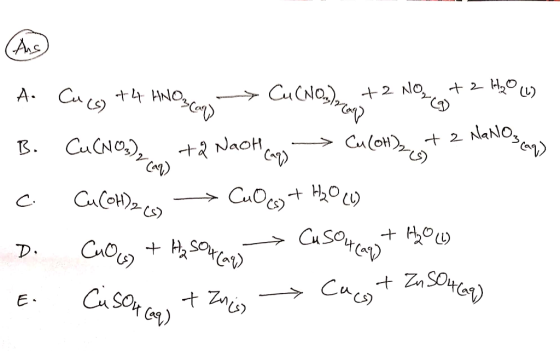
Complete and balance the unfinished equations: A) Cu(s) + 4HNO3(aq) ? Cu(NO3)2(aq) + 2NO2(g) +2H20(l) B)...
Complete and balance the unfinished equations: A) Cu(s) + 4HNO3(aq) ? Cu(NO3)2(aq) + 2NO2(g) +2H20(l) B) Cu(NO3)2(aq) +NaOH(aq) ? ? C) Cu(OH)2(s) ? CuO(s) + H2O(l) D) CuO(s) + H2SO4(aq) ? CuSO4(aq) + H2O(l) E) CuSO4(aq) + Zn(s) ? ?
there are reactions from 1 to 5. Q: what is %yield of Cu?, and % error?...
there are reactions from 1 to 5. Q: what is %yield of Cu?, and % error? -reaction 1: 0.2134g of Cu, 2ml 6Mol HNO3 -reaction 5:0.1646g of Cu (solid) left. Balanced Equation reaction.1 Cu (s) + 4HNO3(aq) → Cu(NO3)2 (aq) + 2NO2 (g) + 2H2O (l) reaction 2: Cu(NO3)2 (aq) + 2NaOH (aq) → Cu(OH)2 (s) + 2NaNO3(aq) reaction 3: Cu(OH)2 (s) → CuO (s) + H2O (l) reaction 4: CuO (s) + H2SO4 (aq) → CuSO4 (aq) + H2O(l)...
Ksp refers to the dissolution reaction of the ionic salts. (a) Write the dissolution reaction for...
 Ksp refers to the dissolution reaction of the ionic salts. (a) Write the dissolution reaction for the ionic solids below. (Use the lowest possible coefficients. Include states-of-matter under the given conditions in your answer.) (i) NaNO3 chemPad Help X.Xº = =+ Greek NaNO3(s) +H20(1) - Na +(aq) + NO3(aq) NaNO_3(s) +H_20(1)-->Na^-+(aq) + NO_34- (aq) Your answer contains an ambiguous or incomplete reaction equation. Check all the components on the reactant-side of the equation. Check all the components on the product-side...
Classify the type of reactions 1. Cu(s) + 4HNO3 (aq) -> Cu(NO3)2(aq) + 2H2O (l) + 2NO2(g) 2. Cu(s) + 4H...
Classify the type of reactions 1. Cu(s) + 4HNO3 (aq) -> Cu(NO3)2(aq) + 2H2O (l) + 2NO2(g) 2. Cu(s) + 4H3O+ (aq) + 2NO3- (aq) -> [Cu(H2O)6]2+ (aq)+ 2NO2(g) 3. [Cu(H2O)6]2+ (aq)+ NaOH (aq)-> Cu(OH)2 (s) + 5H2O (l) 4. Cu(OH)2 (s) (+ heat) -> CuO (s) + H2O (l) 5. CuO (s) + H2SO4 (aq) -> CuSO4 (aq) + H2O(l) 6. CuSO4 (aq) + Zn (s) -> Cu (s) + ZnSO4 (aq) 7. Zn (s) + H2SO4 (aq) -> ZnSO4...
need help balancing the 1st equation then name what type of reaction is occurring for each equation A HNO3(aq) + Cu(...
 need help balancing the 1st equation
then name what type of reaction is occurring for each
equation
A HNO3(aq) + Cu(s) + O2(g) - Cu(NO3)2(aq) + 4H2O(l) +BANO2(g) Cu(NO3)2(aq) + 2 NaOH(aq) - Cu(OH)2(s) +2 NaNO3(aq) rxn. 2 Cu(OH)2(s) - CuO(s) + H2O(l) rxn. 3 rxn. 4 Cuo(s) + H2SO4(aq) CuSO.(aq) + Zn(s) — CuSO4(aq) + H2O(l) + ZnSO4(aq) + Cu(s) rxn. 5
need help balancing the 1st equation
then name what type of reaction is occurring for each
equation
A HNO3(aq) + Cu(s) + O2(g) - Cu(NO3)2(aq) + 4H2O(l) +BANO2(g) Cu(NO3)2(aq) + 2 NaOH(aq) - Cu(OH)2(s) +2 NaNO3(aq) rxn. 2 Cu(OH)2(s) - CuO(s) + H2O(l) rxn. 3 rxn. 4 Cuo(s) + H2SO4(aq) CuSO.(aq) + Zn(s) — CuSO4(aq) + H2O(l) + ZnSO4(aq) + Cu(s) rxn. 5
Name Questions Section 1 1. HNO3(aq) + Cu(s) → Cu(NO3)2 (aq) + _NO2(g) + __ H20...
 Name Questions Section 1 1. HNO3(aq) + Cu(s) → Cu(NO3)2 (aq) + _NO2(g) + __ H20 (1) net ionic equation: Observation: Reaction Type: What is in the solution after the reaction is complete? What color is the gas that evolved from this reaction? 2. _ Cu(NO3)2 (aq) +_ NaOH(aq) → Cu(OH)2 (5) + _ NaNO3(aq) net ionic equation: Observation: Dark blue and thick Reaction Type: What color and texture is the suspended product in this reaction? What is formed in...
(b) The experiment could also be done with solutions of CoCl2 and KOH. What is the...
 (b) The experiment could also be done with solutions of CoCl2 and KOH. What is the balanced net precipitation reaction for this mixture? chemPad 0 Help =-- Creek X. X" Coch (aq) +2KOH(aq) - CO(OH)2 (s) + 2KCI (aq) COCl 2 (aq) + 2KOH( ) COLOH) 2 (s) + 2Cl(aq) Your answer contains an ambiguous or incomplete reaction equation. Check all the components on the product-side of the equation
Write the balanced molecular, total ionic, and net ionic equations for the following reactions. (Include states-of-matter...
Write the balanced molecular, total ionic, and net ionic equations for the following reactions. (Include states-of-matter under the given conditions in your answer. Use the lowest possible whole number coefficients that reflect the reaction stoichiometry.) (a) Cd(OH)2(aq) + HC2H3O2(aq) → Molecular equation chemPad Help Cd(OH)2 (aq) + 2HC2H3O2 (aq) → Cd(C2H3O2)2 (aq) + 2H2O(l) Correct. Total ionic equation chemPad Help Cd(OH)2(aq) + 2HC2H3O2(aq) → Cd2+(aq) +2OH- (aq) +2C2H3O2-(aq) Your answer contains an ambiguous or incomplete reaction equation. Check all the components on the reactant-side...
What is the product containing copper after the reaction of Cu(NO3)2(aq) + NaOH --> Cu(s) O...
 What is the product containing copper after the reaction of Cu(NO3)2(aq) + NaOH --> Cu(s) O Cu(NO3)2(aq) Cuo(s) Cu(OH)2(s) CuSO4(aq) none of these The previous problem had you calculate the mass of carbon dioxide produced when a given mass of potassium carbonate reacted with a given volume of nitric acid. In this reaction with the previously given amounts, what is the limiting reactant? K2CO3 (aq) + 2 HNO3 (aq) --> 2KNO3 (aq) + H20 (1) + CO2 (g) O CO2...
In this laboratory exploration various reactions of copper will illustrate these properties. First, begin with copper...
In this laboratory exploration various reactions of copper will illustrate these properties. First, begin with copper metal. When concentrated nitric acid is added, dramatic changes occur and the metal dissolves forming a brightly colored copper ion-containing solution. Cu(s) + 4HNO3(aq) à Cu(NO3)2(aq) + 2NO2(g) + 2H2O(l) _____________ equation Cu(s) + 4H+ + 4NO3-(aq) à Cu+2(aq) +2NO3-(aq)+ 2NO2(g) + 2H2O(l) _____________ equation Reaction type_______________ What advantage(s) is/are there to the second version of the reaction equation? However, if diluted...
 Ksp refers to the dissolution reaction of the ionic salts. (a) Write the dissolution reaction for the ionic solids below. (Use the lowest possible coefficients. Include states-of-matter under the given conditions in your answer.) (i) NaNO3 chemPad Help X.Xº = =+ Greek NaNO3(s) +H20(1) - Na +(aq) + NO3(aq) NaNO_3(s) +H_20(1)-->Na^-+(aq) + NO_34- (aq) Your answer contains an ambiguous or incomplete reaction equation. Check all the components on the reactant-side of the equation. Check all the components on the product-side...
 need help balancing the 1st equation
then name what type of reaction is occurring for each
equation
A HNO3(aq) + Cu(s) + O2(g) - Cu(NO3)2(aq) + 4H2O(l) +BANO2(g) Cu(NO3)2(aq) + 2 NaOH(aq) - Cu(OH)2(s) +2 NaNO3(aq) rxn. 2 Cu(OH)2(s) - CuO(s) + H2O(l) rxn. 3 rxn. 4 Cuo(s) + H2SO4(aq) CuSO.(aq) + Zn(s) — CuSO4(aq) + H2O(l) + ZnSO4(aq) + Cu(s) rxn. 5
need help balancing the 1st equation
then name what type of reaction is occurring for each
equation
A HNO3(aq) + Cu(s) + O2(g) - Cu(NO3)2(aq) + 4H2O(l) +BANO2(g) Cu(NO3)2(aq) + 2 NaOH(aq) - Cu(OH)2(s) +2 NaNO3(aq) rxn. 2 Cu(OH)2(s) - CuO(s) + H2O(l) rxn. 3 rxn. 4 Cuo(s) + H2SO4(aq) CuSO.(aq) + Zn(s) — CuSO4(aq) + H2O(l) + ZnSO4(aq) + Cu(s) rxn. 5
 Name Questions Section 1 1. HNO3(aq) + Cu(s) → Cu(NO3)2 (aq) + _NO2(g) + __ H20 (1) net ionic equation: Observation: Reaction Type: What is in the solution after the reaction is complete? What color is the gas that evolved from this reaction? 2. _ Cu(NO3)2 (aq) +_ NaOH(aq) → Cu(OH)2 (5) + _ NaNO3(aq) net ionic equation: Observation: Dark blue and thick Reaction Type: What color and texture is the suspended product in this reaction? What is formed in...
 (b) The experiment could also be done with solutions of CoCl2 and KOH. What is the balanced net precipitation reaction for this mixture? chemPad 0 Help =-- Creek X. X" Coch (aq) +2KOH(aq) - CO(OH)2 (s) + 2KCI (aq) COCl 2 (aq) + 2KOH( ) COLOH) 2 (s) + 2Cl(aq) Your answer contains an ambiguous or incomplete reaction equation. Check all the components on the product-side of the equation
 What is the product containing copper after the reaction of Cu(NO3)2(aq) + NaOH --> Cu(s) O Cu(NO3)2(aq) Cuo(s) Cu(OH)2(s) CuSO4(aq) none of these The previous problem had you calculate the mass of carbon dioxide produced when a given mass of potassium carbonate reacted with a given volume of nitric acid. In this reaction with the previously given amounts, what is the limiting reactant? K2CO3 (aq) + 2 HNO3 (aq) --> 2KNO3 (aq) + H20 (1) + CO2 (g) O CO2...
Most questions answered within 3 hours.
-
Where is the error in this code sequence?
String s1 = "Hello";
String s2 = "ello";...
asked 10 months ago -
Financial data for Joel de Paris, Inc., for last year
follow:
Joel de Paris, Inc.
Balance...
asked 10 months ago -
Consider this reaction:
Al2(SO4)3 (aq)+ BaCl3
(aq) Al2Cl6 (aq)- +
3BaSO4(s) . What is the...
asked 10 months ago -
Suppose that Savneet is considering increasing her
recent random sample from 20 car rentals to 40...
asked 10 months ago -
Trucks arrive at an unloading terminal at an average rate of 120
per hour.
Trucks arrive...
asked 10 months ago -
Why are methanol and ethanol completely soluble in water while
octanol is not very little soluble....
asked 10 months ago -
A facilities manager at a university reads in a research report
that the mean amount of...
asked 10 months ago -
When the CuSO4 is rehydrated by adding water to the anhydrous
compound, is this an endothermic...
asked 10 months ago -
A ray of sunlight is passing from diamond into crown glass; the
angle of incidence is...
asked 10 months ago -
A block of mass 0.249 kg is placed on top of a light, vertical
spring of...
asked 10 months ago -
how do the kidneys compensate in the presences of acidosis
a) trigger hyperventilate
b) reserve acid...
asked 10 months ago -
Question 501 pts
The rental rate of capital to the firm increases. Which of the
following...
asked 10 months ago