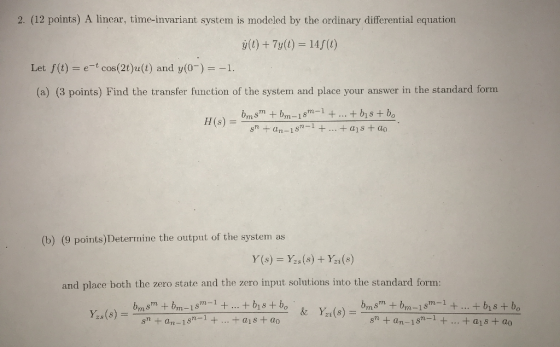
A linear, time-invariant system is modeled by the ordinary differential equation
y(t) + 7y(t) = 14f(t)
Let f(t) = e^-t cos(2t)u(t) and y(0-) = -1.
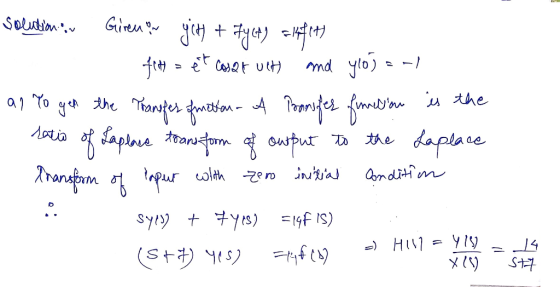
(a) Find the transfer function of the system and place your answer in the standard form
H(s) = bms^m + bm-1s^m-1 + ... + b1s + bo / s^n + an-1s^n-1 + ... + a1s + a0
(b) Determine the output of the system as
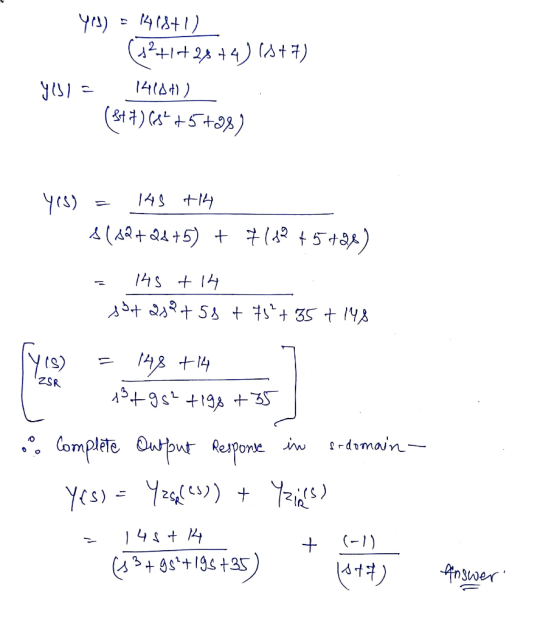
Y(s) = Yzs(s) + Yzi(s)
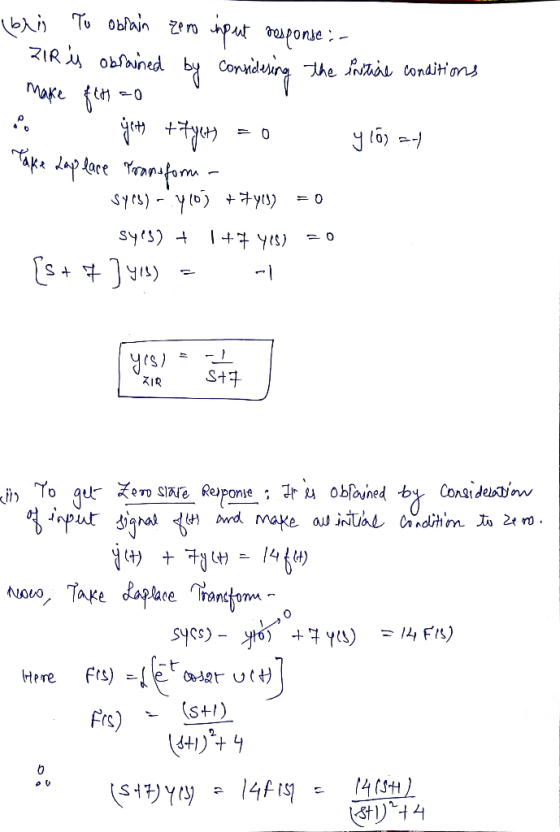
and place both the zero state and the zero input solutions into the standard form:
Yzs(s) = bms^m + bm-1s^m-1 + ... + b1s + bo / s^n + an-1s^n-1 + ... + a1s + a0
&
Yzi(s) = bms^m + bm-1s^m-1 + ... + b1s + bo / s^n + an-1s^n-1 + ... + a1s + a0
Homework Answers
Add Answer to:
A linear, time-invariant system is modeled by the ordinary differential equation y(t) + 7y(t) = 14f(t)...
In a continuous-time system, the laplace transform of the input X(s) and the output Y(s) are...
 In a continuous-time system, the laplace transform of the input X(s) and the output Y(s) are related by Y(s) = 2 (s+2)2 +10 a) If x(t) = u(t), find the zero-state response of the system, yzs(1). yzs() = b) Find the zero-input response of the system, yzi(t). Yzi(t) = c) Find the steady-state solution of the system, yss(t). Yss(t) =
3. Consider the Linear Time-Invariant (LTI) system decribed by the following differential equation: dy +504 +...
 3. Consider the Linear Time-Invariant (LTI) system decribed by the following differential equation: dy +504 + 4y = u(t) dt dt where y(t) is the output of the system and u(t) is the input. This is an Initial Value Problem (IVP) with initial conditions y(0) = 0, y = 0. Also by setting u(t) = (t) an input 8(t) is given to the system, where 8(t) is the unit impulse function. a. Write a function F(s) for a function f(t)...
Consider a second order linear time invariant system represented by the following ordinary differential equation: 4....
 Consider a second order linear time invariant system represented by the following ordinary differential equation: 4. dx(t) dt dt dt Y (s) X(s) a. Find the transfer function H(s) of the system. (5 Points)
Question 1: (2 marks) Find the zero-input response yz(t) for a linear time-invariant (LTI) system described...
 Question 1: (2 marks) Find the zero-input response yz(t) for a linear time-invariant (LTI) system described by the following differential equation: j(t) + 5y(t) + 6y(t) = f(t) + 2x(t) with the initial conditions yz (0) = 0 and jz (0) = 10. Question 2: (4 marks) The impulse response of an LTI system is given by: h(t) = 3e?'u(t) Find the zero-state response yzs (t) of the system for each the following input signals using convolution with direct integration....
2. (Chapter 2). A linear, time-invariant, continuous-time (LTIC) system with input f(t) and output y(t) is specified by the differential equation D2(D +1)y(t) (D - 3)f(t) Find the characteristic poly...
 2. (Chapter 2). A linear, time-invariant, continuous-time (LTIC) system with input f(t) and output y(t) is specified by the differential equation D2(D +1)y(t) (D - 3)f(t) Find the characteristic polynomial, characteristic equation, characteristic root(s), and characteristic mode(s) of this system. a. b. Is this system asymptotically stable, marginally stable, or unstable? Justify your answer.
2. (Chapter 2). A linear, time-invariant, continuous-time (LTIC) system with input f(t) and output y(t) is specified by the differential equation D2(D +1)y(t) (D - 3)f(t)...
2. (Chapter 2). A linear, time-invariant, continuous-time (LTIC) system with input f(t) and output y(t) is specified by the differential equation D2(D +1)y(t) (D - 3)f(t) Find the characteristic polynomial, characteristic equation, characteristic root(s), and characteristic mode(s) of this system. a. b. Is this system asymptotically stable, marginally stable, or unstable? Justify your answer.
2. (Chapter 2). A linear, time-invariant, continuous-time (LTIC) system with input f(t) and output y(t) is specified by the differential equation D2(D +1)y(t) (D - 3)f(t)...
3. Consider a linear time invariant system described by the differential equation dy(t) dt RCww +...
 3. Consider a linear time invariant system described by the differential equation dy(t) dt RCww + y(t)-x(t) where yt) is the system's output, x(t) ?s the system's input, and R and C are both positive real constants. a) Determine both the magnitude and phase of the system's frequency response. b) Determine the frequency spectrum of c) Determine the spectrum of the system's output, y(r), when d) Determine the system's steady state output response x()-1+cos(t) xu)+cost)
2. (Chapter 2). A linear, time-invariant, continuous-time (LTIC) system with input 1(1) and output y(t) is...
 2. (Chapter 2). A linear, time-invariant, continuous-time (LTIC) system with input 1(1) and output y(t) is specified by the differential equation D(D? + 1)y(t) = Df(t). a. Find the characteristic polynomial, characteristic equation, characteristic root(s), and characteristic mode(s) of this system. b. Is this system asymptotically stable, marginally stable, or unstable? Justify your answer.
A SYSTEM MODELED WITH THE SECOND ORDER DIFFERENTIAL EQUATION PRESENTS THE FOLLOWING RESPONSE TO ZERO STATE y(t) = u(t)...
 A SYSTEM MODELED WITH THE SECOND ORDER DIFFERENTIAL EQUATION PRESENTS THE FOLLOWING RESPONSE TO ZERO STATE y(t) = u(t) eatcos(wt)u(t) a,uweR WHEN ENTRANCE IS A UNITARY STAGE (u(t)). SHOWS THAT THE RESPONSE TO IMPULSE IS e-at sen(wt)u(t) a,wE R y(t)aeacos(wt)u(t) +we'
A SYSTEM MODELED WITH THE SECOND ORDER DIFFERENTIAL EQUATION PRESENTS THE FOLLOWING RESPONSE TO ZERO STATE y(t) = u(t) eatcos(wt)u(t) a,uweR WHEN ENTRANCE IS A UNITARY STAGE (u(t)). SHOWS THAT THE RESPONSE TO IMPULSE IS e-at sen(wt)u(t) a,wE R...
A SYSTEM MODELED WITH THE SECOND ORDER DIFFERENTIAL EQUATION PRESENTS THE FOLLOWING RESPONSE TO ZERO STATE y(t) = u(t) eatcos(wt)u(t) a,uweR WHEN ENTRANCE IS A UNITARY STAGE (u(t)). SHOWS THAT THE RESPONSE TO IMPULSE IS e-at sen(wt)u(t) a,wE R y(t)aeacos(wt)u(t) +we'
A SYSTEM MODELED WITH THE SECOND ORDER DIFFERENTIAL EQUATION PRESENTS THE FOLLOWING RESPONSE TO ZERO STATE y(t) = u(t) eatcos(wt)u(t) a,uweR WHEN ENTRANCE IS A UNITARY STAGE (u(t)). SHOWS THAT THE RESPONSE TO IMPULSE IS e-at sen(wt)u(t) a,wE R...
Problem 4. Linear Time-Invariant System.s A linear system has the block diagram y(t) z(t) →| Delay...
 Problem 4. Linear Time-Invariant System.s A linear system has the block diagram y(t) z(t) →| Delay by 1 dt *h(t) where g(t) sinc(t Since this is a linear time invariant system, we can represent it as a convolution with a single impulse response h(t) a) Find the impulse response h(t). You don't need to explicitly differentiate. b) Find the frequency response H(j for this system.
Linear time-invariant sys tems. Consider a SISO, LTI system: t(t) Az(t) + bu(t) y(t) cr (t)...
 Linear time-invariant sys tems. Consider a SISO, LTI system: t(t) Az(t) + bu(t) y(t) cr (t) with IC x(0) 3o. If the nominal input is a non-zero constant, i.e. if u(t)= u, under what conditions does there exist a constant nominal solu- tion (t) nominal output zero? Under what conditions do there exist constant nom- inal solutions that satisfy g = u for all u? To for some axo? Under what conditions is the corresponding
 In a continuous-time system, the laplace transform of the input X(s) and the output Y(s) are related by Y(s) = 2 (s+2)2 +10 a) If x(t) = u(t), find the zero-state response of the system, yzs(1). yzs() = b) Find the zero-input response of the system, yzi(t). Yzi(t) = c) Find the steady-state solution of the system, yss(t). Yss(t) =
 3. Consider the Linear Time-Invariant (LTI) system decribed by the following differential equation: dy +504 + 4y = u(t) dt dt where y(t) is the output of the system and u(t) is the input. This is an Initial Value Problem (IVP) with initial conditions y(0) = 0, y = 0. Also by setting u(t) = (t) an input 8(t) is given to the system, where 8(t) is the unit impulse function. a. Write a function F(s) for a function f(t)...
 Consider a second order linear time invariant system represented by the following ordinary differential equation: 4. dx(t) dt dt dt Y (s) X(s) a. Find the transfer function H(s) of the system. (5 Points)
 Question 1: (2 marks) Find the zero-input response yz(t) for a linear time-invariant (LTI) system described by the following differential equation: j(t) + 5y(t) + 6y(t) = f(t) + 2x(t) with the initial conditions yz (0) = 0 and jz (0) = 10. Question 2: (4 marks) The impulse response of an LTI system is given by: h(t) = 3e?'u(t) Find the zero-state response yzs (t) of the system for each the following input signals using convolution with direct integration....
 2. (Chapter 2). A linear, time-invariant, continuous-time (LTIC) system with input f(t) and output y(t) is specified by the differential equation D2(D +1)y(t) (D - 3)f(t) Find the characteristic polynomial, characteristic equation, characteristic root(s), and characteristic mode(s) of this system. a. b. Is this system asymptotically stable, marginally stable, or unstable? Justify your answer.
2. (Chapter 2). A linear, time-invariant, continuous-time (LTIC) system with input f(t) and output y(t) is specified by the differential equation D2(D +1)y(t) (D - 3)f(t)...
2. (Chapter 2). A linear, time-invariant, continuous-time (LTIC) system with input f(t) and output y(t) is specified by the differential equation D2(D +1)y(t) (D - 3)f(t) Find the characteristic polynomial, characteristic equation, characteristic root(s), and characteristic mode(s) of this system. a. b. Is this system asymptotically stable, marginally stable, or unstable? Justify your answer.
2. (Chapter 2). A linear, time-invariant, continuous-time (LTIC) system with input f(t) and output y(t) is specified by the differential equation D2(D +1)y(t) (D - 3)f(t)...
 3. Consider a linear time invariant system described by the differential equation dy(t) dt RCww + y(t)-x(t) where yt) is the system's output, x(t) ?s the system's input, and R and C are both positive real constants. a) Determine both the magnitude and phase of the system's frequency response. b) Determine the frequency spectrum of c) Determine the spectrum of the system's output, y(r), when d) Determine the system's steady state output response x()-1+cos(t) xu)+cost)
 2. (Chapter 2). A linear, time-invariant, continuous-time (LTIC) system with input 1(1) and output y(t) is specified by the differential equation D(D? + 1)y(t) = Df(t). a. Find the characteristic polynomial, characteristic equation, characteristic root(s), and characteristic mode(s) of this system. b. Is this system asymptotically stable, marginally stable, or unstable? Justify your answer.
 A SYSTEM MODELED WITH THE SECOND ORDER DIFFERENTIAL EQUATION PRESENTS THE FOLLOWING RESPONSE TO ZERO STATE y(t) = u(t) eatcos(wt)u(t) a,uweR WHEN ENTRANCE IS A UNITARY STAGE (u(t)). SHOWS THAT THE RESPONSE TO IMPULSE IS e-at sen(wt)u(t) a,wE R y(t)aeacos(wt)u(t) +we'
A SYSTEM MODELED WITH THE SECOND ORDER DIFFERENTIAL EQUATION PRESENTS THE FOLLOWING RESPONSE TO ZERO STATE y(t) = u(t) eatcos(wt)u(t) a,uweR WHEN ENTRANCE IS A UNITARY STAGE (u(t)). SHOWS THAT THE RESPONSE TO IMPULSE IS e-at sen(wt)u(t) a,wE R...
A SYSTEM MODELED WITH THE SECOND ORDER DIFFERENTIAL EQUATION PRESENTS THE FOLLOWING RESPONSE TO ZERO STATE y(t) = u(t) eatcos(wt)u(t) a,uweR WHEN ENTRANCE IS A UNITARY STAGE (u(t)). SHOWS THAT THE RESPONSE TO IMPULSE IS e-at sen(wt)u(t) a,wE R y(t)aeacos(wt)u(t) +we'
A SYSTEM MODELED WITH THE SECOND ORDER DIFFERENTIAL EQUATION PRESENTS THE FOLLOWING RESPONSE TO ZERO STATE y(t) = u(t) eatcos(wt)u(t) a,uweR WHEN ENTRANCE IS A UNITARY STAGE (u(t)). SHOWS THAT THE RESPONSE TO IMPULSE IS e-at sen(wt)u(t) a,wE R...
 Problem 4. Linear Time-Invariant System.s A linear system has the block diagram y(t) z(t) →| Delay by 1 dt *h(t) where g(t) sinc(t Since this is a linear time invariant system, we can represent it as a convolution with a single impulse response h(t) a) Find the impulse response h(t). You don't need to explicitly differentiate. b) Find the frequency response H(j for this system.
 Linear time-invariant sys tems. Consider a SISO, LTI system: t(t) Az(t) + bu(t) y(t) cr (t) with IC x(0) 3o. If the nominal input is a non-zero constant, i.e. if u(t)= u, under what conditions does there exist a constant nominal solu- tion (t) nominal output zero? Under what conditions do there exist constant nom- inal solutions that satisfy g = u for all u? To for some axo? Under what conditions is the corresponding
Most questions answered within 3 hours.
-
Where is the error in this code sequence?
String s1 = "Hello";
String s2 = "ello";...
asked 11 months ago -
Financial data for Joel de Paris, Inc., for last year
follow:
Joel de Paris, Inc.
Balance...
asked 11 months ago -
Consider this reaction:
Al2(SO4)3 (aq)+ BaCl3
(aq) Al2Cl6 (aq)- +
3BaSO4(s) . What is the...
asked 11 months ago -
Suppose that Savneet is considering increasing her
recent random sample from 20 car rentals to 40...
asked 11 months ago -
Trucks arrive at an unloading terminal at an average rate of 120
per hour.
Trucks arrive...
asked 11 months ago -
Why are methanol and ethanol completely soluble in water while
octanol is not very little soluble....
asked 11 months ago -
A facilities manager at a university reads in a research report
that the mean amount of...
asked 11 months ago -
When the CuSO4 is rehydrated by adding water to the anhydrous
compound, is this an endothermic...
asked 11 months ago -
A ray of sunlight is passing from diamond into crown glass; the
angle of incidence is...
asked 11 months ago -
A block of mass 0.249 kg is placed on top of a light, vertical
spring of...
asked 11 months ago -
how do the kidneys compensate in the presences of acidosis
a) trigger hyperventilate
b) reserve acid...
asked 11 months ago -
Question 501 pts
The rental rate of capital to the firm increases. Which of the
following...
asked 11 months ago