
Homework Answers
Add Answer to:
There are two radioactive elements, elements A and B. Element A decays into element B with...
There are two radioactive elements, elements A and B. Element A decays into element B with...
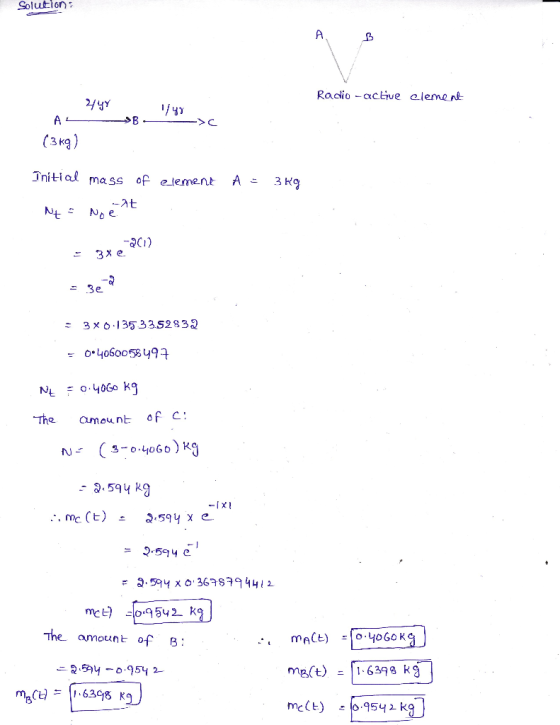
 There are two radioactive elements, elements A and B. Element A decays into element B with a decay constant of 5łyr, and element B decays into the nonradioactive isotope of element C with a decay constant of 1lyr. An initial mass of 5 kg of element A is put into a nonradioactive container, with no other source of elements A, B, and C. How much of each of the three elements is in the container after tyr? (The decay constant...
A certain radioactive substance decays at a rate proportional to its remaining mass M. a. Express this rate of decay as a differential equation. b. When a living organism dies it ceases to replac...
 A certain radioactive substance decays at a rate proportional to its remaining mass M. a. Express this rate of decay as a differential equation. b. When a living organism dies it ceases to replace the carbon isotope C-14, and 48. the C-14 that is present decays with a half-ife of about 5730 years. If archeologists discover a fossilized bone that has 30% of the C-14 of a live bone, approximately how old is it?
A certain radioactive substance decays at...
A certain radioactive substance decays at a rate proportional to its remaining mass M. a. Express this rate of decay as a differential equation. b. When a living organism dies it ceases to replace the carbon isotope C-14, and 48. the C-14 that is present decays with a half-ife of about 5730 years. If archeologists discover a fossilized bone that has 30% of the C-14 of a live bone, approximately how old is it?
A certain radioactive substance decays at...
Please show your steps clearly. . The radioactive isotope Uranium-234 decays to Thoriu-230 with a half-life of T. Thorium 230 itself is also radioactive and decays to Radium-226 with a half-life of γ...
 Please show your steps clearly.
. The radioactive isotope Uranium-234 decays to Thoriu-230 with a half-life of T. Thorium 230 itself is also radioactive and decays to Radium-226 with a half-life of γ and γ > τ Although Radium-226 is also radioactive its half-life is much longer than T and γ and here we assume that it is relative stable. Consider the scenario when we start with a certain amount of pure Uranium-234, because of this chain of decays, we...
Please show your steps clearly.
. The radioactive isotope Uranium-234 decays to Thoriu-230 with a half-life of T. Thorium 230 itself is also radioactive and decays to Radium-226 with a half-life of γ and γ > τ Although Radium-226 is also radioactive its half-life is much longer than T and γ and here we assume that it is relative stable. Consider the scenario when we start with a certain amount of pure Uranium-234, because of this chain of decays, we...
23) In the formula A(O)- Agekt, A is the amount of radioactive material remaining from an...
 23) In the formula A(O)- Agekt, A is the amount of radioactive material remaining from an initial am a given time t, and k is to e decays at a rate of 0.3% annually. Determine hehalf ife of this isotope, to the nearest year is a negative constant determined by the nature of the material. A certain radioactive A) 231 yr B) 100 yr C) 167 y D) 2yr 24) The half-life of an element is 5.0 x і012 yr....
An initial amount of 100 g of the radioactive isotope thorium-234 decays according to Q(t) =...
 An initial amount of 100 g of the radioactive isotope thorium-234 decays according to Q(t) = 100e -0.02828t where t is in years. How long before half of the initial amount has disintegrated? This time is called the half-life of this isotope. (Round your answer to one decimal place.) yr
lt 23) In the formula A)Aekt, A is the amount of radioactive material remaining from an...
 lt 23) In the formula A)Aekt, A is the amount of radioactive material remaining from an initial amount Ao at a given time t, and k is a negative constant determined by the nature of the material. A certain radi isotope decays at a rate of 03% annually Determine the half-life of this isotope, to the nearest year A)231 yr B)100 yr C)167 yr D)2yr
(2 points) An unknown radioactive element decays into non-radioactive substances. In 520 days the radioactivity of...
 (2 points) An unknown radioactive element decays into non-radioactive substances. In 520 days the radioactivity of a sample decreases by 63 percent. (a) What is the half-life of the element? half-life: (days) (b) How long will it take for a sample of 100 mg to decay to 84 mg? time needed: (days)
Er counts the number of decays from a radioactive sample ina e interval Δt from a radioactive sou...
 could you do and explain part a
er counts the number of decays from a radioactive sample ina e interval Δt from a radioactive source, starting at time t 0, The limiting n for this kind of experiment is the exponential distribution (5.69) wthere T is a positive constant. (a) Sketch this function. The distribution is zero for ent begins only at 0.) (b) Prove that this function satisfies the normalization condition (5.13). () Find the mean time T at...
could you do and explain part a
er counts the number of decays from a radioactive sample ina e interval Δt from a radioactive source, starting at time t 0, The limiting n for this kind of experiment is the exponential distribution (5.69) wthere T is a positive constant. (a) Sketch this function. The distribution is zero for ent begins only at 0.) (b) Prove that this function satisfies the normalization condition (5.13). () Find the mean time T at...
A radioactive substance decays at a rate proportional to the amount present at ime t (in...
 A radioactive substance decays at a rate proportional to the amount present at ime t (in hours). Initially, Ao grams of the substance was present, and after 10 hours, the mount has decreased by 20% How long will it take the substance to decay to 40? hat is the half life of this substance? Hint: the half-life is the time required for half of the initial substance to decay)
As a radioactive specimen decays, its activity decreases exponentially as the number of radioacti...
 I only need help with part c). Thanks!
As a radioactive specimen decays, its activity decreases exponentially as the number of radioactive atoms diminishes. Some radioactive species have mean lives in the millions (or even billions) of years, so their exponential decay is not readily apparent. On the other hand, many species have mean lives of minutes or hours, for their exponential decay is easily observed. According to the exponential decay law, the number of radioactive atoms that remain after...
I only need help with part c). Thanks!
As a radioactive specimen decays, its activity decreases exponentially as the number of radioactive atoms diminishes. Some radioactive species have mean lives in the millions (or even billions) of years, so their exponential decay is not readily apparent. On the other hand, many species have mean lives of minutes or hours, for their exponential decay is easily observed. According to the exponential decay law, the number of radioactive atoms that remain after...
 There are two radioactive elements, elements A and B. Element A decays into element B with a decay constant of 5łyr, and element B decays into the nonradioactive isotope of element C with a decay constant of 1lyr. An initial mass of 5 kg of element A is put into a nonradioactive container, with no other source of elements A, B, and C. How much of each of the three elements is in the container after tyr? (The decay constant...
 A certain radioactive substance decays at a rate proportional to its remaining mass M. a. Express this rate of decay as a differential equation. b. When a living organism dies it ceases to replace the carbon isotope C-14, and 48. the C-14 that is present decays with a half-ife of about 5730 years. If archeologists discover a fossilized bone that has 30% of the C-14 of a live bone, approximately how old is it?
A certain radioactive substance decays at...
A certain radioactive substance decays at a rate proportional to its remaining mass M. a. Express this rate of decay as a differential equation. b. When a living organism dies it ceases to replace the carbon isotope C-14, and 48. the C-14 that is present decays with a half-ife of about 5730 years. If archeologists discover a fossilized bone that has 30% of the C-14 of a live bone, approximately how old is it?
A certain radioactive substance decays at...
 Please show your steps clearly.
. The radioactive isotope Uranium-234 decays to Thoriu-230 with a half-life of T. Thorium 230 itself is also radioactive and decays to Radium-226 with a half-life of γ and γ > τ Although Radium-226 is also radioactive its half-life is much longer than T and γ and here we assume that it is relative stable. Consider the scenario when we start with a certain amount of pure Uranium-234, because of this chain of decays, we...
Please show your steps clearly.
. The radioactive isotope Uranium-234 decays to Thoriu-230 with a half-life of T. Thorium 230 itself is also radioactive and decays to Radium-226 with a half-life of γ and γ > τ Although Radium-226 is also radioactive its half-life is much longer than T and γ and here we assume that it is relative stable. Consider the scenario when we start with a certain amount of pure Uranium-234, because of this chain of decays, we...
 23) In the formula A(O)- Agekt, A is the amount of radioactive material remaining from an initial am a given time t, and k is to e decays at a rate of 0.3% annually. Determine hehalf ife of this isotope, to the nearest year is a negative constant determined by the nature of the material. A certain radioactive A) 231 yr B) 100 yr C) 167 y D) 2yr 24) The half-life of an element is 5.0 x і012 yr....
 An initial amount of 100 g of the radioactive isotope thorium-234 decays according to Q(t) = 100e -0.02828t where t is in years. How long before half of the initial amount has disintegrated? This time is called the half-life of this isotope. (Round your answer to one decimal place.) yr
 lt 23) In the formula A)Aekt, A is the amount of radioactive material remaining from an initial amount Ao at a given time t, and k is a negative constant determined by the nature of the material. A certain radi isotope decays at a rate of 03% annually Determine the half-life of this isotope, to the nearest year A)231 yr B)100 yr C)167 yr D)2yr
 (2 points) An unknown radioactive element decays into non-radioactive substances. In 520 days the radioactivity of a sample decreases by 63 percent. (a) What is the half-life of the element? half-life: (days) (b) How long will it take for a sample of 100 mg to decay to 84 mg? time needed: (days)
 could you do and explain part a
er counts the number of decays from a radioactive sample ina e interval Δt from a radioactive source, starting at time t 0, The limiting n for this kind of experiment is the exponential distribution (5.69) wthere T is a positive constant. (a) Sketch this function. The distribution is zero for ent begins only at 0.) (b) Prove that this function satisfies the normalization condition (5.13). () Find the mean time T at...
could you do and explain part a
er counts the number of decays from a radioactive sample ina e interval Δt from a radioactive source, starting at time t 0, The limiting n for this kind of experiment is the exponential distribution (5.69) wthere T is a positive constant. (a) Sketch this function. The distribution is zero for ent begins only at 0.) (b) Prove that this function satisfies the normalization condition (5.13). () Find the mean time T at...
 A radioactive substance decays at a rate proportional to the amount present at ime t (in hours). Initially, Ao grams of the substance was present, and after 10 hours, the mount has decreased by 20% How long will it take the substance to decay to 40? hat is the half life of this substance? Hint: the half-life is the time required for half of the initial substance to decay)
 I only need help with part c). Thanks!
As a radioactive specimen decays, its activity decreases exponentially as the number of radioactive atoms diminishes. Some radioactive species have mean lives in the millions (or even billions) of years, so their exponential decay is not readily apparent. On the other hand, many species have mean lives of minutes or hours, for their exponential decay is easily observed. According to the exponential decay law, the number of radioactive atoms that remain after...
I only need help with part c). Thanks!
As a radioactive specimen decays, its activity decreases exponentially as the number of radioactive atoms diminishes. Some radioactive species have mean lives in the millions (or even billions) of years, so their exponential decay is not readily apparent. On the other hand, many species have mean lives of minutes or hours, for their exponential decay is easily observed. According to the exponential decay law, the number of radioactive atoms that remain after...
Most questions answered within 3 hours.
-
Where is the error in this code sequence?
String s1 = "Hello";
String s2 = "ello";...
asked 10 months ago -
Financial data for Joel de Paris, Inc., for last year
follow:
Joel de Paris, Inc.
Balance...
asked 10 months ago -
Consider this reaction:
Al2(SO4)3 (aq)+ BaCl3
(aq) Al2Cl6 (aq)- +
3BaSO4(s) . What is the...
asked 10 months ago -
Suppose that Savneet is considering increasing her
recent random sample from 20 car rentals to 40...
asked 10 months ago -
Trucks arrive at an unloading terminal at an average rate of 120
per hour.
Trucks arrive...
asked 10 months ago -
Why are methanol and ethanol completely soluble in water while
octanol is not very little soluble....
asked 10 months ago -
A facilities manager at a university reads in a research report
that the mean amount of...
asked 10 months ago -
When the CuSO4 is rehydrated by adding water to the anhydrous
compound, is this an endothermic...
asked 10 months ago -
A ray of sunlight is passing from diamond into crown glass; the
angle of incidence is...
asked 10 months ago -
A block of mass 0.249 kg is placed on top of a light, vertical
spring of...
asked 10 months ago -
how do the kidneys compensate in the presences of acidosis
a) trigger hyperventilate
b) reserve acid...
asked 10 months ago -
Question 501 pts
The rental rate of capital to the firm increases. Which of the
following...
asked 10 months ago