
Homework Answers
Qsystem =0.
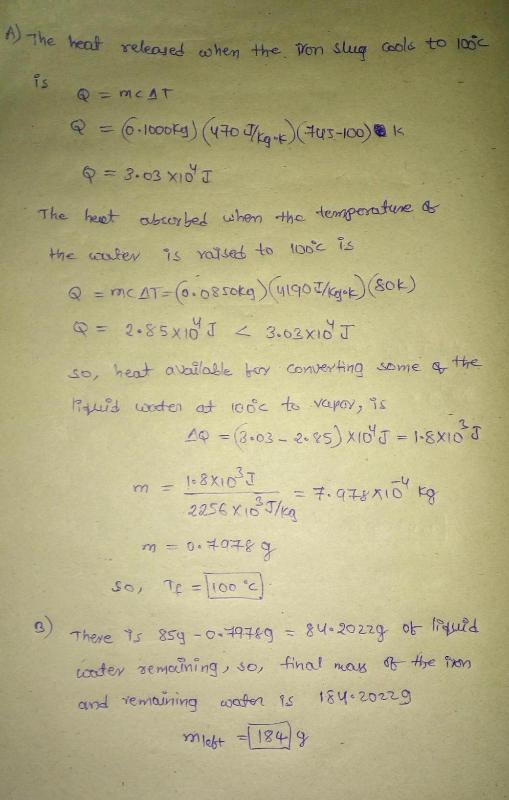
Assume that the normal melting point of iron above 745 celcius degrees,so the iron is initially solid.
Add Answer to:
Constants Part A You cool a 100.0 g slug of red-hot iron (temperature 745 ° C)...
I final = 100 u You cool a 100.0 g slug of red-hot iron (temperature 745°C)...
 I final = 100 u You cool a 100.0 g slug of red-hot iron (temperature 745°C) by dropping it into an insulated cup of negligible mass containing 75.0 g of water at 20.0°C. Assume no heat exchange with the surroundings. Submit Previous Answers ✓ Correct Part B What is the final mass of the iron and the remaining water? Express your answer with the appropriate units. HÅR 2 ? Value Units | m= m = Submit Request Answer
You cool a 120.0 g slug of red-hot iron (temperature 745 ∘C) by dropping it into...
You cool a 120.0 g slug of red-hot iron (temperature 745 ∘C) by dropping it into an insulated cup of negligible mass containing 75.0 g of water at 20.0 ∘C. Assume no heat exchange with the surroundings. a) What is the final temperature of the water? T final = ? degrees C b) What is the final mass of the iron and the remaining water? m final = ? g
Constants Periodic Table Part A A 32.0 g iron rod, initially at 21.8 °C, is submerged...
 Constants Periodic Table Part A A 32.0 g iron rod, initially at 21.8 °C, is submerged into an unknown mass of water at 63.5° C, in an insulated container. The final temperature of the mixture upon reaching thermal equilibrium is 59.6 C. What is the mass of the water? Express your answer to two significant figures and include the appropriate units You may want to reference (Pages 259 - 264) Section 6.4 while completing this problem m Value Units
A 32.4 g iron rod, initially at 23.0°C, is submerged into an unknown mass of water...
 A 32.4 g iron rod, initially at 23.0°C, is submerged into an unknown mass of water at 63.4 °C, in an insulated container. The final temperature of the mixture upon reaching thermal equilibrium is 59.1 °C. Part A What is the mass of the water? You may want to reference (Pages 259-264) Section 6.4 while completing this problem. Express your answer to two significant figures and include the appropriate units. m= Value Units Submit Request Answer
A 32.1 g iron rod, initially at 22.8 ∘C, is submerged into an unknown mass of...
A 32.1 g iron rod, initially at 22.8 ∘C, is submerged into an unknown mass of water at 64.0 ∘C, in an insulated container. The final temperature of the mixture upon reaching thermal equilibrium is 58.8 ∘C. What is the mass of the water? Express your answer to two significant figures and include the appropriate units.
What will be the final temperature of the water in an insulated container as the result...
What will be the final temperature of the water in an insulated container as the result of passing 6.00 g of steam [H2O(g)] at 100.0∘C into 100.0 g of water at 23.0 ∘C? (ΔvapH∘=40.6kJ/molH2O) Express your answer in degrees Celsius to three significant figures.
Four ice cubes at exactly 0 ∘C with a total mass of 52.5 g are combined...
Four ice cubes at exactly 0 ∘C with a total mass of 52.5 g are combined with 140 g of water at 80 ∘C in an insulated container. (ΔH∘fusΔHfus∘=6.02 kJ/molkJ/mol, cwatercwater=4.18J/g⋅∘CJ/g⋅∘C) Part A If no heat is lost to the surroundings, what is the final temperature of the mixture? Express your answer using two significant figures.
Review Part A A 215 g lead ball at a temperature of 81.9 °C is placed in a light calorimeter containing 154 g of water at 22.3 °C. Find the equilibrium temperature of the system. Express your answer...
 Review Part A A 215 g lead ball at a temperature of 81.9 °C is placed in a light calorimeter containing 154 g of water at 22.3 °C. Find the equilibrium temperature of the system. Express your answer using three significant figures. o C Submit
Review Part A A 215 g lead ball at a temperature of 81.9 °C is placed in a light calorimeter containing 154 g of water at 22.3 °C. Find the equilibrium temperature of the system....
Review Part A A 215 g lead ball at a temperature of 81.9 °C is placed in a light calorimeter containing 154 g of water at 22.3 °C. Find the equilibrium temperature of the system. Express your answer using three significant figures. o C Submit
Review Part A A 215 g lead ball at a temperature of 81.9 °C is placed in a light calorimeter containing 154 g of water at 22.3 °C. Find the equilibrium temperature of the system....
A 31.7 g wafer of pure gold initially at 69.9 °C is submerged into 84.0 g...
 A 31.7 g wafer of pure gold initially at 69.9 °C is submerged into 84.0 g of water at 27.1 °C in an insulated container. Part A What is the final temperature of both substances at thermal equilibrium? Express your answer using three significant figures. IVO AED ROO? Submit Request Answ
Calculate the final temperature of the water from the following heat transfer experiment. 45 g of...
 Calculate the final temperature of the water from the following heat transfer experiment. 45 g of water at an initial temperature of 36 degree C (Celsius) is added to 100.0 g of water at 100.0 degree C. The experiment is performed in an insulated container to prevent heat loss to the surroundings. Specific heat of water = 4.184 J/(g degree C) State your answers in degrees Celsius (C) with 3 significant figures.
 I final = 100 u You cool a 100.0 g slug of red-hot iron (temperature 745°C) by dropping it into an insulated cup of negligible mass containing 75.0 g of water at 20.0°C. Assume no heat exchange with the surroundings. Submit Previous Answers ✓ Correct Part B What is the final mass of the iron and the remaining water? Express your answer with the appropriate units. HÅR 2 ? Value Units | m= m = Submit Request Answer
 Constants Periodic Table Part A A 32.0 g iron rod, initially at 21.8 °C, is submerged into an unknown mass of water at 63.5° C, in an insulated container. The final temperature of the mixture upon reaching thermal equilibrium is 59.6 C. What is the mass of the water? Express your answer to two significant figures and include the appropriate units You may want to reference (Pages 259 - 264) Section 6.4 while completing this problem m Value Units
 A 32.4 g iron rod, initially at 23.0°C, is submerged into an unknown mass of water at 63.4 °C, in an insulated container. The final temperature of the mixture upon reaching thermal equilibrium is 59.1 °C. Part A What is the mass of the water? You may want to reference (Pages 259-264) Section 6.4 while completing this problem. Express your answer to two significant figures and include the appropriate units. m= Value Units Submit Request Answer
 Review Part A A 215 g lead ball at a temperature of 81.9 °C is placed in a light calorimeter containing 154 g of water at 22.3 °C. Find the equilibrium temperature of the system. Express your answer using three significant figures. o C Submit
Review Part A A 215 g lead ball at a temperature of 81.9 °C is placed in a light calorimeter containing 154 g of water at 22.3 °C. Find the equilibrium temperature of the system....
Review Part A A 215 g lead ball at a temperature of 81.9 °C is placed in a light calorimeter containing 154 g of water at 22.3 °C. Find the equilibrium temperature of the system. Express your answer using three significant figures. o C Submit
Review Part A A 215 g lead ball at a temperature of 81.9 °C is placed in a light calorimeter containing 154 g of water at 22.3 °C. Find the equilibrium temperature of the system....
 A 31.7 g wafer of pure gold initially at 69.9 °C is submerged into 84.0 g of water at 27.1 °C in an insulated container. Part A What is the final temperature of both substances at thermal equilibrium? Express your answer using three significant figures. IVO AED ROO? Submit Request Answ
 Calculate the final temperature of the water from the following heat transfer experiment. 45 g of water at an initial temperature of 36 degree C (Celsius) is added to 100.0 g of water at 100.0 degree C. The experiment is performed in an insulated container to prevent heat loss to the surroundings. Specific heat of water = 4.184 J/(g degree C) State your answers in degrees Celsius (C) with 3 significant figures.
Most questions answered within 3 hours.
-
Where is the error in this code sequence?
String s1 = "Hello";
String s2 = "ello";...
asked 11 months ago -
Financial data for Joel de Paris, Inc., for last year
follow:
Joel de Paris, Inc.
Balance...
asked 11 months ago -
Consider this reaction:
Al2(SO4)3 (aq)+ BaCl3
(aq) Al2Cl6 (aq)- +
3BaSO4(s) . What is the...
asked 11 months ago -
Suppose that Savneet is considering increasing her
recent random sample from 20 car rentals to 40...
asked 11 months ago -
Trucks arrive at an unloading terminal at an average rate of 120
per hour.
Trucks arrive...
asked 11 months ago -
Why are methanol and ethanol completely soluble in water while
octanol is not very little soluble....
asked 11 months ago -
A facilities manager at a university reads in a research report
that the mean amount of...
asked 11 months ago -
When the CuSO4 is rehydrated by adding water to the anhydrous
compound, is this an endothermic...
asked 11 months ago -
A ray of sunlight is passing from diamond into crown glass; the
angle of incidence is...
asked 11 months ago -
A block of mass 0.249 kg is placed on top of a light, vertical
spring of...
asked 11 months ago -
how do the kidneys compensate in the presences of acidosis
a) trigger hyperventilate
b) reserve acid...
asked 11 months ago -
Question 501 pts
The rental rate of capital to the firm increases. Which of the
following...
asked 11 months ago