
Homework Answers
Answer
![0 The equilibrium Reaction is وهي بهالفروومک A equilinum, constant expression for k= [so,] Lo the equilibrium k - 3 . 84 xls](http://img.homeworklib.com/questions/8da363c0-34ea-11ea-b66f-218cbff5a405.png?x-oss-process=image/resize,w_560)
Add Answer to:
im having trouble solving both of these please help, thank you Tutored Practice Problem 16.3.1 Close...
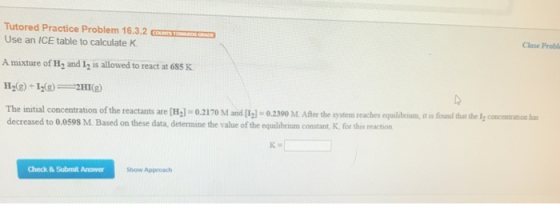
Close Problem Tutored Practice Problem 15.3.2 COUNTS TOWARDS GRADE Use an /CE table to calculate K...
 Close Problem Tutored Practice Problem 15.3.2 COUNTS TOWARDS GRADE Use an /CE table to calculate K A mixture of CO and Cl, is allowed to react at 585 K CO(g) + Cl2(g) cOC2(g) The initial concentration of the reactants are [cO] = 0.3050 M and [Cl2] = 0.3390 M. After the system reaches equilibrium, it is found that the Ch concentration has decreased to 0.0659 M. Based on these data, determine the value of the equilibrium constant, K, for this...
Tutored Practice Problem 18.1.3 cOUNTS TOWARDS GRADE Use equilibrium ion concentration to calculate Ksp Close Problem...
 Tutored Practice Problem 18.1.3 cOUNTS TOWARDS GRADE Use equilibrium ion concentration to calculate Ksp Close Problem The Pb2+ concentration in a saturated solution of lead chloride is measured and found to be 1.65x10² M. Use this information to calculate a K,p value for lead chloride. Ksp Check & Submit Answer Show Approach
Close Problem Tutored Practice Problem 15.4.2 COUNTS TOWARDS GRADE Predict and calculate the effect of volume...
 Close Problem Tutored Practice Problem 15.4.2 COUNTS TOWARDS GRADE Predict and calculate the effect of volume change on an equilibrium system. Consider the equilibrium between COBr2, CO and Br2. COBr2(g) PCO(g) + Brz(9) K = 0.254 at 350 K The reaction is allowed to reach equilibrium in a 8.60-L flask. At equilibrium, [COBr2] = 0.288 M, [CO] = 0.270 M and [Brz] = 0.270 M. (a) The equilibrium mixture is transferred to a 17.2-L flask. In which direction will the...
Tutored Practice Problem 15.4.2 COUNTS TOWARDS GRADE Close Problem Predict and calculate the effect of volume change on...
 Tutored Practice Problem 15.4.2 COUNTS TOWARDS GRADE Close Problem Predict and calculate the effect of volume change on an equilibrium system. Consider the equilibrium between COBr2, CO and Br2 COBr2(g) CO(g)+ Br2(g) K 0.338 at 354 K The reaction is allowed to reach equilibrium in a 5.30-L flask. At equilibrium, [COBr2] 0.295 M and [Br2] = 0.257 M, [CO] 0.295 M. (a) The equilibrium mixture is transferred to a 10.6-L flask. In which direction will the reaction proceed to reach...
Close Problem Tutored Practice Problem 9.5.1 STOWOSCRATS Calculate solution concentration in molarity units A student weighs...
 Close Problem Tutored Practice Problem 9.5.1 STOWOSCRATS Calculate solution concentration in molarity units A student weighs out 154 g of Mg(NO3), transfers it to a 500 ml. volumetric flask, adds enough water to dissolve the solid and then adds water to the 500 ml mark on the neck of the flask. Calculate the concentration (in molarity units) of magnesium nitrate in the resulting solution? Check & Submit Answer Show Approach
Calculate pH of a weak base solution. Please box answers! Thank you! Close Problem Tutored Practice...
 Calculate pH of a weak base solution. Please box answers!
Thank you!
Close Problem Tutored Practice Problem 16.4.6 cm STOWARRANTIE Calculate the pH of a weak base solution (quadratic equation). Calculate the pH of a 0.0304 M aqueous solution of methylamine (CHANH. K. - 4.2x10*) and the equilibrium concentrations of the weak base and its conjugate acid PH [CH3NH2lequilibrium [CH3NH3 Jequilibrium - Check & Submnt Answer Show Approach
Calculate pH of a weak base solution. Please box answers!
Thank you!
Close Problem Tutored Practice Problem 16.4.6 cm STOWARRANTIE Calculate the pH of a weak base solution (quadratic equation). Calculate the pH of a 0.0304 M aqueous solution of methylamine (CHANH. K. - 4.2x10*) and the equilibrium concentrations of the weak base and its conjugate acid PH [CH3NH2lequilibrium [CH3NH3 Jequilibrium - Check & Submnt Answer Show Approach
Tutored Practice Problem 19.3.4 COUNTS TOWARDS GRADE Calculate the equilibrium constant from the standard free energy...
 Tutored Practice Problem 19.3.4 COUNTS TOWARDS GRADE Calculate the equilibrium constant from the standard free energy change. Close Pr Using standard thermodynamic data (linked), calculate the equilibrium constant at 298.15 K for the following reaction. N2(g) + O2(g) +2NO(g) K- Check & Submit Answer Show Approach
Tutored Practice Problem 9.5.3 C Use molarity as a conversion factor. A SSINO Close Problem Calculate...
 Tutored Practice Problem 9.5.3 C Use molarity as a conversion factor. A SSINO Close Problem Calculate the mass, in grams, of zinc chloride that must be added to a 300-ml volumetric flask in order to prepare 300 mL of a 0.147 M aqueous solution of the salt. Check & Submit Answer Show Approach
please box the answers for clarity Close Problem Tutored Practice Problem 14.2.1 COUNTS TOWARDS GRANDE Calculate...
 please box the answers for clarity
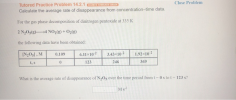
Close Problem Tutored Practice Problem 14.2.1 COUNTS TOWARDS GRANDE Calculate the average rate of disappearance from concentration-time data. For the gas phase decomposition of dinitrogen pentoxide at 335 K 2 N205(9)—>4 NO2(g) + O2(9) the following data have been obtained: 0.109 IN,Os1, M ts 0 6.11x10 2 3.43 1021.92x10 2 123246 369 What is the average rate of disappearance of N20, over the time period from t=0s to t=123 s? MS Close Problem Tutored...
please box the answers for clarity
Close Problem Tutored Practice Problem 14.2.1 COUNTS TOWARDS GRANDE Calculate the average rate of disappearance from concentration-time data. For the gas phase decomposition of dinitrogen pentoxide at 335 K 2 N205(9)—>4 NO2(g) + O2(9) the following data have been obtained: 0.109 IN,Os1, M ts 0 6.11x10 2 3.43 1021.92x10 2 123246 369 What is the average rate of disappearance of N20, over the time period from t=0s to t=123 s? MS Close Problem Tutored...
calculation is not needed Tutored Practice Problem 18.4.3 GO Determine precipitation sequence (qualitative). Close Problem A...
 calculation is not needed
Tutored Practice Problem 18.4.3 GO Determine precipitation sequence (qualitative). Close Problem A solution contains 0.12 M sodium fluoride and 0.12 M sodium iodide. Solid lead nitrate is added slowly to this mixture. What ionic compound precipitates first from the solution Solubility product constant data is found in the Chemistry References Formula of first precipitate - Hint: It is not necessary to do a calculation here. Check & Submit Answer Show Approach Example Problem 18.4.4 Determine lon...
calculation is not needed
Tutored Practice Problem 18.4.3 GO Determine precipitation sequence (qualitative). Close Problem A solution contains 0.12 M sodium fluoride and 0.12 M sodium iodide. Solid lead nitrate is added slowly to this mixture. What ionic compound precipitates first from the solution Solubility product constant data is found in the Chemistry References Formula of first precipitate - Hint: It is not necessary to do a calculation here. Check & Submit Answer Show Approach Example Problem 18.4.4 Determine lon...
 Close Problem Tutored Practice Problem 15.3.2 COUNTS TOWARDS GRADE Use an /CE table to calculate K A mixture of CO and Cl, is allowed to react at 585 K CO(g) + Cl2(g) cOC2(g) The initial concentration of the reactants are [cO] = 0.3050 M and [Cl2] = 0.3390 M. After the system reaches equilibrium, it is found that the Ch concentration has decreased to 0.0659 M. Based on these data, determine the value of the equilibrium constant, K, for this...
 Tutored Practice Problem 18.1.3 cOUNTS TOWARDS GRADE Use equilibrium ion concentration to calculate Ksp Close Problem The Pb2+ concentration in a saturated solution of lead chloride is measured and found to be 1.65x10² M. Use this information to calculate a K,p value for lead chloride. Ksp Check & Submit Answer Show Approach
 Close Problem Tutored Practice Problem 15.4.2 COUNTS TOWARDS GRADE Predict and calculate the effect of volume change on an equilibrium system. Consider the equilibrium between COBr2, CO and Br2. COBr2(g) PCO(g) + Brz(9) K = 0.254 at 350 K The reaction is allowed to reach equilibrium in a 8.60-L flask. At equilibrium, [COBr2] = 0.288 M, [CO] = 0.270 M and [Brz] = 0.270 M. (a) The equilibrium mixture is transferred to a 17.2-L flask. In which direction will the...
 Tutored Practice Problem 15.4.2 COUNTS TOWARDS GRADE Close Problem Predict and calculate the effect of volume change on an equilibrium system. Consider the equilibrium between COBr2, CO and Br2 COBr2(g) CO(g)+ Br2(g) K 0.338 at 354 K The reaction is allowed to reach equilibrium in a 5.30-L flask. At equilibrium, [COBr2] 0.295 M and [Br2] = 0.257 M, [CO] 0.295 M. (a) The equilibrium mixture is transferred to a 10.6-L flask. In which direction will the reaction proceed to reach...
 Close Problem Tutored Practice Problem 9.5.1 STOWOSCRATS Calculate solution concentration in molarity units A student weighs out 154 g of Mg(NO3), transfers it to a 500 ml. volumetric flask, adds enough water to dissolve the solid and then adds water to the 500 ml mark on the neck of the flask. Calculate the concentration (in molarity units) of magnesium nitrate in the resulting solution? Check & Submit Answer Show Approach
 Calculate pH of a weak base solution. Please box answers!
Thank you!
Close Problem Tutored Practice Problem 16.4.6 cm STOWARRANTIE Calculate the pH of a weak base solution (quadratic equation). Calculate the pH of a 0.0304 M aqueous solution of methylamine (CHANH. K. - 4.2x10*) and the equilibrium concentrations of the weak base and its conjugate acid PH [CH3NH2lequilibrium [CH3NH3 Jequilibrium - Check & Submnt Answer Show Approach
Calculate pH of a weak base solution. Please box answers!
Thank you!
Close Problem Tutored Practice Problem 16.4.6 cm STOWARRANTIE Calculate the pH of a weak base solution (quadratic equation). Calculate the pH of a 0.0304 M aqueous solution of methylamine (CHANH. K. - 4.2x10*) and the equilibrium concentrations of the weak base and its conjugate acid PH [CH3NH2lequilibrium [CH3NH3 Jequilibrium - Check & Submnt Answer Show Approach
 Tutored Practice Problem 19.3.4 COUNTS TOWARDS GRADE Calculate the equilibrium constant from the standard free energy change. Close Pr Using standard thermodynamic data (linked), calculate the equilibrium constant at 298.15 K for the following reaction. N2(g) + O2(g) +2NO(g) K- Check & Submit Answer Show Approach
 Tutored Practice Problem 9.5.3 C Use molarity as a conversion factor. A SSINO Close Problem Calculate the mass, in grams, of zinc chloride that must be added to a 300-ml volumetric flask in order to prepare 300 mL of a 0.147 M aqueous solution of the salt. Check & Submit Answer Show Approach
 please box the answers for clarity
Close Problem Tutored Practice Problem 14.2.1 COUNTS TOWARDS GRANDE Calculate the average rate of disappearance from concentration-time data. For the gas phase decomposition of dinitrogen pentoxide at 335 K 2 N205(9)—>4 NO2(g) + O2(9) the following data have been obtained: 0.109 IN,Os1, M ts 0 6.11x10 2 3.43 1021.92x10 2 123246 369 What is the average rate of disappearance of N20, over the time period from t=0s to t=123 s? MS Close Problem Tutored...
please box the answers for clarity
Close Problem Tutored Practice Problem 14.2.1 COUNTS TOWARDS GRANDE Calculate the average rate of disappearance from concentration-time data. For the gas phase decomposition of dinitrogen pentoxide at 335 K 2 N205(9)—>4 NO2(g) + O2(9) the following data have been obtained: 0.109 IN,Os1, M ts 0 6.11x10 2 3.43 1021.92x10 2 123246 369 What is the average rate of disappearance of N20, over the time period from t=0s to t=123 s? MS Close Problem Tutored...
 calculation is not needed
Tutored Practice Problem 18.4.3 GO Determine precipitation sequence (qualitative). Close Problem A solution contains 0.12 M sodium fluoride and 0.12 M sodium iodide. Solid lead nitrate is added slowly to this mixture. What ionic compound precipitates first from the solution Solubility product constant data is found in the Chemistry References Formula of first precipitate - Hint: It is not necessary to do a calculation here. Check & Submit Answer Show Approach Example Problem 18.4.4 Determine lon...
calculation is not needed
Tutored Practice Problem 18.4.3 GO Determine precipitation sequence (qualitative). Close Problem A solution contains 0.12 M sodium fluoride and 0.12 M sodium iodide. Solid lead nitrate is added slowly to this mixture. What ionic compound precipitates first from the solution Solubility product constant data is found in the Chemistry References Formula of first precipitate - Hint: It is not necessary to do a calculation here. Check & Submit Answer Show Approach Example Problem 18.4.4 Determine lon...
Most questions answered within 3 hours.
-
Where is the error in this code sequence?
String s1 = "Hello";
String s2 = "ello";...
asked 10 months ago -
Financial data for Joel de Paris, Inc., for last year
follow:
Joel de Paris, Inc.
Balance...
asked 10 months ago -
Consider this reaction:
Al2(SO4)3 (aq)+ BaCl3
(aq) Al2Cl6 (aq)- +
3BaSO4(s) . What is the...
asked 10 months ago -
Suppose that Savneet is considering increasing her
recent random sample from 20 car rentals to 40...
asked 10 months ago -
Trucks arrive at an unloading terminal at an average rate of 120
per hour.
Trucks arrive...
asked 10 months ago -
Why are methanol and ethanol completely soluble in water while
octanol is not very little soluble....
asked 10 months ago -
A facilities manager at a university reads in a research report
that the mean amount of...
asked 10 months ago -
When the CuSO4 is rehydrated by adding water to the anhydrous
compound, is this an endothermic...
asked 10 months ago -
A ray of sunlight is passing from diamond into crown glass; the
angle of incidence is...
asked 10 months ago -
A block of mass 0.249 kg is placed on top of a light, vertical
spring of...
asked 10 months ago -
how do the kidneys compensate in the presences of acidosis
a) trigger hyperventilate
b) reserve acid...
asked 10 months ago -
Question 501 pts
The rental rate of capital to the firm increases. Which of the
following...
asked 10 months ago