
Homework Answers
Add Answer to:
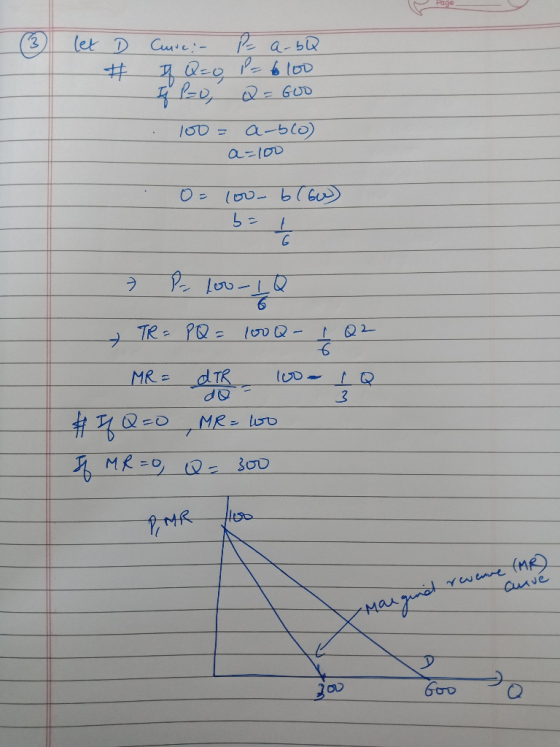
#3 3. The graph below gives the demand curve confronting a price searching firm. Draw the...
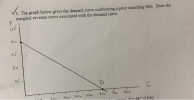
#3 V3. The graph below gives the demand curve confronting a price searching firm. Draw the...
 #3
V3. The graph below gives the demand curve confronting a price searching firm. Draw the marginal revenue curve associated with the demand curve. Tou COC 520 800 in P = 480.500 low 200 300 400
#3
V3. The graph below gives the demand curve confronting a price searching firm. Draw the marginal revenue curve associated with the demand curve. Tou COC 520 800 in P = 480.500 low 200 300 400
2. In a perfectly competitive industry, an individual firm's demand curve will be: a) Perfectly elastic....
 2. In a perfectly competitive industry, an individual firm's demand curve will be: a) Perfectly elastic. b) Perfectly inelastic. c) Downward sloping to the right. d) Upward sloping to the right. 3. A firm in a competitive market will seek to... a) Minimize total costs. b) Maximize total revenue. c) Minimize marginal cost. d) Maximize the difference between total revenue and total cost. e) Maximize the difference between marginal revenue and marginal cost. In the short-run, if a firm's marginal...
Consider the following cost curve for a firm in a competitive industry where the market price...
Consider the following cost curve for a firm in a competitive industry where the market price equals $200 C = 1/3q3+4q+750 What is the firm's marginal cost (MC)? MC = At what level of output does the firm maximize profits (minimize losses)? Profit is maximized at __units of output. (Round your answer to two decimal places.) What is the firm's profit maximizing price? The profit-maximizing price is $___ In the short-run, this firm should produce ____ .
The graph below shows a monopolist's demand (D), marginal revenue (MR), marginal cost (MC), and average...
 The graph below shows a monopolist's demand (D), marginal
revenue (MR), marginal cost (MC), and average total cost (ATC)
curves. Management wants to adjust the production output quantity
to maximize the firm's profits. What quantity should the firm aim
for?
Give your answer by dragging the Q line to a new position to mark
the quantity at which profit is as large as possible.
Price and cost ATC MC MR Quantity
The graph below shows a monopolist's demand (D), marginal
revenue (MR), marginal cost (MC), and average total cost (ATC)
curves. Management wants to adjust the production output quantity
to maximize the firm's profits. What quantity should the firm aim
for?
Give your answer by dragging the Q line to a new position to mark
the quantity at which profit is as large as possible.
Price and cost ATC MC MR Quantity
Suppose a price searching firm faces a demand curve given by Q = 30−.5P, and has...
Suppose a price searching firm faces a demand curve given by Q = 30−.5P, and has an average cost curve given by AC = 8. a. Find the equations for the marginal revenue curve and the marginal cost curve. b. Find the profit maximizing level of output and the profit maximizing price. At this combination, what is the level of firm profit? What is the level of deadweight loss?
2. Use the graph below to figure out if the following price searching firm is profitable,...
 2. Use the graph below to figure out if the following price searching firm is profitable, at zero economic profit, or losing money. Label the firm's demand, MC, ATC, and MR curves. Calculate the quantity of the profit or loss, and indicate what the equilibrium price and quantity is. 30 40 50 60 70 80 90 100Q
Arik Levinson, Georgetown University Questions 1 - 3. This graph illustrates the demand for computers in...
 Arik Levinson, Georgetown University Questions 1 - 3. This graph illustrates the demand for computers in a small country. To develop a domestic computer industry, the government prohibits imports of computers and gives a single local firm the right to produce and sell computers. The demand curve shows the local demand for computers. The cost curves show the marginal cost (MC) and average total cost (ATC) of the single producer. The graph also shows the marginal revenue curve faced by...
The graph below shows a monopolist's demand (D), marginal revenue (MR), marginal cost (MC), and average total cost (ATC) curves. Management wants to adjust the production output quantity to maximize the firm's profits. What quantity should the firm aim fo
 The graph below shows a monopolist's demand (D), marginal revenue (MR), marginal cost (MC), and average total cost (ATC) curves. Management wants to adjust the production output quantity to maximize the firm's profits. What quantity should the firm aim for?Give your answer by dragging the Q line to a new position to mark the quantity at which profit is as large as possible. To refer to the graphing tutorial for this question type, please click here.
4) A firm faces the demand curve, P-80-3Q, and has the cost equation, What is the...
 4) A firm faces the demand curve, P-80-3Q, and has the cost equation, What is the equation for the firm's total revenue? 200+20Q. a) b) What is the equation for the firm's marginal revenue? c) What is the quantity that maximizes total revenue? d) Find the optimal quantity and price for the firm if they are trying to maximize profit e) What is the firm's profit at the price and quantity in (d)? f) Now suppose that the demand for...
The graph below shows demand curve and cost data for a firm operating as a monopolist....
 The graph below shows demand curve and cost data for a firm operating as a monopolist. In addition, the green line shows average total costs (ATC). 30++ Price of Kilowatt Hours of Electricity Quc 10 ty of Kilowatt Hours of Electricity 17. The blue line shows: a. Demand Curve b. Marginal Costs c. Marginal Revenue 18. The red line shows: a. Demand Curve b. Marginal Costs c. Marginal Revenue
 #3
V3. The graph below gives the demand curve confronting a price searching firm. Draw the marginal revenue curve associated with the demand curve. Tou COC 520 800 in P = 480.500 low 200 300 400
#3
V3. The graph below gives the demand curve confronting a price searching firm. Draw the marginal revenue curve associated with the demand curve. Tou COC 520 800 in P = 480.500 low 200 300 400
 2. In a perfectly competitive industry, an individual firm's demand curve will be: a) Perfectly elastic. b) Perfectly inelastic. c) Downward sloping to the right. d) Upward sloping to the right. 3. A firm in a competitive market will seek to... a) Minimize total costs. b) Maximize total revenue. c) Minimize marginal cost. d) Maximize the difference between total revenue and total cost. e) Maximize the difference between marginal revenue and marginal cost. In the short-run, if a firm's marginal...
 The graph below shows a monopolist's demand (D), marginal
revenue (MR), marginal cost (MC), and average total cost (ATC)
curves. Management wants to adjust the production output quantity
to maximize the firm's profits. What quantity should the firm aim
for?
Give your answer by dragging the Q line to a new position to mark
the quantity at which profit is as large as possible.
Price and cost ATC MC MR Quantity
The graph below shows a monopolist's demand (D), marginal
revenue (MR), marginal cost (MC), and average total cost (ATC)
curves. Management wants to adjust the production output quantity
to maximize the firm's profits. What quantity should the firm aim
for?
Give your answer by dragging the Q line to a new position to mark
the quantity at which profit is as large as possible.
Price and cost ATC MC MR Quantity
 2. Use the graph below to figure out if the following price searching firm is profitable, at zero economic profit, or losing money. Label the firm's demand, MC, ATC, and MR curves. Calculate the quantity of the profit or loss, and indicate what the equilibrium price and quantity is. 30 40 50 60 70 80 90 100Q
 Arik Levinson, Georgetown University Questions 1 - 3. This graph illustrates the demand for computers in a small country. To develop a domestic computer industry, the government prohibits imports of computers and gives a single local firm the right to produce and sell computers. The demand curve shows the local demand for computers. The cost curves show the marginal cost (MC) and average total cost (ATC) of the single producer. The graph also shows the marginal revenue curve faced by...
 4) A firm faces the demand curve, P-80-3Q, and has the cost equation, What is the equation for the firm's total revenue? 200+20Q. a) b) What is the equation for the firm's marginal revenue? c) What is the quantity that maximizes total revenue? d) Find the optimal quantity and price for the firm if they are trying to maximize profit e) What is the firm's profit at the price and quantity in (d)? f) Now suppose that the demand for...
 The graph below shows demand curve and cost data for a firm operating as a monopolist. In addition, the green line shows average total costs (ATC). 30++ Price of Kilowatt Hours of Electricity Quc 10 ty of Kilowatt Hours of Electricity 17. The blue line shows: a. Demand Curve b. Marginal Costs c. Marginal Revenue 18. The red line shows: a. Demand Curve b. Marginal Costs c. Marginal Revenue
Most questions answered within 3 hours.
-
Where is the error in this code sequence?
String s1 = "Hello";
String s2 = "ello";...
asked 10 months ago -
Financial data for Joel de Paris, Inc., for last year
follow:
Joel de Paris, Inc.
Balance...
asked 10 months ago -
Consider this reaction:
Al2(SO4)3 (aq)+ BaCl3
(aq) Al2Cl6 (aq)- +
3BaSO4(s) . What is the...
asked 10 months ago -
Suppose that Savneet is considering increasing her
recent random sample from 20 car rentals to 40...
asked 10 months ago -
Trucks arrive at an unloading terminal at an average rate of 120
per hour.
Trucks arrive...
asked 10 months ago -
Why are methanol and ethanol completely soluble in water while
octanol is not very little soluble....
asked 10 months ago -
A facilities manager at a university reads in a research report
that the mean amount of...
asked 10 months ago -
When the CuSO4 is rehydrated by adding water to the anhydrous
compound, is this an endothermic...
asked 10 months ago -
A ray of sunlight is passing from diamond into crown glass; the
angle of incidence is...
asked 10 months ago -
A block of mass 0.249 kg is placed on top of a light, vertical
spring of...
asked 10 months ago -
how do the kidneys compensate in the presences of acidosis
a) trigger hyperventilate
b) reserve acid...
asked 10 months ago -
Question 501 pts
The rental rate of capital to the firm increases. Which of the
following...
asked 10 months ago