
Homework Answers
 Read second page then first
page.
Read second page then first
page.
Add Answer to:
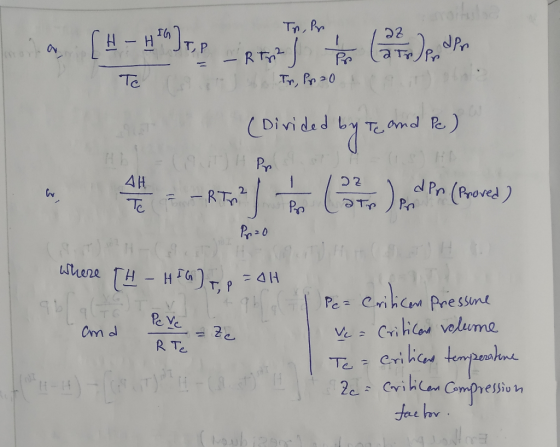
15. For one mole of a real gas, consider the change of enthalpy as the reduced...
1. The following equation of state for 1 mole of a certain real gas is proposed:...
 1. The following equation of state for 1 mole of a certain real gas is proposed: RT P = 1- Te-a/RTV where a and b are characteristic constants for the real gas. (a) Predict the critical compression factor, Z , for the real gas that is satisfied with above equation of state. (b) What is the relation between the Boyle temperature (TB) and the critical temperature (TC)?
1. The following equation of state for 1 mole of a certain real gas is proposed:...
 1. The following equation of state for 1 mole of a certain real gas is proposed: RT .- a/RTV P = V-b where a and b are characteristic constants for the real gas (a) Predict the critical compression factor, Z, for the real gas that is satisfied with above equation of state. (b) What is the relation between the Boyle temperature (TB) and the critical temperature (Tc)?
2. The following equation of state for one mole of a non-ideal gas is proposed as...
 2. The following equation of state for one mole of a non-ideal gas is proposed as a modified version of the van der Waals equation: RT a P = 1-6 - um Where V is the volume, and a, b, n are constants in terms of characteristics of the gas. (a) Express Vc, Pc, and Tc in terms of a, b, n and R. (b) Estimate the critical compression factor, Zc. (c) Write the equation of state in terms of...
8. Initially, 1 mole of the real gas is contained in a thermally insulated piston-cylinder arrangement...
 8. Initially, 1 mole of the real gas is contained in a thermally insulated piston-cylinder arrangement in an initial state (T1, P1, Vi ). 1 mole of the real gas that is expressed by the following equation of state under the investigation. Now, the gas is expanded so as to fill the final state of (T2, P2, V2 ). Suppose that any possible temperature dependence of Cy is negligibly small and the molar heat capacity is approximately equal to 2"...
Parts iii) and iv) are the ones I need help with please :) (a) One mole of a monoatomic van der Waals gas obeys the equ...
 Parts iii) and iv) are the ones I need help with please :)
(a) One mole of a monoatomic van der Waals gas obeys the equation of state and its internal energy is expressed as U where Cv is the molar apacity of an ideal gas. The gas is initially at pr isochoric heat c essure p and volume V Explain the physical meaning of the parameters a and b in the equation of state of the gas (ii) Write...
Parts iii) and iv) are the ones I need help with please :)
(a) One mole of a monoatomic van der Waals gas obeys the equation of state and its internal energy is expressed as U where Cv is the molar apacity of an ideal gas. The gas is initially at pr isochoric heat c essure p and volume V Explain the physical meaning of the parameters a and b in the equation of state of the gas (ii) Write...
One mole of an ideal gas is confined to a container with a movable piston. The...
 One mole of an ideal gas is confined to a container with a movable piston. The questions below refer to the processes shown on the PV diagram at right. Process I is a change from state Xto state Y at constant pressure. Process Il is a change from state W to state Z at a different constant pressure Rank the temperatures of states W, X, Y, and Z. If any temperatures are equal, state that explicitly. Explain. a. b. x...
6. Consider a system at T1, P1,V1 which is composed of one mole of a classical...
6. Consider a system at T1, P1,V1 which is composed of one mole of a classical ideal gas for which PV=RT and U=A+BT. Let the system change in four steps. The first step is a very slow compression to P2,V2 at a constant temperature of T1. The second step is a quick compression to T3, P3, V3. The third step is a very slow expansion to P4, V4 at a constant temperature T3. The fourth step is a very quick...
One mole of an ideal mono-atomic gas is in a state A characterized by a temperature...
One mole of an ideal mono-atomic gas is in a state A characterized by a temperature TA. The gas is then subjected to a succession of three quasi-static reversible processes: An isothermal expansion A → B, which increases the volume by a factor y. The expansion factor is therefore y = VB / VA> 1. An adiabatic compression B → C which increases the pressure by a factor w. The compression factor is w = pC / pB> 1. A...
(a) One mole of a monoatomic van der Waals gas obeys the equation of state A3. ) (V-b)=RT (p+ and its internal energy is expressed as U CvT where Cv is the molar isochoric heat capacity of an ideal g...
 (a) One mole of a monoatomic van der Waals gas obeys the equation of state A3. ) (V-b)=RT (p+ and its internal energy is expressed as U CvT where Cv is the molar isochoric heat capacity of an ideal gas. The gas is initially at pressure p and volume V (i) Explain the physical meaning of the parameters a and b in the equation of state of the gas (ii) Write down the equation that defines entropy in thermodynamics. Define...
The amount of heat needed to raise the temperature of 1 mole of a substance by...
The amount of heat needed to raise the temperature of 1 mole of a substance by one Celsius degree (or, equivalently, one kelvin) is called the molar heat capacity of the system, denoted by the letter C. If a small amount of heat dQ is put into n moles of a substance, and the resulting change in temperature for the system is dT, then C=1ndQdT. This is the definition of molar heat capacity--the amount of heat Q added per infinitesimal...
 1. The following equation of state for 1 mole of a certain real gas is proposed: RT P = 1- Te-a/RTV where a and b are characteristic constants for the real gas. (a) Predict the critical compression factor, Z , for the real gas that is satisfied with above equation of state. (b) What is the relation between the Boyle temperature (TB) and the critical temperature (TC)?
 1. The following equation of state for 1 mole of a certain real gas is proposed: RT .- a/RTV P = V-b where a and b are characteristic constants for the real gas (a) Predict the critical compression factor, Z, for the real gas that is satisfied with above equation of state. (b) What is the relation between the Boyle temperature (TB) and the critical temperature (Tc)?
 2. The following equation of state for one mole of a non-ideal gas is proposed as a modified version of the van der Waals equation: RT a P = 1-6 - um Where V is the volume, and a, b, n are constants in terms of characteristics of the gas. (a) Express Vc, Pc, and Tc in terms of a, b, n and R. (b) Estimate the critical compression factor, Zc. (c) Write the equation of state in terms of...
 8. Initially, 1 mole of the real gas is contained in a thermally insulated piston-cylinder arrangement in an initial state (T1, P1, Vi ). 1 mole of the real gas that is expressed by the following equation of state under the investigation. Now, the gas is expanded so as to fill the final state of (T2, P2, V2 ). Suppose that any possible temperature dependence of Cy is negligibly small and the molar heat capacity is approximately equal to 2"...
 Parts iii) and iv) are the ones I need help with please :)
(a) One mole of a monoatomic van der Waals gas obeys the equation of state and its internal energy is expressed as U where Cv is the molar apacity of an ideal gas. The gas is initially at pr isochoric heat c essure p and volume V Explain the physical meaning of the parameters a and b in the equation of state of the gas (ii) Write...
Parts iii) and iv) are the ones I need help with please :)
(a) One mole of a monoatomic van der Waals gas obeys the equation of state and its internal energy is expressed as U where Cv is the molar apacity of an ideal gas. The gas is initially at pr isochoric heat c essure p and volume V Explain the physical meaning of the parameters a and b in the equation of state of the gas (ii) Write...
 One mole of an ideal gas is confined to a container with a movable piston. The questions below refer to the processes shown on the PV diagram at right. Process I is a change from state Xto state Y at constant pressure. Process Il is a change from state W to state Z at a different constant pressure Rank the temperatures of states W, X, Y, and Z. If any temperatures are equal, state that explicitly. Explain. a. b. x...
 (a) One mole of a monoatomic van der Waals gas obeys the equation of state A3. ) (V-b)=RT (p+ and its internal energy is expressed as U CvT where Cv is the molar isochoric heat capacity of an ideal gas. The gas is initially at pressure p and volume V (i) Explain the physical meaning of the parameters a and b in the equation of state of the gas (ii) Write down the equation that defines entropy in thermodynamics. Define...
Most questions answered within 3 hours.
-
Where is the error in this code sequence?
String s1 = "Hello";
String s2 = "ello";...
asked 11 months ago -
Financial data for Joel de Paris, Inc., for last year
follow:
Joel de Paris, Inc.
Balance...
asked 11 months ago -
Consider this reaction:
Al2(SO4)3 (aq)+ BaCl3
(aq) Al2Cl6 (aq)- +
3BaSO4(s) . What is the...
asked 11 months ago -
Suppose that Savneet is considering increasing her
recent random sample from 20 car rentals to 40...
asked 11 months ago -
Trucks arrive at an unloading terminal at an average rate of 120
per hour.
Trucks arrive...
asked 11 months ago -
Why are methanol and ethanol completely soluble in water while
octanol is not very little soluble....
asked 11 months ago -
A facilities manager at a university reads in a research report
that the mean amount of...
asked 11 months ago -
When the CuSO4 is rehydrated by adding water to the anhydrous
compound, is this an endothermic...
asked 11 months ago -
A ray of sunlight is passing from diamond into crown glass; the
angle of incidence is...
asked 11 months ago -
A block of mass 0.249 kg is placed on top of a light, vertical
spring of...
asked 11 months ago -
how do the kidneys compensate in the presences of acidosis
a) trigger hyperventilate
b) reserve acid...
asked 11 months ago -
Question 501 pts
The rental rate of capital to the firm increases. Which of the
following...
asked 11 months ago