An investor obtains the following probability distributions for two stocks: Statei Pi  
An investor obtains the following probability distributions for two
stocks:
Statei
Pi
RX
RY
______ ____
_____ ____
1
30% -10%
40%
2
40% 10% -20%
3
30% 30 %
30
a. What are the expected returns for the Security X and for
Security Y?
b. What are the standard deviations of these two stocks?
c. What are the CVs for these two securities?
Homework Answers
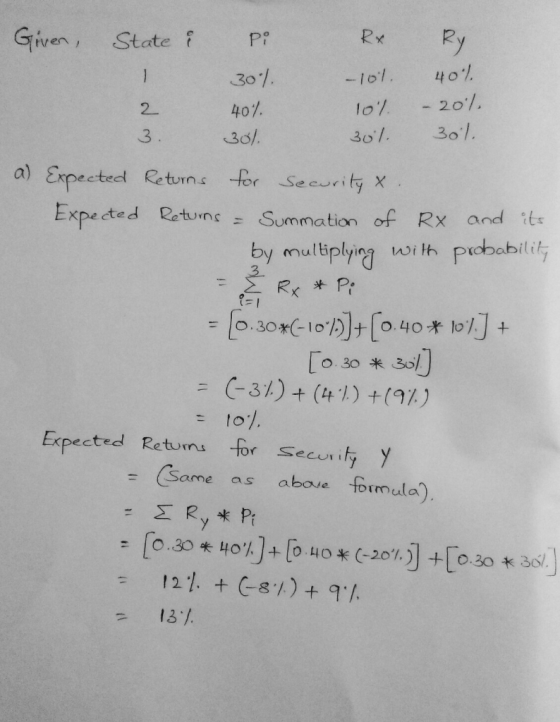
Expected return for stock X = 10%
Expected return for stock Y = 13%
Pi indicates Probability index
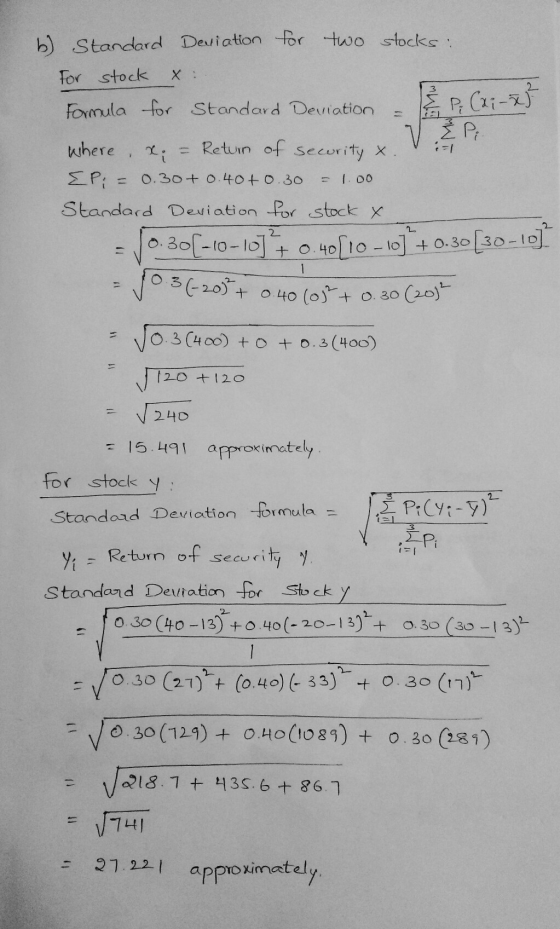
Standard deduction for stock X = 15.492
Standard deduction for stock Y = 27.221
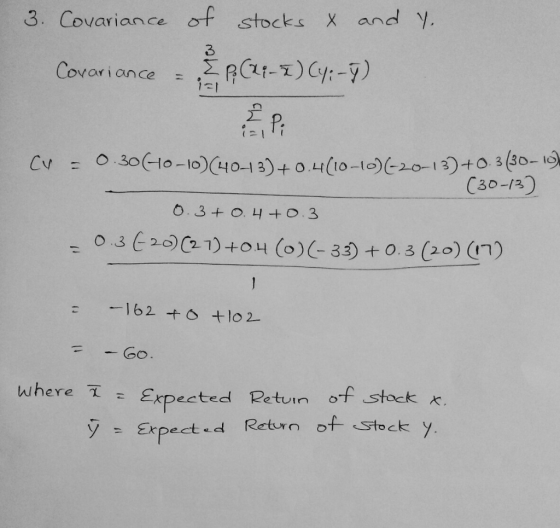
Covariance of stock X and Stock Y = -60
Add Answer to:
An investor obtains the following probability distributions for two stocks: Statei Pi  
Stocks A and B have the following probability distributions: % Returns Probability A B 0.40 15...
Stocks A and B have the following probability distributions: % Returns Probability A B 0.40 15 35 0.10 10 20 0.30 -5 15 0.20 -15 -5 If you form a 50-50 portfolio of the two stocks, calculate the expected rate of return and the standard deviation for the portfolio. (Remember, you must calculate a new range of outcomes for the portfolio.) Briefly explain why the standard deviation for the portfolio would be less than the weighted average of the standard deviations...
2- You have estimated the following probability distributions of expected future returns for Stocks X and...
 2- You have estimated the following probability distributions of expected future returns for Stocks X and Y: (2 marks) Stock X Probability Return 0.4 -20 0.5 0.1 2a- What is the expected rate of return for Stock X? 2b- What is the standard deviation of expected returns for Stock X?
Stocks X and Y have the following probability distributions of expected future returns: Probability 0.1 0.2...
 Stocks X and Y have the following probability distributions of expected future returns: Probability 0.1 0.2 0.4 0.2 0.1 (10%) 2 12 20 48 (35%) 0 20 25 What are the expected returns of both X and Y? O 12% and 15% 13% and 14% 13% and 16% 13% and 15% 12% and 14%
s presented with the two following stocks 17. The investor Stock A Stock B Expected Return...
 s presented with the two following stocks 17. The investor Stock A Stock B Expected Return Standard Deviation 30% 40% 60% 50% the portfolio that the expected return Assume that the correlation coefficient between the stocks is zero. What stock A invests 30% i A.20% B.37% 07a 18. The investor is presented with the two following stocks: Stock A Stock B Expected Return Standard Deviation 0% 40% 50% 60% Assume that the correlation coefficient between the stocks is zero. What...
Consider the following expected return on two stocks for two particular market returns: With probability 1/2...
Consider the following expected return on two stocks for two particular market returns: With probability 1/2 the market return is equal to 4%, return of stock A is 1% and B is 6%. With probability 1/2 the market return is equal to 20%, return of stock A is 33% and B is 10%. (Hint: these are realizations and not expected values, you should calculate the expected returns using the given probabilities and returns) (a) What is the expected rate of...
2. Consider the following expected return on two stocks for two particular market returns: With probability...
2. Consider the following expected return on two stocks for two particular market returns: With probability 1/2 the market return is equal to 4%, return of stock A is 1% and B is 6%. With probability 1/2 the market return is equal to 20%, return of stock A is 33% and B is 10%. (Hint: these are realizations and not expected values, you should calculate the expected returns using the given probabilities and returns) (a) What is the expected rate...
Stocks A and B have the following probability distributions of expected future returns: Probability A B...
Stocks A and B have the following probability distributions of expected future returns: Probability A B 0.1 (5 %) (37 %) 0.1 3 0 0.6 14 21 0.1 20 29 0.1 31 45 Calculate the expected rate of return, , for Stock B ( = 13.30%.) Do not round intermediate calculations. Round your answer to two decimal places. % Calculate the standard deviation of expected returns, σA, for Stock A (σB = 20.55%.) Do not round intermediate calculations. Round your...
Stocks A and B have the following probability distributions of expected future returns: Probability A B...
Stocks A and B have the following probability distributions of expected future returns: Probability A B .1 (13%) (40%) .1 5 0 .5 15 21 .2 22 30 .1 33 48 a.) Calculate the expected rate of return for Stock B ( = 14.40%.) Do not round intermediate calculations. Round your answer to two decimal places. b.) Calculate the standard deviation of expected returns, σA, for Stock A (σB = 22.17%.) Do not round intermediate calculations. Round your answer to...
Stocks X and Y have the following probability distributions of expected future returns: Probability X Y...
Stocks X and Y have the following probability distributions of expected future returns: Probability X Y 0.1 -10.0% -35.0% 0.2 2.0% 0.0% 0.4 12.0% 20.0% 0.2 20.0% 25.0% 0.1 34.0% 45.0% Calculate the expected rate of return,� , for Stock X A. 12.20 B. 11.20 C. 12.00 D. 11.60
Stocks A and B have the following probability distributions of expected future returns: Probability A B...
Stocks A and B have the following probability distributions of expected future returns: Probability A B 0.1 (13 %) (37 %) 0.1 6 0 0.5 10 18 0.2 22 28 0.1 38 35 A.Calculate the expected rate of return,rb , for Stock B (rA = 12.50%.) Do not round intermediate calculations. Round your answer to two decimal places. B. Calculate the standard deviation of expected returns, σA, for Stock A (σB = 19.26%.) Do not round intermediate calculations. Round your...
 2- You have estimated the following probability distributions of expected future returns for Stocks X and Y: (2 marks) Stock X Probability Return 0.4 -20 0.5 0.1 2a- What is the expected rate of return for Stock X? 2b- What is the standard deviation of expected returns for Stock X?
 Stocks X and Y have the following probability distributions of expected future returns: Probability 0.1 0.2 0.4 0.2 0.1 (10%) 2 12 20 48 (35%) 0 20 25 What are the expected returns of both X and Y? O 12% and 15% 13% and 14% 13% and 16% 13% and 15% 12% and 14%
 s presented with the two following stocks 17. The investor Stock A Stock B Expected Return Standard Deviation 30% 40% 60% 50% the portfolio that the expected return Assume that the correlation coefficient between the stocks is zero. What stock A invests 30% i A.20% B.37% 07a 18. The investor is presented with the two following stocks: Stock A Stock B Expected Return Standard Deviation 0% 40% 50% 60% Assume that the correlation coefficient between the stocks is zero. What...
Most questions answered within 3 hours.
-
Where is the error in this code sequence?
String s1 = "Hello";
String s2 = "ello";...
asked 10 months ago -
Financial data for Joel de Paris, Inc., for last year
follow:
Joel de Paris, Inc.
Balance...
asked 10 months ago -
Consider this reaction:
Al2(SO4)3 (aq)+ BaCl3
(aq) Al2Cl6 (aq)- +
3BaSO4(s) . What is the...
asked 10 months ago -
Suppose that Savneet is considering increasing her
recent random sample from 20 car rentals to 40...
asked 10 months ago -
Trucks arrive at an unloading terminal at an average rate of 120
per hour.
Trucks arrive...
asked 10 months ago -
Why are methanol and ethanol completely soluble in water while
octanol is not very little soluble....
asked 10 months ago -
A facilities manager at a university reads in a research report
that the mean amount of...
asked 10 months ago -
When the CuSO4 is rehydrated by adding water to the anhydrous
compound, is this an endothermic...
asked 10 months ago -
A ray of sunlight is passing from diamond into crown glass; the
angle of incidence is...
asked 10 months ago -
A block of mass 0.249 kg is placed on top of a light, vertical
spring of...
asked 10 months ago -
how do the kidneys compensate in the presences of acidosis
a) trigger hyperventilate
b) reserve acid...
asked 10 months ago -
Question 501 pts
The rental rate of capital to the firm increases. Which of the
following...
asked 10 months ago