What explains the 10,000 to 1 selectivity of the potassium channel for K+ over Na+ considering...
What explains the 10,000 to 1 selectivity of the potassium channel for K+ over Na+ considering that the atomic radii of these two ions differ by only 0.4 Angstroms.
Homework Answers
K-channels and valinomycin molecules share the exquisite ability to select K+ over Na+ ions. Highly selective K-channels maintain a special local environment around their binding sites devoid of competing hydrogen bond donor groups, which enables spontaneous transfer of K+ from states of low coordinations in water into states of over-coordination by 8 carbonyl ligands. In such a phase-activated state, electrostatic interactions from these 8-fold binding sites, constrained to maintain high coordinations, result in K+/Na+selectivity with no need for a specific cavity size. Under such conditions, however, direct coordination from 5 or 6 carbonyl ligands does not result in selectivity. Yet, valinomycin molecules achieve selectivity by providing only 6 carbonyl ligands. Does valinomycin use additional coordinating ligands from the solvent or does it have special structural features not present in K-channels? Quantum chemical investigations undertaken here demonstrate that valinomycin selectivity is due to cavity size constraints that physically prevent it from collapsing onto the smaller Na+ ion. Valinomycin enforces these constraints using a combination of intra-molecular hydrogen bonds and other structural features, including its specific ring size and the spacing between its connected ligands. Results from these investigations also provide a consistent explanation for the experimental data available for valinomycin’s ion-complexation properties in solvents of varying polarity. Together, investigations on these two systems reveal how nature, despite being popular for its parsimony in recycling functional motifs, can use different combinations of phase, coordination number, cavity size, and rigidity (constraints) to achieve K+/Na+ selectivity.
Among bio-molecules that differentiate between these two ions, some selectively bind K+, while others bind Na+. What drives selectivity in favor of a particular ion? Equilibrium thermodynamics dictates that transfer of a particular ion A from one solvation phase m, say water, to another solvation phase p, say protein, is favorable when the ion’s solvation free energy in phase p is lower than its value in phase m,
ΔΔGA(m → p) = ΔGA(p)−ΔGA(m) < 0,
where ΔGA(m) is the free energy change for ion A in phase m relative to the gas phase.
Add Answer to:
What explains the 10,000 to 1 selectivity of the potassium channel for K+ over Na+ considering...
Which of the following is true regarding the selectivity filter of the bacterial potassium channel? 1....
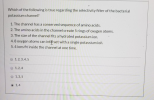 Which of the following is true regarding the selectivity filter of the bacterial potassium channel? 1. The channel has a conserved sequence of amino acids. 2. The amino acids in the channel create 5 rings of oxygen atoms. 3. The size of the channel fits a hydrated potassium ion. 4.8 oxygen atoms can intąract with a single potassium ion. 5.4 ions fit inside the channel at one time. 1,2,3,4,5 1,2,4 1,3,5 • 1.4
ana ion channels. The two ions in questions are Na+ (sodium ion) and K+ (potassium ion)....
 ana ion channels. The two ions in questions are Na+ (sodium ion) and K+ (potassium ion). The on channels/pumps are a) voltage-gated sodium channel, b) voltage-gated potassium channel, and c) sodium/potassium pump. a) Depolarization: b) Repolarization: c) Restoring ion concentrations:
A glass membrane electrode is constructed that has a selectivity for Na vs Li, K, and...
 A glass membrane electrode is constructed that has a selectivity for Na vs Li, K, and Ag with the following selectivity coefficents: K = 1/2800; KNax = 1/2750; and KwaAg = 1/3015. Answer the following questions: 1. What is the potential for the Na ISE when immersed in the following solutions: a) A 0.0100 M Nacl solution b) A 0.1100 M NaOH Solution c) A 0.5701 M NaNO Solution 2. Compute the potential change for each of the solutions in...
1. Cytosolic G-proteins that bind to the neck of a clathrin-coated vesicle to help pinch it...
1. Cytosolic G-proteins that bind to the neck of a clathrin-coated vesicle to help pinch it off from the donor membrane are called: A. SNARES B. Cargo C. Dynamin D. Adaptin E. RABs 2. Sodium ions are unable to pass through a potassium ion channel as a result of which of the following? A. Their charge B. The larger size of the Na+ atomic Radii relative to K+ C. Their inability to shed their sphere of hydration to pass through...
1. What triggers the opening of each of the different channels: ligand-gated K+ channels, ligand-gated Na+...
1. What triggers the opening of each of the different channels: ligand-gated K+ channels, ligand-gated Na+ channels, ligand-gated Cl- channels, voltage-gated Na+ channels, voltage-gated K+ channels, voltage-gated Ca2+ channels. 2. What happens to membrane potential in the immediate area where the channel is located when the channel opens and ions flow through? 3. Since graded and action potentials happen in different locations on the neuron, explain what has to happen to link these different events together.
4. Inspired by the natural design of cell membranes, you have invented a strange new semi-permeable...
 4. Inspired by the natural design of cell membranes, you have invented a strange new semi-permeable membrane consisting of a water-impemeable base layer interspersed with hydrophilic transmembrane glycoproteins which form three types of channels. Channel type 'A' is approx imately 3 angstroms in diameter and lined with negative charges Channel type 'B' is approximately 3 angstroms in diameter also but lined with positive charges Channel type C is approximately 4 angstroms in diameter and electrically neutral This membrane separates two...
1. What is the ground state configuration for each of the following ions? (a) Mg2+ (b)...
1. What is the ground state configuration for each of the following ions? (a) Mg2+ (b) F− (c) Cu+ (d) Mn3+ (e) S2− 2. The average atomic weight of silicon is 28.086 amu. It has three stable isotopes, two of which are 28Si (92.23% abundance, mass = 27.977 amu) and 30Si (3.10% abundance, mass = 29.974 amu). What is the mass of the third stable isotope? 3. Considering their EN values, explain why potassium, strontium, and aluminum are classified as...
1. What is the maximum number of unpaired electrons that can occupy each of the following...
1. What is the maximum number of unpaired electrons that can occupy each of the following subshells? a. 3p, b. 5d c. 2s d. 4f 2. Identify the specific element that corresponds to each of the following electron configurations and indicate the number of unpaired electrons for each. a. 1s 2 2s 2 b. 1s 2 2s 2 2p 4 c. [Ar]4s 1 3d 5 d. [Kr]5s 2 4d 10 5p 4 3. Note: The atomic radius of an element...
Question 1 [40 Points] Liquid mercury at 300 K flows over a flat surface at a...
 Question 1 [40 Points] Liquid mercury at 300 K flows over a flat surface at a free stream velocity 0.15 m/s. The flat plate is smooth with a width of 0.25 m and length 0.5 m and is kept at a uniform temperature of 400 K. The flow is parallel to the longer dimension of the plate. Find out: 1. MINIMUM LOCAL convective heat flux, q min and its location (60%) 2. Total convective heat transfer rate, q (40%) Use...
EENG 245 Physical electronics HW 1 1) The NaCl crystal is cubic, and can be described...
 EENG 245 Physical electronics HW 1 1) The NaCl crystal is cubic, and can be described as follows. Na atoms sit at the corners and faces of a cube, and Cl atoms sit in between two Na atoms. This means that a Clatom is found half-way along each of the cube edges, and there is a Cl in the center of the cube. (We could also have described the lattice by interchanging Na and Cl in the description above.) Another...
 Which of the following is true regarding the selectivity filter of the bacterial potassium channel? 1. The channel has a conserved sequence of amino acids. 2. The amino acids in the channel create 5 rings of oxygen atoms. 3. The size of the channel fits a hydrated potassium ion. 4.8 oxygen atoms can intąract with a single potassium ion. 5.4 ions fit inside the channel at one time. 1,2,3,4,5 1,2,4 1,3,5 • 1.4
 ana ion channels. The two ions in questions are Na+ (sodium ion) and K+ (potassium ion). The on channels/pumps are a) voltage-gated sodium channel, b) voltage-gated potassium channel, and c) sodium/potassium pump. a) Depolarization: b) Repolarization: c) Restoring ion concentrations:
 A glass membrane electrode is constructed that has a selectivity for Na vs Li, K, and Ag with the following selectivity coefficents: K = 1/2800; KNax = 1/2750; and KwaAg = 1/3015. Answer the following questions: 1. What is the potential for the Na ISE when immersed in the following solutions: a) A 0.0100 M Nacl solution b) A 0.1100 M NaOH Solution c) A 0.5701 M NaNO Solution 2. Compute the potential change for each of the solutions in...
 4. Inspired by the natural design of cell membranes, you have invented a strange new semi-permeable membrane consisting of a water-impemeable base layer interspersed with hydrophilic transmembrane glycoproteins which form three types of channels. Channel type 'A' is approx imately 3 angstroms in diameter and lined with negative charges Channel type 'B' is approximately 3 angstroms in diameter also but lined with positive charges Channel type C is approximately 4 angstroms in diameter and electrically neutral This membrane separates two...
 Question 1 [40 Points] Liquid mercury at 300 K flows over a flat surface at a free stream velocity 0.15 m/s. The flat plate is smooth with a width of 0.25 m and length 0.5 m and is kept at a uniform temperature of 400 K. The flow is parallel to the longer dimension of the plate. Find out: 1. MINIMUM LOCAL convective heat flux, q min and its location (60%) 2. Total convective heat transfer rate, q (40%) Use...
 EENG 245 Physical electronics HW 1 1) The NaCl crystal is cubic, and can be described as follows. Na atoms sit at the corners and faces of a cube, and Cl atoms sit in between two Na atoms. This means that a Clatom is found half-way along each of the cube edges, and there is a Cl in the center of the cube. (We could also have described the lattice by interchanging Na and Cl in the description above.) Another...
Most questions answered within 3 hours.
-
Where is the error in this code sequence?
String s1 = "Hello";
String s2 = "ello";...
asked 11 months ago -
Financial data for Joel de Paris, Inc., for last year
follow:
Joel de Paris, Inc.
Balance...
asked 11 months ago -
Consider this reaction:
Al2(SO4)3 (aq)+ BaCl3
(aq) Al2Cl6 (aq)- +
3BaSO4(s) . What is the...
asked 11 months ago -
Suppose that Savneet is considering increasing her
recent random sample from 20 car rentals to 40...
asked 11 months ago -
Trucks arrive at an unloading terminal at an average rate of 120
per hour.
Trucks arrive...
asked 11 months ago -
Why are methanol and ethanol completely soluble in water while
octanol is not very little soluble....
asked 11 months ago -
A facilities manager at a university reads in a research report
that the mean amount of...
asked 11 months ago -
When the CuSO4 is rehydrated by adding water to the anhydrous
compound, is this an endothermic...
asked 11 months ago -
A ray of sunlight is passing from diamond into crown glass; the
angle of incidence is...
asked 11 months ago -
A block of mass 0.249 kg is placed on top of a light, vertical
spring of...
asked 11 months ago -
how do the kidneys compensate in the presences of acidosis
a) trigger hyperventilate
b) reserve acid...
asked 11 months ago -
Question 501 pts
The rental rate of capital to the firm increases. Which of the
following...
asked 11 months ago