
Homework Answers
 thank
you very much
thank
you very much
Add Answer to:
show work please 1. When hydrotelluric acid is added into a solution of antimony (III) nitrate,...
1. When hydrotelluric acid is added into a solution of antimony (III) nitrate, a black precipitate...
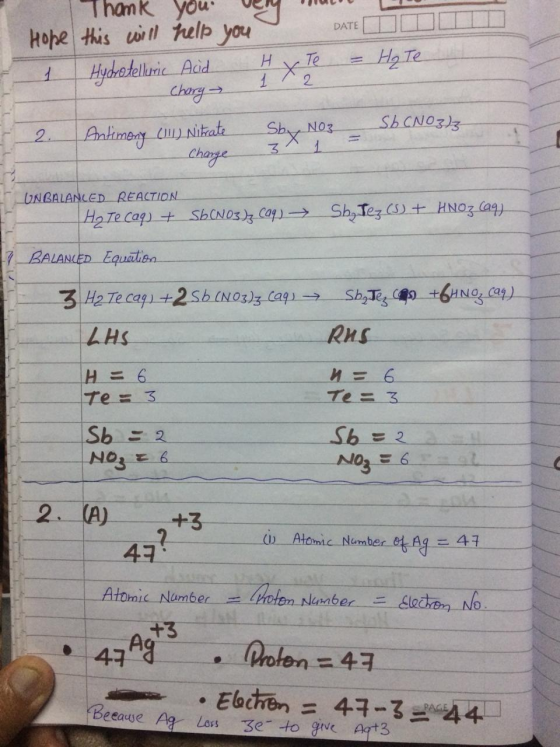
 1. When hydrotelluric acid is added into a solution of antimony (III) nitrate, a black precipitate of antimony (III) telluride is formed. First, write an unbalanced equation for this double displacement reaction and then balance it
1. When hydrotelluric acid is added into a solution of antimony (III) nitrate, a black precipitate...
 1. When hydrotelluric acid is added into a solution of antimony (III) nitrate, a black precipitate of antimony (III) telluride is formed. First, write an unbalanced equation for this double displacement reaction and then balance it.
1. When hydroselenic acid is added into a solution of antimony (III) nitrate, a black precipitate of antimony (III)...
 1. When hydroselenic acid is added into a solution of antimony (III) nitrate, a black precipitate of antimony (III) selenide is formed. First, write an unbalanced equation for this double displacement reaction and then balance it.
when hydroselenic acid is added into a solution of antimony (III) nitrate, a black precipitate of...
when hydroselenic acid is added into a solution of antimony (III) nitrate, a black precipitate of antimony (III) selenide is formed. first write an unbalanced equation of this double displacement reaction and then balance it
when hydrotelluric acid is added to arsenic 3 nitrate , a precipitate is of arsenic Telluride...
when hydrotelluric acid is added to arsenic 3 nitrate , a precipitate is of arsenic Telluride is formed. in a double displacement reaction I need help finding the other products and balancing the equation. TIA
2.When concentrated H2SO4 (18M) is added to a saturated solution of sodium sulfate, a white precipitate...
2.When concentrated H2SO4 (18M) is added to a saturated solution of sodium sulfate, a white precipitate is formed. Write a net-ionic equation for the equilibrium in saturated sodium sulfate, and explain the change in terms of Le Chatelier’s principle. 3.A solution contains the blood-red hexathiocyanatoferrate(III) complex ion, Fe(SCN)63-, in equilibrium with the iron(III) ion, Fe3+, and six thiocyanate ions, SCN-. If the solution is diluted with water, will the color deepen, fade, or stay the same? Why? In addition to...
Post-Lab Questions: 1. If you had a solution which contained only chloride, bromide, or iodide ion,...
 Post-Lab Questions: 1. If you had a solution which contained only chloride, bromide, or iodide ion, which of the three tests would most clearly tell you which anion was in the solution? Explain. 2.) Suppose that you were quite sure that your unknown centained only sulfate ion. Which test would most quickly 3. Consider each set of results below which were carried out on a solution containing either (1)one of the six anions studied in this experiment, or (2) none...
1.) An aqueous solution containing 5.66 g of lead(II) nitrate is added to an aqueous solution...
1.) An aqueous solution containing 5.66 g of lead(II) nitrate is added to an aqueous solution containing 6.30 g of potassium chloride. Enter the balanced chemical equation for this reaction. Be sure to include all physical states. balanced chemical equation What is the limiting reactant? The percent yield for the reaction is 79.2 % . How many grams of precipitate is recovered? precipitate recovered: How many grams of the excess reactant remain? excess reactant remaining: 2.) Chlorine gas can be...
Post-Lab Questions: 1. If you had a solution which contained only chloride, bromide, or iodide ion,...
 Post-Lab Questions: 1. If you had a solution which contained only chloride, bromide, or iodide ion, which of the three tests would most clearly tell you which anion was in the solution? Explain. 2.) Suppose that you were quite sure that your unknown contained only sulfate ion. Which test would most quickly (that is, in the fewest steps) confirm your hypothesis? Explain. Consider each set of results below which were carried out on a solution containing either (1)one of the...
When you write the answers, please write the page number for which the question is located....
 When you write the answers, please write the page number for
which the question is located. Thank you!
Experiment 8 Name: Double Replacement Reactions Background: Some reactions have the net effect of causing the cation of cach reactant to trade places, forming a compound with the other anion. These reactions are known as double replacement reactions. In the example below (unbalanced equation), the barium and sodium cations switch places so that barium forms a product with sulfate while sodium forms...
When you write the answers, please write the page number for
which the question is located. Thank you!
Experiment 8 Name: Double Replacement Reactions Background: Some reactions have the net effect of causing the cation of cach reactant to trade places, forming a compound with the other anion. These reactions are known as double replacement reactions. In the example below (unbalanced equation), the barium and sodium cations switch places so that barium forms a product with sulfate while sodium forms...
 1. When hydrotelluric acid is added into a solution of antimony (III) nitrate, a black precipitate of antimony (III) telluride is formed. First, write an unbalanced equation for this double displacement reaction and then balance it
 1. When hydrotelluric acid is added into a solution of antimony (III) nitrate, a black precipitate of antimony (III) telluride is formed. First, write an unbalanced equation for this double displacement reaction and then balance it.
 1. When hydroselenic acid is added into a solution of antimony (III) nitrate, a black precipitate of antimony (III) selenide is formed. First, write an unbalanced equation for this double displacement reaction and then balance it.
 Post-Lab Questions: 1. If you had a solution which contained only chloride, bromide, or iodide ion, which of the three tests would most clearly tell you which anion was in the solution? Explain. 2.) Suppose that you were quite sure that your unknown centained only sulfate ion. Which test would most quickly 3. Consider each set of results below which were carried out on a solution containing either (1)one of the six anions studied in this experiment, or (2) none...
 Post-Lab Questions: 1. If you had a solution which contained only chloride, bromide, or iodide ion, which of the three tests would most clearly tell you which anion was in the solution? Explain. 2.) Suppose that you were quite sure that your unknown contained only sulfate ion. Which test would most quickly (that is, in the fewest steps) confirm your hypothesis? Explain. Consider each set of results below which were carried out on a solution containing either (1)one of the...
 When you write the answers, please write the page number for
which the question is located. Thank you!
Experiment 8 Name: Double Replacement Reactions Background: Some reactions have the net effect of causing the cation of cach reactant to trade places, forming a compound with the other anion. These reactions are known as double replacement reactions. In the example below (unbalanced equation), the barium and sodium cations switch places so that barium forms a product with sulfate while sodium forms...
When you write the answers, please write the page number for
which the question is located. Thank you!
Experiment 8 Name: Double Replacement Reactions Background: Some reactions have the net effect of causing the cation of cach reactant to trade places, forming a compound with the other anion. These reactions are known as double replacement reactions. In the example below (unbalanced equation), the barium and sodium cations switch places so that barium forms a product with sulfate while sodium forms...
Most questions answered within 3 hours.
-
Where is the error in this code sequence?
String s1 = "Hello";
String s2 = "ello";...
asked 10 months ago -
Financial data for Joel de Paris, Inc., for last year
follow:
Joel de Paris, Inc.
Balance...
asked 10 months ago -
Consider this reaction:
Al2(SO4)3 (aq)+ BaCl3
(aq) Al2Cl6 (aq)- +
3BaSO4(s) . What is the...
asked 10 months ago -
Suppose that Savneet is considering increasing her
recent random sample from 20 car rentals to 40...
asked 10 months ago -
Trucks arrive at an unloading terminal at an average rate of 120
per hour.
Trucks arrive...
asked 10 months ago -
Why are methanol and ethanol completely soluble in water while
octanol is not very little soluble....
asked 10 months ago -
A facilities manager at a university reads in a research report
that the mean amount of...
asked 10 months ago -
When the CuSO4 is rehydrated by adding water to the anhydrous
compound, is this an endothermic...
asked 10 months ago -
A ray of sunlight is passing from diamond into crown glass; the
angle of incidence is...
asked 10 months ago -
A block of mass 0.249 kg is placed on top of a light, vertical
spring of...
asked 10 months ago -
how do the kidneys compensate in the presences of acidosis
a) trigger hyperventilate
b) reserve acid...
asked 10 months ago -
Question 501 pts
The rental rate of capital to the firm increases. Which of the
following...
asked 10 months ago