
Homework Answers
%%Matlab example for Lagrange Interpolation function
clear all
close all
%Example for using function p=polyintourastname(x,y,w)
%x and y data values
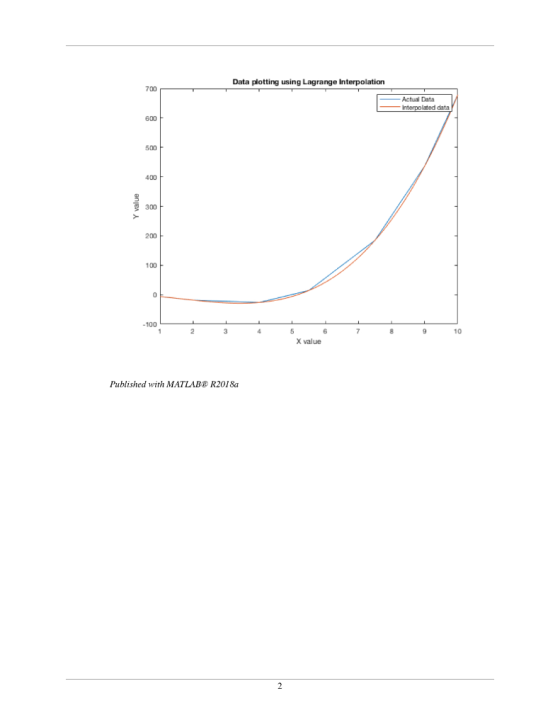
x1=[1 2 4 5.5 7.5 9 10];
y1=[-6.5 -18.5 -26.5 14 184.5 436.5 679];
%plotting of actual data
plot(x1,y1);
%interpolated data points
w=linspace(1,10,200);
p=lagrangeforminterpolation(7,x1,y1,w);
hold on
%plotting of interpolated data
plot(w,p)
title('Data plotting using Lagrange Interpolation')
xlabel('X value')
ylabel('Y value')
legend('Actual Data','Interpolated data')
%%%%%%%%%%%%%%%%%%%%%%%%%%%%%%%%%%%%%%%%%%%%%%%%%%%%%%%%%%%%%%%%%%%%%%
%%%%%%%%%% Matlab function for Lagrange interpolation
%%%%%%%%%%
function [value]=lagrangeforminterpolation(N,x,y,z)
syms xx
%xi=independent variable;yi=dependent variable;x=value at which we
have to
%find the dependent variable;y=corresponding value of dependent
variable at x;
%loop for creating the Lagrange Interpolation function
for i=1:N
s1=1;
s2=1;
for j=1:N
if i~=j
s1=(xx-x(j))*s1;
s2=(x(i)-x(j))*s2;
end
end
zz(i)=(s1./s2)*y(i);
end
f(xx)=sum(zz);
%interpolated data using Lagrange Method
for i=1:length(z)
value(i)=double(f(z(i)));
end
end
%%%%%%%%%%%%%%%%%%%%%%%%%%%%%%%%%%%%%%%%%%%%%%%%%%%%%%%%%%%%%%%%%%%%%%
%%%%%%%%%%%%%% End of Code %%%%%%%%%%%%%%
Add Answer to:
1. (25 pts) Given integer N > 0; vector r of distinct nodes with N components,...
1. (25 pts) Given integer N>0; vector x of distinct nodes with N components; vector y of valucs at nodes with N comp...
 1. (25 pts) Given integer N>0; vector x of distinct nodes with N components; vector y of valucs at nodes with N components; location 2 complete the Matlab function with header function [valuelagrangeforminterpolation(N,x,yz) so that it uses the Lagrange form to output the value of the Lagrange interpolating polynomial at Remember Lagrange form:
1. (25 pts) Given integer N>0; vector x of distinct nodes with N components; vector y of valucs at nodes with N components; location 2 complete the...
1. (25 pts) Given integer N>0; vector x of distinct nodes with N components; vector y of valucs at nodes with N components; location 2 complete the Matlab function with header function [valuelagrangeforminterpolation(N,x,yz) so that it uses the Lagrange form to output the value of the Lagrange interpolating polynomial at Remember Lagrange form:
1. (25 pts) Given integer N>0; vector x of distinct nodes with N components; vector y of valucs at nodes with N components; location 2 complete the...
1. (25 pts) Write a Matlab function with the header function [value- polynomialpiece(m,x.y,k,z) that inputs number of d...
 1. (25 pts) Write a Matlab function with the header function [value- polynomialpiece(m,x.y,k,z) that inputs number of data points m; vectors a and y, both with m components, holding r- and y-coordinates, respec- tively, of data points, and where the components of r are evenly spaced and in increasing order (rk/2,z,n+1-k/2) an even number k and a location distinct from the 0, > z . nodes; and outputs, using Lagrange form, the value at z of the deg S k-1...
3. For any function f and n1 distinct nodes ro,....Tn, Lagrange interpolation factors f P R where...
 3. For any function f and n1 distinct nodes ro,....Tn, Lagrange interpolation factors f P R where and R is the approximation error. The following Matlab function, function a linterp_poly (X, a-zeros (1,numel(X)) for i1:numel(X) aa - poly (X([1:i-1 i+1:end])); a-a + Y(i) * aa / polyval (aa, X(i)); end end represents P(z)-Ση:0akrk as its coefficients a-lan, an-1, , al, ao (this solves Worksheet 7 Q2.) a) Write a Matlab function that uses P to approximate fd() for any positive...
1. (25 pts) Let f(x) be a continuous function and suppose we are already given the Matlab function "f.", with header "function y fx)", that returns values of f(x) Given the following...
 1. (25 pts) Let f(x) be a continuous function and suppose we are already given the Matlab function "f.", with header "function y fx)", that returns values of f(x) Given the following header for a Matlab function: function [pN] falseposition(c,d,N) complete the function so that it outputs the approximation pN, of the method of false position, using initial guesses po c,pd. You may assume c<d and f(x) has different signs at c and d, however, make sure your program uses...
The Taylor polynomial approximation pn (r) for f(x) = sin(x) around x,-0 is given as follows: TL ...
 The Taylor polynomial approximation pn (r) for f(x) = sin(x) around x,-0 is given as follows: TL 2k 1)! Write a MATLAB function taylor sin.m to approximate the sine function. The function should have the following header: function [p] = taylor-sin(x, n) where x is the input vector, scalar n indicates the order of the Taylor polynomials, and output vector p has the values of the polynomial. Remember to give the function a description and call format. in your script,...
2. Discrete Fourier Transform.(/25) 1. N-th roots of unity are defined as solutions to the equation:...
 2. Discrete Fourier Transform.(/25) 1. N-th roots of unity are defined as solutions to the equation: w = 1. There are exactly N distinct N-th roots of unity. Let w be a primitive root of unity, for example w = exp(2 i/N). Show the following: N, if N divides m k=0 10, otherwise N -1 N wmk 2. Fix and integer N > 2. Let f = (f(0), ..., f(N − 1)) a vector (func- tion) f : [N] →...
Task The task for this assignment is to have the following user-defined data type: struct rgb...
Task The task for this assignment is to have the following user-defined data type: struct rgb { unsigned char red; unsigned char green; unsigned char blue; }; be able to be: read in from a stream (e.g., std::cin), i.e., write: std::istream& operator >>(std::istream& is, rgb& colour); (see below) written out to a stream (e.g., std::cout), i.e., write: std::ostream& operator <<(std::ostream& os, rgb const& colour); (see below) stored in a container, e.g., std::vector<rgb>, std::array<rgb,16>; (see below) processed via algorithms (and other...
 1. (25 pts) Given integer N>0; vector x of distinct nodes with N components; vector y of valucs at nodes with N components; location 2 complete the Matlab function with header function [valuelagrangeforminterpolation(N,x,yz) so that it uses the Lagrange form to output the value of the Lagrange interpolating polynomial at Remember Lagrange form:
1. (25 pts) Given integer N>0; vector x of distinct nodes with N components; vector y of valucs at nodes with N components; location 2 complete the...
1. (25 pts) Given integer N>0; vector x of distinct nodes with N components; vector y of valucs at nodes with N components; location 2 complete the Matlab function with header function [valuelagrangeforminterpolation(N,x,yz) so that it uses the Lagrange form to output the value of the Lagrange interpolating polynomial at Remember Lagrange form:
1. (25 pts) Given integer N>0; vector x of distinct nodes with N components; vector y of valucs at nodes with N components; location 2 complete the...
 1. (25 pts) Write a Matlab function with the header function [value- polynomialpiece(m,x.y,k,z) that inputs number of data points m; vectors a and y, both with m components, holding r- and y-coordinates, respec- tively, of data points, and where the components of r are evenly spaced and in increasing order (rk/2,z,n+1-k/2) an even number k and a location distinct from the 0, > z . nodes; and outputs, using Lagrange form, the value at z of the deg S k-1...
 3. For any function f and n1 distinct nodes ro,....Tn, Lagrange interpolation factors f P R where and R is the approximation error. The following Matlab function, function a linterp_poly (X, a-zeros (1,numel(X)) for i1:numel(X) aa - poly (X([1:i-1 i+1:end])); a-a + Y(i) * aa / polyval (aa, X(i)); end end represents P(z)-Ση:0akrk as its coefficients a-lan, an-1, , al, ao (this solves Worksheet 7 Q2.) a) Write a Matlab function that uses P to approximate fd() for any positive...
 1. (25 pts) Let f(x) be a continuous function and suppose we are already given the Matlab function "f.", with header "function y fx)", that returns values of f(x) Given the following header for a Matlab function: function [pN] falseposition(c,d,N) complete the function so that it outputs the approximation pN, of the method of false position, using initial guesses po c,pd. You may assume c<d and f(x) has different signs at c and d, however, make sure your program uses...
 The Taylor polynomial approximation pn (r) for f(x) = sin(x) around x,-0 is given as follows: TL 2k 1)! Write a MATLAB function taylor sin.m to approximate the sine function. The function should have the following header: function [p] = taylor-sin(x, n) where x is the input vector, scalar n indicates the order of the Taylor polynomials, and output vector p has the values of the polynomial. Remember to give the function a description and call format. in your script,...
 2. Discrete Fourier Transform.(/25) 1. N-th roots of unity are defined as solutions to the equation: w = 1. There are exactly N distinct N-th roots of unity. Let w be a primitive root of unity, for example w = exp(2 i/N). Show the following: N, if N divides m k=0 10, otherwise N -1 N wmk 2. Fix and integer N > 2. Let f = (f(0), ..., f(N − 1)) a vector (func- tion) f : [N] →...
Most questions answered within 3 hours.
-
Where is the error in this code sequence?
String s1 = "Hello";
String s2 = "ello";...
asked 10 months ago -
Financial data for Joel de Paris, Inc., for last year
follow:
Joel de Paris, Inc.
Balance...
asked 10 months ago -
Consider this reaction:
Al2(SO4)3 (aq)+ BaCl3
(aq) Al2Cl6 (aq)- +
3BaSO4(s) . What is the...
asked 10 months ago -
Suppose that Savneet is considering increasing her
recent random sample from 20 car rentals to 40...
asked 10 months ago -
Trucks arrive at an unloading terminal at an average rate of 120
per hour.
Trucks arrive...
asked 10 months ago -
Why are methanol and ethanol completely soluble in water while
octanol is not very little soluble....
asked 10 months ago -
A facilities manager at a university reads in a research report
that the mean amount of...
asked 10 months ago -
When the CuSO4 is rehydrated by adding water to the anhydrous
compound, is this an endothermic...
asked 10 months ago -
A ray of sunlight is passing from diamond into crown glass; the
angle of incidence is...
asked 10 months ago -
A block of mass 0.249 kg is placed on top of a light, vertical
spring of...
asked 10 months ago -
how do the kidneys compensate in the presences of acidosis
a) trigger hyperventilate
b) reserve acid...
asked 10 months ago -
Question 501 pts
The rental rate of capital to the firm increases. Which of the
following...
asked 10 months ago