
Homework Answers

Add Answer to:
{(r, y,) R a2+y+1}. 6. Consider a vector field F(r, v. z) = (ar. y, z)...
(c) Let F be the vector field on R given by F(x, y, z) = (2x...
 (c) Let F be the vector field on R given by F(x, y, z) = (2x +3y, z, 3y + z). (i) Calculate the divergence of F and the curl of F (ii) Let V be the region in IR enclosed by the plane I +2y +z S denote the closed surface that is the boundary of this region V. Sketch a picture of V and S. Then, using the Divergence Theorem, or otherwise, calculate 3 and the XY, YZ...
ems (1 point) A) Consider the vector field F(x, y, z) = (6yz, -7zz, zy). Find...
 ems (1 point) A) Consider the vector field F(x, y, z) = (6yz, -7zz, zy). Find the divergence and curl of F. div(F) = V.F= curl(F) = V F =( ). 5 (5x?, 2(x + y), -7(x + y + x)) 7 B) Consider the vector field F(x, y, z) Find the divergence and curl of F. div(F) = V.P= curl(F) = V XF =( 8 9 10 )
Problem (10 marks) Verify the Divergence Theorem for the vector field F(x, y, z) = (y,1,-)...
 Problem (10 marks) Verify the Divergence Theorem for the vector field F(x, y, z) = (y,1,-) on the region E bounded by the planes y + : = 2 := 0 and the cylinder r +y = 1. Surface Integral: 6 marks) Triple Integral: (4 marks)
1. Gauß theorem / Divergence Theorenm Given the surface S(V) with surface normal vector i of...
 1. Gauß theorem / Divergence Theorenm Given the surface S(V) with surface normal vector i of the volume V. Then, we define the surface integral fs(v) F , df = fs(v) F-ndf over a vector field F. S(V) a) Evaluate the surface integral for the vector field ()ze, - yez+yz es over a cube bounded by x = 0,x = 1, y = 0, y = 1, z 0, z = 1 . Then use Gauß theorem and verify it....
Questions. Please show all work. 1. Consider the vector field F(x, y, z) (-y, x-z, 3x + z)and the surface S, which is the part of the sphere x2 + y2 + z2 = 25 above the plane z = 3. Let C be the...
 Questions. Please show all work. 1. Consider the vector field F(x, y, z) (-y, x-z, 3x + z)and the surface S, which is the part of the sphere x2 + y2 + z2 = 25 above the plane z = 3. Let C be the boundary of S with counterclockwise orientation when looking down from the z-axis. Verify Stokes' Theorem as follows. (a) (i) Sketch the surface S and the curve C. Indicate the orientation of C (ii) Use the...
4. Consider the vector field u = (3r+yz) region V bounded by 2y2 < (2 -...
 4. Consider the vector field u = (3r+yz) region V bounded by 2y2 < (2 - z)2 for y 2 0 and 0 y)j+(xy+2z)k, defined across a three-dimensional 1. z (a) Show that u is conservative and find a scalar function d that satisfies u = Vo. [6 marks] (b) Sketch the volume V and express the limits of the volume V in terms of cylindrical coordi nates (r, 0, z) [3 marks (c) Using the divergence theorem calculate the...
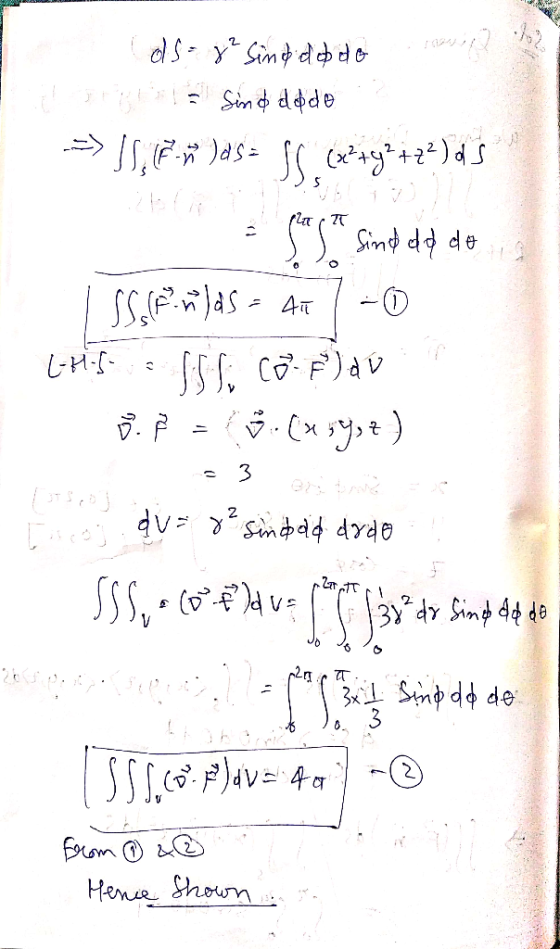
r 37. Singular radial field Consider the radial field (x, y, z) F (x2 + y2...
 r 37. Singular radial field Consider the radial field (x, y, z) F (x2 + y2 + z2)1/2" a. Evaluate a surface integral to show that SsFonds = 4ta?, where S is the surface of a sphere of radius a centered at the origin. b. Note that the first partial derivatives of the components of F are undefined at the origin, so the Divergence Theorem does not apply directly. Nevertheless, the flux across the sphere as computed in part (a)...
(1) Let F denote the inverse square vector field (axr, y, z) F= (Note that ||F...
 (1) Let F denote the inverse square vector field (axr, y, z) F= (Note that ||F 1/r2.) The domain of F is R3\{(0, 0, 0)} where r = the chain rule (a) Verify that Hint: first show that then use (b) Show that div(F 0. (c) Suppose that S is a closed surface in R3 that does not enclose the origin. Show that the flux of F through S is zero. Hint: since the interior of S does not contain...
Consider Gauss' divergence theorem for V being a simple region of the form V=((z, y, z} : 1 + f(z...
 Step by step solution would be grateful thanks ☺
Consider Gauss' divergence theorem for V being a simple region of the form V=((z, y, z} : 1 + f(z,y) < z < x2 + 4y} for some function f(z, y). With (x, y, 2) being a scalar function convert the following integral into a surface integral +4y dzdrdy
Consider Gauss' divergence theorem for V being a simple region of the form V=((z, y, z} : 1 + f(z,y)
Step by step solution would be grateful thanks ☺
Consider Gauss' divergence theorem for V being a simple region of the form V=((z, y, z} : 1 + f(z,y) < z < x2 + 4y} for some function f(z, y). With (x, y, 2) being a scalar function convert the following integral into a surface integral +4y dzdrdy
Consider Gauss' divergence theorem for V being a simple region of the form V=((z, y, z} : 1 + f(z,y)
Consider the vector field. F(x, y, z) = 6ex sin(y), 8ey sin(z), 5ez sin(x) Consider the...
 Consider the vector field.
F(x, y, z) =
6ex sin(y), 8ey sin(z), 5ez
sin(x)
Consider the vector field. F(x, y, z) = (6e* sin(y), 8ey sin(z), 5e? sin(x)) (a) Find the curl of the vector field. curl F = (-8e'sin(z), – 5e'sin(x), – 6e'sin(y)) x (b) Find the divergence of the vector field. div F = 6e sin(y) + 8e) sin(z) + 5e+sin(x)
Consider the vector field.
F(x, y, z) =
6ex sin(y), 8ey sin(z), 5ez
sin(x)
Consider the vector field. F(x, y, z) = (6e* sin(y), 8ey sin(z), 5e? sin(x)) (a) Find the curl of the vector field. curl F = (-8e'sin(z), – 5e'sin(x), – 6e'sin(y)) x (b) Find the divergence of the vector field. div F = 6e sin(y) + 8e) sin(z) + 5e+sin(x)
 (c) Let F be the vector field on R given by F(x, y, z) = (2x +3y, z, 3y + z). (i) Calculate the divergence of F and the curl of F (ii) Let V be the region in IR enclosed by the plane I +2y +z S denote the closed surface that is the boundary of this region V. Sketch a picture of V and S. Then, using the Divergence Theorem, or otherwise, calculate 3 and the XY, YZ...
 ems (1 point) A) Consider the vector field F(x, y, z) = (6yz, -7zz, zy). Find the divergence and curl of F. div(F) = V.F= curl(F) = V F =( ). 5 (5x?, 2(x + y), -7(x + y + x)) 7 B) Consider the vector field F(x, y, z) Find the divergence and curl of F. div(F) = V.P= curl(F) = V XF =( 8 9 10 )
 Problem (10 marks) Verify the Divergence Theorem for the vector field F(x, y, z) = (y,1,-) on the region E bounded by the planes y + : = 2 := 0 and the cylinder r +y = 1. Surface Integral: 6 marks) Triple Integral: (4 marks)
 1. Gauß theorem / Divergence Theorenm Given the surface S(V) with surface normal vector i of the volume V. Then, we define the surface integral fs(v) F , df = fs(v) F-ndf over a vector field F. S(V) a) Evaluate the surface integral for the vector field ()ze, - yez+yz es over a cube bounded by x = 0,x = 1, y = 0, y = 1, z 0, z = 1 . Then use Gauß theorem and verify it....
 Questions. Please show all work. 1. Consider the vector field F(x, y, z) (-y, x-z, 3x + z)and the surface S, which is the part of the sphere x2 + y2 + z2 = 25 above the plane z = 3. Let C be the boundary of S with counterclockwise orientation when looking down from the z-axis. Verify Stokes' Theorem as follows. (a) (i) Sketch the surface S and the curve C. Indicate the orientation of C (ii) Use the...
 4. Consider the vector field u = (3r+yz) region V bounded by 2y2 < (2 - z)2 for y 2 0 and 0 y)j+(xy+2z)k, defined across a three-dimensional 1. z (a) Show that u is conservative and find a scalar function d that satisfies u = Vo. [6 marks] (b) Sketch the volume V and express the limits of the volume V in terms of cylindrical coordi nates (r, 0, z) [3 marks (c) Using the divergence theorem calculate the...
 r 37. Singular radial field Consider the radial field (x, y, z) F (x2 + y2 + z2)1/2" a. Evaluate a surface integral to show that SsFonds = 4ta?, where S is the surface of a sphere of radius a centered at the origin. b. Note that the first partial derivatives of the components of F are undefined at the origin, so the Divergence Theorem does not apply directly. Nevertheless, the flux across the sphere as computed in part (a)...
 (1) Let F denote the inverse square vector field (axr, y, z) F= (Note that ||F 1/r2.) The domain of F is R3\{(0, 0, 0)} where r = the chain rule (a) Verify that Hint: first show that then use (b) Show that div(F 0. (c) Suppose that S is a closed surface in R3 that does not enclose the origin. Show that the flux of F through S is zero. Hint: since the interior of S does not contain...
 Step by step solution would be grateful thanks ☺
Consider Gauss' divergence theorem for V being a simple region of the form V=((z, y, z} : 1 + f(z,y) < z < x2 + 4y} for some function f(z, y). With (x, y, 2) being a scalar function convert the following integral into a surface integral +4y dzdrdy
Consider Gauss' divergence theorem for V being a simple region of the form V=((z, y, z} : 1 + f(z,y)
Step by step solution would be grateful thanks ☺
Consider Gauss' divergence theorem for V being a simple region of the form V=((z, y, z} : 1 + f(z,y) < z < x2 + 4y} for some function f(z, y). With (x, y, 2) being a scalar function convert the following integral into a surface integral +4y dzdrdy
Consider Gauss' divergence theorem for V being a simple region of the form V=((z, y, z} : 1 + f(z,y)
 Consider the vector field.
F(x, y, z) =
6ex sin(y), 8ey sin(z), 5ez
sin(x)
Consider the vector field. F(x, y, z) = (6e* sin(y), 8ey sin(z), 5e? sin(x)) (a) Find the curl of the vector field. curl F = (-8e'sin(z), – 5e'sin(x), – 6e'sin(y)) x (b) Find the divergence of the vector field. div F = 6e sin(y) + 8e) sin(z) + 5e+sin(x)
Consider the vector field.
F(x, y, z) =
6ex sin(y), 8ey sin(z), 5ez
sin(x)
Consider the vector field. F(x, y, z) = (6e* sin(y), 8ey sin(z), 5e? sin(x)) (a) Find the curl of the vector field. curl F = (-8e'sin(z), – 5e'sin(x), – 6e'sin(y)) x (b) Find the divergence of the vector field. div F = 6e sin(y) + 8e) sin(z) + 5e+sin(x)
Most questions answered within 3 hours.
-
Where is the error in this code sequence?
String s1 = "Hello";
String s2 = "ello";...
asked 11 months ago -
Financial data for Joel de Paris, Inc., for last year
follow:
Joel de Paris, Inc.
Balance...
asked 11 months ago -
Consider this reaction:
Al2(SO4)3 (aq)+ BaCl3
(aq) Al2Cl6 (aq)- +
3BaSO4(s) . What is the...
asked 11 months ago -
Suppose that Savneet is considering increasing her
recent random sample from 20 car rentals to 40...
asked 11 months ago -
Trucks arrive at an unloading terminal at an average rate of 120
per hour.
Trucks arrive...
asked 11 months ago -
Why are methanol and ethanol completely soluble in water while
octanol is not very little soluble....
asked 11 months ago -
A facilities manager at a university reads in a research report
that the mean amount of...
asked 11 months ago -
When the CuSO4 is rehydrated by adding water to the anhydrous
compound, is this an endothermic...
asked 11 months ago -
A ray of sunlight is passing from diamond into crown glass; the
angle of incidence is...
asked 11 months ago -
A block of mass 0.249 kg is placed on top of a light, vertical
spring of...
asked 11 months ago -
how do the kidneys compensate in the presences of acidosis
a) trigger hyperventilate
b) reserve acid...
asked 11 months ago -
Question 501 pts
The rental rate of capital to the firm increases. Which of the
following...
asked 11 months ago