
Homework Answers
Add Answer to:
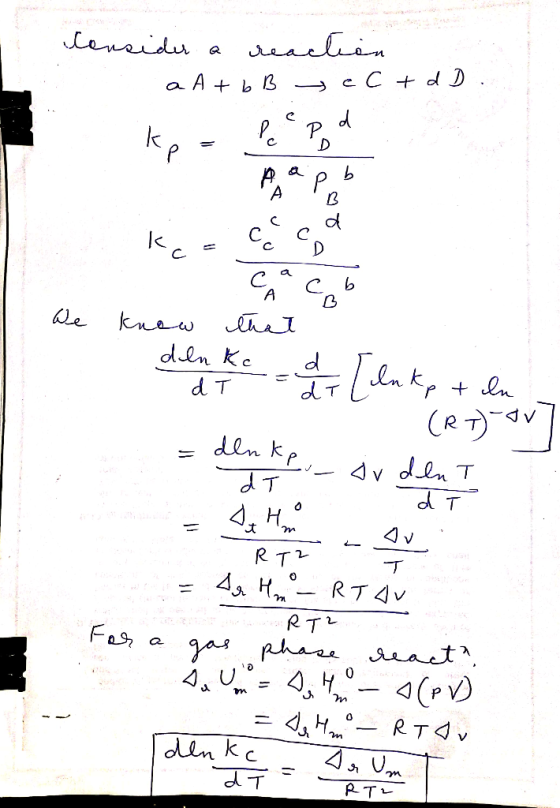
please the problem solution... 5. Show that d In K AU® RT dT for a reaction...
Please show all work and answer all parts with an original solution. Find the solution rt)...
 Please show all work and answer all parts with an original
solution.
Find the solution rt) for the following 1-D heat oquation with homsgensous boundary condiions: au t > 0 u(0, t) 0, t >0 t>0, u(z,0) = 5 sin(2x)-14 sin(3x), Are there infinitely many terms in the solution for this initial boundary value problem? How many non-zero terms comprise the solution?
Please show all work and answer all parts with an original
solution.
Find the solution rt) for the following 1-D heat oquation with homsgensous boundary condiions: au t > 0 u(0, t) 0, t >0 t>0, u(z,0) = 5 sin(2x)-14 sin(3x), Are there infinitely many terms in the solution for this initial boundary value problem? How many non-zero terms comprise the solution?
Problem 6 Show that dq dt Has a solution of L/Ck + k If EO) Eo...
 Problem 6 Show that dq dt Has a solution of L/Ck + k If EO) Eo and q(0) NOTE: This is a relatively long derivation. Show all your steps and recall the rules of exponents.
3. [20pt] For a reaction involving perfect gases, VAA + VRB = VCC + VD (a)...
 3. [20pt] For a reaction involving perfect gases, VAA + VRB = VCC + VD (a) (5pt) Define the equilibrium constants (Ky and Kc) in terms of partial pressure and molarity, respectively. RT Δν (b) (5pt) Based on the above definitions, show that K, = K (cºsp)” where Av = vc + vp - (VA + VB). (c) (10pt) Based on the above equation and van't Hoff equation, show that da neko - Aero (The van't Hoff equation can be...
Determine the equilibrium constant for the following reaction. Please show work, thank you! (forgot to add...
 Determine the equilibrium constant for the following reaction.
Please show work, thank you!
(forgot to add the equations)
16. U Understanding reactions involving normal components of air is essential for solving problems dealing with atmospheric pollution. Here is a reaction sequence involving Na and Oz, the most abundant gases in air. Nitrogen dioxide is a toxic pollutant that contributes to photochemical smog. Using the reactions given below, determine the equilibrium constant for the following reaction Understanding reactions involving normal components...
Determine the equilibrium constant for the following reaction.
Please show work, thank you!
(forgot to add the equations)
16. U Understanding reactions involving normal components of air is essential for solving problems dealing with atmospheric pollution. Here is a reaction sequence involving Na and Oz, the most abundant gases in air. Nitrogen dioxide is a toxic pollutant that contributes to photochemical smog. Using the reactions given below, determine the equilibrium constant for the following reaction Understanding reactions involving normal components...
Just need help with d[N2]/dt please 18.1 Nitrogen pentoxide (N205) gas decomposes according to the reaction...
 Just need help with d[N2]/dt please
18.1 Nitrogen pentoxide (N205) gas decomposes according to the reaction 2N2O5 = 4NO2 + O2 At 328 K, the rate of reaction v under certain conditions is 0.75 X 10⁻⁴ mol L-75-1. Assuming that none of the interme- diates have appreciable concentrations, what are the values of d[N2O5]/dt, d[N2]/dt, and d[02]/dt?
Just need help with d[N2]/dt please
18.1 Nitrogen pentoxide (N205) gas decomposes according to the reaction 2N2O5 = 4NO2 + O2 At 328 K, the rate of reaction v under certain conditions is 0.75 X 10⁻⁴ mol L-75-1. Assuming that none of the interme- diates have appreciable concentrations, what are the values of d[N2O5]/dt, d[N2]/dt, and d[02]/dt?
please show steps Problem 9. (5 points) Cowen met L "sta) dr – 3 " sie)dt...
 please show steps
Problem 9. (5 points) Cowen met L "sta) dr – 3 " sie)dt = 2. and 1” siedz – 5. Compute[ 3f(x) dx = 0
please show steps
Problem 9. (5 points) Cowen met L "sta) dr – 3 " sie)dt = 2. and 1” siedz – 5. Compute[ 3f(x) dx = 0
Please show work and explain ts19) For the reaction, C, H12(g) + 802(g)5 CO2(g) +6H20), AU-3524...
 Please show work and
explain
ts19) For the reaction, C, H12(g) + 802(g)5 CO2(g) +6H20), AU-3524 kJ at 75°C. What is AH for the reaction? 244-3512 kJ -3518 kJ -3530 kJ -3536 kJ Point out of a
Please show work and
explain
ts19) For the reaction, C, H12(g) + 802(g)5 CO2(g) +6H20), AU-3524 kJ at 75°C. What is AH for the reaction? 244-3512 kJ -3518 kJ -3530 kJ -3536 kJ Point out of a
PLEASE ANSWER #2 Problem 1: Find the general solution for dx d?.x dt2 + 2k- +...
 PLEASE ANSWER #2
Problem 1: Find the general solution for dx d?.x dt2 + 2k- + k.x = 0 dt where k is an arbitrary constant. Problem 2: Find a differential equation with solution -2.x -23 y = e cos(x) +e sin(x). Hint: Use the property that i2 = = -1 to simplify your work.
PLEASE ANSWER #2
Problem 1: Find the general solution for dx d?.x dt2 + 2k- + k.x = 0 dt where k is an arbitrary constant. Problem 2: Find a differential equation with solution -2.x -23 y = e cos(x) +e sin(x). Hint: Use the property that i2 = = -1 to simplify your work.
mol-i and For C(graphite)-C(diamond) at 298 K and one bar, Δ,Ho-+1.895 kJ A,S® =-3.363 JK-l spontaneous?...
 mol-i and For C(graphite)-C(diamond) at 298 K and one bar, Δ,Ho-+1.895 kJ A,S® =-3.363 JK-l spontaneous? 5. mol-1, Is this reaction spontaneous? Is the reverse reaction show that for the reversible expansion of one mole of an ideal gas:; Ti Vi if Cy f(T).
1.3 Show how d In K/dT = AH/RT2 can be used to obtain a plot where...
 1.3 Show how d In K/dT = AH/RT2 can be used to obtain a plot where In K vs 1/T will yield AH° and ASO. (4)
 Please show all work and answer all parts with an original
solution.
Find the solution rt) for the following 1-D heat oquation with homsgensous boundary condiions: au t > 0 u(0, t) 0, t >0 t>0, u(z,0) = 5 sin(2x)-14 sin(3x), Are there infinitely many terms in the solution for this initial boundary value problem? How many non-zero terms comprise the solution?
Please show all work and answer all parts with an original
solution.
Find the solution rt) for the following 1-D heat oquation with homsgensous boundary condiions: au t > 0 u(0, t) 0, t >0 t>0, u(z,0) = 5 sin(2x)-14 sin(3x), Are there infinitely many terms in the solution for this initial boundary value problem? How many non-zero terms comprise the solution?
 Problem 6 Show that dq dt Has a solution of L/Ck + k If EO) Eo and q(0) NOTE: This is a relatively long derivation. Show all your steps and recall the rules of exponents.
 3. [20pt] For a reaction involving perfect gases, VAA + VRB = VCC + VD (a) (5pt) Define the equilibrium constants (Ky and Kc) in terms of partial pressure and molarity, respectively. RT Δν (b) (5pt) Based on the above definitions, show that K, = K (cºsp)” where Av = vc + vp - (VA + VB). (c) (10pt) Based on the above equation and van't Hoff equation, show that da neko - Aero (The van't Hoff equation can be...
 Determine the equilibrium constant for the following reaction.
Please show work, thank you!
(forgot to add the equations)
16. U Understanding reactions involving normal components of air is essential for solving problems dealing with atmospheric pollution. Here is a reaction sequence involving Na and Oz, the most abundant gases in air. Nitrogen dioxide is a toxic pollutant that contributes to photochemical smog. Using the reactions given below, determine the equilibrium constant for the following reaction Understanding reactions involving normal components...
Determine the equilibrium constant for the following reaction.
Please show work, thank you!
(forgot to add the equations)
16. U Understanding reactions involving normal components of air is essential for solving problems dealing with atmospheric pollution. Here is a reaction sequence involving Na and Oz, the most abundant gases in air. Nitrogen dioxide is a toxic pollutant that contributes to photochemical smog. Using the reactions given below, determine the equilibrium constant for the following reaction Understanding reactions involving normal components...
 Just need help with d[N2]/dt please
18.1 Nitrogen pentoxide (N205) gas decomposes according to the reaction 2N2O5 = 4NO2 + O2 At 328 K, the rate of reaction v under certain conditions is 0.75 X 10⁻⁴ mol L-75-1. Assuming that none of the interme- diates have appreciable concentrations, what are the values of d[N2O5]/dt, d[N2]/dt, and d[02]/dt?
Just need help with d[N2]/dt please
18.1 Nitrogen pentoxide (N205) gas decomposes according to the reaction 2N2O5 = 4NO2 + O2 At 328 K, the rate of reaction v under certain conditions is 0.75 X 10⁻⁴ mol L-75-1. Assuming that none of the interme- diates have appreciable concentrations, what are the values of d[N2O5]/dt, d[N2]/dt, and d[02]/dt?
 please show steps
Problem 9. (5 points) Cowen met L "sta) dr – 3 " sie)dt = 2. and 1” siedz – 5. Compute[ 3f(x) dx = 0
please show steps
Problem 9. (5 points) Cowen met L "sta) dr – 3 " sie)dt = 2. and 1” siedz – 5. Compute[ 3f(x) dx = 0
 Please show work and
explain
ts19) For the reaction, C, H12(g) + 802(g)5 CO2(g) +6H20), AU-3524 kJ at 75°C. What is AH for the reaction? 244-3512 kJ -3518 kJ -3530 kJ -3536 kJ Point out of a
Please show work and
explain
ts19) For the reaction, C, H12(g) + 802(g)5 CO2(g) +6H20), AU-3524 kJ at 75°C. What is AH for the reaction? 244-3512 kJ -3518 kJ -3530 kJ -3536 kJ Point out of a
 PLEASE ANSWER #2
Problem 1: Find the general solution for dx d?.x dt2 + 2k- + k.x = 0 dt where k is an arbitrary constant. Problem 2: Find a differential equation with solution -2.x -23 y = e cos(x) +e sin(x). Hint: Use the property that i2 = = -1 to simplify your work.
PLEASE ANSWER #2
Problem 1: Find the general solution for dx d?.x dt2 + 2k- + k.x = 0 dt where k is an arbitrary constant. Problem 2: Find a differential equation with solution -2.x -23 y = e cos(x) +e sin(x). Hint: Use the property that i2 = = -1 to simplify your work.
 mol-i and For C(graphite)-C(diamond) at 298 K and one bar, Δ,Ho-+1.895 kJ A,S® =-3.363 JK-l spontaneous? 5. mol-1, Is this reaction spontaneous? Is the reverse reaction show that for the reversible expansion of one mole of an ideal gas:; Ti Vi if Cy f(T).
 1.3 Show how d In K/dT = AH/RT2 can be used to obtain a plot where In K vs 1/T will yield AH° and ASO. (4)
Most questions answered within 3 hours.
-
Where is the error in this code sequence?
String s1 = "Hello";
String s2 = "ello";...
asked 10 months ago -
Financial data for Joel de Paris, Inc., for last year
follow:
Joel de Paris, Inc.
Balance...
asked 10 months ago -
Consider this reaction:
Al2(SO4)3 (aq)+ BaCl3
(aq) Al2Cl6 (aq)- +
3BaSO4(s) . What is the...
asked 10 months ago -
Suppose that Savneet is considering increasing her
recent random sample from 20 car rentals to 40...
asked 10 months ago -
Trucks arrive at an unloading terminal at an average rate of 120
per hour.
Trucks arrive...
asked 10 months ago -
Why are methanol and ethanol completely soluble in water while
octanol is not very little soluble....
asked 10 months ago -
A facilities manager at a university reads in a research report
that the mean amount of...
asked 10 months ago -
When the CuSO4 is rehydrated by adding water to the anhydrous
compound, is this an endothermic...
asked 10 months ago -
A ray of sunlight is passing from diamond into crown glass; the
angle of incidence is...
asked 10 months ago -
A block of mass 0.249 kg is placed on top of a light, vertical
spring of...
asked 10 months ago -
how do the kidneys compensate in the presences of acidosis
a) trigger hyperventilate
b) reserve acid...
asked 10 months ago -
Question 501 pts
The rental rate of capital to the firm increases. Which of the
following...
asked 10 months ago