
Homework Answers
Add Answer to:
An enzyme catalyzes the reaction M N. The enzyme is present at a concentration of 3.5...
An enzyme catalyzes the reaction M↽−−⇀N . An enzyme catalyzes the reaction M = N. The...
 An enzyme catalyzes the reaction M↽−−⇀N .
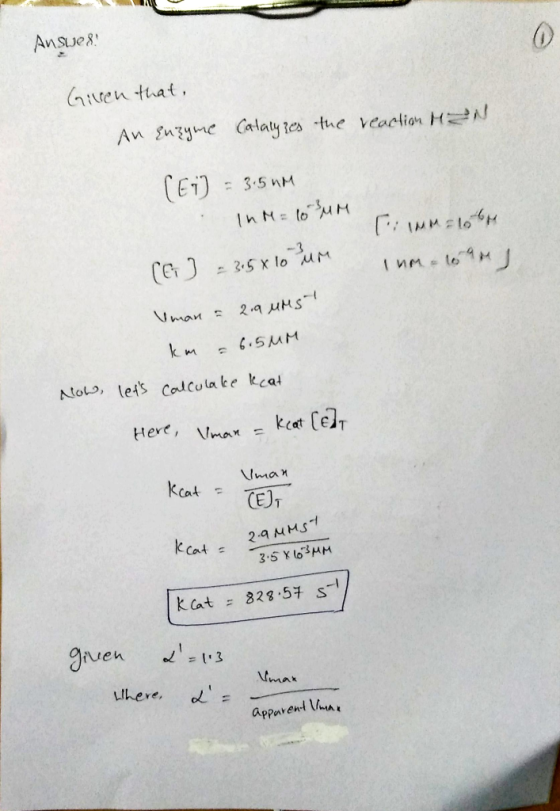
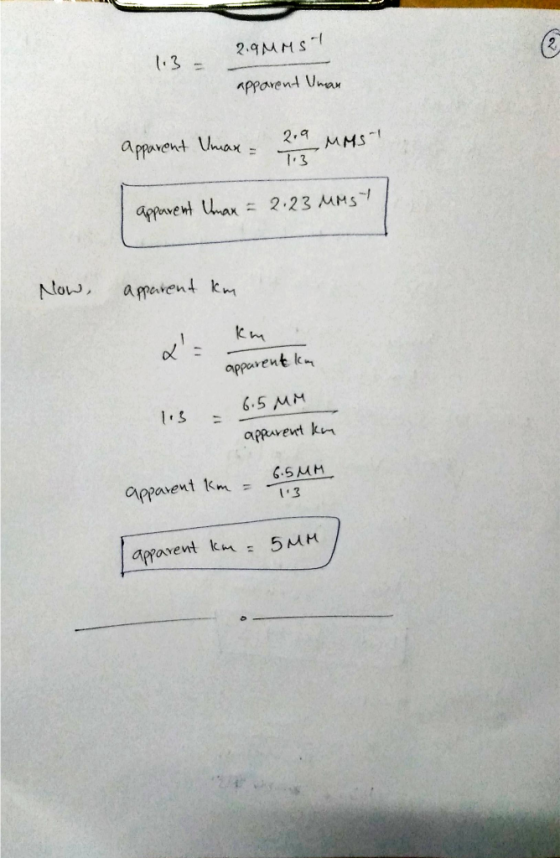
An enzyme catalyzes the reaction M = N. The enzyme is present at a concentration of 3.5 nM, and the Vmax is 1.9 uM -. The Km for substrate M is 2.9 uM. Calculate kcat kcat = 542.86 What values of Vmax and Km would be observed in the presence of sufficient amounts of an uncompetitive inhibitor to generate an a' of 1.5? apparent Vmax = 0.526 UM s-1 apparent Km = 1.2
An enzyme catalyzes the reaction M↽−−⇀N .
An enzyme catalyzes the reaction M = N. The enzyme is present at a concentration of 3.5 nM, and the Vmax is 1.9 uM -. The Km for substrate M is 2.9 uM. Calculate kcat kcat = 542.86 What values of Vmax and Km would be observed in the presence of sufficient amounts of an uncompetitive inhibitor to generate an a' of 1.5? apparent Vmax = 0.526 UM s-1 apparent Km = 1.2
HUUR UUU UUILUUITUL LUIUILINU 2 PV, 10 pul, posta 10. Applying the Michaelis-Menten Equation II An...
 HUUR UUU UUILUUITUL LUIUILINU 2 PV, 10 pul, posta 10. Applying the Michaelis-Menten Equation II An en- zyme catalyzes the reaction M = N. The enzyme is present at a concentration of 1 nm, and the Vmax is 2 um s-1. The Kn for substrate M is 4 um. (a) Calculate kcat. (b) What values of Vmax and Km would be observed in the presence of sufficient amounts of an uncompetitive inhibitor to generate an a' of 2.0?
You are still interested in the enzyme happyase, which catalyzes the following reaction: HAPPY = SAD...
 You are still interested in the enzyme happyase, which catalyzes the following reaction: HAPPY = SAD Previously, you determined that kcat = 400 s and Km = 10 M for your sample of happyase. Further research shows that this happyase sample was actually contaminated with a reversible inhibitor called ANGER. When ANGER is fully removed from the happyase preparation and [Eltotalis 4 nM, the measured Vmax is increased to 4.8 umes-1 and the measured Km is now 15 MM. Use...
13. An enzyme catalyzes the reaction A = B. The enzyme is present at a concentration...
 13. An enzyme catalyzes the reaction A = B. The enzyme is present at a concentration of 2 nM, and the Vmax is 1.2 uMs. The K for substrate A is 10 uM. Calculate the initial velocity of the reaction, Vo, when the substrate concentration is (a) 2 uM, (b) 10 UM, (C) 30 UM.
An enzyme catalyzes the reaction A ⇌ B. The enzyme is present at a concentration of...
An enzyme catalyzes the reaction A ⇌ B. The enzyme is present at a concentration of 2 nM, and the Vmax is 1.2 μM s−1. The Km for substrate A is 10 μM. Calculate the initial velocity of the reaction, V0, when the substrate concentration is (a) 2 μM, (b) 10 μM, (c) 30 μM.
CHEM3250 Assignment-Enzyme Inhibition Consider the data below for an enzyme catalyzed reaction. T...
 CHEM3250 Assignment-Enzyme Inhibition Consider the data below for an enzyme catalyzed reaction. The rate of the reaction has been determined with and without an inhibitor. A total concentration of enzyme of 20 uM was used in the experiment. SHOW WORK AND UNITS!!! Without Inhibitor With Inhibitor [substrate] (mM)Rate of formation of te of formation of product product (mM/min) mM/min) 6.67 5.25 0.49 7.04 38.91 1.0 2.2 6.9 41.8 44.0 1.5 3.5 1 a) On the same graph, plot the data...
10. An enzyme catalyzes the reaction of Y to Z. The enzyme is present at a...
 10. An enzyme catalyzes the reaction of Y to Z. The enzyme is present at a concentration of 1 nM. and the Vmax is 2 M/s. The Km for substrate Y is 4 M. Calculate kot
The following observations come from Lineweaver-Burke plots, based on kinetic data generated from a Michaelis/Menton-type enzyme...
The following observations come from Lineweaver-Burke plots, based on kinetic data generated from a Michaelis/Menton-type enzyme (E) that catalyzes the hydrolysis of a peptide substrate (S). All data were generated in the presence of 18.0 μM total enzyme. The enzyme-catalyzed reaction has a Km of 3.00 μM and a Vmax of 2.00 μM/sec. The enzyme-catalyzed reaction in the presence of 15.0 μM of Inhibitor A has an apparent Km of 2.25 μM and an apparent Vmax of 1.50 μM/sec. The...
9. Applying the Michaelis-Menten Equation I An enzyme catalyzes the reaction A = B. The enzyme is present at a con- cen...
 9. Applying the Michaelis-Menten Equation I An enzyme catalyzes the reaction A = B. The enzyme is present at a con- centration of 2 nm, and the Vmax is 1.2 ums". The Km for substrate A is 10 um. Calculate the initial velocity of the reaction, Vo, when the substrate concentration is (a) 2 um, (b) 10 um, (C) 30 um.
16. At right is a graph obtained from a series of enzyme kinetics assays. The Vmax...
 16. At right is a graph obtained from a series of enzyme kinetics assays. The Vmax for this enzyme and substrate is 4.5 uM/s. 5 4.5 4 a) What is the KM? KM: v. (mM/s) 3.5 3 2.5 2 1.5 1 0.5 b) If a pure non-competitive inhibitor was added to the assays, what would the resulting kinetics curve be like? Give a Km and Vmax in the presence of the inhibitor (write them below) and draw an appropriate curve...
 An enzyme catalyzes the reaction M↽−−⇀N .
An enzyme catalyzes the reaction M = N. The enzyme is present at a concentration of 3.5 nM, and the Vmax is 1.9 uM -. The Km for substrate M is 2.9 uM. Calculate kcat kcat = 542.86 What values of Vmax and Km would be observed in the presence of sufficient amounts of an uncompetitive inhibitor to generate an a' of 1.5? apparent Vmax = 0.526 UM s-1 apparent Km = 1.2
An enzyme catalyzes the reaction M↽−−⇀N .
An enzyme catalyzes the reaction M = N. The enzyme is present at a concentration of 3.5 nM, and the Vmax is 1.9 uM -. The Km for substrate M is 2.9 uM. Calculate kcat kcat = 542.86 What values of Vmax and Km would be observed in the presence of sufficient amounts of an uncompetitive inhibitor to generate an a' of 1.5? apparent Vmax = 0.526 UM s-1 apparent Km = 1.2
 HUUR UUU UUILUUITUL LUIUILINU 2 PV, 10 pul, posta 10. Applying the Michaelis-Menten Equation II An en- zyme catalyzes the reaction M = N. The enzyme is present at a concentration of 1 nm, and the Vmax is 2 um s-1. The Kn for substrate M is 4 um. (a) Calculate kcat. (b) What values of Vmax and Km would be observed in the presence of sufficient amounts of an uncompetitive inhibitor to generate an a' of 2.0?
 You are still interested in the enzyme happyase, which catalyzes the following reaction: HAPPY = SAD Previously, you determined that kcat = 400 s and Km = 10 M for your sample of happyase. Further research shows that this happyase sample was actually contaminated with a reversible inhibitor called ANGER. When ANGER is fully removed from the happyase preparation and [Eltotalis 4 nM, the measured Vmax is increased to 4.8 umes-1 and the measured Km is now 15 MM. Use...
 13. An enzyme catalyzes the reaction A = B. The enzyme is present at a concentration of 2 nM, and the Vmax is 1.2 uMs. The K for substrate A is 10 uM. Calculate the initial velocity of the reaction, Vo, when the substrate concentration is (a) 2 uM, (b) 10 UM, (C) 30 UM.
 CHEM3250 Assignment-Enzyme Inhibition Consider the data below for an enzyme catalyzed reaction. The rate of the reaction has been determined with and without an inhibitor. A total concentration of enzyme of 20 uM was used in the experiment. SHOW WORK AND UNITS!!! Without Inhibitor With Inhibitor [substrate] (mM)Rate of formation of te of formation of product product (mM/min) mM/min) 6.67 5.25 0.49 7.04 38.91 1.0 2.2 6.9 41.8 44.0 1.5 3.5 1 a) On the same graph, plot the data...
 10. An enzyme catalyzes the reaction of Y to Z. The enzyme is present at a concentration of 1 nM. and the Vmax is 2 M/s. The Km for substrate Y is 4 M. Calculate kot
 9. Applying the Michaelis-Menten Equation I An enzyme catalyzes the reaction A = B. The enzyme is present at a con- centration of 2 nm, and the Vmax is 1.2 ums". The Km for substrate A is 10 um. Calculate the initial velocity of the reaction, Vo, when the substrate concentration is (a) 2 um, (b) 10 um, (C) 30 um.
 16. At right is a graph obtained from a series of enzyme kinetics assays. The Vmax for this enzyme and substrate is 4.5 uM/s. 5 4.5 4 a) What is the KM? KM: v. (mM/s) 3.5 3 2.5 2 1.5 1 0.5 b) If a pure non-competitive inhibitor was added to the assays, what would the resulting kinetics curve be like? Give a Km and Vmax in the presence of the inhibitor (write them below) and draw an appropriate curve...
Most questions answered within 3 hours.
-
Where is the error in this code sequence?
String s1 = "Hello";
String s2 = "ello";...
asked 11 months ago -
Financial data for Joel de Paris, Inc., for last year
follow:
Joel de Paris, Inc.
Balance...
asked 11 months ago -
Consider this reaction:
Al2(SO4)3 (aq)+ BaCl3
(aq) Al2Cl6 (aq)- +
3BaSO4(s) . What is the...
asked 11 months ago -
Suppose that Savneet is considering increasing her
recent random sample from 20 car rentals to 40...
asked 11 months ago -
Trucks arrive at an unloading terminal at an average rate of 120
per hour.
Trucks arrive...
asked 11 months ago -
Why are methanol and ethanol completely soluble in water while
octanol is not very little soluble....
asked 11 months ago -
A facilities manager at a university reads in a research report
that the mean amount of...
asked 11 months ago -
When the CuSO4 is rehydrated by adding water to the anhydrous
compound, is this an endothermic...
asked 11 months ago -
A ray of sunlight is passing from diamond into crown glass; the
angle of incidence is...
asked 11 months ago -
A block of mass 0.249 kg is placed on top of a light, vertical
spring of...
asked 11 months ago -
how do the kidneys compensate in the presences of acidosis
a) trigger hyperventilate
b) reserve acid...
asked 11 months ago -
Question 501 pts
The rental rate of capital to the firm increases. Which of the
following...
asked 11 months ago