If the mean GPA among students is 3.25 with a standard deviation of 0.75, and we...
If the mean GPA among students is 3.25 with a standard deviation of 0.75, and we select a random sample of 300 people, at what value for the sample mean would be greater than exactly 95% of possible sample means?
Homework Answers
Solution :
Given that,

s =0.75
n = 100
Degrees of freedom = df = n - 1 = 100 - 1 = 99
At 95% confidence level the z is ,

t
Margin of error = E = t
=1.984 * (0.75 /
= 0.158
The 95% confidence interval estimate of the population mean is,

3.25 - 0.158 <
3.092 <
(3.092, 3.409 )
Add Answer to:
If the mean GPA among students is 3.25 with a standard deviation of 0.75, and we...
If the mean GPA among students is 3.25 with a standard deviation of 0.75, and we...
If the mean GPA among students is 3.25 with a standard deviation of 0.75, and we select a random sample of 300 people, at what value for the sample mean would be greater than exactly 95% of possible sample means?
A random sample of students taking statistics was asked their GPA. The mean was 3.25 with...
A random sample of students taking statistics was asked their GPA. The mean was 3.25 with a standard deviation of 0.503. Find a confidence interval for the population mean.
Students at SHSU have an average GPA of 2.78 with a standard deviation of 0.65. You...
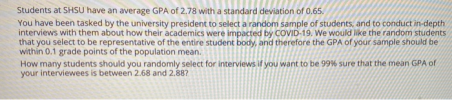 Students at SHSU have an average GPA of 2.78 with a standard deviation of 0.65. You have been tasked by the university president to select a random sample of students, and to conduct in-depth interviews with them about how their academics were impacted by COVID-19. We would like the random students that you select to be representative of the entire student body, and therefore the GPA of your sample should be within 0.1 grade points of the population mean. How...
A random sample of 15 night students was taken with a sample mean GPA of 2.82...
 A random sample of 15 night students was taken with a sample mean GPA of 2.82 and a standard deviation of 0.05. A random sample of 17 day students was taken with a sample mean GPA of 2.79 and a standard deviation of 0.07. Test the claim that the mean GPA of night students (un) is greater than than the mean GPA of day students (up) at a = 0.10. Assume that the data come from normal populations with unequal...
8. Assume the GPA of Stats II students is distributed normally with a population standard deviation...
8. Assume the GPA of Stats II students is distributed normally with a population standard deviation of .10. To test whether the average GPA of Stats II students is GREATER THAN 3.12, a sample of size 49 was drawn and a sample mean of 3.16 was calculated. What is the test statistic? Select one: a. z = 2.10 b. z = 2.80 c. t = 2.10 d. z= 2.57
You are testing the claim that the mean GPA of night students is greater than the...
You are testing the claim that the mean GPA of night students is greater than the mean GPA of day students. You sample 60 night students, and the sample mean GPA is 2.65 with a standard deviation of 0.3 You sample 55 day students, and the sample mean GPA is 2.31 with a standard deviation of 0.81 Round 2 decimal places
You are testing the claim that the mean GPA of night students is greater than the...
You are testing the claim that the mean GPA of night students is greater than the mean GPA of day students. You sample 20 night students, and the sample mean GPA is 2.03 with a standard deviation of 0.85 You sample 60 day students, and the sample mean GPA is 2.12 with a standard deviation of 0.4 Calculate the test statistic, rounded to 2 decimal places
Test the claim that the mean GPA of night students is smaller than the mean GPA...
 Test the claim that the mean GPA of night students is smaller than the mean GPA of day students at the 0.05 significance level, The null and alternative hypothesis would he: HPxPD Ho: Un = yd H: PN PD HH:My CMD HUN MD Hai Py = PD HIPN Po H.Mn + My H.Py > Po H. x > Hp H.: 4n <H H.:Py + P The test is: right-tailed left-tailed two-tailed The sample consisted of 18 night students, with a...
You wish to test the claim that the mean GPA of night students is than 2.5...
You wish to test the claim that the mean GPA of night students is than 2.5 at the 0.05 significance level. Based on a sample of 45 people, the sample mean GPA was 2.47 with a standard deviation of 0.05. When finding the critical value and test statistic, which distribution would we be using? Normal distribution (invNorm for critical value) T distribution (invT for critical value) χ2χ2 distribution (invχχ for critical value) F distribution (invF for critical value)
Test the claim that the mean GPA of night students is larger than 3 at the...
Test the claim that the mean GPA of night students is larger than 3 at the .025 significance level. Based on a sample of 15 people, the sample mean GPA was 3.05 with a standard deviation of 0.02, find the following to 4 decimal places: t-statistic and p-value Do we reject the null hypothesis, or fail to reject the null hypothesis?
 Students at SHSU have an average GPA of 2.78 with a standard deviation of 0.65. You have been tasked by the university president to select a random sample of students, and to conduct in-depth interviews with them about how their academics were impacted by COVID-19. We would like the random students that you select to be representative of the entire student body, and therefore the GPA of your sample should be within 0.1 grade points of the population mean. How...
 A random sample of 15 night students was taken with a sample mean GPA of 2.82 and a standard deviation of 0.05. A random sample of 17 day students was taken with a sample mean GPA of 2.79 and a standard deviation of 0.07. Test the claim that the mean GPA of night students (un) is greater than than the mean GPA of day students (up) at a = 0.10. Assume that the data come from normal populations with unequal...
 Test the claim that the mean GPA of night students is smaller than the mean GPA of day students at the 0.05 significance level, The null and alternative hypothesis would he: HPxPD Ho: Un = yd H: PN PD HH:My CMD HUN MD Hai Py = PD HIPN Po H.Mn + My H.Py > Po H. x > Hp H.: 4n <H H.:Py + P The test is: right-tailed left-tailed two-tailed The sample consisted of 18 night students, with a...
Most questions answered within 3 hours.
-
Where is the error in this code sequence?
String s1 = "Hello";
String s2 = "ello";...
asked 11 months ago -
Financial data for Joel de Paris, Inc., for last year
follow:
Joel de Paris, Inc.
Balance...
asked 11 months ago -
Consider this reaction:
Al2(SO4)3 (aq)+ BaCl3
(aq) Al2Cl6 (aq)- +
3BaSO4(s) . What is the...
asked 11 months ago -
Suppose that Savneet is considering increasing her
recent random sample from 20 car rentals to 40...
asked 11 months ago -
Trucks arrive at an unloading terminal at an average rate of 120
per hour.
Trucks arrive...
asked 11 months ago -
Why are methanol and ethanol completely soluble in water while
octanol is not very little soluble....
asked 11 months ago -
A facilities manager at a university reads in a research report
that the mean amount of...
asked 11 months ago -
When the CuSO4 is rehydrated by adding water to the anhydrous
compound, is this an endothermic...
asked 11 months ago -
A ray of sunlight is passing from diamond into crown glass; the
angle of incidence is...
asked 11 months ago -
A block of mass 0.249 kg is placed on top of a light, vertical
spring of...
asked 11 months ago -
how do the kidneys compensate in the presences of acidosis
a) trigger hyperventilate
b) reserve acid...
asked 11 months ago -
Question 501 pts
The rental rate of capital to the firm increases. Which of the
following...
asked 11 months ago