
Homework Answers

Add Answer to:
1, 2-Diols form carbonyl compounds via the Pinacol Rearrangement. Propose a stepwise mechanism for this reaction....
Please help ! 1,2 diols form carbonyl compounds via the Pinacol Rearrangement. Provide a stepwise mechanism, Detail...
 Please help !
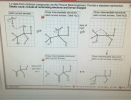
1,2 diols form carbonyl compounds via the Pinacol Rearrangement. Provide a stepwise mechanism, Details count; include all nonbonding electrons and formal charges!
Please help !
1,2 diols form carbonyl compounds via the Pinacol Rearrangement. Provide a stepwise mechanism, Details count; include all nonbonding electrons and formal charges!
Map 1,2 diols form carbonyl compounds via the Pinacol Rearrangement. Propose a stepwise mechanism for this...
 Map 1,2 diols form carbonyl compounds via the Pinacol Rearrangement. Propose a stepwise mechanism for this reaction. Details count; include all nonbonding electrons and formal charges! Draw intermediate structure; Draw intermediate structure; Add curved arrows. add curved arrows. Omit H20. add curved arrows. Omit H20. _он, loss of :он H20 The :0H Draw intermediate structure; add curved arrows. Draw intermediate structure; add curved arrows. Omit H20. loss of H+ (as H307)
CH322 Exam 2 D.S. 2019 1. Propose a reasonable mechanism for the Pinacol-type rearrangement reported recently...
 CH322 Exam 2 D.S. 2019 1. Propose a reasonable mechanism for the Pinacol-type rearrangement reported recently in the chemical literature (JACS, 2009, 6516-6524). (12 pt ОН RR R R' ОН
#2 Propose reagents that could be used to accomplish each reaction. Show a stepwise mechanism for each that inclu...
 #2 Propose reagents that could be used to accomplish each reaction. Show a stepwise mechanism for each that includes all intermediates and curly arrows to show the flow of the electrons. acid-activated Sn1 OH acid-activated OME acid-activated substitution at carbonyl
2. Draw a detailed, stepwise mechanism to show how the products of this reaction form. Clearly...
 2. Draw a detailed, stepwise mechanism to show how the products of this reaction form. Clearly draw the structures of all reactive intermediates. Use curved arrows and include all formal charges. Hint: both Sy1 and SN2 chemistry is required. (2 pts) Oor 21Oo..mo
Draw a detailed, stepwise mechanism to show how the products of this Sy1 reaction form. Clearly draw the structures of...
 Draw a detailed, stepwise mechanism to show how the products of this Sy1 reaction form. Clearly draw the structures of all reactive intermediates. Use curved arrows and include all formal charges. (0.7 pts)
Show the mechanism for the following reaction conducted at –5 °C in CCl4: cyclohexene bromine yields...
 Show the mechanism for the following reaction conducted at –5 °C
in CCl4: cyclohexene bromine yields a dibromocyclohexane Draw
structures – including charges and electrons – and add curved
arrows. Details count.
Map do cyclohexene + bromine yields a dibromocyclohexane Draw structures - including charges and electrons - and add curved arrows. Details count. Add curved arrows to the first step. 1l Draw each species (organic and inorganic) resulting from the previous step. Include charges and nonbonding electrons. Add curved...
Show the mechanism for the following reaction conducted at –5 °C
in CCl4: cyclohexene bromine yields a dibromocyclohexane Draw
structures – including charges and electrons – and add curved
arrows. Details count.
Map do cyclohexene + bromine yields a dibromocyclohexane Draw structures - including charges and electrons - and add curved arrows. Details count. Add curved arrows to the first step. 1l Draw each species (organic and inorganic) resulting from the previous step. Include charges and nonbonding electrons. Add curved...
(10 pts) able, detailed, stepwise mechanism for the reaction of 1. Mechanism - Carbonyl to Imine:...
 (10 pts) able, detailed, stepwise mechanism for the reaction of 1. Mechanism - Carbonyl to Imine: Provide a reasonable, detailed, stepwise mechanism fo p-toluidine with 3-pentanone. (Initially, be concerned about making the ketone a better ele Label important intermediate(s). As appropriate, show important resonance structures) We were unable to transcribe this image
Help!! The following reaction will give one major alkene product via the E1 mechanism. In the...
 Help!!
The following reaction will give one major alkene product via the E1 mechanism. In the boxes draw the mechanism arrows, and in the final box draw the major alkene product, Be sure to include all lone pairs of electrons and nonzero formal charges on all species.
Help!!
The following reaction will give one major alkene product via the E1 mechanism. In the boxes draw the mechanism arrows, and in the final box draw the major alkene product, Be sure to include all lone pairs of electrons and nonzero formal charges on all species.
Hydration of alkenes under aqueous acidic conditions. Draw the detailed stepwise mechanism for this reaction. Be...
 Hydration of alkenes under aqueous acidic conditions. Draw the detailed stepwise mechanism for this reaction. Be sure to show all steps, intermediates, formal charges, and show the movement of electrons with curved arrows. You do not need to draw transition states. H2SO4 H20 ?? The hydration of alkynes can also occur under aqueous acidic conditions however, instead of forming the alcohol, a ketone is formed. Draw the detailed stepwise mechanism for the conversion of the alkyne to the ketone (one...
 Please help !
1,2 diols form carbonyl compounds via the Pinacol Rearrangement. Provide a stepwise mechanism, Details count; include all nonbonding electrons and formal charges!
Please help !
1,2 diols form carbonyl compounds via the Pinacol Rearrangement. Provide a stepwise mechanism, Details count; include all nonbonding electrons and formal charges!
 Map 1,2 diols form carbonyl compounds via the Pinacol Rearrangement. Propose a stepwise mechanism for this reaction. Details count; include all nonbonding electrons and formal charges! Draw intermediate structure; Draw intermediate structure; Add curved arrows. add curved arrows. Omit H20. add curved arrows. Omit H20. _он, loss of :он H20 The :0H Draw intermediate structure; add curved arrows. Draw intermediate structure; add curved arrows. Omit H20. loss of H+ (as H307)
 CH322 Exam 2 D.S. 2019 1. Propose a reasonable mechanism for the Pinacol-type rearrangement reported recently in the chemical literature (JACS, 2009, 6516-6524). (12 pt ОН RR R R' ОН
 #2 Propose reagents that could be used to accomplish each reaction. Show a stepwise mechanism for each that includes all intermediates and curly arrows to show the flow of the electrons. acid-activated Sn1 OH acid-activated OME acid-activated substitution at carbonyl
 2. Draw a detailed, stepwise mechanism to show how the products of this reaction form. Clearly draw the structures of all reactive intermediates. Use curved arrows and include all formal charges. Hint: both Sy1 and SN2 chemistry is required. (2 pts) Oor 21Oo..mo
 Draw a detailed, stepwise mechanism to show how the products of this Sy1 reaction form. Clearly draw the structures of all reactive intermediates. Use curved arrows and include all formal charges. (0.7 pts)
 Show the mechanism for the following reaction conducted at –5 °C
in CCl4: cyclohexene bromine yields a dibromocyclohexane Draw
structures – including charges and electrons – and add curved
arrows. Details count.
Map do cyclohexene + bromine yields a dibromocyclohexane Draw structures - including charges and electrons - and add curved arrows. Details count. Add curved arrows to the first step. 1l Draw each species (organic and inorganic) resulting from the previous step. Include charges and nonbonding electrons. Add curved...
Show the mechanism for the following reaction conducted at –5 °C
in CCl4: cyclohexene bromine yields a dibromocyclohexane Draw
structures – including charges and electrons – and add curved
arrows. Details count.
Map do cyclohexene + bromine yields a dibromocyclohexane Draw structures - including charges and electrons - and add curved arrows. Details count. Add curved arrows to the first step. 1l Draw each species (organic and inorganic) resulting from the previous step. Include charges and nonbonding electrons. Add curved...
 (10 pts) able, detailed, stepwise mechanism for the reaction of 1. Mechanism - Carbonyl to Imine: Provide a reasonable, detailed, stepwise mechanism fo p-toluidine with 3-pentanone. (Initially, be concerned about making the ketone a better ele Label important intermediate(s). As appropriate, show important resonance structures) We were unable to transcribe this image
 Help!!
The following reaction will give one major alkene product via the E1 mechanism. In the boxes draw the mechanism arrows, and in the final box draw the major alkene product, Be sure to include all lone pairs of electrons and nonzero formal charges on all species.
Help!!
The following reaction will give one major alkene product via the E1 mechanism. In the boxes draw the mechanism arrows, and in the final box draw the major alkene product, Be sure to include all lone pairs of electrons and nonzero formal charges on all species.
 Hydration of alkenes under aqueous acidic conditions. Draw the detailed stepwise mechanism for this reaction. Be sure to show all steps, intermediates, formal charges, and show the movement of electrons with curved arrows. You do not need to draw transition states. H2SO4 H20 ?? The hydration of alkynes can also occur under aqueous acidic conditions however, instead of forming the alcohol, a ketone is formed. Draw the detailed stepwise mechanism for the conversion of the alkyne to the ketone (one...
Most questions answered within 3 hours.
-
Where is the error in this code sequence?
String s1 = "Hello";
String s2 = "ello";...
asked 11 months ago -
Financial data for Joel de Paris, Inc., for last year
follow:
Joel de Paris, Inc.
Balance...
asked 11 months ago -
Consider this reaction:
Al2(SO4)3 (aq)+ BaCl3
(aq) Al2Cl6 (aq)- +
3BaSO4(s) . What is the...
asked 11 months ago -
Suppose that Savneet is considering increasing her
recent random sample from 20 car rentals to 40...
asked 11 months ago -
Trucks arrive at an unloading terminal at an average rate of 120
per hour.
Trucks arrive...
asked 11 months ago -
Why are methanol and ethanol completely soluble in water while
octanol is not very little soluble....
asked 11 months ago -
A facilities manager at a university reads in a research report
that the mean amount of...
asked 11 months ago -
When the CuSO4 is rehydrated by adding water to the anhydrous
compound, is this an endothermic...
asked 11 months ago -
A ray of sunlight is passing from diamond into crown glass; the
angle of incidence is...
asked 11 months ago -
A block of mass 0.249 kg is placed on top of a light, vertical
spring of...
asked 11 months ago -
how do the kidneys compensate in the presences of acidosis
a) trigger hyperventilate
b) reserve acid...
asked 11 months ago -
Question 501 pts
The rental rate of capital to the firm increases. Which of the
following...
asked 11 months ago