
Homework Answers
Add Answer to:
(1) Consider two point charges of magnitude q/2 separated by distance R and held in relative...
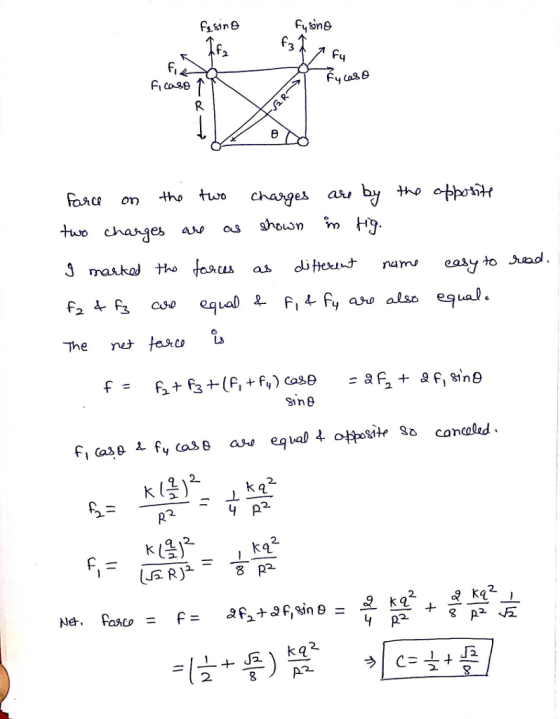
(1) Consider two point charges of magnitude q/2 separated by distance R and held in relative...
 (1) Consider two point charges of magnitude q/2 separated by distance R and held in relative position by a massless rod. An identical massless rod with the same charges lies a distance R away, in the same plane, parallel, q and with centers aligned. I guess you better see the drawing! 2 By dimensional analysis, the force between these two objects must be some factor times kq2/R2, in other words: kq2 Find the factor C.
Two point charges q and ?q are separated by a distance L. What is the magnitude...
Two point charges q and ?q are separated by a distance L. What is the magnitude of the force on a third point charge q placed at the midpoint between them? (a) 8kq2/L2 (b) 2kq2/L2 (c) 0 (d) 4kq2/L2 (e) kq2/L2 any explanation is helpful!
Two point charges, Q1 and Q2, are separated by a distance R. If the magnitude of...
Two point charges, Q1 and Q2, are separated by a distance R. If the magnitude of both charges are tripled and their separation is also tripled, what happens to the magnitude of the electrostatic force that each charge exerts on the other. A. It decreases by a factor of 3 1/2 B. It increases by a factor of 9 C. It stays the same D. It increases by a factor of 3 E. It increases by a factor of 3...
Two point charges are separated by a distance r. If the separation is reduced by a...
Two point charges are separated by a distance r. If the separation is reduced by a factor of 3.6, by what factor does the electric force between the two charges increase?
Two point charges are separated by a distance r. If the separation is reduced by a...
Two point charges are separated by a distance r. If the separation is reduced by a factor of 2.9, by what factor does the electric force between them change?
2, An electric dipole consists of charges+q separated by a distance d and aligned along the...
 2, An electric dipole consists of charges+q separated by a distance d and aligned along the z- axis Show that the potential due to this dipole at points far from the dipole (i.e. r od) is approximately qd cos θ
If two equal positive charges are separated by a distance r and then they are moved...
If two equal positive charges are separated by a distance r and then they are moved so that their separation distance doubles, what happens to the electrical potential energy stored in the system? which answer is right: ??? A. Increased by a factor of 4 B. Increased by a factor of 2 C. Decreased by a factor of 2 D. Decreased by a factor of 4
5. Two point charges +Q and -Q are separated by a distance D and fixed in...
5. Two point charges +Q and -Q are separated by a distance D and fixed in place. You then bring in from very far away a third point charge q to form an equilaterial triangle (i.e., all lengths are D). In doing so, you have: A. Increased the potential energy if q < 0; decreased it if q > 0. B. Increased the potential energy of the system. C. Not changed the potential energy of the system D. Increased the...
Two identical particles, each having charge +q, are fixed in space and separated by a distance...
 Two identical particles, each having charge +q, are fixed in space and separated by a distance d. A third particle with charge -Q is free to move and lies initially at rest on the perpendicular bisector of the two fixed charges a distance x from the midpoint between those charges (see figure below). tq -Q a) Show that if х ıs small compared with d, the motion of Q is simple harmonic along the perpendicu arbi sector. Submit a e...
Please answer all parts. Thank you! PART A) PART B &C) A point charge gives rise...
 Please answer all parts. Thank you!
PART A)
PART B &C)
A point charge gives rise to an electric field of 3 N/C at a distance of 7 m. If the distance remains the same and the charge is increased by a factor of 5, then what will be the new electric field? N/C Submit Answer Tries 0/2 What is the magnitude of the electric field due to a point charge of -4 Q at a distance of 1 R?...
Please answer all parts. Thank you!
PART A)
PART B &C)
A point charge gives rise to an electric field of 3 N/C at a distance of 7 m. If the distance remains the same and the charge is increased by a factor of 5, then what will be the new electric field? N/C Submit Answer Tries 0/2 What is the magnitude of the electric field due to a point charge of -4 Q at a distance of 1 R?...
 (1) Consider two point charges of magnitude q/2 separated by distance R and held in relative position by a massless rod. An identical massless rod with the same charges lies a distance R away, in the same plane, parallel, q and with centers aligned. I guess you better see the drawing! 2 By dimensional analysis, the force between these two objects must be some factor times kq2/R2, in other words: kq2 Find the factor C.
 2, An electric dipole consists of charges+q separated by a distance d and aligned along the z- axis Show that the potential due to this dipole at points far from the dipole (i.e. r od) is approximately qd cos θ
 Two identical particles, each having charge +q, are fixed in space and separated by a distance d. A third particle with charge -Q is free to move and lies initially at rest on the perpendicular bisector of the two fixed charges a distance x from the midpoint between those charges (see figure below). tq -Q a) Show that if х ıs small compared with d, the motion of Q is simple harmonic along the perpendicu arbi sector. Submit a e...
 Please answer all parts. Thank you!
PART A)
PART B &C)
A point charge gives rise to an electric field of 3 N/C at a distance of 7 m. If the distance remains the same and the charge is increased by a factor of 5, then what will be the new electric field? N/C Submit Answer Tries 0/2 What is the magnitude of the electric field due to a point charge of -4 Q at a distance of 1 R?...
Please answer all parts. Thank you!
PART A)
PART B &C)
A point charge gives rise to an electric field of 3 N/C at a distance of 7 m. If the distance remains the same and the charge is increased by a factor of 5, then what will be the new electric field? N/C Submit Answer Tries 0/2 What is the magnitude of the electric field due to a point charge of -4 Q at a distance of 1 R?...
Most questions answered within 3 hours.
-
Where is the error in this code sequence?
String s1 = "Hello";
String s2 = "ello";...
asked 11 months ago -
Financial data for Joel de Paris, Inc., for last year
follow:
Joel de Paris, Inc.
Balance...
asked 11 months ago -
Consider this reaction:
Al2(SO4)3 (aq)+ BaCl3
(aq) Al2Cl6 (aq)- +
3BaSO4(s) . What is the...
asked 11 months ago -
Suppose that Savneet is considering increasing her
recent random sample from 20 car rentals to 40...
asked 11 months ago -
Trucks arrive at an unloading terminal at an average rate of 120
per hour.
Trucks arrive...
asked 11 months ago -
Why are methanol and ethanol completely soluble in water while
octanol is not very little soluble....
asked 11 months ago -
A facilities manager at a university reads in a research report
that the mean amount of...
asked 11 months ago -
When the CuSO4 is rehydrated by adding water to the anhydrous
compound, is this an endothermic...
asked 11 months ago -
A ray of sunlight is passing from diamond into crown glass; the
angle of incidence is...
asked 11 months ago -
A block of mass 0.249 kg is placed on top of a light, vertical
spring of...
asked 11 months ago -
how do the kidneys compensate in the presences of acidosis
a) trigger hyperventilate
b) reserve acid...
asked 11 months ago -
Question 501 pts
The rental rate of capital to the firm increases. Which of the
following...
asked 11 months ago