
Homework Answers
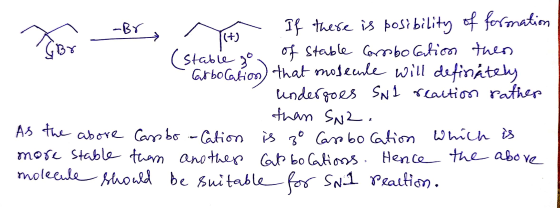
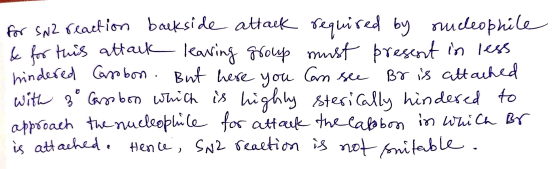
Add Answer to:
5. Describe the suitability of the following substrate for an Syl and S2 reaction is it...
6. Describe the suitability of the following substrate for an Sn1 and SN2 reaction (is it...
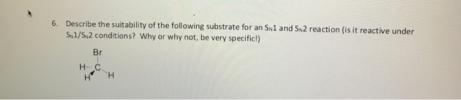 6. Describe the suitability of the following substrate for an Sn1 and SN2 reaction (is it reactive under S,1/S, 2 conditions? Why or why not, be very specific!) HC Η Η
2. In lab, we learned that Br makes a better leaving group than Cl. Do your...
 2. In lab, we learned that Br makes a better leaving group than Cl. Do your results (how fast the reaction took place, if a reaction took place, how much participate was produced, etc.) agree with this? Explain. Give specific examples from your results. For the S1 reactions in this lab, what was the identity of the nucleophile? What was the solvent? What are the best types solvents for SN1 reactions. 4. For the S2 reactions in the lab, what...
Since we haven't yet covered this in class, your class textbook may be a valuable source...
 Since we haven't yet covered this in class, your class textbook may be a valuable source of information in helping to answer these questions. 1. Using the generic chemical species below (E = eletrophile/substrate, LG = leaving group, and Nu nucleophile), show the mechanism (adding curvy arrows/showing electron movement) for both an S, 2 and an S, 1 reaction. Be careful with charges as bonds are broken and created. Also notice that the nucleophile for the S.2 reaction has a...
Which reaction pathway is favored given the following substrate and conditions? ci NaBr Acetone a. E2...
 Which reaction pathway is favored given the following substrate and conditions? ci NaBr Acetone a. E2 b. Syl El c SX2 d. SN 2 E2 e. E1 f. Sni
Which statement or set of conditions listed below is not consistent with an Syl reaction pathway?...
 Which statement or set of conditions listed below is not consistent with an Syl reaction pathway? O a. Neutral nucleophile work just fine. b. The leaving group is typically the conjugate base of a strong acid. O c. The rate is not dependent upon the concentration of the nucleophile. d. The temperature is relatively "cooler" to reduce competing elimination products. e. The solvent is polar and aprotic. Of. The substrate has a leaving group that is typically on a 30,...
6. Which one of the following compounds will react the fastest in an Syl reaction? a...
 6. Which one of the following compounds will react the fastest in an Syl reaction? a a a a all are equally reactive A B с D E 7. Which one of the following compounds will not react with NaBH and H20 all of them PhCHO Mezco MCO Me OCH, react with NaBH4 А B С D E
Sul B Sx2 Either Syl or S2 None of these D) 103) What substitution reaction mechanism...
 Sul B Sx2 Either Syl or S2 None of these D) 103) What substitution reaction mechanism is most likely for the following conversion? A) SI SN2 Either Snl or S2 None of these 105) Which of the following is a strong nucleophile? OH H0 A) B) C) D) E) CH OH ΝΗ, All of these 108) Which of the following is a weakest nucleophile in a polar protic solvent? A) F B) CH Br D) E) All of these 111)...
Which statement or set of conditions listed below is not consistent with an Syl reaction pathway?...
 Which statement or set of conditions listed below is not consistent with an Syl reaction pathway? a. The leaving group is typically the conjugate base of a strong acid. b. The temperature is relatively "cooler" to reduce competing elimination products. c. The solvent is polar and protic. d. All of these are consistent with an Sni pathway. e. Neutral nucleophile work just fine. f. The rate is not dependent upon the concentration of the nucleophile. · The substrate has a...
that's the whole question 1. Identify the fundamental mechanism(s) (E1, E2, Syl, S2, SyAc, addition, acid/base) that...
 that's the whole question
1. Identify the fundamental mechanism(s) (E1, E2, Syl, S2, SyAc, addition, acid/base) that occur in each reaction and fill in the boxes with the missing reagent(s) or product(s). If there is no reaction, write no reaction. Label each reaction as an "oxidation" or "reduction." Mechanism Starting Material Reagent(s) Product(s) ОН ОН N/A (radical) HO- HO OH SNA, addition, acid/base CrO3, HCl, pyridine OH 2 eq. HCMgBr
that's the whole question
1. Identify the fundamental mechanism(s) (E1, E2, Syl, S2, SyAc, addition, acid/base) that occur in each reaction and fill in the boxes with the missing reagent(s) or product(s). If there is no reaction, write no reaction. Label each reaction as an "oxidation" or "reduction." Mechanism Starting Material Reagent(s) Product(s) ОН ОН N/A (radical) HO- HO OH SNA, addition, acid/base CrO3, HCl, pyridine OH 2 eq. HCMgBr
11. For each of the following reactions, predict whether Syl or Sy2 will be the primary...
 11. For each of the following reactions, predict whether Syl or Sy2 will be the primary substitution mechanism. (Circle one) Br Nal in H2O - SN or SN2 CH,OH Sn1 or SN2 NaCN in DMSO Sn1 or S2 12. For the second reaction in question 11 (above), which do you think would react faster--the sec- ondary bromide or a secondary chloride (assuming the same reaction conditions)? (Circle one) Bromide Chloride Neither (rates are the same)
 6. Describe the suitability of the following substrate for an Sn1 and SN2 reaction (is it reactive under S,1/S, 2 conditions? Why or why not, be very specific!) HC Η Η
 2. In lab, we learned that Br makes a better leaving group than Cl. Do your results (how fast the reaction took place, if a reaction took place, how much participate was produced, etc.) agree with this? Explain. Give specific examples from your results. For the S1 reactions in this lab, what was the identity of the nucleophile? What was the solvent? What are the best types solvents for SN1 reactions. 4. For the S2 reactions in the lab, what...
 Since we haven't yet covered this in class, your class textbook may be a valuable source of information in helping to answer these questions. 1. Using the generic chemical species below (E = eletrophile/substrate, LG = leaving group, and Nu nucleophile), show the mechanism (adding curvy arrows/showing electron movement) for both an S, 2 and an S, 1 reaction. Be careful with charges as bonds are broken and created. Also notice that the nucleophile for the S.2 reaction has a...
 Which reaction pathway is favored given the following substrate and conditions? ci NaBr Acetone a. E2 b. Syl El c SX2 d. SN 2 E2 e. E1 f. Sni
 Which statement or set of conditions listed below is not consistent with an Syl reaction pathway? O a. Neutral nucleophile work just fine. b. The leaving group is typically the conjugate base of a strong acid. O c. The rate is not dependent upon the concentration of the nucleophile. d. The temperature is relatively "cooler" to reduce competing elimination products. e. The solvent is polar and aprotic. Of. The substrate has a leaving group that is typically on a 30,...
 6. Which one of the following compounds will react the fastest in an Syl reaction? a a a a all are equally reactive A B с D E 7. Which one of the following compounds will not react with NaBH and H20 all of them PhCHO Mezco MCO Me OCH, react with NaBH4 А B С D E
 Sul B Sx2 Either Syl or S2 None of these D) 103) What substitution reaction mechanism is most likely for the following conversion? A) SI SN2 Either Snl or S2 None of these 105) Which of the following is a strong nucleophile? OH H0 A) B) C) D) E) CH OH ΝΗ, All of these 108) Which of the following is a weakest nucleophile in a polar protic solvent? A) F B) CH Br D) E) All of these 111)...
 Which statement or set of conditions listed below is not consistent with an Syl reaction pathway? a. The leaving group is typically the conjugate base of a strong acid. b. The temperature is relatively "cooler" to reduce competing elimination products. c. The solvent is polar and protic. d. All of these are consistent with an Sni pathway. e. Neutral nucleophile work just fine. f. The rate is not dependent upon the concentration of the nucleophile. · The substrate has a...
 that's the whole question
1. Identify the fundamental mechanism(s) (E1, E2, Syl, S2, SyAc, addition, acid/base) that occur in each reaction and fill in the boxes with the missing reagent(s) or product(s). If there is no reaction, write no reaction. Label each reaction as an "oxidation" or "reduction." Mechanism Starting Material Reagent(s) Product(s) ОН ОН N/A (radical) HO- HO OH SNA, addition, acid/base CrO3, HCl, pyridine OH 2 eq. HCMgBr
that's the whole question
1. Identify the fundamental mechanism(s) (E1, E2, Syl, S2, SyAc, addition, acid/base) that occur in each reaction and fill in the boxes with the missing reagent(s) or product(s). If there is no reaction, write no reaction. Label each reaction as an "oxidation" or "reduction." Mechanism Starting Material Reagent(s) Product(s) ОН ОН N/A (radical) HO- HO OH SNA, addition, acid/base CrO3, HCl, pyridine OH 2 eq. HCMgBr
 11. For each of the following reactions, predict whether Syl or Sy2 will be the primary substitution mechanism. (Circle one) Br Nal in H2O - SN or SN2 CH,OH Sn1 or SN2 NaCN in DMSO Sn1 or S2 12. For the second reaction in question 11 (above), which do you think would react faster--the sec- ondary bromide or a secondary chloride (assuming the same reaction conditions)? (Circle one) Bromide Chloride Neither (rates are the same)
Most questions answered within 3 hours.
-
Where is the error in this code sequence?
String s1 = "Hello";
String s2 = "ello";...
asked 11 months ago -
Financial data for Joel de Paris, Inc., for last year
follow:
Joel de Paris, Inc.
Balance...
asked 11 months ago -
Consider this reaction:
Al2(SO4)3 (aq)+ BaCl3
(aq) Al2Cl6 (aq)- +
3BaSO4(s) . What is the...
asked 11 months ago -
Suppose that Savneet is considering increasing her
recent random sample from 20 car rentals to 40...
asked 11 months ago -
Trucks arrive at an unloading terminal at an average rate of 120
per hour.
Trucks arrive...
asked 11 months ago -
Why are methanol and ethanol completely soluble in water while
octanol is not very little soluble....
asked 11 months ago -
A facilities manager at a university reads in a research report
that the mean amount of...
asked 11 months ago -
When the CuSO4 is rehydrated by adding water to the anhydrous
compound, is this an endothermic...
asked 11 months ago -
A ray of sunlight is passing from diamond into crown glass; the
angle of incidence is...
asked 11 months ago -
A block of mass 0.249 kg is placed on top of a light, vertical
spring of...
asked 11 months ago -
how do the kidneys compensate in the presences of acidosis
a) trigger hyperventilate
b) reserve acid...
asked 11 months ago -
Question 501 pts
The rental rate of capital to the firm increases. Which of the
following...
asked 11 months ago