U(X,Y) = ln(X) + ln(Y) I = 50, Px = 5, Py = 10 Find MRSX,Y...
U(X,Y) = ln(X) + ln(Y)
I = 50, Px = 5, Py = 10
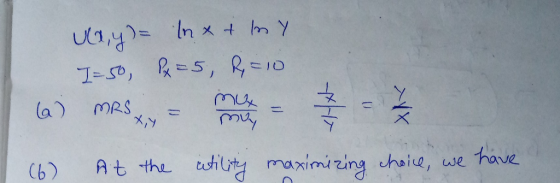
- Find MRSX,Y
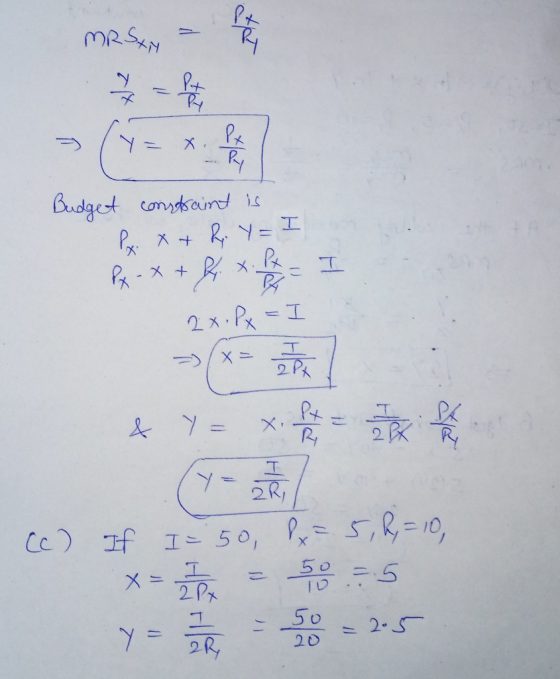
- Find demand functions for X and Y
- Find the optimal bundle for the following values of the exogenous variables
Homework Answers
Step by step solution is provided in the pic attached here.
If you have any doubt , feel free to ask.
Don't forget to thumbs up , if you like the solution.
A) Suppose U = min[X, 3Y] and I=12, Px=1 and Py=5. Find X* and Y*. B)...
A) Suppose U = min[X, 3Y] and I=12, Px=1 and Py=5. Find X* and Y*. B) Draw an indifference curve and a normal linear budget constraint such that there is a tangency point (where MRS= price ratio) that is not the optimal bundle. C) Suppose U=X∙Y5. Find X* and Y*. D) Suppose U = 5∙X + 2∙Y and I=12, Px=2 and Py=1. Find X* and Y*.
1. U = XY where MRS = Y/X; I = 1500, Px = Py = 15,...
1. U = XY where MRS = Y/X; I = 1500, Px = Py = 15, A. Derive optimal consumption bundle. B. If Px increases to be $30, derive the new optimal consumption bundle C. Using the results from A and B, derive the individual demand for good X assuming the demand is linear. 2. Assuming the market has two consumers for a very special GPU and their individual demands are given below Consumer A: P = 450 – 4...
A) Suppose U = min[X, 3Y] and I=12, Px=1 and Py=5. Find X* and Y*. B) Draw an indifference curve and a normal linear budget constraint such that there is a tangency point (where MRS= price ratio) that...
A) Suppose U = min[X, 3Y] and I=12, Px=1 and Py=5. Find X* and Y*. B) Draw an indifference curve and a normal linear budget constraint such that there is a tangency point (where MRS= price ratio) that is not the optimal bundle. C) Suppose U=X∙Y5. Find X* and Y*. D) Suppose U = 5∙X + 2∙Y and I=12, Px=2 and Py=1. Find X* and Y*.
Assume that Sam has following utility function: U(x,y) = 2√x+y. Assume px = 1/5, py = 1 and her i...
Assume that Sam has following utility function: U(x,y) = 2√x+y. Assume px = 1/5, py = 1 and her income I = 10. (e) Draw an optimal bundle which is the result of utility maximization under given budget set. (Hint: Assume interior solution). Define corresponding expenditure minimization problem (note the elements for expenditure minimization problem are (i) objective function, (ii) constraint, (iii) what to choose). (f)Describeaboutwhatthedualityproblemis. Definemarshalliandemandfuction andhicksiandemandfunction. (Hint: identifytheinputfactorsofthesefunctions.) (g) Consider a price increase for the good x from...
A) Suppose U = ln(x)+y and Px=2, and Py=4. Write down the expenditure minimizing lagrangian for...
A) Suppose U = ln(x)+y and Px=2, and Py=4. Write down the expenditure minimizing lagrangian for this problem. (you don’t need to solve it) B) You have $8 which you can spend on X or Y. The price of Y is always $1 but the price of X is $1 for the first 2 and $2 after that. Draw the budget constraint (make sure to label the graph with all of the relevant information). C) Suppose U = min[2X, 3Y]...
Suppose your utility function is U (x, y) = 2 ln(2) + 4y c) Given PX...
 Suppose your utility function is U (x, y) = 2 ln(2) + 4y c) Given PX - 1. Py = 2, and M =5. Find the elasticity of demand (own-price elasticity) for good x -- is good x ordinary or Giffen? Edit View Insert Format Tools Table 12pt Paragraph B I VART :
4) A consumer’s utility function is u(x, y) = min{x, 3y} (a) Find the consumer’s optimal...
4) A consumer’s utility function is u(x, y) = min{x, 3y} (a) Find the consumer’s optimal choice for x, y as functions of income I and prices px,py. (b) Sketch the demand curve for y as a function of other price px when py = 10, I = 100. Suggestion: a picture showing the budget set, optimal choice and indifference curve. (I need help with the sketching which is the second part)
Utility Function: U = ln (x) + ln (z) Budget Constraint: 120 = 2x + 3z...
Utility Function: U = ln (x) + ln (z) Budget Constraint: 120 = 2x + 3z (a) Find the optimal values of x and z (b) Explain in words the idea of a compensating variation for the case where the budget constraint changed to 120 = 2x + 5z Problem 4 (a) Derive the demand functions for the utility function (b) Let a = 2, b = 5, px = 1, pz = 3, and Y = 75. Find the...
1.2 (10 mks each). In parts a) and b) below, assume px = $1, py =...
 1.2 (10 mks each). In parts a) and b) below, assume px = $1, py = $5, I = income = $21. Solve the U-max problem for each of the following two utility functions: (a) U = xy?, x, y = 0; (b) U=x1/3y2/3, x, y 2 0; (c) now, let px = p, Py = $5, 1 = $21, find the u-max solution for U = xy?, x, y = 0; (d) let px = 1, Py = p,...
(a) 1.2 (10 mks each). In parts a) and b) below, assume px = $1, Py...
 (a) 1.2 (10 mks each). In parts a) and b) below, assume px = $1, Py = $5, I = income = $21. Solve the U-max problem for each of the following two utility functions: U= xy?, x, y 2 0; (b) U = x1/3y2/3, x, y = 0; now, let px = P, Py = $5, I = $21, find the u-max solution for U = xy?, x, y 2 0; let px = 1, Py =p, I =...
 Suppose your utility function is U (x, y) = 2 ln(2) + 4y c) Given PX - 1. Py = 2, and M =5. Find the elasticity of demand (own-price elasticity) for good x -- is good x ordinary or Giffen? Edit View Insert Format Tools Table 12pt Paragraph B I VART :
 1.2 (10 mks each). In parts a) and b) below, assume px = $1, py = $5, I = income = $21. Solve the U-max problem for each of the following two utility functions: (a) U = xy?, x, y = 0; (b) U=x1/3y2/3, x, y 2 0; (c) now, let px = p, Py = $5, 1 = $21, find the u-max solution for U = xy?, x, y = 0; (d) let px = 1, Py = p,...
 (a) 1.2 (10 mks each). In parts a) and b) below, assume px = $1, Py = $5, I = income = $21. Solve the U-max problem for each of the following two utility functions: U= xy?, x, y 2 0; (b) U = x1/3y2/3, x, y = 0; now, let px = P, Py = $5, I = $21, find the u-max solution for U = xy?, x, y 2 0; let px = 1, Py =p, I =...
Most questions answered within 3 hours.
-
Where is the error in this code sequence?
String s1 = "Hello";
String s2 = "ello";...
asked 11 months ago -
Financial data for Joel de Paris, Inc., for last year
follow:
Joel de Paris, Inc.
Balance...
asked 11 months ago -
Consider this reaction:
Al2(SO4)3 (aq)+ BaCl3
(aq) Al2Cl6 (aq)- +
3BaSO4(s) . What is the...
asked 11 months ago -
Suppose that Savneet is considering increasing her
recent random sample from 20 car rentals to 40...
asked 11 months ago -
Trucks arrive at an unloading terminal at an average rate of 120
per hour.
Trucks arrive...
asked 11 months ago -
Why are methanol and ethanol completely soluble in water while
octanol is not very little soluble....
asked 11 months ago -
A facilities manager at a university reads in a research report
that the mean amount of...
asked 11 months ago -
When the CuSO4 is rehydrated by adding water to the anhydrous
compound, is this an endothermic...
asked 11 months ago -
A ray of sunlight is passing from diamond into crown glass; the
angle of incidence is...
asked 11 months ago -
A block of mass 0.249 kg is placed on top of a light, vertical
spring of...
asked 11 months ago -
how do the kidneys compensate in the presences of acidosis
a) trigger hyperventilate
b) reserve acid...
asked 11 months ago -
Question 501 pts
The rental rate of capital to the firm increases. Which of the
following...
asked 11 months ago