the autodissocation of water is a highly endothermic reaction. therefore you expect the ph of pure...
the autodissocation of water is a highly endothermic reaction. therefore you expect the ph of pure water at 100 degrees Celsius to be lower/greater/equal to 7?
Homework Answers
The autodissocation of water is an endothermic process. When the temperature is increased to 100°C , according to le-Chatlier principle the equilibrium will shift to the direction in which heat is consumed hence water will dissociate more and more and hence more H+ ions is formed . Here we note that hydronium and hydroxide ions are formed equally .
The solution is still neutral but the pH will decrease from 7 to 6.14. hence it is lower than 7
Add Answer to:
the autodissocation of water is a highly endothermic reaction. therefore you expect the ph of pure...
The dissolution of NH4ClO4(s) in water is endothermic, with ΔHsoln = +33.5kJ/mol. If you prepare a...
The dissolution of NH4ClO4(s) in water is endothermic, with ΔHsoln = +33.5kJ/mol. If you prepare a 1.00 m solution of NH4ClO4 beginning with water at 21.5 ∘C, what is the final temperature of the solution (in ∘C)? Assume that the specific heats of both pure H2O and the solution are the same, 4.18 J/(K⋅g). Express the temperature in degrees Celsius to three significant digits.
6. Logically prove, starting by writing basic autoinization equilibrium reaction of water, that the pH of pure is 7 at 25°C. 6. Logically prove, starting by writing basic autoinization equ...
 6. Logically prove, starting by writing basic autoinization equilibrium reaction of water, that the pH of pure is 7 at 25°C.
6. Logically prove, starting by writing basic autoinization equilibrium reaction of water, that the pH of pure is 7 at 25°C.
6. Logically prove, starting by writing basic autoinization equilibrium reaction of water, that the pH of pure is 7 at 25°C.
The pH of a liquid is a measure of its acidity or alkalinity. Pure water has...
 The pH of a liquid is a measure of its acidity or alkalinity. Pure water has a pH of 7, which is neutral. Solutions with a pH less than 7 are acidic while solutions with a pH greater than 7 or basic or alkaline. A random sample of lakes in Florida was taken and the pH was recorded for each lake. Summary statistics are given below. The primary question to answer is: "Is there evidence to indicate the mean pH...
02:40 18 0% Level 3 (Unit 15, L.G. 4) The autoionization of water is endothermic. What...
 02:40 18 0% Level 3 (Unit 15, L.G. 4) The autoionization of water is endothermic. What would you expect the [H'] in pure water to do with increasing temperature? A. B. There is no H' in pure water, water is neutral. C. Increase D. Decrease E. Stay the same
pH of acetic acid/acetate buffer pH of pure water Pure solution (no additions) Addition of 10...
 pH of acetic acid/acetate buffer pH of pure water Pure solution (no additions) Addition of 10 mL of 0.01 M HCI Addition of 10 mL of 0.01 M NaOH Comment on the changes in pH in the acetate buffer as opposed to that of pure water. What does this tell you about the role of a buffer?
Consider the endothermic reaction C2H4(g) + H2O(g) → C2H5OH(g). When would you expect this reaction to...
Consider the endothermic reaction C2H4(g) + H2O(g) → C2H5OH(g). When would you expect this reaction to be spontaneous? The answer is “at no temperature.” Can someone please explain this to me so I can understand it better? Thanks so much!
At 100 degrees Celsius, the ion product for pure water is Kw= 51.3*10^-14. What is the...
At 100 degrees Celsius, the ion product for pure water is Kw= 51.3*10^-14. What is the pOH of water at this temperature? A) 7.00 B) 7.27 C) 6.14 D) 6.63 E) 7.86
Bonus Question (Extra Credit) - You have a 50.0 mL of pure water at pH =...
 Bonus Question (Extra Credit) - You have a 50.0 mL of pure water at pH = 7. Considering the equilibrium of water at 25°C, how many individual H,O* (by count) are in solution? The density of water is 0.998 g/ml.
The pH of pure water at 60°C is 8.517. Which one of the following statements is...
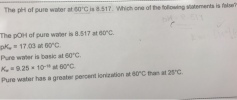 The pH of pure water at 60°C is 8.517. Which one of the following statements is false ? The pOH of pure water is 8.517 at 60°C pKw 17.03 at 60°C Pure water is basic at 60°C Ku = 9.25 10-18 at 60°C. Pure water has a greater percent ionization at 60°C than at 25°C.
a. You perform a coffee cup calorimetry experiment to determine the enthalpy change for the dissolution...
a. You perform a coffee cup calorimetry experiment to determine the enthalpy change for the dissolution of sodium chloride in water. You add 10g of NaCl to 100 ml of water at 20.00 degrees C and mix well. The final temperature is 19.80 degrees celsius which of the following statements is true. -energy moves from the surroundings to the system due to the endothermic reaction -energy moves from the system to the surroundings due to the endothermic reaction -energy moves...
 6. Logically prove, starting by writing basic autoinization equilibrium reaction of water, that the pH of pure is 7 at 25°C.
6. Logically prove, starting by writing basic autoinization equilibrium reaction of water, that the pH of pure is 7 at 25°C.
6. Logically prove, starting by writing basic autoinization equilibrium reaction of water, that the pH of pure is 7 at 25°C.
 The pH of a liquid is a measure of its acidity or alkalinity. Pure water has a pH of 7, which is neutral. Solutions with a pH less than 7 are acidic while solutions with a pH greater than 7 or basic or alkaline. A random sample of lakes in Florida was taken and the pH was recorded for each lake. Summary statistics are given below. The primary question to answer is: "Is there evidence to indicate the mean pH...
 02:40 18 0% Level 3 (Unit 15, L.G. 4) The autoionization of water is endothermic. What would you expect the [H'] in pure water to do with increasing temperature? A. B. There is no H' in pure water, water is neutral. C. Increase D. Decrease E. Stay the same
 pH of acetic acid/acetate buffer pH of pure water Pure solution (no additions) Addition of 10 mL of 0.01 M HCI Addition of 10 mL of 0.01 M NaOH Comment on the changes in pH in the acetate buffer as opposed to that of pure water. What does this tell you about the role of a buffer?
 Bonus Question (Extra Credit) - You have a 50.0 mL of pure water at pH = 7. Considering the equilibrium of water at 25°C, how many individual H,O* (by count) are in solution? The density of water is 0.998 g/ml.
 The pH of pure water at 60°C is 8.517. Which one of the following statements is false ? The pOH of pure water is 8.517 at 60°C pKw 17.03 at 60°C Pure water is basic at 60°C Ku = 9.25 10-18 at 60°C. Pure water has a greater percent ionization at 60°C than at 25°C.
Most questions answered within 3 hours.
-
Where is the error in this code sequence?
String s1 = "Hello";
String s2 = "ello";...
asked 10 months ago -
Financial data for Joel de Paris, Inc., for last year
follow:
Joel de Paris, Inc.
Balance...
asked 10 months ago -
Consider this reaction:
Al2(SO4)3 (aq)+ BaCl3
(aq) Al2Cl6 (aq)- +
3BaSO4(s) . What is the...
asked 10 months ago -
Suppose that Savneet is considering increasing her
recent random sample from 20 car rentals to 40...
asked 10 months ago -
Trucks arrive at an unloading terminal at an average rate of 120
per hour.
Trucks arrive...
asked 10 months ago -
Why are methanol and ethanol completely soluble in water while
octanol is not very little soluble....
asked 10 months ago -
A facilities manager at a university reads in a research report
that the mean amount of...
asked 10 months ago -
When the CuSO4 is rehydrated by adding water to the anhydrous
compound, is this an endothermic...
asked 10 months ago -
A ray of sunlight is passing from diamond into crown glass; the
angle of incidence is...
asked 10 months ago -
A block of mass 0.249 kg is placed on top of a light, vertical
spring of...
asked 10 months ago -
how do the kidneys compensate in the presences of acidosis
a) trigger hyperventilate
b) reserve acid...
asked 10 months ago -
Question 501 pts
The rental rate of capital to the firm increases. Which of the
following...
asked 10 months ago