
Homework Answers
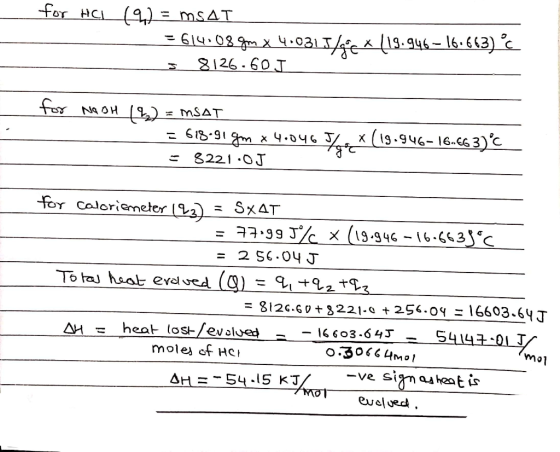
Here is the solution of your question. If you have any doubt or need any clarification please comment in comment box and will definitely resolve your query. If you find useful please upvote it. Thanks in advance.
Add Answer to:
Additional Problem 6.098 Your answer is partially correct. Try again. A dilute solution of hydrochloric acid...
FULL SCREEN PRINTER VERSION BACK NEXT Additional Problem 6.098 A dilute solution of hydrochloric acid with...
 FULL SCREEN PRINTER VERSION BACK NEXT Additional Problem 6.098 A dilute solution of hydrochloric acid with a mass of 608.38 g and containing 0.32862 mol of HCI was exactly neutralized in a calorimeter by the sodium hydroxide in 615.73 g of a comparably dilute solution. The temperature increased from 15.357 to 20.353 °C. The specific heat of the Ha solution was 4.031 ].g-1.0.1; that of the NaOH solution was 4.046 J-g-1.°C-1. The heat capacity of the calorimeter was 77.99 J.oC1...
15.231 to 20.339 °C. The specific A dilute solution of hydrochloric acid with a mass of...
 15.231 to 20.339 °C. The specific A dilute solution of hydrochloric acid with a mass of 605.02 g and containing 0.38266 mol of HCl was exactly neutralized in a calorimeter by the sodium hydroxide in 613.06 g of a comparably dilute solution. The temperature increased from heat of the HCl solution was 4.031 J.g1.0c-1; that of the NaOH solution was 4.046Jg-1.00-1. The heat capacity of the calorimeter was 77.99 .0c-1 Enter the balanced equation for the reaction. Include states in...
Click to see additional instructions The molar heat of neutralization from hydrochloric acid (HCI) and sodium...
 Click to see additional instructions The molar heat of neutralization from hydrochloric acid (HCI) and sodium hydroxide (NaOH) is -56.1 kJ/mol. Use this accepted value to predict that heat evolved during the neutralization of 168 mL of 3.00 M HCl solution with 168mL of 3.00 M NaOH solution KJ
moles of h3o neutralized with oh and heat of neutralization per mole of h3o neutralized Lab...
 moles of h3o neutralized with oh and heat of neutralization
per mole of h3o neutralized
Lab 6 Chemistry 117 University of Massachusetts Boston Part 2: Heat of Neutralization Data a. Exact volume of 1.00 M HCl(aq) (-50 mL) b. Exact volume of 1.00 M NaOH(aq) to be added (30-40 mL) c. Moles of NaOH d. Assuming 1.00 mL = 1.00 g, mass of solution produced on mixing e. Heat capacity of calorimeter, Coal f. Initial temperature, Ti g. Final temperature,...
moles of h3o neutralized with oh and heat of neutralization
per mole of h3o neutralized
Lab 6 Chemistry 117 University of Massachusetts Boston Part 2: Heat of Neutralization Data a. Exact volume of 1.00 M HCl(aq) (-50 mL) b. Exact volume of 1.00 M NaOH(aq) to be added (30-40 mL) c. Moles of NaOH d. Assuming 1.00 mL = 1.00 g, mass of solution produced on mixing e. Heat capacity of calorimeter, Coal f. Initial temperature, Ti g. Final temperature,...
D 2. When 7.29 g hydrochloric acid (36.46 g/mol) and 8.00 g sodium hydroxide (40.00 g/mol)...
 D 2. When 7.29 g hydrochloric acid (36.46 g/mol) and 8.00 g sodium hydroxide (40.00 g/mol) are mixed in 250.0 g water, the temperature of the solution increases by 10.3°C. Assume that the heat capacity of the solution is 4.18 J/(g °C). What is the molar enthalpy of neutralization of HCl by NaOH? 57.1 kJ/mol -57.1 kJ/mol 53.8 kJ/mol -53.8 kJ/mol 28.6 kJ/mol
Be sure to answer all parts. If 0.050 mol hydrochloric acid (HCl) is mixed with 0.050 mol of sodi...
Be sure to answer all parts. If 0.050 mol hydrochloric acid (HCl) is mixed with 0.050 mol of sodium hydroxide (NaOH) in a "coffee cup" calorimeter, the temperature of 1.33 × 10² g of the resulting solution increases from 25.3°C to 31.0°C. Part 1 out of 2 If the specific heat of the solution is 1.00cal/g·°C, calculate the quantity of energy involved in the reaction. Q = Enter your answer in scientific notation.
1. Zinc metal reacts with hydrochloric acid according to the following balanced equation. Zn(s)+2HCl(aq)→ZnCl2(aq)+H2(g) When 0.106...
1. Zinc metal reacts with hydrochloric acid according to the following balanced equation. Zn(s)+2HCl(aq)→ZnCl2(aq)+H2(g) When 0.106 g of Zn(s) is combined with enough HCl to make 50.1 mL of solution in a coffee-cup calorimeter, all of the zinc reacts, raising the temperature of the solution from 21.9 ∘C to 24.6 ∘C. Part A Find ΔHrxn for this reaction as written. (Use 1.0 g/mL for the density of the solution and 4.18 J/g⋅∘C as the specific heat capacity.) ΔHrxn ΔHrxn =...
The addition of hydrochloric acid to a silver nitrate solution precipitates silver chloride according to the...
The addition of hydrochloric acid to a silver nitrate solution precipitates silver chloride according to the reaction: AgNO3(aq)+HCl(aq)→AgCl(s)+HNO3(aq) When you combine 90.0 mL of 0.250 M AgNO3 with 90.0 mL of 0.250 M HCl in a coffee-cup calorimeter, the temperature changes from 23.10 ∘C to 24.47 ∘C. Calculate ΔHrxn for the reaction as written. Use 1.00 g/mL as the density of the solution and C=4.18J/g⋅∘C as the specific heat capacity. (also please tell me the right UNIT of this question)...
Zinc metal reacts with hydrochloric acid according to the following balanced equation. Zn(s) + 2HCl(aq) --> ZnCl_...
Zinc metal reacts with hydrochloric acid according to the following balanced equation. Zn(s) + 2HCl(aq) --> ZnCl_2(aq) + H_2(g) When 0.124 g of Zn(s) is combined with enough HCl to make 51.3 mL of solution in a coffee-cup calorimeter, all of the zinc reacts, raising the temperature of the solution from 21.5 C to 23.9 C. Find Delta Hrxn for this reaction as written. (Use 1.0 g/mL for the density of the solution and 4.18 J/g *C as the specific...
Zinc metal reacts with hydrochloric acid according to the following balanced equation. Zn(s) + 2HCl(aq) -> ZnCl2(aq...
Zinc metal reacts with hydrochloric acid according to the following balanced equation. Zn(s) + 2HCl(aq) -> ZnCl2(aq) + H2(g) When 0.104g of Zn(s) is combined with enough HCl to make 54.5 mL of solution in a coffee-cup calorimeter, all of the zinc reacts, raising the temperature of the solution from 22.4 Celcius to 24.7Celcius. Find the delta Hrxn (in kJ/mol) for this reaction as written. (Use 1.0g/mL for the density of the solution and 4.18 J/g *Celcius as the specific...
 FULL SCREEN PRINTER VERSION BACK NEXT Additional Problem 6.098 A dilute solution of hydrochloric acid with a mass of 608.38 g and containing 0.32862 mol of HCI was exactly neutralized in a calorimeter by the sodium hydroxide in 615.73 g of a comparably dilute solution. The temperature increased from 15.357 to 20.353 °C. The specific heat of the Ha solution was 4.031 ].g-1.0.1; that of the NaOH solution was 4.046 J-g-1.°C-1. The heat capacity of the calorimeter was 77.99 J.oC1...
 15.231 to 20.339 °C. The specific A dilute solution of hydrochloric acid with a mass of 605.02 g and containing 0.38266 mol of HCl was exactly neutralized in a calorimeter by the sodium hydroxide in 613.06 g of a comparably dilute solution. The temperature increased from heat of the HCl solution was 4.031 J.g1.0c-1; that of the NaOH solution was 4.046Jg-1.00-1. The heat capacity of the calorimeter was 77.99 .0c-1 Enter the balanced equation for the reaction. Include states in...
 Click to see additional instructions The molar heat of neutralization from hydrochloric acid (HCI) and sodium hydroxide (NaOH) is -56.1 kJ/mol. Use this accepted value to predict that heat evolved during the neutralization of 168 mL of 3.00 M HCl solution with 168mL of 3.00 M NaOH solution KJ
 moles of h3o neutralized with oh and heat of neutralization
per mole of h3o neutralized
Lab 6 Chemistry 117 University of Massachusetts Boston Part 2: Heat of Neutralization Data a. Exact volume of 1.00 M HCl(aq) (-50 mL) b. Exact volume of 1.00 M NaOH(aq) to be added (30-40 mL) c. Moles of NaOH d. Assuming 1.00 mL = 1.00 g, mass of solution produced on mixing e. Heat capacity of calorimeter, Coal f. Initial temperature, Ti g. Final temperature,...
moles of h3o neutralized with oh and heat of neutralization
per mole of h3o neutralized
Lab 6 Chemistry 117 University of Massachusetts Boston Part 2: Heat of Neutralization Data a. Exact volume of 1.00 M HCl(aq) (-50 mL) b. Exact volume of 1.00 M NaOH(aq) to be added (30-40 mL) c. Moles of NaOH d. Assuming 1.00 mL = 1.00 g, mass of solution produced on mixing e. Heat capacity of calorimeter, Coal f. Initial temperature, Ti g. Final temperature,...
 D 2. When 7.29 g hydrochloric acid (36.46 g/mol) and 8.00 g sodium hydroxide (40.00 g/mol) are mixed in 250.0 g water, the temperature of the solution increases by 10.3°C. Assume that the heat capacity of the solution is 4.18 J/(g °C). What is the molar enthalpy of neutralization of HCl by NaOH? 57.1 kJ/mol -57.1 kJ/mol 53.8 kJ/mol -53.8 kJ/mol 28.6 kJ/mol
Most questions answered within 3 hours.
-
Where is the error in this code sequence?
String s1 = "Hello";
String s2 = "ello";...
asked 10 months ago -
Financial data for Joel de Paris, Inc., for last year
follow:
Joel de Paris, Inc.
Balance...
asked 10 months ago -
Consider this reaction:
Al2(SO4)3 (aq)+ BaCl3
(aq) Al2Cl6 (aq)- +
3BaSO4(s) . What is the...
asked 10 months ago -
Suppose that Savneet is considering increasing her
recent random sample from 20 car rentals to 40...
asked 10 months ago -
Trucks arrive at an unloading terminal at an average rate of 120
per hour.
Trucks arrive...
asked 10 months ago -
Why are methanol and ethanol completely soluble in water while
octanol is not very little soluble....
asked 10 months ago -
A facilities manager at a university reads in a research report
that the mean amount of...
asked 10 months ago -
When the CuSO4 is rehydrated by adding water to the anhydrous
compound, is this an endothermic...
asked 10 months ago -
A ray of sunlight is passing from diamond into crown glass; the
angle of incidence is...
asked 10 months ago -
A block of mass 0.249 kg is placed on top of a light, vertical
spring of...
asked 10 months ago -
how do the kidneys compensate in the presences of acidosis
a) trigger hyperventilate
b) reserve acid...
asked 10 months ago -
Question 501 pts
The rental rate of capital to the firm increases. Which of the
following...
asked 10 months ago