You are a member of parliament in Iran. Iran is suffering from rising prices and a...
You are a member of parliament in Iran. Iran is suffering from rising prices and a recession. The government is debating whether the government should undertake a stimulus bill (increase government spending) or austerity (decrease government spending).
a. Explain what will happen to aggregate demand, inflation and unemployment in the short run if government spending increases (3 points).
b. Explain what will happen to aggregate demand, inflation and unemployment in the short run if government spending decreases (3 points).
Homework Answers
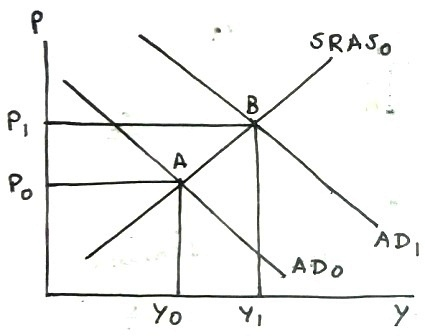
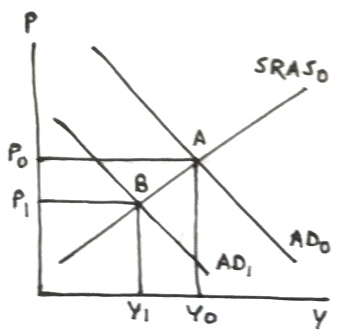
In each graph, initial equilibrium is at point A where AD0 (initial aggregate demand) and SRAS0 (initial short-run aggregate supply) curves intersect, with initial equilibrium price level P0 and real GDP Y0.
(a) An increase in government spending increases aggregate demand, which will shift the AD curve to right, which increases both price level (increasing inflation) and real GDP in short run. Higher real GDP will reduce unemployment in short run.
In following graph, increase in aggregate demand shifts AD0 to right to AD1, intersecting SRAS0 at point B with higher price level P1 and higher real GDP Y1.
(b) A decrease in government spending decreases aggregate demand, which will shift the AD curve to left, which decreases both price level (decreasing inflation) and real GDP in short run. Lower real GDP will increase unemployment in short run.
In following graph, decrease in aggregate demand shifts AD0 to left to AD1, intersecting SRAS0 at point B with lower price level P1 and lower real GDP Y1.
Add Answer to:
You are a member of parliament in Iran. Iran is suffering from rising prices and a...
Q5 25 points) 5)- Consider if in a given economy, the parliament approves an increase in...
 Q5 25 points) 5)- Consider if in a given economy, the parliament approves an increase in minimum wage. Starting from the initial medium run equilibrium, discuss the effects of this policy in following questions. (Total 25 points) a)- Using a set of WS/PS curves, and only in labor market, in step by step way, explain the impacts. (6) b)- Using the aggregate supply and demand (AS/AD), and IS/LM curves, show the short and medium run equilibrium points. [No explanation. Only...
1. If the economy is at full employment, increases in government spending: A) have a multiplier...
 1. If the economy is at full employment, increases in government spending: A) have a multiplier effect on equilibrium output. B) have no effect on the aggregate price level. C) are primarily absorbed by price increases. D) reduce aggregate output. 2. Which of the following measures is NOT an example of discretionary fiscal policy? A) The unemployment compensation program pays out more money as unemployment rates rise. B) Tax rates are increased in the hope of slowing down the rate...
What is the spending multiplier if the MPC is 62%? 1.61 .62 2.63 Unlike the neoclassical...
What is the spending multiplier if the MPC is 62%? 1.61 .62 2.63 Unlike the neoclassical approach to the economy, the Keynesian approach focuses on sticky prices and aggregate demand. This focus is advantageous for understanding the reason cyclical unemployment and recessions occur, as these fluctuations take place in the ________ -run. long gap short What is true about the expenditure multiplier? GDP does not change proportionally. GDP changes when the aggregate expenditure changes. A larger change in expenditure causes...
2. When aggregate demand increases, what happens to prices and employment? a. Prices will fall and...
 2. When aggregate demand increases, what happens to prices and employment? a. Prices will fall and unemployment will rise. b. Prices and unemployment fall. Prices and unemployment rise. d. Prices will rise and unemployment will fall. c. Figure 16-1 a Price Level Inflation Rate c d e 3 Output Unemployment 3. Refer to the Figure 16-1. If the economy starts at c and 1, then in the short run, where does an increase in government expenditures move the economy? a....
(6) Imagine that the economy is in a recession. Which one of the following tactics is...
(6) Imagine that the economy is in a recession. Which one of the following tactics is a way to increase output by shifting aggregate demand outward? Raising taxes to increase the government surplus Increasing government spending Increasing the required reserve ratio Imposing tariffs on foreign goods (7) In the short run, supply shocks cause prices to __________ and the quantity demanded to __________. increase; increase increase; decrease decrease; increase decrease; decrease (8) Good deflation...
A weakness of the neoclassical economic view is that it: can overlook the long-term causes of...
A weakness of the neoclassical economic view is that it: can overlook the long-term causes of economic growth like the existing natural rate of unemployment even when the economy is at potential GDP. focuses on the long-term factors for economic growth and not the short-term causes of economic growth such as why unemployment fluctuates up and down over a few years. can overlook the efficiency of the market economy in self-correcting in the long-run. Keynes' Law says that demand creates...
Question: Aggregate Demand stimulus, TARP (Troubled Asset Relief Program) and or also called the bailout package helped...
Question: Aggregate Demand stimulus, TARP (Troubled Asset Relief Program) and or also called the bailout package helped to prevent the 2007-2009 US economy's downturn from becoming another Great Depression. Why was the stimulus-fueled recovery substantially weaker than expected? Article: Aggregate Demand Stimulus Helped to Prevent the 2007–2009 Downturn from Becoming Another Great Depression. But Why Was the Stimulus-Fueled Recovery Substantially Weaker Than Expected? In retrospect, it is clear that the U.S. economy was in a precarious position in 2006. Trillions of...
1.Describe the impact of rising interest rates on consumer spending. 2. When the economy is operating...
1.Describe the impact of rising interest rates on consumer spending. 2. When the economy is operating at full employment, why is an increase in aggregate demand not helpful to the economy? 3. When the economy is hit with a supply shock, such as oil prices rising from $25 a barrel to $75 a barrel, why is this doubly disruptive and harmful to the economy? 4. Explain why the aggregate supply curve is positively sloped during the short run and vertical...
Which would most likely shift the aggregate supply curve? A change in the prices of _____....
Which would most likely shift the aggregate supply curve? A change in the prices of _____. domestic products foreign products financial assets resources A decrease in aggregate demand in the short run will reduce _____. both real output and the price level the price level and increase the real domestic output the real domestic output and have no effect on the price level the price level and have no effect on real domestic output The economy's long-run AS curve assumes...
Chapter 13 1. Why might rising prices stimulate short-run production but have no effect on long-run...
 Chapter 13 1. Why might rising prices stimulate short-run production but have no effect on long-run production? Chapter 17 1 I. Suppose the consumption function is C-S400 billion + 0.8Y and the government wants to stimulate the economy. By how much will aggregate demand at current prices increase with each of the following options? (a) A S50 billion increase in government purchases (b) A S50 billion increase in income transfers
 Q5 25 points) 5)- Consider if in a given economy, the parliament approves an increase in minimum wage. Starting from the initial medium run equilibrium, discuss the effects of this policy in following questions. (Total 25 points) a)- Using a set of WS/PS curves, and only in labor market, in step by step way, explain the impacts. (6) b)- Using the aggregate supply and demand (AS/AD), and IS/LM curves, show the short and medium run equilibrium points. [No explanation. Only...
 1. If the economy is at full employment, increases in government spending: A) have a multiplier effect on equilibrium output. B) have no effect on the aggregate price level. C) are primarily absorbed by price increases. D) reduce aggregate output. 2. Which of the following measures is NOT an example of discretionary fiscal policy? A) The unemployment compensation program pays out more money as unemployment rates rise. B) Tax rates are increased in the hope of slowing down the rate...
 2. When aggregate demand increases, what happens to prices and employment? a. Prices will fall and unemployment will rise. b. Prices and unemployment fall. Prices and unemployment rise. d. Prices will rise and unemployment will fall. c. Figure 16-1 a Price Level Inflation Rate c d e 3 Output Unemployment 3. Refer to the Figure 16-1. If the economy starts at c and 1, then in the short run, where does an increase in government expenditures move the economy? a....
 Chapter 13 1. Why might rising prices stimulate short-run production but have no effect on long-run production? Chapter 17 1 I. Suppose the consumption function is C-S400 billion + 0.8Y and the government wants to stimulate the economy. By how much will aggregate demand at current prices increase with each of the following options? (a) A S50 billion increase in government purchases (b) A S50 billion increase in income transfers
Most questions answered within 3 hours.
-
Where is the error in this code sequence?
String s1 = "Hello";
String s2 = "ello";...
asked 11 months ago -
Financial data for Joel de Paris, Inc., for last year
follow:
Joel de Paris, Inc.
Balance...
asked 11 months ago -
Consider this reaction:
Al2(SO4)3 (aq)+ BaCl3
(aq) Al2Cl6 (aq)- +
3BaSO4(s) . What is the...
asked 11 months ago -
Suppose that Savneet is considering increasing her
recent random sample from 20 car rentals to 40...
asked 11 months ago -
Trucks arrive at an unloading terminal at an average rate of 120
per hour.
Trucks arrive...
asked 11 months ago -
Why are methanol and ethanol completely soluble in water while
octanol is not very little soluble....
asked 11 months ago -
A facilities manager at a university reads in a research report
that the mean amount of...
asked 11 months ago -
When the CuSO4 is rehydrated by adding water to the anhydrous
compound, is this an endothermic...
asked 11 months ago -
A ray of sunlight is passing from diamond into crown glass; the
angle of incidence is...
asked 11 months ago -
A block of mass 0.249 kg is placed on top of a light, vertical
spring of...
asked 11 months ago -
how do the kidneys compensate in the presences of acidosis
a) trigger hyperventilate
b) reserve acid...
asked 11 months ago -
Question 501 pts
The rental rate of capital to the firm increases. Which of the
following...
asked 11 months ago