Tom and Jerry both push on the 3.00 m --diameter merry-go-round shown in (Figure 1) ....
Tom and Jerry both push on the 3.00 m --diameter merry-go-round shown in (Figure 1) . Tom pushes with a force of 47.5 N and Jerry pushes with a force of 35.5 N .
60o tom, 80o jerry
What is the magnitude of the torque exerted by Tom?
What is the magnitude of the torque exerted by Jerry?
Homework Answers
1) The radius is R = d/2 = 3.0/2 = 1.5m.
apply thr formula for torque T = r x F or r F sin theta
The torque by Tom is Ttom = F_t*R*sin60
Ttom = 47.5 *1.5*sin60 = 61.70 N-m.
The torque by Jerry is Tjerry = Fj*R*sin80
Tj = 35.5*1.5*sin80
Tj = 52.44 N-m
.The net torque is T = T1-T2
T = 61.7 - 52.44
T = 9.26 N*m. and it goes clockwise
-----------------------------------------
2) The net torque is T = T1 + T2
Tnet = 61.7 + 52.44
Tnet = 114.14 Nm and it goes counterclockwise
Add Answer to:
Tom and Jerry both push on the 3.00 m --diameter merry-go-round
shown in (Figure 1) ....
Tom and Jerry both push on the 3.10-m-diameter merry-go-round shown in (Figure 1). Tom pushes with...
Tom and Jerry both push on the 3.10-m-diameter merry-go-round shown in (Figure 1). Tom pushes with a force of 51.5 N and Jerry pushes with a force of 37.5 N . What is the net torque on the merry-go-round? What is the net torque if Jerry reverses the direction that he pushes by 180∘ without changing the magnitude of his force?
Tom and Jerry both push on the 3.10-m-diameter merry-go-round shown in (Figure 1) . Tom pushes...
Tom and Jerry both push on the 3.10-m-diameter merry-go-round shown in (Figure 1) . Tom pushes with a force of 49.0 N and Jerry pushes with a force of 34.5 N . What is the net torque on the merry-go-round? What is the net torque if Jerry reverses the direction that he pushes by 180∘ without changing the magnitude of his force?
Tom and Jerry both push on the 3.10-m-diameter merry-go-round shown in (Figure 1). Tom pushes with...
Tom and Jerry both push on the 3.10-m-diameter merry-go-round shown in (Figure 1). Tom pushes with a force of 51.5 N and Jerry pushes with a force of 32.5 N . (Toms angle 60 degrees, Jerrys angle 80 degrees) (Part A) What is the net torque on the merry-go-round? (Part B) What is the net torque if Jerry reverses the direction that he pushes by 180∘ without changing the magnitude of his force?
Tom and Jerry both push on the 3.10m -diameter merry-go-round shown in the figure. \ a)...
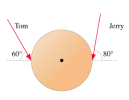 Tom and Jerry both push on the 3.10m -diameter merry-go-round
shown in the figure.
\
a) If Tom pushes with a force of 39.8N and Jerry pushes with a
force of 36.0N , what is the net torque on the merry-go-round?
b) What is the net torque if Jerry reverses the direction that
he pushes by 180? without changing the magnitude of his force?
Tom and Jerry both push on the 3.10m -diameter merry-go-round
shown in the figure.
\
a) If Tom pushes with a force of 39.8N and Jerry pushes with a
force of 36.0N , what is the net torque on the merry-go-round?
b) What is the net torque if Jerry reverses the direction that
he pushes by 180? without changing the magnitude of his force?
Tom and Jerry both push on the 3.00m diameter merry-go-round shown in figure 80 To Jenny...
 Tom and Jerry both push on the 3.00m diameter merry-go-round shown in figure 80 To Jenny . If Tom pushes with a force of 40.0N and Jerry pushes with a force of 35.2N, what is the net torque on the merry-go-round? What is the net torque if Jerry reverses the direction he pushes by 180 deg without changing the magnitude of his force? .
A child sits on a merry-go-round that has a diameter of 6.00 m. The child uses...
 A child sits on a merry-go-round that has a diameter of 6.00 m. The child uses her legs to push the merry-go-round, making it go from rest to an angular speed of 15.0 rpm in a time of 37.0 s. What is the average angular acceleration aavg of the merry-go-round in units of radians per second squared (rad/s2)? avg0.042 rad/s2 What is the angular displacement Δθ of the merry-go-round, in units of radians (rad), during the time the child pushes...
A child sits on a merry‑go‑round that has a diameter of 6.00 m. 6.00 m. The...
A child sits on a merry‑go‑round that has a diameter of 6.00 m. 6.00 m. The child uses her legs to push the merry‑go‑round, making it go from rest to an angular speed of 19.0 rpm 19.0 rpm in a time of 44.0 s. 44.0 s. What is the average angular acceleration ? avg αavg of the merry‑go‑round in units of radians per second squared ( rad/s 2 )? ? avg = _rad/s2 What is the angular displacement Δ? Δθ...
A child sits on a merry‑go‑round that has a diameter of 4.00 m. The child uses...
A child sits on a merry‑go‑round that has a diameter of 4.00 m. The child uses her legs to push the merry‑go‑round, making it go from rest to an angular speed of 19.0 rpm in a time of 47.0 s. What is the average angular acceleration ?avg of the merry‑go‑round in units of radians per second squared (rad/s2)? ?avg= What is the angular displacement Δ? of the merry‑go‑round, in units of radians (rad), during the time the child pushes the...
a merry-go-round in the park has a radius of 2.5 m and rotational inertia of 1000...
a merry-go-round in the park has a radius of 2.5 m and rotational inertia of 1000 kg*m^2. a child pushes the merry-go-round with a constant force of 50 N applied at a point tangent to the edge. a frictional torque of 12 N*m acts at the axle of the merry-go-round. what is the rotational acceleration of the merry-go-round while the child is pushing? at this rate, what will the rotational velocity of the merry-go-round be after 12 s if it...
A 3.5 kg cat is near the edge of a 6.5 m diameter merry-go-round in a...
A 3.5 kg cat is near the edge of a 6.5 m diameter merry-go-round in a playground. A man pushes and accelerates the merry-go-round from rest at a uniform rate of 0.75 rad/s2. The cat clings tighter and tighter, but can only hold on with 150 N of force and eventually flies off. At what tangential velocity will the cat fly off? This occurs when the needed centripetal force exceeds what the cat's claws can supply.
 Tom and Jerry both push on the 3.10m -diameter merry-go-round
shown in the figure.
\
a) If Tom pushes with a force of 39.8N and Jerry pushes with a
force of 36.0N , what is the net torque on the merry-go-round?
b) What is the net torque if Jerry reverses the direction that
he pushes by 180? without changing the magnitude of his force?
Tom and Jerry both push on the 3.10m -diameter merry-go-round
shown in the figure.
\
a) If Tom pushes with a force of 39.8N and Jerry pushes with a
force of 36.0N , what is the net torque on the merry-go-round?
b) What is the net torque if Jerry reverses the direction that
he pushes by 180? without changing the magnitude of his force?
 Tom and Jerry both push on the 3.00m diameter merry-go-round shown in figure 80 To Jenny . If Tom pushes with a force of 40.0N and Jerry pushes with a force of 35.2N, what is the net torque on the merry-go-round? What is the net torque if Jerry reverses the direction he pushes by 180 deg without changing the magnitude of his force? .
 A child sits on a merry-go-round that has a diameter of 6.00 m. The child uses her legs to push the merry-go-round, making it go from rest to an angular speed of 15.0 rpm in a time of 37.0 s. What is the average angular acceleration aavg of the merry-go-round in units of radians per second squared (rad/s2)? avg0.042 rad/s2 What is the angular displacement Δθ of the merry-go-round, in units of radians (rad), during the time the child pushes...
Most questions answered within 3 hours.
-
Where is the error in this code sequence?
String s1 = "Hello";
String s2 = "ello";...
asked 10 months ago -
Financial data for Joel de Paris, Inc., for last year
follow:
Joel de Paris, Inc.
Balance...
asked 10 months ago -
Consider this reaction:
Al2(SO4)3 (aq)+ BaCl3
(aq) Al2Cl6 (aq)- +
3BaSO4(s) . What is the...
asked 10 months ago -
Suppose that Savneet is considering increasing her
recent random sample from 20 car rentals to 40...
asked 10 months ago -
Trucks arrive at an unloading terminal at an average rate of 120
per hour.
Trucks arrive...
asked 10 months ago -
Why are methanol and ethanol completely soluble in water while
octanol is not very little soluble....
asked 10 months ago -
A facilities manager at a university reads in a research report
that the mean amount of...
asked 10 months ago -
When the CuSO4 is rehydrated by adding water to the anhydrous
compound, is this an endothermic...
asked 10 months ago -
A ray of sunlight is passing from diamond into crown glass; the
angle of incidence is...
asked 10 months ago -
A block of mass 0.249 kg is placed on top of a light, vertical
spring of...
asked 10 months ago -
how do the kidneys compensate in the presences of acidosis
a) trigger hyperventilate
b) reserve acid...
asked 10 months ago -
Question 501 pts
The rental rate of capital to the firm increases. Which of the
following...
asked 10 months ago