Producing robots is a very specialized process which requires special factories.
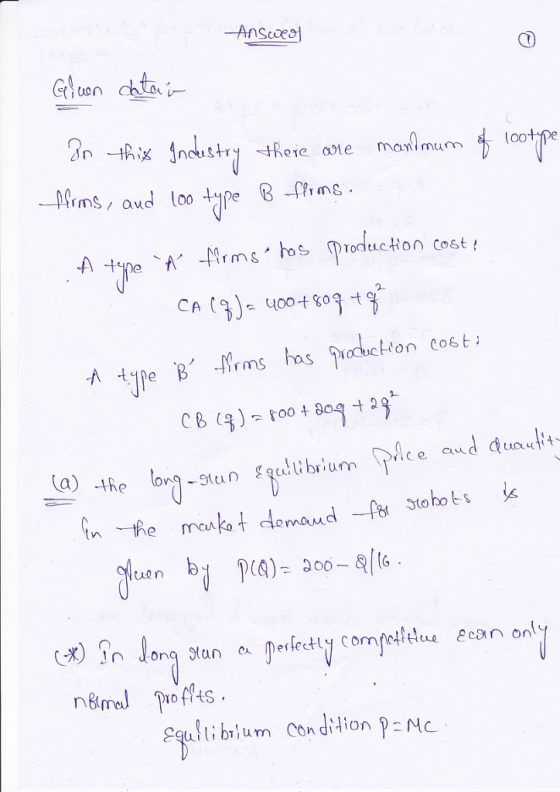
There are two ways to produce robots (process A and process B).
It turns out that there are exactly 100 locations where you could build a type-A production facility and 100 locations where you could build a type-B facility.
That is, in this industry, there are a maximum of 100 type A firms, and 100 type B firms.
A type "A" firm has production costs:
.
A type "B" firm has production costs
.
These costs are the most efficient way of producing output in the long-run.
Firms in this industry are price takers.
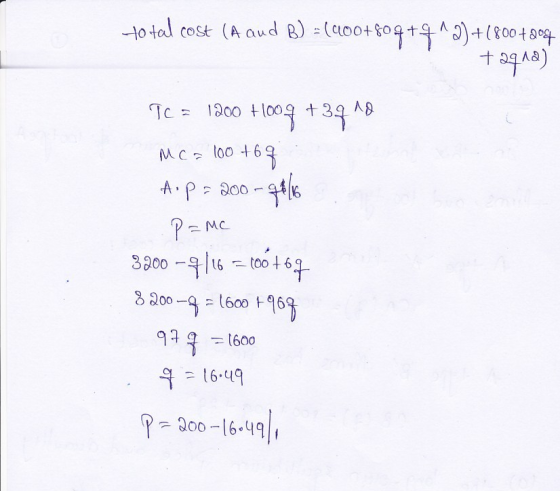
a) What is the long-run equilibrium price and quantity in this
market if demand for robots is given by ?
Homework Answers
Add Answer to:
Producing robots is a very specialized process which requires special factories. There are two ways to...
Producing robots is a very specialized process which requires special factories. There are two ways to...
Producing robots is a very specialized process which requires special factories. There are two ways to produce robots (process A and process B). It turns out that there are exactly 100 locations where you could build a type-A production facility and 100 locations where you could build a type-B facility. That is, in this industry, there are a maximum of 100 type A firms, and 100 type B firms. A type "A" firm has production costs: . A type "B"...
In a monopolistically competitive market: There are few firms, each producing a very differentiated product...
 In a monopolistically competitive market: There are few firms, each producing a very differentiated product. There is one firm that produces a standardized product. There are many firms producing a differentiated product. There are market participants who are all price takers. In a perfectly competitive model all the following are assumed, except: patents and copyrights that serve as barriers to entry into the industry. a large number of buyers. standardized product. easy entry to and exit from the market. In...
Suppose a manufacturing firm has two factories (Factory 1 and Factory 2), and a single production process (Process A) that is used in both factories. A new process (Process B) is developed that potent...
Suppose a manufacturing firm has two factories (Factory 1 and Factory 2), and a single production process (Process A) that is used in both factories. A new process (Process B) is developed that potentially reduces production costs. To test whether Process B is less costly than Process A, an experiment is designed where: Within each Factory, products are assigned randomly to Process A or Process B. Production costs for each product are recorded. Note that resources (i.e. materials, workers, equipment)...
5. (20 points) An entrepreneur purchases two factories to produce frisbees. Each factory produces...
 5. (20 points) An entrepreneur purchases two factories to produce frisbees. Each factory produces identical products, and each has a production function given by: he factories differ, however, in the amount of capital equipment each has. Factory 1 has K1-25 and factory 2 has K2 -100. The wage rate and the rental rate for capital are givern If the entrepreneur wishes to minimize short-run total costs of frisbee production, how should output be allocated between the two factories? Please explain...
A firm in a purely competitive industry is currently producing 1,200 units per day at a...
 A firm in a purely competitive industry is currently producing 1,200 units per day at a total cost of $450. If the firm produced 1,000 units per day, its total cost would be $300, and if it produced 700 units per day, its total cost would be $275. Instructions: Round your answers to 2 decimal places. a. What are the firm's ATC at these three levels of production? At 1,200 units per day, ATC = $ 0.33 At 1,000 units...
Suppose a manufacturing firm has two factories (Factory 1 and Factory 2), and a single production...
Suppose a manufacturing firm has two factories (Factory 1 and Factory 2), and a single production process (Process A) that is used in both factories. A new process (Process B) is developed that potentially reduces production costs. To test whether Process B is less costly than Process A, an experiment is designed where: Within each Factory, products are assigned randomly to Process A or Process B. Production costs for each product are recorded. Note that resources (i.e. materials, workers, equipment)...
Suppose gizmos are produced in a perfectly competitive industry where two types of managers oversee the...
 Suppose gizmos are produced in a perfectly competitive industry where two types of managers oversee the production. One type of the managers are called as alpha-type and the other as omega- type. There are only 100 alpha managers, whereas there is unlimited supply of omega managers Both types of managers are willing to work for a salary of $144,000 per year. The long-run total cost of a firm with an alpha manager at this salary is: TCAlpha (9)=144+q2 if q=0...
74. If a perfectly competitive firm’s marginal cost of producing and selling the 100th unit of...
74. If a perfectly competitive firm’s marginal cost of producing and selling the 100th unit of good X is $20 and the market price for good X is $30, then the firm will Group of answer choices increase its profits by producing more than 100 units of good X. decrease its profits by producing more than 100 units of good X. increase its profits by producing less than 100 units of good X. maximize its profits by producing exactly 100...
A firm in a purely competitive industry is currently producing 1,200 units per day at a total cost of $450. If the...
 A firm in a purely competitive industry is currently producing 1,200 units per day at a total cost of $450. If the firm produced 1,000 units per day, its total cost would be $300, and if it produced 700 units per day, its total cost would be $275. Instructions: In parts a and c, round your answers to 2 decimal places In part d, round your answer to 1 decimal place. a. What are the firm's ATC at these three...
Consider a market with two firms, A and B, producing a differentiated product. The demand for...
Consider a market with two firms, A and B, producing a differentiated product. The demand for the products of firms A and B are, respectively, QA = 60 – 2pA + pB and QB = 60 – 2pB + pA, where pA is the price of firm A and pB is the price of firm B. Each firm has a constant marginal cost of production which is equal to 30 and no fixed costs. The firms choose prices only once...
 In a monopolistically competitive market: There are few firms, each producing a very differentiated product. There is one firm that produces a standardized product. There are many firms producing a differentiated product. There are market participants who are all price takers. In a perfectly competitive model all the following are assumed, except: patents and copyrights that serve as barriers to entry into the industry. a large number of buyers. standardized product. easy entry to and exit from the market. In...
 5. (20 points) An entrepreneur purchases two factories to produce frisbees. Each factory produces identical products, and each has a production function given by: he factories differ, however, in the amount of capital equipment each has. Factory 1 has K1-25 and factory 2 has K2 -100. The wage rate and the rental rate for capital are givern If the entrepreneur wishes to minimize short-run total costs of frisbee production, how should output be allocated between the two factories? Please explain...
 A firm in a purely competitive industry is currently producing 1,200 units per day at a total cost of $450. If the firm produced 1,000 units per day, its total cost would be $300, and if it produced 700 units per day, its total cost would be $275. Instructions: Round your answers to 2 decimal places. a. What are the firm's ATC at these three levels of production? At 1,200 units per day, ATC = $ 0.33 At 1,000 units...
 Suppose gizmos are produced in a perfectly competitive industry where two types of managers oversee the production. One type of the managers are called as alpha-type and the other as omega- type. There are only 100 alpha managers, whereas there is unlimited supply of omega managers Both types of managers are willing to work for a salary of $144,000 per year. The long-run total cost of a firm with an alpha manager at this salary is: TCAlpha (9)=144+q2 if q=0...
 A firm in a purely competitive industry is currently producing 1,200 units per day at a total cost of $450. If the firm produced 1,000 units per day, its total cost would be $300, and if it produced 700 units per day, its total cost would be $275. Instructions: In parts a and c, round your answers to 2 decimal places In part d, round your answer to 1 decimal place. a. What are the firm's ATC at these three...
Most questions answered within 3 hours.
-
Where is the error in this code sequence?
String s1 = "Hello";
String s2 = "ello";...
asked 10 months ago -
Financial data for Joel de Paris, Inc., for last year
follow:
Joel de Paris, Inc.
Balance...
asked 10 months ago -
Consider this reaction:
Al2(SO4)3 (aq)+ BaCl3
(aq) Al2Cl6 (aq)- +
3BaSO4(s) . What is the...
asked 10 months ago -
Suppose that Savneet is considering increasing her
recent random sample from 20 car rentals to 40...
asked 10 months ago -
Trucks arrive at an unloading terminal at an average rate of 120
per hour.
Trucks arrive...
asked 10 months ago -
Why are methanol and ethanol completely soluble in water while
octanol is not very little soluble....
asked 10 months ago -
A facilities manager at a university reads in a research report
that the mean amount of...
asked 10 months ago -
When the CuSO4 is rehydrated by adding water to the anhydrous
compound, is this an endothermic...
asked 10 months ago -
A ray of sunlight is passing from diamond into crown glass; the
angle of incidence is...
asked 10 months ago -
A block of mass 0.249 kg is placed on top of a light, vertical
spring of...
asked 10 months ago -
how do the kidneys compensate in the presences of acidosis
a) trigger hyperventilate
b) reserve acid...
asked 10 months ago -
Question 501 pts
The rental rate of capital to the firm increases. Which of the
following...
asked 10 months ago