
Homework Answers
Add Answer to:
answer a & b please Suppose that a simple random sample is taken from a normal...
Suppose that a simple random sample is taken from a normal population having a standard deviation...
Suppose that a simple random sample is taken from a normal population having a standard deviation of 11 for the purpose of obtaining a 95% confidence interval for the mean of the population. a. If the sample size is 16, obtain the margin of error. b. Repeat part (a) for a sample size of 81. a. The margin of error for a sample size of 16 is ??? (Round to two decimal places as needed.) b. The margin of error...
Suppose that a simple random sample is taken from a normal population having a standard deviation...
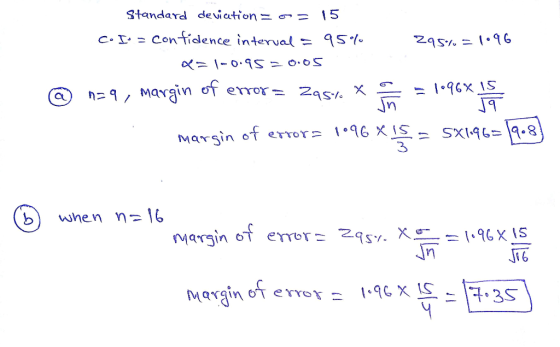
Suppose that a simple random sample is taken from a normal population having a standard deviation of 15 for the purpose of obtaining a 95% confidence interval for the mean of the population. a. If the sample size is 44, obtain the margin of error. b. Repeat part (a) for a sample size of 25
Suppose that a simple random sample is taken from a normal population having a standard deviation...
 Suppose that a simple random sample is taken from a normal population having a standard deviation of 11 for the purpose of obtaining a 90% confidence interval for the mean of the population a. If the sample size is 9, obtain the margin of error. b. Repeat part (a) for a sample size of 36 a. The margin of error for a sample size of 9 is (Round to two decimal places as needed.) b. The margin of error for...
Suppose that a simple random sample is taken from a normal population having a standard deviation...
Suppose that a simple random sample is taken from a normal population having a standard deviation of 6 for the purpose of obtaining a 90% confidence interval for the mean of the population. The margin of error for a sample size of 16 is ??? (Round to four decimal places as needed.) The margin of error for a sample size of 81 is ??? (Round to four decimal places as needed.)
Suppose a random sample of size 17 was taken from a normally distributed population, and the...
Suppose a random sample of size 17 was taken from a normally distributed population, and the sample standard deviation was calculated to be s = 5.0. a) Calculate the margin of error for a 95% confidence interval for the population mean. Round your response to at least 3 decimal places. b) Calculate the margin of error for a 90% confidence interval for the population mean. Round your response to at least 3 decimal places.
A simple random sample of size 64 is drawn from a normal population with a known...
A simple random sample of size 64 is drawn from a normal population with a known standard deviation σ. The 95% confidence interval for the population mean μ is found to be (12, 16). The approximate population standard deviation σ is:
A simple random sample of 60 items resulted in a sample mean of 75. The population...
A simple random sample of 60 items resulted in a sample mean of 75. The population standard deviation is 16. a. Compute the 95% confidence interval for the population mean (to 1 decimal). ( , ) b. Assume that the same sample mean was obtained from a sample of 120 items. Provide a 95% confidence interval for the population mean (to 2 decimals). ( , ) c. What is the effect of a larger sample size on the margin of error?
A simple random sample of 60 items resulted in a sample mean of 84. The population...
 A simple random sample of 60 items resulted in a sample mean of 84. The population standard deviation is 16. a. Compute the 95% confidence interval for the population mean (to 1 decimal). ( b. Assume that the same sample mean was obtained from a sample of 120 items. Provide a 95% confidence interval for the population mean (to 2 decimals). ( c. What is the effect of a larger sample size on the margin of error? Select Select It...
In a simple random sample of size 51, taken from a population, 24 of the individuals...
In a simple random sample of size 51, taken from a population, 24 of the individuals met a specified criteria. a) What is the margin of error for a 90% confidence interval for p, the population proportion? Round your response to at least 4 decimal places. Number b) What is the margin of error for a 95% confidence interval for p? Round your response to at least 4 decimal places. Number NOTE: These margin of errors are greater than .10...
A random sample of size n = 21, taken from a normal population with a standard...
 A random sample of size n = 21, taken from a normal population with a standard deviation 04 =5, has a mean X4 = 90. A second random sample of size n2 = 37, taken from a different normal population with a standard deviation o2 = 4, has a mean X2 = 39. Find a 94% confidence interval for 11 - H2 Click here to view page 1 of the standard normal distribution table. Click here to view page 2...
 Suppose that a simple random sample is taken from a normal population having a standard deviation of 11 for the purpose of obtaining a 90% confidence interval for the mean of the population a. If the sample size is 9, obtain the margin of error. b. Repeat part (a) for a sample size of 36 a. The margin of error for a sample size of 9 is (Round to two decimal places as needed.) b. The margin of error for...
 A simple random sample of 60 items resulted in a sample mean of 84. The population standard deviation is 16. a. Compute the 95% confidence interval for the population mean (to 1 decimal). ( b. Assume that the same sample mean was obtained from a sample of 120 items. Provide a 95% confidence interval for the population mean (to 2 decimals). ( c. What is the effect of a larger sample size on the margin of error? Select Select It...
 A random sample of size n = 21, taken from a normal population with a standard deviation 04 =5, has a mean X4 = 90. A second random sample of size n2 = 37, taken from a different normal population with a standard deviation o2 = 4, has a mean X2 = 39. Find a 94% confidence interval for 11 - H2 Click here to view page 1 of the standard normal distribution table. Click here to view page 2...
Most questions answered within 3 hours.
-
Where is the error in this code sequence?
String s1 = "Hello";
String s2 = "ello";...
asked 10 months ago -
Financial data for Joel de Paris, Inc., for last year
follow:
Joel de Paris, Inc.
Balance...
asked 10 months ago -
Consider this reaction:
Al2(SO4)3 (aq)+ BaCl3
(aq) Al2Cl6 (aq)- +
3BaSO4(s) . What is the...
asked 10 months ago -
Suppose that Savneet is considering increasing her
recent random sample from 20 car rentals to 40...
asked 10 months ago -
Trucks arrive at an unloading terminal at an average rate of 120
per hour.
Trucks arrive...
asked 10 months ago -
Why are methanol and ethanol completely soluble in water while
octanol is not very little soluble....
asked 10 months ago -
A facilities manager at a university reads in a research report
that the mean amount of...
asked 10 months ago -
When the CuSO4 is rehydrated by adding water to the anhydrous
compound, is this an endothermic...
asked 10 months ago -
A ray of sunlight is passing from diamond into crown glass; the
angle of incidence is...
asked 10 months ago -
A block of mass 0.249 kg is placed on top of a light, vertical
spring of...
asked 10 months ago -
how do the kidneys compensate in the presences of acidosis
a) trigger hyperventilate
b) reserve acid...
asked 10 months ago -
Question 501 pts
The rental rate of capital to the firm increases. Which of the
following...
asked 10 months ago