
Homework Answers
Solution:
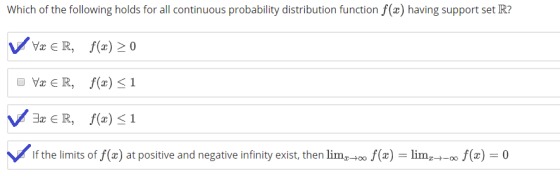
The first option is correct because probability density function of a continuous random variable is always greater than or equal to 0
The third option is correct because there exist some values of x for which f(x) will be less than or equal to 1.
The fourth option is correct probability reaches to 0 as x tends to positive or negative infinity.
Add Answer to:
Answer can be one or multiple Which of the following holds for all continuous probability distribution...
A discrete probability distribution differs from a continuous probability distribution, by only t...
 A discrete probability distribution differs from a continuous probability distribution, by only taking values on a discrete set (like the whole numbers) instead of a continuous set. The geometric distribution is a discrete probability distribution which measures the number of times an experiment must be repeated before a success occurs. For example, in this problem, we will roll a fair six-sided die until the number six occurs, at which point we stop rolling. (a) If we are rolling a die,...
PHYS1047 a) Given a random variable x, with a continuous probability distribution function fx) 4 marks...
 PHYS1047 a) Given a random variable x, with a continuous probability distribution function fx) 4 marks b) The life expectancy (in days) of a mechanical system has a probability density write down equations for the cumulative distribution C(x) and the survival distribution Px). State a relationship between them. function f(x)=1/x, for x21, and f(x)=0 for x <1. i Find the probability that the system lasts between 0 and I day.2 marks i) Find the probability that the system lasts between...
Answer can be one or multiple Which of the following hold(s) for random variables X and...
 Answer can be one or multiple
Which of the following hold(s) for random variables X and Y? X and Y are independent if they are uncorrelated O X and Y are uncorrelated if they are independent None of the above holds.
Answer can be one or multiple
Which of the following hold(s) for random variables X and Y? X and Y are independent if they are uncorrelated O X and Y are uncorrelated if they are independent None of the above holds.
I am studying Continuous Random Variables. Hope can some one tell me the solutions of these two problems! II.1 Let X be...
 I am studying Continuous Random Variables.
Hope can some one tell me the solutions of these two
problems!
II.1 Let X be a continuous random variable with the density function 1/4 if x E (-2,2) 0 otherwise &Cx)={ Find the probability density function of Z = X density function fx. Find the distribution function Fy (t) and the density function f,(t) of Y=지 (in terms of Fx and fx).
II.1 Let X be a continuous random variable with the density...
I am studying Continuous Random Variables.
Hope can some one tell me the solutions of these two
problems!
II.1 Let X be a continuous random variable with the density function 1/4 if x E (-2,2) 0 otherwise &Cx)={ Find the probability density function of Z = X density function fx. Find the distribution function Fy (t) and the density function f,(t) of Y=지 (in terms of Fx and fx).
II.1 Let X be a continuous random variable with the density...
. In probability theory, the Normal Distribution (sometimes called a Gaussian Distribution or Bell Curve) is a very common continuous probability distribution. Normal distributions are important...
 . In probability theory, the Normal Distribution (sometimes called a Gaussian Distribution or Bell Curve) is a very common continuous probability distribution. Normal distributions are important in statistics and are often used in the natural and social sciences to represent real-valued random variables whose distributions are not known. Describing the normal distribution using a mathematical function is called a probability distribution function (PDF) which is given here: H The mean of the distribution ơ-The standard deviation f(x)--e 2σ We can...
5. (20%) Let X be a continuous random variable whose probability density function is fr(x) (a +bx)%0(x) (a) If Ex)f...
 5. (20%) Let X be a continuous random variable whose probability density function is fr(x) (a +bx)%0(x) (a) If Ex)f find a and b. (b) Give the cumulative distribution function F,(x) f()dt of X and Var(X) (c) Let A be any Borel set of R. Define P by P(A) [,f dm
5. (20%) Let X be a continuous random variable whose probability density function is fr(x) (a +bx)%0(x) (a) If Ex)f find a and b. (b) Give the cumulative distribution...
5. (20%) Let X be a continuous random variable whose probability density function is fr(x) (a +bx)%0(x) (a) If Ex)f find a and b. (b) Give the cumulative distribution function F,(x) f()dt of X and Var(X) (c) Let A be any Borel set of R. Define P by P(A) [,f dm
5. (20%) Let X be a continuous random variable whose probability density function is fr(x) (a +bx)%0(x) (a) If Ex)f find a and b. (b) Give the cumulative distribution...
Even though the normal probability distribution deals with continuous variables, we can use it to approximate...
 Even though the normal probability distribution deals with
continuous variables, we can use it to approximate the binomial
probability distribution whenever n 30 and also
n(q) 30.
T/F ...why?
Even though the normal probability distribution deals with
continuous variables, we can use it to approximate the binomial
probability distribution whenever n 30 and also
n(q) 30.
T/F ...why?
Answer can be one or multiple Which of the following statements are true about all Independent...
 Answer can be one or multiple
Which of the following statements are true about all Independent random variables, X and Y? V(X+ Y) = V(X) + V(Y)
Answer can be one or multiple
Which of the following statements are true about all Independent random variables, X and Y? V(X+ Y) = V(X) + V(Y)
7.2. Which of the following functions represent a probability density function for a continuous random variable?...
 7.2. Which of the following functions represent a probability density function for a continuous random variable? Hint: Check if both rules of a proper probability density function hold. (a) f(z) = 0.25 where 0-1-8. b) f(r) =1/2 where 0 <1<2
help me with these problems and ill give you amazing ratings!! (must do all please) 7. Answer the following questions about continuity. (a) Write down the values of z at which the following func...
 help me with these problems and ill give you amazing ratings!!
(must do all please)
7. Answer the following questions about continuity. (a) Write down the values of z at which the following function is discontinuous. If the function is continuous at every value of z, write 'Continuous Everywhere' f(a)1 (separate multiple values by commas) (b) Write down the values of z at which the following function is discontinuous. If the function is continuous at every value of z, write...
help me with these problems and ill give you amazing ratings!!
(must do all please)
7. Answer the following questions about continuity. (a) Write down the values of z at which the following function is discontinuous. If the function is continuous at every value of z, write 'Continuous Everywhere' f(a)1 (separate multiple values by commas) (b) Write down the values of z at which the following function is discontinuous. If the function is continuous at every value of z, write...
 A discrete probability distribution differs from a continuous probability distribution, by only taking values on a discrete set (like the whole numbers) instead of a continuous set. The geometric distribution is a discrete probability distribution which measures the number of times an experiment must be repeated before a success occurs. For example, in this problem, we will roll a fair six-sided die until the number six occurs, at which point we stop rolling. (a) If we are rolling a die,...
 PHYS1047 a) Given a random variable x, with a continuous probability distribution function fx) 4 marks b) The life expectancy (in days) of a mechanical system has a probability density write down equations for the cumulative distribution C(x) and the survival distribution Px). State a relationship between them. function f(x)=1/x, for x21, and f(x)=0 for x <1. i Find the probability that the system lasts between 0 and I day.2 marks i) Find the probability that the system lasts between...
 Answer can be one or multiple
Which of the following hold(s) for random variables X and Y? X and Y are independent if they are uncorrelated O X and Y are uncorrelated if they are independent None of the above holds.
Answer can be one or multiple
Which of the following hold(s) for random variables X and Y? X and Y are independent if they are uncorrelated O X and Y are uncorrelated if they are independent None of the above holds.
 I am studying Continuous Random Variables.
Hope can some one tell me the solutions of these two
problems!
II.1 Let X be a continuous random variable with the density function 1/4 if x E (-2,2) 0 otherwise &Cx)={ Find the probability density function of Z = X density function fx. Find the distribution function Fy (t) and the density function f,(t) of Y=지 (in terms of Fx and fx).
II.1 Let X be a continuous random variable with the density...
I am studying Continuous Random Variables.
Hope can some one tell me the solutions of these two
problems!
II.1 Let X be a continuous random variable with the density function 1/4 if x E (-2,2) 0 otherwise &Cx)={ Find the probability density function of Z = X density function fx. Find the distribution function Fy (t) and the density function f,(t) of Y=지 (in terms of Fx and fx).
II.1 Let X be a continuous random variable with the density...
 . In probability theory, the Normal Distribution (sometimes called a Gaussian Distribution or Bell Curve) is a very common continuous probability distribution. Normal distributions are important in statistics and are often used in the natural and social sciences to represent real-valued random variables whose distributions are not known. Describing the normal distribution using a mathematical function is called a probability distribution function (PDF) which is given here: H The mean of the distribution ơ-The standard deviation f(x)--e 2σ We can...
 5. (20%) Let X be a continuous random variable whose probability density function is fr(x) (a +bx)%0(x) (a) If Ex)f find a and b. (b) Give the cumulative distribution function F,(x) f()dt of X and Var(X) (c) Let A be any Borel set of R. Define P by P(A) [,f dm
5. (20%) Let X be a continuous random variable whose probability density function is fr(x) (a +bx)%0(x) (a) If Ex)f find a and b. (b) Give the cumulative distribution...
5. (20%) Let X be a continuous random variable whose probability density function is fr(x) (a +bx)%0(x) (a) If Ex)f find a and b. (b) Give the cumulative distribution function F,(x) f()dt of X and Var(X) (c) Let A be any Borel set of R. Define P by P(A) [,f dm
5. (20%) Let X be a continuous random variable whose probability density function is fr(x) (a +bx)%0(x) (a) If Ex)f find a and b. (b) Give the cumulative distribution...
 Even though the normal probability distribution deals with
continuous variables, we can use it to approximate the binomial
probability distribution whenever n 30 and also
n(q) 30.
T/F ...why?
Even though the normal probability distribution deals with
continuous variables, we can use it to approximate the binomial
probability distribution whenever n 30 and also
n(q) 30.
T/F ...why?
 Answer can be one or multiple
Which of the following statements are true about all Independent random variables, X and Y? V(X+ Y) = V(X) + V(Y)
Answer can be one or multiple
Which of the following statements are true about all Independent random variables, X and Y? V(X+ Y) = V(X) + V(Y)
 7.2. Which of the following functions represent a probability density function for a continuous random variable? Hint: Check if both rules of a proper probability density function hold. (a) f(z) = 0.25 where 0-1-8. b) f(r) =1/2 where 0 <1<2
 help me with these problems and ill give you amazing ratings!!
(must do all please)
7. Answer the following questions about continuity. (a) Write down the values of z at which the following function is discontinuous. If the function is continuous at every value of z, write 'Continuous Everywhere' f(a)1 (separate multiple values by commas) (b) Write down the values of z at which the following function is discontinuous. If the function is continuous at every value of z, write...
help me with these problems and ill give you amazing ratings!!
(must do all please)
7. Answer the following questions about continuity. (a) Write down the values of z at which the following function is discontinuous. If the function is continuous at every value of z, write 'Continuous Everywhere' f(a)1 (separate multiple values by commas) (b) Write down the values of z at which the following function is discontinuous. If the function is continuous at every value of z, write...
Most questions answered within 3 hours.
-
Where is the error in this code sequence?
String s1 = "Hello";
String s2 = "ello";...
asked 11 months ago -
Financial data for Joel de Paris, Inc., for last year
follow:
Joel de Paris, Inc.
Balance...
asked 11 months ago -
Consider this reaction:
Al2(SO4)3 (aq)+ BaCl3
(aq) Al2Cl6 (aq)- +
3BaSO4(s) . What is the...
asked 11 months ago -
Suppose that Savneet is considering increasing her
recent random sample from 20 car rentals to 40...
asked 11 months ago -
Trucks arrive at an unloading terminal at an average rate of 120
per hour.
Trucks arrive...
asked 11 months ago -
Why are methanol and ethanol completely soluble in water while
octanol is not very little soluble....
asked 11 months ago -
A facilities manager at a university reads in a research report
that the mean amount of...
asked 11 months ago -
When the CuSO4 is rehydrated by adding water to the anhydrous
compound, is this an endothermic...
asked 11 months ago -
A ray of sunlight is passing from diamond into crown glass; the
angle of incidence is...
asked 11 months ago -
A block of mass 0.249 kg is placed on top of a light, vertical
spring of...
asked 11 months ago -
how do the kidneys compensate in the presences of acidosis
a) trigger hyperventilate
b) reserve acid...
asked 11 months ago -
Question 501 pts
The rental rate of capital to the firm increases. Which of the
following...
asked 11 months ago