
Homework Answers
vx = 1.3/1.25 = 1.04 m/s
vx = v*Cos(350)
v= vx/cos350
v = 1.27 m/s
-----------------------------------------
Add Answer to:
A cork shoots out of a champagne bottle at an angle of 35.0 above the horizontal....
A cork shoots out of a champagne bottle at an angle of 36.0 ∘above the horizontal....
A cork shoots out of a champagne bottle at an angle of 36.0 ∘above the horizontal. If the cork travels a horizontal distance of 1.50 m in 1.35 s , what was its initial speed?
Opening champagne. In a bottle of champagne, the pocket of gas (primarily carbon dioxide) between the liquid and the cork is at pressure of p = 5.07 atm. When the cork is pulled from the bottle, the g...
Opening champagne. In a bottle of champagne, the pocket of gas (primarily carbon dioxide) between the liquid and the cork is at pressure of p = 5.07 atm. When the cork is pulled from the bottle, the gas undergoes an adiabatic expansion until its pressure matches the ambient air pressure of 1.00 atm. Assume that the ratio of the molar specific heats is γ = 4/3. If the gas has initial temperature T = 4.7°C, what is its temperature at...
A hot-air balloon is descending with a velocity of (−2.00m/s)y^. A champagne bottle is opened to...
A hot-air balloon is descending with a velocity of (−2.00m/s)y^. A champagne bottle is opened to celebrate takeoff, expelling the cork horizontally with a velocity of (5.00m/s)x^ relative to the balloon. When opened, the bottle is 5.50 m above the ground. part a) What is the initial velocity of the cork, as seen by an observer on the ground? Give your answer in terms of the x and y unit vectors. part b) What is the speed of the cork...
Opening champagne. In a bottle of champagne, the pocket of gas (primarily carbon dioxide) between the...
Opening champagne. In a bottle of champagne, the pocket of gas (primarily carbon dioxide) between the liquid and the cork is at pressure of p = 2.98 atm. When the cork is pulled from the bottle, the gas undergoes an adiabatic expansion until its pressure matches the ambient air pressure of 1.00 atm. Assume that the ratio of the molar specific heats is γ = 4/3. If the gas has initial temperature T = 2.6°C, what is its temperature at...
Opening champagne. In a bottle of champagne, the pocket of gas (primarily carbon dioxide) between the...
 Opening champagne. In a bottle of champagne, the pocket of gas (primarily carbon dioxide) between the liquid and the cork is at pressure of p = 5.30 atm, when the cork is pulled from the bottle, the gas undergoes an adiabatic expansion until its pressure matches the ambient air pressure of 1.00 atm. Assume that the ratio of the molar specific heats is γ-4/3. If the gas has initial temperature T-4.7°C, what is its temperature at the end of the...
You are in a hot air balloon (yes, another balloon problem!) rising from the ground at...
You are in a hot air balloon (yes, another balloon problem!) rising from the ground at a constant velocity of 2.20 m/s upward. To celebrate the takeoff, you open a bottle of champagne, expelling the cork with a horizontal velocity of 4.40 m/s relative to the balloon. When opened, the bottle is 6.40 m above the ground. (A)What is the initial speed of the cork, as seen by your friend on the ground? (B)What is the initial direction of the...
Artemis shoots an arrow at a target that is a horizontal distance d=65 m away: the...
Artemis shoots an arrow at a target that is a horizontal distance d=65 m away: the bull's eye of the target is at same height of the arrow. At what angle in degrees above the horizontal must the arrow be released to hit the bull's eye if the arrows initial speed in 39 m/s?
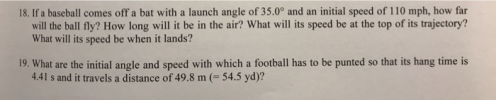
18,19? 18. If a baseball comes off a bat with a launch angle of 35.0° and...
 18,19?
18. If a baseball comes off a bat with a launch angle of 35.0° and an initial speed of i 10 mph, how far will the ball fly? How long will it be in the air? What will its speed be at the top of its trajectory? What will its speed be when it lands? 19. What are the initial angle and speed with which a football has to be punted so that its hang time is 4.41 s...
18,19?
18. If a baseball comes off a bat with a launch angle of 35.0° and an initial speed of i 10 mph, how far will the ball fly? How long will it be in the air? What will its speed be at the top of its trajectory? What will its speed be when it lands? 19. What are the initial angle and speed with which a football has to be punted so that its hang time is 4.41 s...
Initially, a particle is moving at 5.30 m/s at an angle of 35.0° above the horizontal...
Initially, a particle is moving at 5.30 m/s at an angle of 35.0° above the horizontal (+x axis). Two seconds later, its velocity is 5.13 m/s at an angle of 50.0° below the horizontal. What was the particle's average acceleration during this time interval? m/s2 (x component) m/s2 (y component)
Initially, a particle is moving at 4.50 m/s at an angle of 35.0° above the horizontal...
Initially, a particle is moving at 4.50 m/s at an angle of 35.0° above the horizontal (+x axis). Two seconds later, its velocity is 5.79 m/s at an angle of 50.0° below the horizontal. What was the particle's average acceleration during these 2.00 seconds? 1. m/s2 (x component) 2. m/s2 (y component)
 Opening champagne. In a bottle of champagne, the pocket of gas (primarily carbon dioxide) between the liquid and the cork is at pressure of p = 5.30 atm, when the cork is pulled from the bottle, the gas undergoes an adiabatic expansion until its pressure matches the ambient air pressure of 1.00 atm. Assume that the ratio of the molar specific heats is γ-4/3. If the gas has initial temperature T-4.7°C, what is its temperature at the end of the...
 18,19?
18. If a baseball comes off a bat with a launch angle of 35.0° and an initial speed of i 10 mph, how far will the ball fly? How long will it be in the air? What will its speed be at the top of its trajectory? What will its speed be when it lands? 19. What are the initial angle and speed with which a football has to be punted so that its hang time is 4.41 s...
18,19?
18. If a baseball comes off a bat with a launch angle of 35.0° and an initial speed of i 10 mph, how far will the ball fly? How long will it be in the air? What will its speed be at the top of its trajectory? What will its speed be when it lands? 19. What are the initial angle and speed with which a football has to be punted so that its hang time is 4.41 s...
Most questions answered within 3 hours.
-
Where is the error in this code sequence?
String s1 = "Hello";
String s2 = "ello";...
asked 11 months ago -
Financial data for Joel de Paris, Inc., for last year
follow:
Joel de Paris, Inc.
Balance...
asked 11 months ago -
Consider this reaction:
Al2(SO4)3 (aq)+ BaCl3
(aq) Al2Cl6 (aq)- +
3BaSO4(s) . What is the...
asked 11 months ago -
Suppose that Savneet is considering increasing her
recent random sample from 20 car rentals to 40...
asked 11 months ago -
Trucks arrive at an unloading terminal at an average rate of 120
per hour.
Trucks arrive...
asked 11 months ago -
Why are methanol and ethanol completely soluble in water while
octanol is not very little soluble....
asked 11 months ago -
A facilities manager at a university reads in a research report
that the mean amount of...
asked 11 months ago -
When the CuSO4 is rehydrated by adding water to the anhydrous
compound, is this an endothermic...
asked 11 months ago -
A ray of sunlight is passing from diamond into crown glass; the
angle of incidence is...
asked 11 months ago -
A block of mass 0.249 kg is placed on top of a light, vertical
spring of...
asked 11 months ago -
how do the kidneys compensate in the presences of acidosis
a) trigger hyperventilate
b) reserve acid...
asked 11 months ago -
Question 501 pts
The rental rate of capital to the firm increases. Which of the
following...
asked 11 months ago