
Homework Answers
C. in C part if there is air resistance acting F= -bv
where v is velocity
then it can happen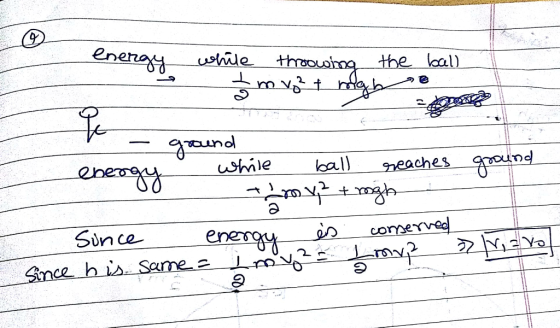
Add Answer to:
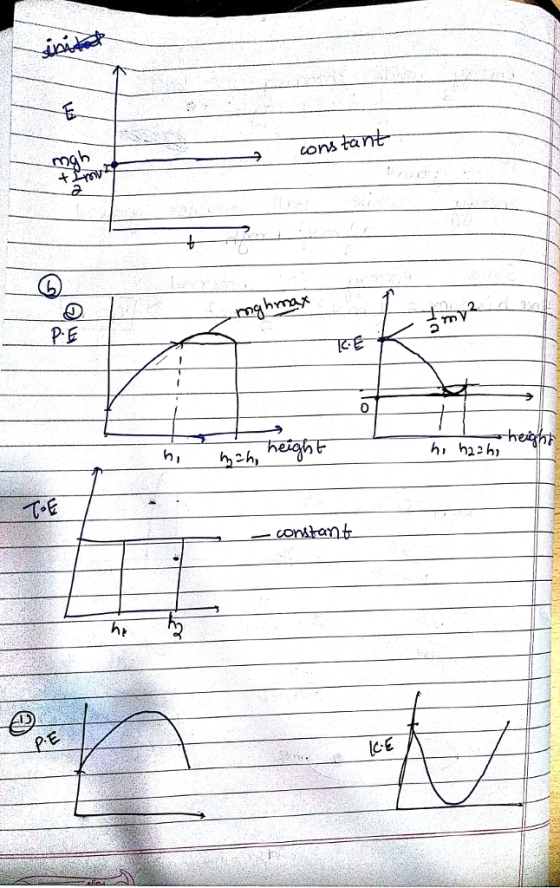
4) Use the Energy-Interaction Model to show that an object thrown vertically upward will have the...
Question 8 1pts A ball is thrown vertically upward with an initial speed of 20 m/s....
 Question 8 1pts A ball is thrown vertically upward with an initial speed of 20 m/s. Two seconds later a stone is thrown vertically from the same initial height as the ball) with an initial speed of 24 m/s. At what height above the release point will the ball and stone pass each other? The acceleration is 9.8 m/s in the downwards direction 17 m E E 21 m
A ball is thrown vertically upward. Neglecting air resistance, which one of the following statements is...
 A ball is thrown vertically upward. Neglecting air resistance, which one of the following statements is FALSE. Select one: a. The kinetic energy of the ball decreases while the ball is going up. b. The sum of the kinetic energy and gravitational potential energy of the ball is constant. C. The kinetic energy of the ball increases when the ball is coming down. d. The gravitational potential energy decreases as the ball is going up
A ball is thrown down vertically with an initial speed of 31 ft/s from a height...
A ball is thrown down vertically with an initial speed of 31 ft/s from a height of 44 ft. (a) What is its speed just before it strikes the ground? (b) How long does the ball take to reach the ground? What would be the answers to (c) part a and (d) part b if the ball were thrown upward from the same height and with the same initial speed ? Before solving any equations, decide whether the answers to...
A 0.36-kg ball is thrown vertically upward with an initial speed of 12.5 m/s. What is...
A 0.36-kg ball is thrown vertically upward with an initial speed of 12.5 m/s. What is the potential energy of the ball when it has travelled two-thirds of the distance to its maximum height? (Use the launch point to be the zero reference point of measurements of the heights)
At t = 0 s, a ball B1 is thrown vertically upward with a speed of...
At t = 0 s, a ball B1 is thrown vertically upward with a speed of 30 m/s. When B1 is 25 m above ground on the way up, a second ball B2 is thrown vertically upward from the ground with a speed of 40 m/s (Take the magnitude of the acceleration due to gravity g =10m/s2) a) How many seconds after B1 was B2 thrown upward?
Problem A) A penny is thrown vertically upward with a speed of 13 m/s. Exactly 2...
Problem A) A penny is thrown vertically upward with a speed of 13 m/s. Exactly 2 seconds later a nickel is thrown upward along the same path as the penny at a speed of 15 m/s. Ignoring air resistance, (a) at what time do the penny and nickel collide? (b) At what height does the collision occur? (c) Is the penny on its way up or down when the collision occurs?
A ball is thrown vertically upward and hits a telephone wire located 5.1 m above the...
A ball is thrown vertically upward and hits a telephone wire located 5.1 m above the release point with a speed of 0.70 m/s. What was the initial speed of the ball when it was released?
1. A stone is thrown vertically upward. On its way up it passes point A with...
 1.
A stone is thrown vertically upward. On its way up it passes point A with speed v, and point B, 5.10 m higher than A, with speed 1/2v. (a) Calculate the speed v. (Enter your answer to at least two decimal places.) (b) Calculate the maximum height reached by the stone above point B.
1.
A stone is thrown vertically upward. On its way up it passes point A with speed v, and point B, 5.10 m higher than A, with speed 1/2v. (a) Calculate the speed v. (Enter your answer to at least two decimal places.) (b) Calculate the maximum height reached by the stone above point B.
A ball was thrown to a height of 10 m vertically upwards. The acceleration of the...
A ball was thrown to a height of 10 m vertically upwards. The acceleration of the ball while coming down was - 9.8 m/s2 . What was the acceleration of the ball while it was going up?
A ball is thrown vertically upward, which is the positive direction. A little later it returns...
 A ball is thrown vertically upward, which is the positive direction. A little later it returns to its point of release. The ball is in the air for a total time of 6.1 s. What is the maximum height reached by the ball? Answer: Choose hallic thrown ortically in which is the native direction to storitratumet tenint of relance The hallic in 0:26 AM
 Question 8 1pts A ball is thrown vertically upward with an initial speed of 20 m/s. Two seconds later a stone is thrown vertically from the same initial height as the ball) with an initial speed of 24 m/s. At what height above the release point will the ball and stone pass each other? The acceleration is 9.8 m/s in the downwards direction 17 m E E 21 m
 A ball is thrown vertically upward. Neglecting air resistance, which one of the following statements is FALSE. Select one: a. The kinetic energy of the ball decreases while the ball is going up. b. The sum of the kinetic energy and gravitational potential energy of the ball is constant. C. The kinetic energy of the ball increases when the ball is coming down. d. The gravitational potential energy decreases as the ball is going up
 1.
A stone is thrown vertically upward. On its way up it passes point A with speed v, and point B, 5.10 m higher than A, with speed 1/2v. (a) Calculate the speed v. (Enter your answer to at least two decimal places.) (b) Calculate the maximum height reached by the stone above point B.
1.
A stone is thrown vertically upward. On its way up it passes point A with speed v, and point B, 5.10 m higher than A, with speed 1/2v. (a) Calculate the speed v. (Enter your answer to at least two decimal places.) (b) Calculate the maximum height reached by the stone above point B.
 A ball is thrown vertically upward, which is the positive direction. A little later it returns to its point of release. The ball is in the air for a total time of 6.1 s. What is the maximum height reached by the ball? Answer: Choose hallic thrown ortically in which is the native direction to storitratumet tenint of relance The hallic in 0:26 AM
Most questions answered within 3 hours.
-
Where is the error in this code sequence?
String s1 = "Hello";
String s2 = "ello";...
asked 10 months ago -
Financial data for Joel de Paris, Inc., for last year
follow:
Joel de Paris, Inc.
Balance...
asked 10 months ago -
Consider this reaction:
Al2(SO4)3 (aq)+ BaCl3
(aq) Al2Cl6 (aq)- +
3BaSO4(s) . What is the...
asked 10 months ago -
Suppose that Savneet is considering increasing her
recent random sample from 20 car rentals to 40...
asked 10 months ago -
Trucks arrive at an unloading terminal at an average rate of 120
per hour.
Trucks arrive...
asked 10 months ago -
Why are methanol and ethanol completely soluble in water while
octanol is not very little soluble....
asked 10 months ago -
A facilities manager at a university reads in a research report
that the mean amount of...
asked 10 months ago -
When the CuSO4 is rehydrated by adding water to the anhydrous
compound, is this an endothermic...
asked 10 months ago -
A ray of sunlight is passing from diamond into crown glass; the
angle of incidence is...
asked 10 months ago -
A block of mass 0.249 kg is placed on top of a light, vertical
spring of...
asked 10 months ago -
how do the kidneys compensate in the presences of acidosis
a) trigger hyperventilate
b) reserve acid...
asked 10 months ago -
Question 501 pts
The rental rate of capital to the firm increases. Which of the
following...
asked 10 months ago