You expect the stock market to increase, but instead of acquiring stock, you decide to acquire...
You expect the stock market to increase, but instead of acquiring stock, you decide to acquire a stock index futures contract. That index is currently 60.0, and the contract has a value that is $800 times the amount of the index. The margin requirement is $4,000.
- When you make the contract, how much must you put up? Round
your answer to the nearest dollar.
$ ________
- What is the value of the contract based on the index? Round
your answer to the nearest dollar.
$ ________
-
If the value of the index rises 1 percent to 60.600, what is the profit on the investment? Round your answer to the nearest cent.
$ ________
What is the percentage earned on the funds you put up? Round your answer to one decimal place.
________%
- If the value of the index declines 1 percent to 59.400, what
percentage of your funds will you lose? Round your answer to one
decimal place. Enter your answer as a positive value.
_______ %
- What is the percentage you earn (or lose) if the index falls to
55.0? Round your answer to one decimal place. Enter your answer as
a positive value.
The percentage __profit / loss___ is ______%.
Homework Answers
Ans. a) Given Index Value 60.00, Lot Size 800 and Margin required $4000
The value need to put up to acquire Index future is the amount of margin required.
The value need to put up to acquire Index future = $4000
Ans. b) The Value of the contract = Index value * Lot Size
The Value of the contract = 60*800
The Value of the contract = $48000
Ans. c): If Index rises 1% from 60.00 to 60.600
Profit = Increment in Index value * Lot size
Profit = (60.600-60) * 800
Profit = 0.600*800 = $480
The Fund Invested = Margin paid = $4000
Percentage Earned on the fund invested = (Profit/ Fund Invested)*100
Percentage Earned on the fund invested = 480/4000 = 12.00%
Ans.d) If Index declines 1% from 60.00 to 59.400
Loss = Decrease in Index value * Lot size
Loss = 0.600*800 = $480.00
Percentage lose on the fund invested = (Loss/Fund Invested)*100
Percentage lose on the fund invested = 480/4000 = 12%
Add Answer to:
You expect the stock market to increase, but instead of acquiring stock, you decide to acquire...
You expect the stock market to decline, but instead of selling a stock short you decide...
You expect the stock market to decline, but instead of selling a stock short you decide to sell a stock index futures contract based on the New York Stock Exchange Composite Index. The index is currently 138, and the contract has a value that is 500 times the amount of the index. The margin requirement is $3,500 and the maintenance margin requirement is $1,000. 1. When you sell the contract, how much are you required to put up? 2. What...
The futures price of corn is $3.10 a bushel. Futures contracts for corn are based on...
The futures price of corn is $3.10 a bushel. Futures contracts for corn are based on 9,000 bushels, and the margin requirement is $2,000 a contract. You expect the price of corn to fall and sell the contract short. What is the value of the contract and how much must you initially remit? Round your answers to the nearest dollar. Value of the contract: $ _______ Remit amount: $ _________ If the futures price of corn rises to $3.19, what...
A stock has a beta of 1.10, the expected return on the market is 10%, and...
A stock has a beta of 1.10, the expected return on the market is 10%, and the risk-free rate is 2.5%. What must the expected return on this stock be? **ENTER YOUR ANSWER AS A PERCENTAGE WITH ONE DECIMAL PLACE (e.g., 12.1) AND NOT AS A DECIMAL (e.g., 0.121). ROUND TO THE NEAREST TENTH OF A PERCENT.**
Last year stock A had a return of 7 percent and stock B had a return of 10 percent. If you held each stock equally in a...
Last year stock A had a return of 7 percent and stock B had a return of 10 percent. If you held each stock equally in a portfolio (i.e. 50% in A and 50% in B), what would the return of your portfolio have been? **ENTER YOUR ANSWER AS A PERCENTAGE WITH ONE DECIMAL PLACE (e.g., 12.1) AND NOT AS A DECIMAL (e.g., 0.121). ROUND TO THE NEAREST TENTH OF A PERCENT.**
You have a portfolio that has 125 shares of Stock A that sell for $54 per share and 112 shares of Stock B that sell for...
You have a portfolio that has 125 shares of Stock A that sell for $54 per share and 112 shares of Stock B that sell for $93 per share. What is the portfolio weight for Stock A? ENTER YOUR ANSWER AS A PERCENTAGE WITH ONE DECIMAL PLACE (e.g., 12.1) AND NOT AS A DECIMAL (e.g., 0.121). ROUND TO THE NEAREST TENTH OF A PERCENT.
You are considering acquiring a common stock that you would like to hold for one year....
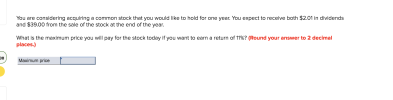 You are considering acquiring a common stock that you would like to hold for one year. You expect to receive both $2.01 in dividends and $39.00 from the sale of the stock at the end of the year. What is the maximum price you will pay for the stock today if you want to earn a return of 11%? (Round your answer to 2 decimal places.) 38 Maximum price
A stock has a beta of 1.20, the market premium is 13.0%, and the risk-free rate is 1.0%. What must the expected return o...
A stock has a beta of 1.20, the market premium is 13.0%, and the risk-free rate is 1.0%. What must the expected return on this stock be? ENTER YOUR ANSWER AS A PERCENTAGE WITH ONE DECIMAL PLACE (e.g., 12.1) AND NOT AS A DECIMAL (e.g., 0.121). ROUND TO THE NEAREST TENTH OF A PERCENT.
One year ago, you purchased 325 shares of Best Wings stock at a price of $63.00...
One year ago, you purchased 325 shares of Best Wings stock at a price of $63.00 a share. The company pays an annual dividend of $1.36 per share. Today, you sold for the shares for $65.00 a share. What is your total percentage return on this investment? ENTER YOUR ANSWER AS A PERCENTAGE WITH ONE DECIMAL PLACE (e.g., 12.1) AND NOT AS A DECIMAL (e.g., 0.121). ROUND TO THE NEAREST TENTH OF A PERCENT.
A stock has the following stock information: Year Stock Price 2014 $ 22.75 2015 $ 22.00...
A stock has the following stock information: Year Stock Price 2014 $ 22.75 2015 $ 22.00 2016 $ 23.75 2017 $ 26.00 What is the arithmetic average return of this stock? ENTER YOUR ANSWER AS A PERCENTAGE WITH ONE DECIMAL PLACE (e.g., 12.1) AND NOT AS A DECIMAL (e.g., 0.121). ROUND TO THE NEAREST TENTH OF A PERCENT. DO NOT USE THE PERCENT SIGN (%) IN YOUR ANSWER.
Question 5 (10 points) Suppose you believe that Du Pont's stock price is going to decline...
 Question 5 (10 points) Suppose you believe that Du Pont's stock price is going to decline from its current level of $ 82.09 sometime during the next 5 months. For $ 717.05 you could buy a 5-month put option giving you the right to sell 100 shares at a price of $ 84 per share. If you bought a 100-share contract for $ 717.05 and Du Pont's stock price actually changed to $ 70.62 , your net profit (or loss)...
 You are considering acquiring a common stock that you would like to hold for one year. You expect to receive both $2.01 in dividends and $39.00 from the sale of the stock at the end of the year. What is the maximum price you will pay for the stock today if you want to earn a return of 11%? (Round your answer to 2 decimal places.) 38 Maximum price
 Question 5 (10 points) Suppose you believe that Du Pont's stock price is going to decline from its current level of $ 82.09 sometime during the next 5 months. For $ 717.05 you could buy a 5-month put option giving you the right to sell 100 shares at a price of $ 84 per share. If you bought a 100-share contract for $ 717.05 and Du Pont's stock price actually changed to $ 70.62 , your net profit (or loss)...
Most questions answered within 3 hours.
-
Where is the error in this code sequence?
String s1 = "Hello";
String s2 = "ello";...
asked 11 months ago -
Financial data for Joel de Paris, Inc., for last year
follow:
Joel de Paris, Inc.
Balance...
asked 11 months ago -
Consider this reaction:
Al2(SO4)3 (aq)+ BaCl3
(aq) Al2Cl6 (aq)- +
3BaSO4(s) . What is the...
asked 11 months ago -
Suppose that Savneet is considering increasing her
recent random sample from 20 car rentals to 40...
asked 11 months ago -
Trucks arrive at an unloading terminal at an average rate of 120
per hour.
Trucks arrive...
asked 11 months ago -
Why are methanol and ethanol completely soluble in water while
octanol is not very little soluble....
asked 11 months ago -
A facilities manager at a university reads in a research report
that the mean amount of...
asked 11 months ago -
When the CuSO4 is rehydrated by adding water to the anhydrous
compound, is this an endothermic...
asked 11 months ago -
A ray of sunlight is passing from diamond into crown glass; the
angle of incidence is...
asked 11 months ago -
A block of mass 0.249 kg is placed on top of a light, vertical
spring of...
asked 11 months ago -
how do the kidneys compensate in the presences of acidosis
a) trigger hyperventilate
b) reserve acid...
asked 11 months ago -
Question 501 pts
The rental rate of capital to the firm increases. Which of the
following...
asked 11 months ago