
Homework Answers
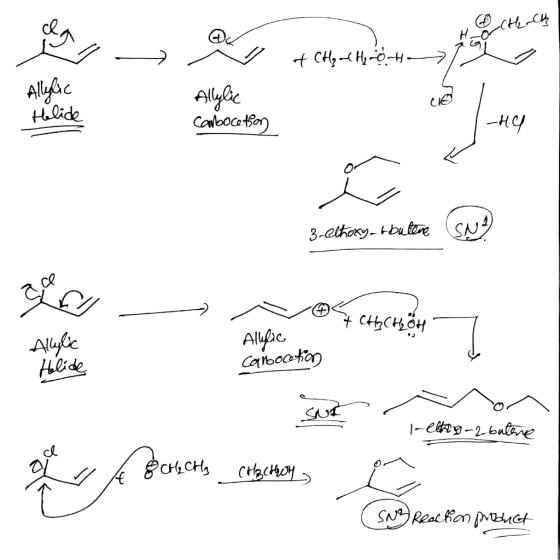
first identify the type of alkyl halide and then based on that here sn1 and sn2 reaction takes place and the mechanisms are as follows
Add Answer to:
The reaction of 3-chloro-1-butene with ethoxide ion in ethanol yields only 3-ethoxy-1-butene; the rate of this...
3a) (5 pts) When 1,2-epoxypropane is treated with sodium ethoxide in ethanol, 1-ethoxy-2-propanol is the major...
 3a) (5 pts) When 1,2-epoxypropane is treated with sodium ethoxide in ethanol, 1-ethoxy-2-propanol is the major product while only a trace amount of 2-ethoxy-1-propanol is produced. Propose a mechanism for the major product and explain the results based on the mechanism. OH NaOCH2CH3 OH EtOH trace major Hoc
Question 34 (Mandatory) (2 points) Name the following molecule CH3 CI Br 1-chloro-2-methyl-4-bromo=2=butene 04-chloro-3-methyl-1-bromo=2=butene 01-bromo-4-chloro-3-methyl-2-butene 04-bromr-1-chloro-2-methyl-2-butene...
 Question 34 (Mandatory) (2 points) Name the following molecule CH3 CI Br 1-chloro-2-methyl-4-bromo=2=butene 04-chloro-3-methyl-1-bromo=2=butene 01-bromo-4-chloro-3-methyl-2-butene 04-bromr-1-chloro-2-methyl-2-butene Question 35 (Mandatory) (2 points) Name the following molecule Question 33 (Mandatory) (2 points) Name the following molecule ОН 2-ethoxy-1-ethanol ethyl ethanol ether 2-oxy-1-butanol 1-ethoxy-1-ethanol Question 34 (Mandatory) (2 points) Question 35 (Mandatory) (2 points) Name the following molecule OH p-isopropylmethylphenol 2-isopropyl-5-methylphenol 6-isopropyl-3-methylphenol 2-isopropyl-1-hydroxy-5-methylcyclohexatriene Type here to search о в е Question 36 (Mandatory) (2 points) Name the following molecule 2-methyl-2-oxy-butane 0 1,1-dimethyl ethyl...
Only need help with #5, please. 5) Draw the product(s) of the reaction of (R)-3-chloro-1-butene with...
 Only need help with #5, please.
5) Draw the product(s) of the reaction of (R)-3-chloro-1-butene with BH:/HO2. Indicate stereochemistry. (20 pts) 6) What are isomers and how are they classified. (10 pts)
Only need help with #5, please.
5) Draw the product(s) of the reaction of (R)-3-chloro-1-butene with BH:/HO2. Indicate stereochemistry. (20 pts) 6) What are isomers and how are they classified. (10 pts)
(R)–3-chloro-2-methylhexane may undergo a nucleophilic substitution reaction in the presence of sodium ethoxide and ethanol. Complete...
 (R)–3-chloro-2-methylhexane may undergo a nucleophilic
substitution reaction in the presence of sodium ethoxide and
ethanol. Complete the mechanism and draw the products of the
reaction.
<Chapter 7 SN2 and E2 Reactions of Alkyl Halides DOCH: FU MacBook Air
(R)–3-chloro-2-methylhexane may undergo a nucleophilic
substitution reaction in the presence of sodium ethoxide and
ethanol. Complete the mechanism and draw the products of the
reaction.
<Chapter 7 SN2 and E2 Reactions of Alkyl Halides DOCH: FU MacBook Air
Challenge Problem 6.45 (R)-(3-Chloro-2-methylpropyl) methyl ether (A) on reaction with azide ion (N') in aqueous ethanol...
 Challenge Problem 6.45 (R)-(3-Chloro-2-methylpropyl) methyl ether (A) on reaction with azide ion (N') in aqueous ethanol gives (5)-(3-azido-2-methylpropyl) methyl ether (B). Compound A has the structure CICH2CH(CH3)CH2CH3. Get help answering Molecular Drawing questions (a) Draw wedge-dashed wedge-line formulas of both A and B.
In the presence of sodium ethoxide and ethanol, (R)–3-chloro-2-methylhexane can undergo an elimination reaction as well...
 In the presence of sodium ethoxide and ethanol,
(R)–3-chloro-2-methylhexane can undergo an elimination
reaction as well as the SN2 reaction. Complete the reaction
mechanism for the major product of the reaction and draw that
product of the elimination reaction.
Draw all missing reactants and/or products in the appropriate
boxes by placing atoms on the grid and connecting them with bonds
and including charges where needed. Indicate the mechanism by
drawing the electron-flow arrows on the molecules. Arrows should
start on...
In the presence of sodium ethoxide and ethanol,
(R)–3-chloro-2-methylhexane can undergo an elimination
reaction as well as the SN2 reaction. Complete the reaction
mechanism for the major product of the reaction and draw that
product of the elimination reaction.
Draw all missing reactants and/or products in the appropriate
boxes by placing atoms on the grid and connecting them with bonds
and including charges where needed. Indicate the mechanism by
drawing the electron-flow arrows on the molecules. Arrows should
start on...
1. 3-methyl-1-butene on reaction with H-Cl forms two products, namely 2-chloro-3- methylbutane (minor) and 2-chloro-2-methylbutane (major)....
 1. 3-methyl-1-butene on reaction with H-Cl forms two products, namely 2-chloro-3- methylbutane (minor) and 2-chloro-2-methylbutane (major). Illustrate the mechanism for the formation of these two products. Use curved arrows to illustrate electron movement and all intermediates must be shown. 2. 3,3-dimethyl-1-butene on reaction with HBr forms two products, namely 3-bromo-2,2- dimethylbutane (minor) and 2-bromo-2,3-dimethylbutane (major). Illustrate the mechanism for the formation of these two products. Use curved arrows to illustrate electron movement and all intermediates must be shown. 3. Calculate...
The reaction of (R)-2-iodopentane with one-molar equivalent of ammonia in ethanol to give 1 was found...
 The reaction of (R)-2-iodopentane with one-molar
equivalent of ammonia in ethanol to give 1 was
found to be first order.
Consider the following statements and choose the correct
one(s).
I. Both enantiomers of 1 form.
II. Increasing the concentration of (R)-2-iodopentane has
no effect on the rate of the reaction.
III. The rate of the reaction depends on the concentration of
ammonia.
Group of answer choices
I and II only
I and III only
II and III only
I only...
The reaction of (R)-2-iodopentane with one-molar
equivalent of ammonia in ethanol to give 1 was
found to be first order.
Consider the following statements and choose the correct
one(s).
I. Both enantiomers of 1 form.
II. Increasing the concentration of (R)-2-iodopentane has
no effect on the rate of the reaction.
III. The rate of the reaction depends on the concentration of
ammonia.
Group of answer choices
I and II only
I and III only
II and III only
I only...
111111 Juana Scott monitored the rate of the reaction of sodium ethoxide with 2-bromo-2-methyl hexane and...
 111111 Juana Scott monitored the rate of the reaction of sodium ethoxide with 2-bromo-2-methyl hexane and with 2-fluoro-2-methyl hexane, The reactions were carried out in two respectively in hexane (CH). different, solvents and at two different concentrations as shown in the table below. King James inspired by the work of JS tried the reaction of 2-Bromobutane and 2-fluorobutane with sodium ethoxide under similar reaction conditions used by Dr. Scott. Rate Solvent JS EXPT. (NaOet) {R-X) 10/sec Hexane X - Br...
Juana Scott monitored the rate of the reaction of sodium ethoxide with 2-bromo-2-methyl hexane and with...
 Juana Scott monitored the rate of the reaction of sodium ethoxide with 2-bromo-2-methyl hexane and with 2-fluoro-2-methyl hexane, respectively in hexane (CH..). The reactions were carried out in two different solvents and at two different concentrations as shown in the table below. King James inspired by the work of JS tried the reaction of 2-Bromobutane and 2-fluorobutane with sodiusethoxide under similar reaction conditions used by Dr. Scott. JS EXPT. + X = Br X = Br X-Br X - Br...
 3a) (5 pts) When 1,2-epoxypropane is treated with sodium ethoxide in ethanol, 1-ethoxy-2-propanol is the major product while only a trace amount of 2-ethoxy-1-propanol is produced. Propose a mechanism for the major product and explain the results based on the mechanism. OH NaOCH2CH3 OH EtOH trace major Hoc
 Question 34 (Mandatory) (2 points) Name the following molecule CH3 CI Br 1-chloro-2-methyl-4-bromo=2=butene 04-chloro-3-methyl-1-bromo=2=butene 01-bromo-4-chloro-3-methyl-2-butene 04-bromr-1-chloro-2-methyl-2-butene Question 35 (Mandatory) (2 points) Name the following molecule Question 33 (Mandatory) (2 points) Name the following molecule ОН 2-ethoxy-1-ethanol ethyl ethanol ether 2-oxy-1-butanol 1-ethoxy-1-ethanol Question 34 (Mandatory) (2 points) Question 35 (Mandatory) (2 points) Name the following molecule OH p-isopropylmethylphenol 2-isopropyl-5-methylphenol 6-isopropyl-3-methylphenol 2-isopropyl-1-hydroxy-5-methylcyclohexatriene Type here to search о в е Question 36 (Mandatory) (2 points) Name the following molecule 2-methyl-2-oxy-butane 0 1,1-dimethyl ethyl...
 Only need help with #5, please.
5) Draw the product(s) of the reaction of (R)-3-chloro-1-butene with BH:/HO2. Indicate stereochemistry. (20 pts) 6) What are isomers and how are they classified. (10 pts)
Only need help with #5, please.
5) Draw the product(s) of the reaction of (R)-3-chloro-1-butene with BH:/HO2. Indicate stereochemistry. (20 pts) 6) What are isomers and how are they classified. (10 pts)
 (R)–3-chloro-2-methylhexane may undergo a nucleophilic
substitution reaction in the presence of sodium ethoxide and
ethanol. Complete the mechanism and draw the products of the
reaction.
<Chapter 7 SN2 and E2 Reactions of Alkyl Halides DOCH: FU MacBook Air
(R)–3-chloro-2-methylhexane may undergo a nucleophilic
substitution reaction in the presence of sodium ethoxide and
ethanol. Complete the mechanism and draw the products of the
reaction.
<Chapter 7 SN2 and E2 Reactions of Alkyl Halides DOCH: FU MacBook Air
 Challenge Problem 6.45 (R)-(3-Chloro-2-methylpropyl) methyl ether (A) on reaction with azide ion (N') in aqueous ethanol gives (5)-(3-azido-2-methylpropyl) methyl ether (B). Compound A has the structure CICH2CH(CH3)CH2CH3. Get help answering Molecular Drawing questions (a) Draw wedge-dashed wedge-line formulas of both A and B.
 In the presence of sodium ethoxide and ethanol,
(R)–3-chloro-2-methylhexane can undergo an elimination
reaction as well as the SN2 reaction. Complete the reaction
mechanism for the major product of the reaction and draw that
product of the elimination reaction.
Draw all missing reactants and/or products in the appropriate
boxes by placing atoms on the grid and connecting them with bonds
and including charges where needed. Indicate the mechanism by
drawing the electron-flow arrows on the molecules. Arrows should
start on...
In the presence of sodium ethoxide and ethanol,
(R)–3-chloro-2-methylhexane can undergo an elimination
reaction as well as the SN2 reaction. Complete the reaction
mechanism for the major product of the reaction and draw that
product of the elimination reaction.
Draw all missing reactants and/or products in the appropriate
boxes by placing atoms on the grid and connecting them with bonds
and including charges where needed. Indicate the mechanism by
drawing the electron-flow arrows on the molecules. Arrows should
start on...
 1. 3-methyl-1-butene on reaction with H-Cl forms two products, namely 2-chloro-3- methylbutane (minor) and 2-chloro-2-methylbutane (major). Illustrate the mechanism for the formation of these two products. Use curved arrows to illustrate electron movement and all intermediates must be shown. 2. 3,3-dimethyl-1-butene on reaction with HBr forms two products, namely 3-bromo-2,2- dimethylbutane (minor) and 2-bromo-2,3-dimethylbutane (major). Illustrate the mechanism for the formation of these two products. Use curved arrows to illustrate electron movement and all intermediates must be shown. 3. Calculate...
 The reaction of (R)-2-iodopentane with one-molar
equivalent of ammonia in ethanol to give 1 was
found to be first order.
Consider the following statements and choose the correct
one(s).
I. Both enantiomers of 1 form.
II. Increasing the concentration of (R)-2-iodopentane has
no effect on the rate of the reaction.
III. The rate of the reaction depends on the concentration of
ammonia.
Group of answer choices
I and II only
I and III only
II and III only
I only...
The reaction of (R)-2-iodopentane with one-molar
equivalent of ammonia in ethanol to give 1 was
found to be first order.
Consider the following statements and choose the correct
one(s).
I. Both enantiomers of 1 form.
II. Increasing the concentration of (R)-2-iodopentane has
no effect on the rate of the reaction.
III. The rate of the reaction depends on the concentration of
ammonia.
Group of answer choices
I and II only
I and III only
II and III only
I only...
 111111 Juana Scott monitored the rate of the reaction of sodium ethoxide with 2-bromo-2-methyl hexane and with 2-fluoro-2-methyl hexane, The reactions were carried out in two respectively in hexane (CH). different, solvents and at two different concentrations as shown in the table below. King James inspired by the work of JS tried the reaction of 2-Bromobutane and 2-fluorobutane with sodium ethoxide under similar reaction conditions used by Dr. Scott. Rate Solvent JS EXPT. (NaOet) {R-X) 10/sec Hexane X - Br...
 Juana Scott monitored the rate of the reaction of sodium ethoxide with 2-bromo-2-methyl hexane and with 2-fluoro-2-methyl hexane, respectively in hexane (CH..). The reactions were carried out in two different solvents and at two different concentrations as shown in the table below. King James inspired by the work of JS tried the reaction of 2-Bromobutane and 2-fluorobutane with sodiusethoxide under similar reaction conditions used by Dr. Scott. JS EXPT. + X = Br X = Br X-Br X - Br...
Most questions answered within 3 hours.
-
Where is the error in this code sequence?
String s1 = "Hello";
String s2 = "ello";...
asked 11 months ago -
Financial data for Joel de Paris, Inc., for last year
follow:
Joel de Paris, Inc.
Balance...
asked 11 months ago -
Consider this reaction:
Al2(SO4)3 (aq)+ BaCl3
(aq) Al2Cl6 (aq)- +
3BaSO4(s) . What is the...
asked 11 months ago -
Suppose that Savneet is considering increasing her
recent random sample from 20 car rentals to 40...
asked 11 months ago -
Trucks arrive at an unloading terminal at an average rate of 120
per hour.
Trucks arrive...
asked 11 months ago -
Why are methanol and ethanol completely soluble in water while
octanol is not very little soluble....
asked 11 months ago -
A facilities manager at a university reads in a research report
that the mean amount of...
asked 11 months ago -
When the CuSO4 is rehydrated by adding water to the anhydrous
compound, is this an endothermic...
asked 11 months ago -
A ray of sunlight is passing from diamond into crown glass; the
angle of incidence is...
asked 11 months ago -
A block of mass 0.249 kg is placed on top of a light, vertical
spring of...
asked 11 months ago -
how do the kidneys compensate in the presences of acidosis
a) trigger hyperventilate
b) reserve acid...
asked 11 months ago -
Question 501 pts
The rental rate of capital to the firm increases. Which of the
following...
asked 11 months ago