Suppose that a parallel-plate capacitor has circular plates with radius R = 23 mm and a...
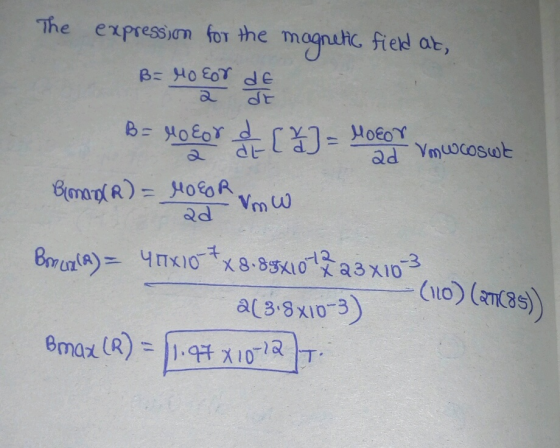
Suppose that a parallel-plate capacitor has circular plates with radius R = 23 mm and a plate separation of 3.8 mm. Suppose also that a sinusoidal potential difference with a maximum value of 110 V and a frequency of 85 Hz is applied across the plates; that is, V = (110 V) sin[2π(85 Hz)t]. Find Bmax(R), the maximum value of the induced magnetic field that occurs at r = R.
Homework Answers
Add Answer to:
Suppose that a parallel-plate capacitor has circular plates with radius R = 23 mm and a...
Suppose that a parallel-plate capacitor has circular plates with radius R = 26 mm and a...
Suppose that a parallel-plate capacitor has circular plates with radius R = 26 mm and a plate separation of 4.1 mm. Suppose also that a sinusoidal potential difference with a maximum value of 170 V and a frequency of 82 Hz is applied across the plates; that is, V = (170 V) sin[2π(82 Hz)t]. Find Bmax(R), the maximum value of the induced magnetic field that occurs at r = R.
Suppose that a parallel-plate capacitor has circular plates with radius R = 37 mm and a...
Suppose that a parallel-plate capacitor has circular plates with radius R = 37 mm and a plate separation of 6.8 mm. Suppose also that a sinusoidal potential difference with a maximum value of 120 V and a frequency of 47 Hz is applied across the plates; that is, V = (120 V) sin[2π(47 Hz)t]. Find Bmax(R), the maximum value of the induced magnetic field that occurs at r = R.
Suppose that a parallel-plate capacitor has circular plates with radius R = 32 mm and a...
 Suppose that a parallel-plate capacitor has circular plates with radius R = 32 mm and a plate separation of 4.7 mm. suppose also that a sinusoidal potential difference with a maximum value of 160 V and a frequency of 60 Hz is applied across the plates: that is, V = (160 V) sin[2 n(60 Hz)t] Find B_max, the maximum value of the induced magnetic that occurs at r = R.
1. Suppose that the dipole moment associated with an iron atom of an iron bar is...
1. Suppose that the dipole moment associated with an iron atom of an iron bar is 1.6 × 10⁻²³ J/T. Assume that all the atoms in the bar, which is 4.3 cm long and has a cross-sectional area of 1.5 cm2, have their dipole moments aligned. (a) What is the dipole moment of the bar? (b) What torque must be exerted to hold this magnet perpendicular to an external field of 1.2 T? (The density of iron is 7.9 g/cm3...
A parallel plate capacitor with circular plates of radius R = 16.0 cm and plate separation...
A parallel plate capacitor with circular plates of radius R = 16.0 cm and plate separation d = 9.00 mm is being charged at the rate of 8.00 C/s. What is the displacement current through a circular loop of radius r = 21.00 cm centered on the axis of the capacitor? 8.00 You are correct. What is the displacement current through a circular loop of radius r = 3.00 cm centered on the axis of the capacitor? What is the...
6. (II) Suppose an air-gap capacitor has circular plates of radius R 2.5 cm and separation...
 6. (II) Suppose an air-gap capacitor has circular plates of radius R 2.5 cm and separation d 1.6 mm. A 76.0-Hz emf, E= E cos wt, is applied to the capacitor. The maximum displacement current is 35 uA. Determine (a) the maximum conduction current I, (b) the value of , (c) the maximum value of dE/dt between the plates. Neglect fringing. 7. (II Suppose that a circular parallel-plate capacitor has
Suppose that, instead of forming a complete ring, the two ends of the wire are connected to the electrodes of a parallel-plate capacitor. The capacitor plates are circular with radius 1.0 cm and sepa...
 Suppose that, instead of forming a complete ring, the two ends of the wire are connected to the electrodes of a parallel-plate capacitor. The capacitor plates are circular with radius 1.0 cm and separation 1.0 mm. Again, the magnetic field strength is initially B 0.750 T and subsequently decreases in time at the constant rate -0.035 T/s (a) Sketch a charge diagram illustrating the final charge distribution on the capacitor plates When this final distribution is obtained, what is the...
A parallel plate capacitor is constructed with circular plates of radius 0.750 cm and plate separation...
A parallel plate capacitor is constructed with circular plates of radius 0.750 cm and plate separation 0.0500 mm. If the capacitor is connected across a 37.2 V source, find: a) the capacitance b) the surface charge on each plate c) The energy stored in the capacitor d) the electric field between the plates e) the energy density between the plates
A parallel plate capacitor with circular plates has a radius of 25cm and a plate spacing or 0.2mm...
 A parallel plate capacitor with circular plates has a radius of 25cm and a plate spacing or 0.2mm. The plates are charged to 90.0V. a) What is the electric field between the plates? The plates are discharged in 0.25ms. b) What is the induced magnetic field 15cm from the axis? c What is the induced magnetic field 30cm from the axis?
A parallel plate capacitor with circular plates has a radius of 25cm and a plate spacing or 0.2mm. The...
A parallel plate capacitor with circular plates has a radius of 25cm and a plate spacing or 0.2mm. The plates are charged to 90.0V. a) What is the electric field between the plates? The plates are discharged in 0.25ms. b) What is the induced magnetic field 15cm from the axis? c What is the induced magnetic field 30cm from the axis?
A parallel plate capacitor with circular plates has a radius of 25cm and a plate spacing or 0.2mm. The...
Consider a parallel-plate capacitor constructed from two circular metal plates of radius R. The plates are...
Consider a parallel-plate capacitor constructed from two circular metal plates of radius R. The plates are separated by a distance of 1.5 mm. What radius must the plates have if the capacitance of this capacitor is to be 1.0 μF ? Find the radius of the plates that gives a capacitance of 1.0 μF for a plate separation of 4.0 mm .
 Suppose that a parallel-plate capacitor has circular plates with radius R = 32 mm and a plate separation of 4.7 mm. suppose also that a sinusoidal potential difference with a maximum value of 160 V and a frequency of 60 Hz is applied across the plates: that is, V = (160 V) sin[2 n(60 Hz)t] Find B_max, the maximum value of the induced magnetic that occurs at r = R.
 6. (II) Suppose an air-gap capacitor has circular plates of radius R 2.5 cm and separation d 1.6 mm. A 76.0-Hz emf, E= E cos wt, is applied to the capacitor. The maximum displacement current is 35 uA. Determine (a) the maximum conduction current I, (b) the value of , (c) the maximum value of dE/dt between the plates. Neglect fringing. 7. (II Suppose that a circular parallel-plate capacitor has
 Suppose that, instead of forming a complete ring, the two ends of the wire are connected to the electrodes of a parallel-plate capacitor. The capacitor plates are circular with radius 1.0 cm and separation 1.0 mm. Again, the magnetic field strength is initially B 0.750 T and subsequently decreases in time at the constant rate -0.035 T/s (a) Sketch a charge diagram illustrating the final charge distribution on the capacitor plates When this final distribution is obtained, what is the...
 A parallel plate capacitor with circular plates has a radius of 25cm and a plate spacing or 0.2mm. The plates are charged to 90.0V. a) What is the electric field between the plates? The plates are discharged in 0.25ms. b) What is the induced magnetic field 15cm from the axis? c What is the induced magnetic field 30cm from the axis?
A parallel plate capacitor with circular plates has a radius of 25cm and a plate spacing or 0.2mm. The...
A parallel plate capacitor with circular plates has a radius of 25cm and a plate spacing or 0.2mm. The plates are charged to 90.0V. a) What is the electric field between the plates? The plates are discharged in 0.25ms. b) What is the induced magnetic field 15cm from the axis? c What is the induced magnetic field 30cm from the axis?
A parallel plate capacitor with circular plates has a radius of 25cm and a plate spacing or 0.2mm. The...
Most questions answered within 3 hours.
-
Where is the error in this code sequence?
String s1 = "Hello";
String s2 = "ello";...
asked 1 year ago -
Financial data for Joel de Paris, Inc., for last year
follow:
Joel de Paris, Inc.
Balance...
asked 1 year ago -
Consider this reaction:
Al2(SO4)3 (aq)+ BaCl3
(aq) Al2Cl6 (aq)- +
3BaSO4(s) . What is the...
asked 1 year ago -
Suppose that Savneet is considering increasing her
recent random sample from 20 car rentals to 40...
asked 1 year ago -
Trucks arrive at an unloading terminal at an average rate of 120
per hour.
Trucks arrive...
asked 1 year ago -
Why are methanol and ethanol completely soluble in water while
octanol is not very little soluble....
asked 1 year ago -
A facilities manager at a university reads in a research report
that the mean amount of...
asked 1 year ago -
When the CuSO4 is rehydrated by adding water to the anhydrous
compound, is this an endothermic...
asked 1 year ago -
A ray of sunlight is passing from diamond into crown glass; the
angle of incidence is...
asked 1 year ago -
A block of mass 0.249 kg is placed on top of a light, vertical
spring of...
asked 1 year ago -
how do the kidneys compensate in the presences of acidosis
a) trigger hyperventilate
b) reserve acid...
asked 1 year ago -
Question 501 pts
The rental rate of capital to the firm increases. Which of the
following...
asked 1 year ago