The reaction between propinoyl chloride and acetate ion is outlined below. a) Complete the meachanism of...
The reaction between propinoyl chloride and acetate ion is
outlined below. a) Complete the meachanism of the forward reation
by placing curved arrows to show the electron movements in the
reactants and intermediate product. b) Draw the structures of the
final product and leaving group, including any charges. (Elecrons
may be omitted.)
Homework Answers
In the given reaction acid chloride reacts with acetate ion and an acid anhydride is formed. This reaction is a type of nucleophilic acyl substitution reaction in the which a nucleophile substitutes the substituent that was attached to acyl group in the reactant.
The carboxylic acid and its derivatives undergo nucleophilic acyl substitution reaction. In this reaction, a nucleophile substitutes the substituent that was attached to acyl group in the reactant, that is, carboxylic acid and its derivatives. The reaction occurs because the carbonyl group is polar, thus, the carbonyl carbon gets a partial positive charge and oxygen atom gets a partial negative charge. The carbonyl carbon is attacked by nucleophiles.
The general reaction mechanism of nucleophilic acyl substitution reaction is as follows:
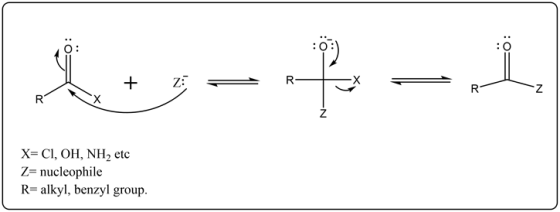
In the first step, the carbon of carbonyl is attacks by nucleophile and C-O  bond is breaks. As the
  breaks, a tetrahedral intermediate is formed. In the second step, the negative charge presents in oxygen re-forms the and expelled the
  with its bonding electron.
In the second step, three groups are present, the group which is weaker base is the better leaving group.
(a)
The negative charge containing oxygen in acetate ion attacks the carbonyl carbon of acid chloride.
The reaction is as follows:
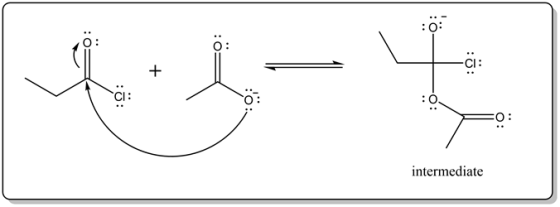
The tetrahedral intermediate reformed the double bond and by the removal of chloride ion.
The curved arrow reaction mechanism for the formation of product in the intermediate is as follows:
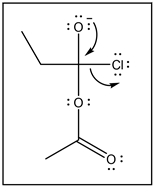
[Part a]
(b)
The product and the leaving group for the above reaction are as follows:
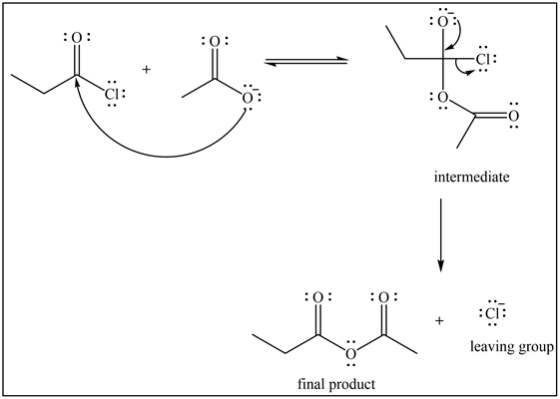
[Part b]
Ans: Part aThe curved arrow mechanism when acid chloride reacts with acetate ion and for the removal of chloride ion is as follows:

Add Answer to:
The reaction between propinoyl chloride and acetate ion is
outlined below. a) Complete the meachanism of...
The reaction between propionyl chloride and acetate ion is outlined below. Complete the mechanism of the...
 The reaction between propionyl chloride and acetate ion is outlined below. Complete the mechanism of the forward reaction by placing curved arrows to show the electron movements in the reactants and intermediate product. Draw the structures of the final product and leaving group, including any charges. (Electrons may be omitted.)
Complete the mechanism of the following Diels-Alder reaction by drawing the curved arrows for the concerted...
Complete the mechanism of the following Diels-Alder reaction by drawing the curved arrows for the concerted reaction and the final product formed. (Note that the COOH group is a carboxylic acid group, which is electron withdrawing.) Interactive 3D display mode Draw all missing reactants and/or products in the appropriate boxes by placing atoms on the grid and connecting them with bonds, including charges where needed. Indicate the mechanism by drawing the electron-flow arrows on the molecules. Arrows should start on...
Consider the following reaction: Complete the electron-pushing mechanism for the reaction by drawing the necessary organic...
 Consider the following reaction: Complete the electron-pushing mechanism for the reaction by drawing the necessary organic structures and curved arrows for each step. Make sure to include all nonbonding electron pairs. treatment with D_2O Add curved arrows for the second step. Do not show Na+ counter ion. treatment with NaBH_4 Add curved arrows for the first step. Treat Na+ as a spectator ion. Final products Draw the products of the last step (one organic and one inorganic species), including all...
Complete the electron-pushing mechanism for the E1 reaction when 2-methylbutan-2-ol is treated with 20% sulfuric acid....
 Complete the electron-pushing mechanism for the E1 reaction when
2-methylbutan-2-ol is treated with 20% sulfuric acid.
Hint: The E1 mechanism involves dissociation of the hydroxyl
group from the substrate. The acid is used to convert the hydroxyl
group to a good leaving group. Do not delete any pre-drawn
bonds/charges/lone pairs.
Complete the electron-pushing mechanism for the E1 reaction when 2-methylbutan-2-ol is treated with 20% sulfuric acid Map a) Use two curved arrows to show the fast b) Use a curved...
Complete the electron-pushing mechanism for the E1 reaction when
2-methylbutan-2-ol is treated with 20% sulfuric acid.
Hint: The E1 mechanism involves dissociation of the hydroxyl
group from the substrate. The acid is used to convert the hydroxyl
group to a good leaving group. Do not delete any pre-drawn
bonds/charges/lone pairs.
Complete the electron-pushing mechanism for the E1 reaction when 2-methylbutan-2-ol is treated with 20% sulfuric acid Map a) Use two curved arrows to show the fast b) Use a curved...
Show the mechanism for the following reaction conducted at –5 °C in CCl4: cyclohexene bromine yields...
 Show the mechanism for the following reaction conducted at –5 °C
in CCl4: cyclohexene bromine yields a dibromocyclohexane Draw
structures – including charges and electrons – and add curved
arrows. Details count.
Map do cyclohexene + bromine yields a dibromocyclohexane Draw structures - including charges and electrons - and add curved arrows. Details count. Add curved arrows to the first step. 1l Draw each species (organic and inorganic) resulting from the previous step. Include charges and nonbonding electrons. Add curved...
Show the mechanism for the following reaction conducted at –5 °C
in CCl4: cyclohexene bromine yields a dibromocyclohexane Draw
structures – including charges and electrons – and add curved
arrows. Details count.
Map do cyclohexene + bromine yields a dibromocyclohexane Draw structures - including charges and electrons - and add curved arrows. Details count. Add curved arrows to the first step. 1l Draw each species (organic and inorganic) resulting from the previous step. Include charges and nonbonding electrons. Add curved...
Complete the electron-pushing mechanism for the reaction by drawing the necessary organic structures and curved arrows...
 Complete the electron-pushing mechanism for the reaction by
drawing the necessary organic structures and curved arrows for each
step. Make sure to include all nonbonding electron pairs.
Complete the mechanism for the conversion
of the following deuterated alcohol to deuterated chloroalkane via
the mesylate intermediate by adding any missing atoms, bonds,
charges, nonbonding electrons, and curved arrows. Also, select the
correct absolute stereochemistry of the starting material and the
final product. (Note the use of a generic alcohol representing the...
Complete the electron-pushing mechanism for the reaction by
drawing the necessary organic structures and curved arrows for each
step. Make sure to include all nonbonding electron pairs.
Complete the mechanism for the conversion
of the following deuterated alcohol to deuterated chloroalkane via
the mesylate intermediate by adding any missing atoms, bonds,
charges, nonbonding electrons, and curved arrows. Also, select the
correct absolute stereochemistry of the starting material and the
final product. (Note the use of a generic alcohol representing the...
2-Bromo-2-methylbutane undergoes an E1 elimination reaction in the presence of ethanol. In the next reaction only one o...
 2-Bromo-2-methylbutane undergoes an E1 elimination reaction in
the presence of ethanol. In the next reaction only one of the
possible products is represented. Although the product shown is not
the major product of the reaction, notice that there is more than
one way it can be produced. Complete the mechanism and draw the
missing substances.
Draw all missing reactants and/or products in the appropriate
boxes by placing atoms on the grid and connecting them with bonds,
including charges where needed....
2-Bromo-2-methylbutane undergoes an E1 elimination reaction in
the presence of ethanol. In the next reaction only one of the
possible products is represented. Although the product shown is not
the major product of the reaction, notice that there is more than
one way it can be produced. Complete the mechanism and draw the
missing substances.
Draw all missing reactants and/or products in the appropriate
boxes by placing atoms on the grid and connecting them with bonds,
including charges where needed....
Complete the electron-pushing mechanism for the E1 reaction when 2-methylbutan-2-ol is treated with 20% sulfuric acid....
 Complete the electron-pushing mechanism for the E1 reaction when
2-methylbutan-2-ol is treated with 20% sulfuric acid.
Use two curved arrows to show the fast protonation of the alcohol. Use a curved arrow to show the dissociation of the leaving group from the substrate. Draw the organic product of the E1 dehydration Use two curved arrow to show the deprotonation of the carbocation intermediate.
Complete the electron-pushing mechanism for the E1 reaction when
2-methylbutan-2-ol is treated with 20% sulfuric acid.
Use two curved arrows to show the fast protonation of the alcohol. Use a curved arrow to show the dissociation of the leaving group from the substrate. Draw the organic product of the E1 dehydration Use two curved arrow to show the deprotonation of the carbocation intermediate.
Below is the E1 reaction between t-butyl chloride and water (H20). Draw the missing curved arrow...
 Below is the E1 reaction between t-butyl chloride and water (H20). Draw the missing curved arrow notation in the first and second boxes to reflect electron movements. In all boxes, add lone pairs of electrons and nonzero formal charges. 1st attempt hd See Periodic Table Q See Hint CI CI CI Draw the missing curved arrow notation. Add lone pairs of electrons and nonzero formal charges.
07 Question (3 points) Below is the E1 reaction between t-butyl chloride and water (H20). Draw...
 07 Question (3 points) Below is the E1 reaction between t-butyl chloride and water (H20). Draw the missing curved arrow notation in the first and second boxes to reflect electron movements. In all boxes, add lone pairs of electrons and nonzero formal charges. 1st attempt See Periodic Table See Hint HAKA Draw the missing curved arrow notation. Add lone pairs of electrons and nonzero formal charges.
 The reaction between propionyl chloride and acetate ion is outlined below. Complete the mechanism of the forward reaction by placing curved arrows to show the electron movements in the reactants and intermediate product. Draw the structures of the final product and leaving group, including any charges. (Electrons may be omitted.)
 Consider the following reaction: Complete the electron-pushing mechanism for the reaction by drawing the necessary organic structures and curved arrows for each step. Make sure to include all nonbonding electron pairs. treatment with D_2O Add curved arrows for the second step. Do not show Na+ counter ion. treatment with NaBH_4 Add curved arrows for the first step. Treat Na+ as a spectator ion. Final products Draw the products of the last step (one organic and one inorganic species), including all...
 Complete the electron-pushing mechanism for the E1 reaction when
2-methylbutan-2-ol is treated with 20% sulfuric acid.
Hint: The E1 mechanism involves dissociation of the hydroxyl
group from the substrate. The acid is used to convert the hydroxyl
group to a good leaving group. Do not delete any pre-drawn
bonds/charges/lone pairs.
Complete the electron-pushing mechanism for the E1 reaction when 2-methylbutan-2-ol is treated with 20% sulfuric acid Map a) Use two curved arrows to show the fast b) Use a curved...
Complete the electron-pushing mechanism for the E1 reaction when
2-methylbutan-2-ol is treated with 20% sulfuric acid.
Hint: The E1 mechanism involves dissociation of the hydroxyl
group from the substrate. The acid is used to convert the hydroxyl
group to a good leaving group. Do not delete any pre-drawn
bonds/charges/lone pairs.
Complete the electron-pushing mechanism for the E1 reaction when 2-methylbutan-2-ol is treated with 20% sulfuric acid Map a) Use two curved arrows to show the fast b) Use a curved...
 Show the mechanism for the following reaction conducted at –5 °C
in CCl4: cyclohexene bromine yields a dibromocyclohexane Draw
structures – including charges and electrons – and add curved
arrows. Details count.
Map do cyclohexene + bromine yields a dibromocyclohexane Draw structures - including charges and electrons - and add curved arrows. Details count. Add curved arrows to the first step. 1l Draw each species (organic and inorganic) resulting from the previous step. Include charges and nonbonding electrons. Add curved...
Show the mechanism for the following reaction conducted at –5 °C
in CCl4: cyclohexene bromine yields a dibromocyclohexane Draw
structures – including charges and electrons – and add curved
arrows. Details count.
Map do cyclohexene + bromine yields a dibromocyclohexane Draw structures - including charges and electrons - and add curved arrows. Details count. Add curved arrows to the first step. 1l Draw each species (organic and inorganic) resulting from the previous step. Include charges and nonbonding electrons. Add curved...
 Complete the electron-pushing mechanism for the reaction by
drawing the necessary organic structures and curved arrows for each
step. Make sure to include all nonbonding electron pairs.
Complete the mechanism for the conversion
of the following deuterated alcohol to deuterated chloroalkane via
the mesylate intermediate by adding any missing atoms, bonds,
charges, nonbonding electrons, and curved arrows. Also, select the
correct absolute stereochemistry of the starting material and the
final product. (Note the use of a generic alcohol representing the...
Complete the electron-pushing mechanism for the reaction by
drawing the necessary organic structures and curved arrows for each
step. Make sure to include all nonbonding electron pairs.
Complete the mechanism for the conversion
of the following deuterated alcohol to deuterated chloroalkane via
the mesylate intermediate by adding any missing atoms, bonds,
charges, nonbonding electrons, and curved arrows. Also, select the
correct absolute stereochemistry of the starting material and the
final product. (Note the use of a generic alcohol representing the...
 2-Bromo-2-methylbutane undergoes an E1 elimination reaction in
the presence of ethanol. In the next reaction only one of the
possible products is represented. Although the product shown is not
the major product of the reaction, notice that there is more than
one way it can be produced. Complete the mechanism and draw the
missing substances.
Draw all missing reactants and/or products in the appropriate
boxes by placing atoms on the grid and connecting them with bonds,
including charges where needed....
2-Bromo-2-methylbutane undergoes an E1 elimination reaction in
the presence of ethanol. In the next reaction only one of the
possible products is represented. Although the product shown is not
the major product of the reaction, notice that there is more than
one way it can be produced. Complete the mechanism and draw the
missing substances.
Draw all missing reactants and/or products in the appropriate
boxes by placing atoms on the grid and connecting them with bonds,
including charges where needed....
 Complete the electron-pushing mechanism for the E1 reaction when
2-methylbutan-2-ol is treated with 20% sulfuric acid.
Use two curved arrows to show the fast protonation of the alcohol. Use a curved arrow to show the dissociation of the leaving group from the substrate. Draw the organic product of the E1 dehydration Use two curved arrow to show the deprotonation of the carbocation intermediate.
Complete the electron-pushing mechanism for the E1 reaction when
2-methylbutan-2-ol is treated with 20% sulfuric acid.
Use two curved arrows to show the fast protonation of the alcohol. Use a curved arrow to show the dissociation of the leaving group from the substrate. Draw the organic product of the E1 dehydration Use two curved arrow to show the deprotonation of the carbocation intermediate.
 Below is the E1 reaction between t-butyl chloride and water (H20). Draw the missing curved arrow notation in the first and second boxes to reflect electron movements. In all boxes, add lone pairs of electrons and nonzero formal charges. 1st attempt hd See Periodic Table Q See Hint CI CI CI Draw the missing curved arrow notation. Add lone pairs of electrons and nonzero formal charges.
 07 Question (3 points) Below is the E1 reaction between t-butyl chloride and water (H20). Draw the missing curved arrow notation in the first and second boxes to reflect electron movements. In all boxes, add lone pairs of electrons and nonzero formal charges. 1st attempt See Periodic Table See Hint HAKA Draw the missing curved arrow notation. Add lone pairs of electrons and nonzero formal charges.
Most questions answered within 3 hours.
-
Where is the error in this code sequence?
String s1 = "Hello";
String s2 = "ello";...
asked 10 months ago -
Financial data for Joel de Paris, Inc., for last year
follow:
Joel de Paris, Inc.
Balance...
asked 10 months ago -
Consider this reaction:
Al2(SO4)3 (aq)+ BaCl3
(aq) Al2Cl6 (aq)- +
3BaSO4(s) . What is the...
asked 10 months ago -
Suppose that Savneet is considering increasing her
recent random sample from 20 car rentals to 40...
asked 10 months ago -
Trucks arrive at an unloading terminal at an average rate of 120
per hour.
Trucks arrive...
asked 10 months ago -
Why are methanol and ethanol completely soluble in water while
octanol is not very little soluble....
asked 10 months ago -
A facilities manager at a university reads in a research report
that the mean amount of...
asked 10 months ago -
When the CuSO4 is rehydrated by adding water to the anhydrous
compound, is this an endothermic...
asked 10 months ago -
A ray of sunlight is passing from diamond into crown glass; the
angle of incidence is...
asked 10 months ago -
A block of mass 0.249 kg is placed on top of a light, vertical
spring of...
asked 10 months ago -
how do the kidneys compensate in the presences of acidosis
a) trigger hyperventilate
b) reserve acid...
asked 10 months ago -
Question 501 pts
The rental rate of capital to the firm increases. Which of the
following...
asked 10 months ago