
Homework Answers
Add Answer to:
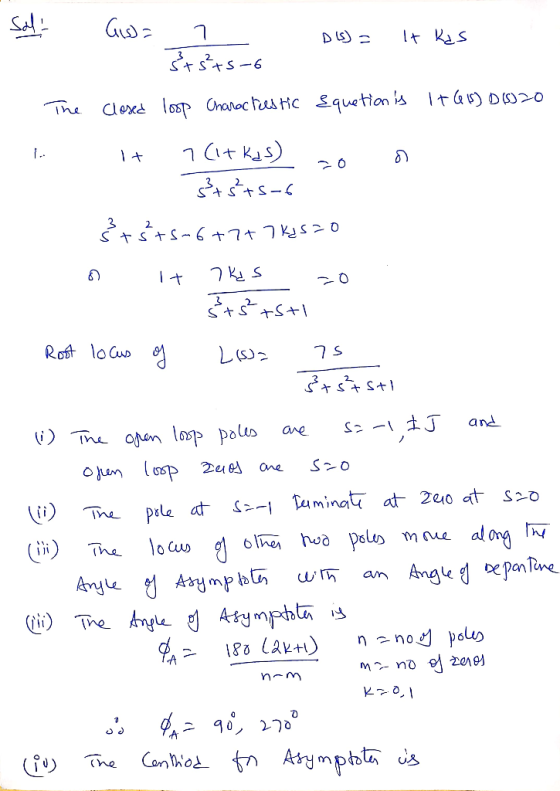
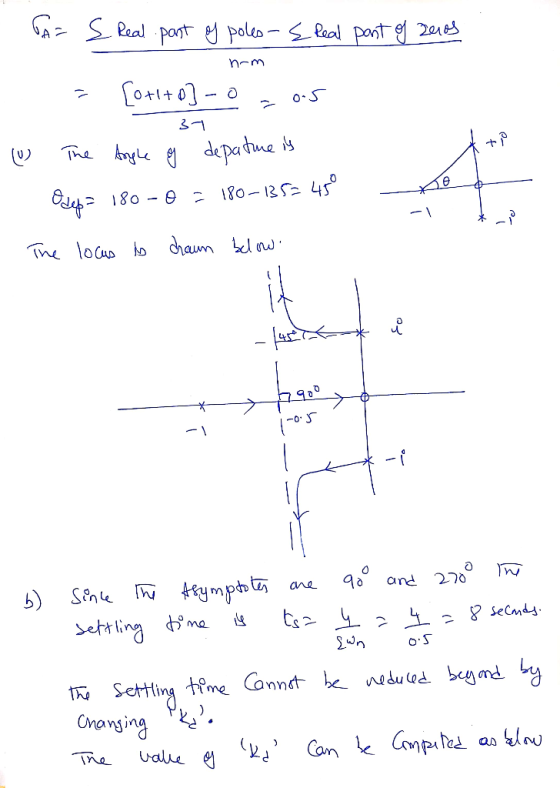
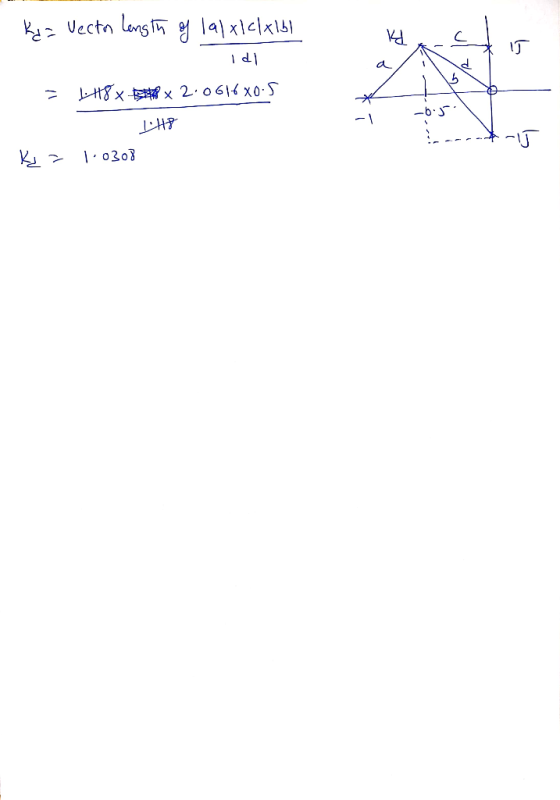
Consider the transfer function Problem 2: 7 G(s) (s2 1)(s17 in closed-loop with a proportional and...
Problem 3 Consider the transfer function: 108 (s2 5s +100) (s + 1000)2 G(s) 1. Sketch...
 Problem 3 Consider the transfer function: 108 (s2 5s +100) (s + 1000)2 G(s) 1. Sketch the bode diagram for G. 2. Knowing that a proportional controller with gain 1000 in a unity feedback loop with G results in an unstable system, what are the phase and gain margins of G? 3. Design a proportional controller that achieves a gain margin of 40dB. gain of 10dB at 0.01rad/s and a gain margin 4. Design that is infinity. compensator that results...
2. Consider the closed-loop system shown below Here Kp represents the gain of a proportional controller, and the proces...
 2. Consider the closed-loop system shown below
Here Kp represents the gain of a proportional controller, and
the process transfer function is given by
.
(a) Sketch the locus of the closed-loop poles as the
proportional gain, Kp, varies from 0 to ∞. Be sure to clearly mark
poles, zeros, asymptotes, angles of arrival/departure,
break-in/away points, and real axis portion of the locus.
(b) Using Routh's array, determine the range of the proportional
gain, Kp, for which the closed-loop system...
2. Consider the closed-loop system shown below
Here Kp represents the gain of a proportional controller, and
the process transfer function is given by
.
(a) Sketch the locus of the closed-loop poles as the
proportional gain, Kp, varies from 0 to ∞. Be sure to clearly mark
poles, zeros, asymptotes, angles of arrival/departure,
break-in/away points, and real axis portion of the locus.
(b) Using Routh's array, determine the range of the proportional
gain, Kp, for which the closed-loop system...
[7] Sketch the root locus for the unity feedback system whose open loop transfer function is K G(s) Draw the root lo...
 [7] Sketch the root locus for the unity feedback system whose open loop transfer function is K G(s) Draw the root locus of the system with the gain Kas a variable. s(s+4) (s2+4s+20) Determine asymptotes, centroid, breakaway point, angle of departure, and the gain at which root locus crosses ja-axis. A control system with type-0 process and a PID controller is shown below. Design the [8 parameters of the PID controller so that the following specifications are satisfied. =100 a)...
A second-order process is described by its transfer function G(s) = (s+1)(843) and a PI controlle...
 A second-order process is described by its transfer function G(s) = (s+1)(843) and a PI controller by Consider feedback control with unit feedback gain as shown in Figure 1 A disturbance D(s) exists, and to achieve zero steady-state error, a small integral component is applied. Technical limitations restrict the controller gain kp to values of 0.2 or less. The goal is to examine the influence of the controller parameter k on the dynamic response. D(s) Controller Process X(s) Y(s) Figure...
Required Plant Transfer Function! 사, (H183) 3. Design the proportional (Kp) and derivative (Ka) ...
 I need help with the following:
Required Plant Transfer Function! 사, (H183) 3. Design the proportional (Kp) and derivative (Ka) coefficients for a controller in Propotional- Derivative with Derivative on Output Only (PD-DOO) form. (Fig. 4). T(t) Gp(s) Figure 4: Proportional-Derivative closed loop control with Derivative-on-Output-Only Derive the closed loop transfer function, G2(s). Let the desired specifications of the compensated, closed loop system be wn 12 and-0.6 -In this configuration the known parameters are J, c, wn and Ç. Determine...
I need help with the following:
Required Plant Transfer Function! 사, (H183) 3. Design the proportional (Kp) and derivative (Ka) coefficients for a controller in Propotional- Derivative with Derivative on Output Only (PD-DOO) form. (Fig. 4). T(t) Gp(s) Figure 4: Proportional-Derivative closed loop control with Derivative-on-Output-Only Derive the closed loop transfer function, G2(s). Let the desired specifications of the compensated, closed loop system be wn 12 and-0.6 -In this configuration the known parameters are J, c, wn and Ç. Determine...
Given a transfer function: a. Sketch the root locus of G(s) b. Calculate the proportional gain required for to place the dominant poles at this point: s = -1.5-j3.5 c for G(s) give the controller :...
 Given a transfer function:
a. Sketch the root locus of G(s)
b. Calculate the proportional gain required for to place the
dominant poles at this point: s = -1.5-j3.5
c for G(s) give the controller :
considered closed loop, plot root locus for this system
7 (s + 5) (s + 2)(s2 + 6s + 10) G (s) H(s) = Ks +5
7 (s + 5) (s + 2)(s2 + 6s + 10) G (s)
H(s) = Ks +5
Given a transfer function:
a. Sketch the root locus of G(s)
b. Calculate the proportional gain required for to place the
dominant poles at this point: s = -1.5-j3.5
c for G(s) give the controller :
considered closed loop, plot root locus for this system
7 (s + 5) (s + 2)(s2 + 6s + 10) G (s) H(s) = Ks +5
7 (s + 5) (s + 2)(s2 + 6s + 10) G (s)
H(s) = Ks +5
1. Consider a unity feedback control system with the transfer function G(s) = 1/[s(s+ 2)] in...
1. Consider a unity feedback control system with the transfer function G(s) = 1/[s(s+ 2)] in the forward path. (a) Design a proportional controller that yields a stable system with percent overshoot less that 5% for the step input (b) Find settling time and peak time of the closed-loop system designed in part (a); (c) Design a PD compensator that reduces the settling time computed in (b) by a factor of 4 while keeping the percent overshoot less that 5%...
Problem (2) The open loop transfer function of a feedback system is given by к H...
 Problem (2) The open loop transfer function of a feedback system is given by к H (s) = 10 G(s) = ------ - s (s +1) (0.2 s+ 1) Design a controller such that the closed loop system will have a settling time less than 1.0 sec. and a percentage overshoot (PO) less than 5%. Draw the root locus plots of the uncompensated and compensated systems using Matlab.
1) Plot the root locus of the system whose characteristic equation is 2) Plot the root locus of the closed loop system whose open-loop transfer function is given as 2s + 2 G(S)H(S)+7s3 +10s2 3)...
 1) Plot the root locus of the system whose characteristic equation is 2) Plot the root locus of the closed loop system whose open-loop transfer function is given as 2s + 2 G(S)H(S)+7s3 +10s2 3) Plot root locus of the closed-loop system for which feedforward transfer function is s + 1 G(S) s( ) St(s - and feedback transfer function is H(S)2 +8s +32
1) Plot the root locus of the system whose characteristic equation is 2) Plot the root...
1) Plot the root locus of the system whose characteristic equation is 2) Plot the root locus of the closed loop system whose open-loop transfer function is given as 2s + 2 G(S)H(S)+7s3 +10s2 3) Plot root locus of the closed-loop system for which feedforward transfer function is s + 1 G(S) s( ) St(s - and feedback transfer function is H(S)2 +8s +32
1) Plot the root locus of the system whose characteristic equation is 2) Plot the root...
Consider a unity-feedback control system with a PI controller Gpr(s) and a plant G(s) in cascade. In particular, the plant transfer function is given as 2. G(s) = s+4, and the PI controller trans...
 Consider a unity-feedback control system with a PI controller Gpr(s) and a plant G(s) in cascade. In particular, the plant transfer function is given as 2. G(s) = s+4, and the PI controller transfer function is of the forrm KI p and Ki are the proportional and integral controller gains, respectively where K Design numerical values for Kp and Ki such that the closed-loop control system has a step- response settling time T, 0.5 seconds with a damping ratio of...
 Problem 3 Consider the transfer function: 108 (s2 5s +100) (s + 1000)2 G(s) 1. Sketch the bode diagram for G. 2. Knowing that a proportional controller with gain 1000 in a unity feedback loop with G results in an unstable system, what are the phase and gain margins of G? 3. Design a proportional controller that achieves a gain margin of 40dB. gain of 10dB at 0.01rad/s and a gain margin 4. Design that is infinity. compensator that results...
 2. Consider the closed-loop system shown below
Here Kp represents the gain of a proportional controller, and
the process transfer function is given by
.
(a) Sketch the locus of the closed-loop poles as the
proportional gain, Kp, varies from 0 to ∞. Be sure to clearly mark
poles, zeros, asymptotes, angles of arrival/departure,
break-in/away points, and real axis portion of the locus.
(b) Using Routh's array, determine the range of the proportional
gain, Kp, for which the closed-loop system...
2. Consider the closed-loop system shown below
Here Kp represents the gain of a proportional controller, and
the process transfer function is given by
.
(a) Sketch the locus of the closed-loop poles as the
proportional gain, Kp, varies from 0 to ∞. Be sure to clearly mark
poles, zeros, asymptotes, angles of arrival/departure,
break-in/away points, and real axis portion of the locus.
(b) Using Routh's array, determine the range of the proportional
gain, Kp, for which the closed-loop system...
 [7] Sketch the root locus for the unity feedback system whose open loop transfer function is K G(s) Draw the root locus of the system with the gain Kas a variable. s(s+4) (s2+4s+20) Determine asymptotes, centroid, breakaway point, angle of departure, and the gain at which root locus crosses ja-axis. A control system with type-0 process and a PID controller is shown below. Design the [8 parameters of the PID controller so that the following specifications are satisfied. =100 a)...
 A second-order process is described by its transfer function G(s) = (s+1)(843) and a PI controller by Consider feedback control with unit feedback gain as shown in Figure 1 A disturbance D(s) exists, and to achieve zero steady-state error, a small integral component is applied. Technical limitations restrict the controller gain kp to values of 0.2 or less. The goal is to examine the influence of the controller parameter k on the dynamic response. D(s) Controller Process X(s) Y(s) Figure...
 I need help with the following:
Required Plant Transfer Function! 사, (H183) 3. Design the proportional (Kp) and derivative (Ka) coefficients for a controller in Propotional- Derivative with Derivative on Output Only (PD-DOO) form. (Fig. 4). T(t) Gp(s) Figure 4: Proportional-Derivative closed loop control with Derivative-on-Output-Only Derive the closed loop transfer function, G2(s). Let the desired specifications of the compensated, closed loop system be wn 12 and-0.6 -In this configuration the known parameters are J, c, wn and Ç. Determine...
I need help with the following:
Required Plant Transfer Function! 사, (H183) 3. Design the proportional (Kp) and derivative (Ka) coefficients for a controller in Propotional- Derivative with Derivative on Output Only (PD-DOO) form. (Fig. 4). T(t) Gp(s) Figure 4: Proportional-Derivative closed loop control with Derivative-on-Output-Only Derive the closed loop transfer function, G2(s). Let the desired specifications of the compensated, closed loop system be wn 12 and-0.6 -In this configuration the known parameters are J, c, wn and Ç. Determine...
 Given a transfer function:
a. Sketch the root locus of G(s)
b. Calculate the proportional gain required for to place the
dominant poles at this point: s = -1.5-j3.5
c for G(s) give the controller :
considered closed loop, plot root locus for this system
7 (s + 5) (s + 2)(s2 + 6s + 10) G (s) H(s) = Ks +5
7 (s + 5) (s + 2)(s2 + 6s + 10) G (s)
H(s) = Ks +5
Given a transfer function:
a. Sketch the root locus of G(s)
b. Calculate the proportional gain required for to place the
dominant poles at this point: s = -1.5-j3.5
c for G(s) give the controller :
considered closed loop, plot root locus for this system
7 (s + 5) (s + 2)(s2 + 6s + 10) G (s) H(s) = Ks +5
7 (s + 5) (s + 2)(s2 + 6s + 10) G (s)
H(s) = Ks +5
 Problem (2) The open loop transfer function of a feedback system is given by к H (s) = 10 G(s) = ------ - s (s +1) (0.2 s+ 1) Design a controller such that the closed loop system will have a settling time less than 1.0 sec. and a percentage overshoot (PO) less than 5%. Draw the root locus plots of the uncompensated and compensated systems using Matlab.
 1) Plot the root locus of the system whose characteristic equation is 2) Plot the root locus of the closed loop system whose open-loop transfer function is given as 2s + 2 G(S)H(S)+7s3 +10s2 3) Plot root locus of the closed-loop system for which feedforward transfer function is s + 1 G(S) s( ) St(s - and feedback transfer function is H(S)2 +8s +32
1) Plot the root locus of the system whose characteristic equation is 2) Plot the root...
1) Plot the root locus of the system whose characteristic equation is 2) Plot the root locus of the closed loop system whose open-loop transfer function is given as 2s + 2 G(S)H(S)+7s3 +10s2 3) Plot root locus of the closed-loop system for which feedforward transfer function is s + 1 G(S) s( ) St(s - and feedback transfer function is H(S)2 +8s +32
1) Plot the root locus of the system whose characteristic equation is 2) Plot the root...
 Consider a unity-feedback control system with a PI controller Gpr(s) and a plant G(s) in cascade. In particular, the plant transfer function is given as 2. G(s) = s+4, and the PI controller transfer function is of the forrm KI p and Ki are the proportional and integral controller gains, respectively where K Design numerical values for Kp and Ki such that the closed-loop control system has a step- response settling time T, 0.5 seconds with a damping ratio of...
Most questions answered within 3 hours.
-
Where is the error in this code sequence?
String s1 = "Hello";
String s2 = "ello";...
asked 11 months ago -
Financial data for Joel de Paris, Inc., for last year
follow:
Joel de Paris, Inc.
Balance...
asked 11 months ago -
Consider this reaction:
Al2(SO4)3 (aq)+ BaCl3
(aq) Al2Cl6 (aq)- +
3BaSO4(s) . What is the...
asked 11 months ago -
Suppose that Savneet is considering increasing her
recent random sample from 20 car rentals to 40...
asked 11 months ago -
Trucks arrive at an unloading terminal at an average rate of 120
per hour.
Trucks arrive...
asked 11 months ago -
Why are methanol and ethanol completely soluble in water while
octanol is not very little soluble....
asked 11 months ago -
A facilities manager at a university reads in a research report
that the mean amount of...
asked 11 months ago -
When the CuSO4 is rehydrated by adding water to the anhydrous
compound, is this an endothermic...
asked 11 months ago -
A ray of sunlight is passing from diamond into crown glass; the
angle of incidence is...
asked 11 months ago -
A block of mass 0.249 kg is placed on top of a light, vertical
spring of...
asked 11 months ago -
how do the kidneys compensate in the presences of acidosis
a) trigger hyperventilate
b) reserve acid...
asked 11 months ago -
Question 501 pts
The rental rate of capital to the firm increases. Which of the
following...
asked 11 months ago